Sentiment & Position
Two of GrackerAI's visibility signals get their own dedicated view: Sentiment (how AI talks about you) and Position (where within the response you land, down to a per-mention percentile). Position is tracked separately from Prominence, the coarser first/middle/final-third signal that feeds your visibility score - related ideas, but different measurements. Both move independently of whether you're mentioned at all.
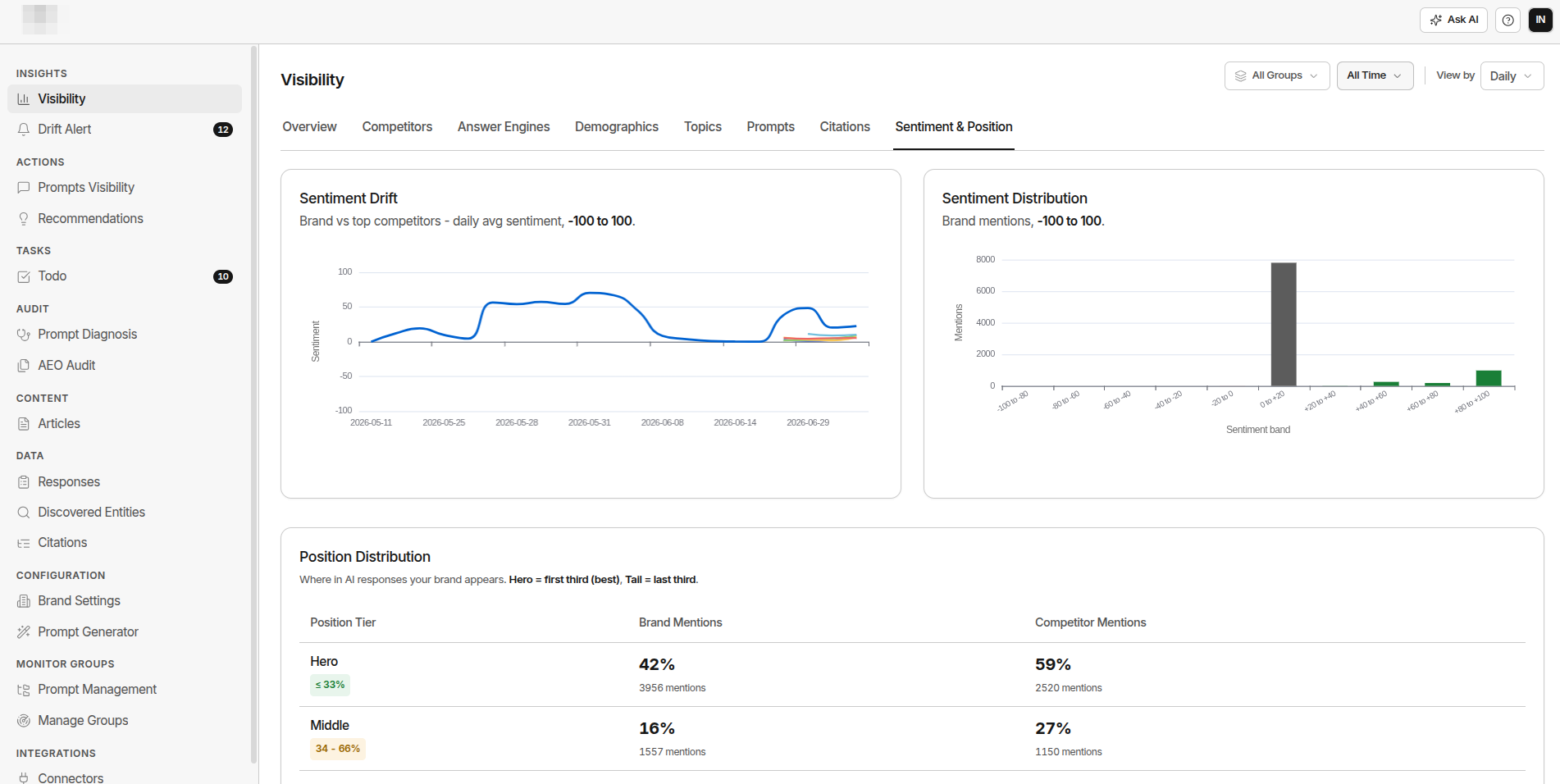
Sentiment Drift
Your average sentiment score over time, plotted alongside your tracked competitors. GrackerAI scores the tone of every response that mentions you - positive, neutral, or negative - and tracks the trend.
Watch for:
- Declining trend - AI is describing you less favourably. A visibility drop usually follows 4–8 weeks later, so this is an early warning, not a lagging metric.
- Sudden negative spike - Usually traces to one specific source: a new negative review, a competitor's comparison page, or content of yours that's gone stale.
Sentiment Distribution
A breakdown of every response that mentions you into positive, neutral, and negative buckets across your monitoring period.
A healthy distribution for most B2B brands is 60%+ positive, under 10% negative. If negative exceeds 20%, treat it as a priority investigation, not background noise.
Position Distribution
Position is about where in the response you're mentioned, not whether you are. AI answers read top to bottom - a brand named first reads as the default recommendation; a brand named fourth reads as an afterthought, even with identical sentiment.
Every mention carries a position percentile - how early in the response it falls, based on its exact character offset, from 0 (the very start) to 100 (the very end). The Position Distribution table groups mentions into three tiers - Hero (first third of the response), Middle, and Tail (last third) - and shows how your mentions split across them versus your competitors. A high Hero share means AI leads with you.
For the per-competitor average-position comparison (Position Battle), see the Competitors tab.
Reading Sentiment and Position Together
The two signals answer different questions, and the combination tells you what to fix:
| Sentiment | Position | What it means |
|---|---|---|
| Positive | Early | Strong - AI treats you as the leading answer |
| Positive | Late | AI likes you but doesn't lead with you - an authority gap, not a perception gap |
| Negative | Early | Visible but framed badly - a messaging fix, not a content-gap fix |
| Negative | Late | Weakest combination - both authority and framing need work |
Common Workflows
Monthly Sentiment Review (15 min)
- Open Sentiment Drift and check for a declining trend over the last 30 days
- Cross-check Sentiment Distribution - if negative is above 20%, open the underlying Responses to read what's driving it
- Identify whether the source is a review, a competitor comparison page, or outdated content of yours
- Log the finding and assign a fix - content update, PR outreach, or a review-response strategy
Position Trend Check (10 min, weekly)
- Check your Hero/Middle/Tail split in Position Distribution, then open Position Battle on the Competitors tab to compare your average position against your top 2 competitors
- If you're consistently mentioned after a specific competitor, open Competitor Analysis to see what's driving their lead
- Prioritise content that directly targets the comparison prompts where you're losing position