Citations
Citations are the websites AI engines link to when generating answers. Tracking them shows you exactly which content earns AI trust in your category and where you need to compete.
Citations surface in two places:
- Visibility dashboard → Citations tab - the charts covered below (Competitor Citation Comparison, Citation Mix, Citation Source Types)
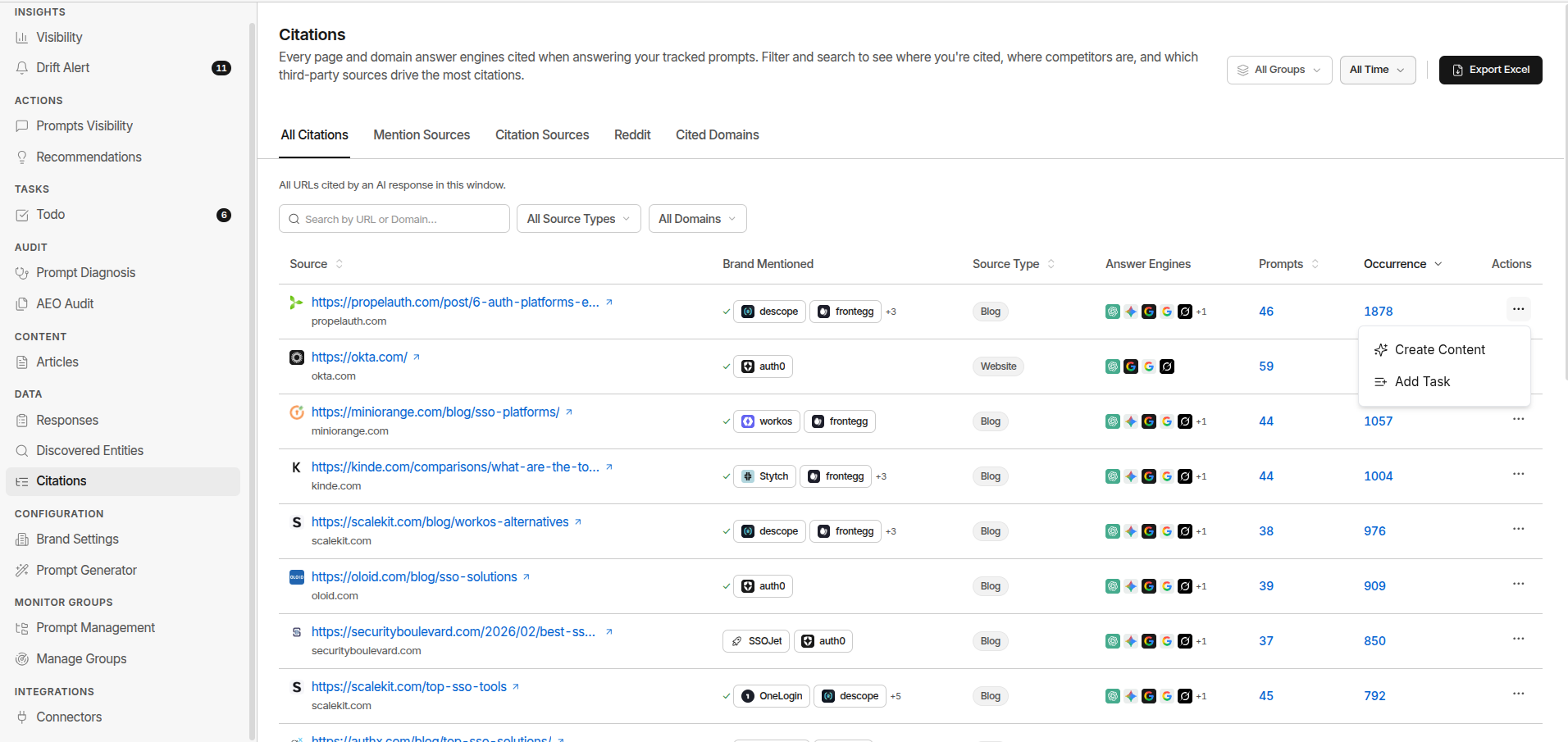
- Data → Citations - the full citation explorer, organised into tabs: All Citations, Mention Sources, Citation Sources, Reddit (a subreddit-level rollup of community citations), and Cited Domains (top / new / lost domains)
Competitor Citation Comparison
A daily line chart tracking how many citations your domain earns compared with each competitor you track, side by side. Use it to see whether your citation volume is pulling ahead of, keeping pace with, or falling behind specific rivals over time - a sudden jump in a competitor's line is your cue to find out what they published.
Citation Mix
The Citation Mix chart splits every citation into three buckets:
| Bucket | What It Means |
|---|---|
| Your domain | AI is linking to your content as a supporting source |
| Competitor domains | AI is linking to competitor content instead of yours |
| Neutral sources | Everything else - news, community, directories, review sites, and other third parties |
For a finer breakdown by source type (news, forum, directory, review site, and more), see Citation Source Types below.
Citation Source Types
A donut chart breaking your citations down by the kind of source: Blog, Forum, Review Site, Code Repository, Video, Wikipedia, Marketplace, Academic, News, Press Release, Social Media, Official Docs, and Podcast. It shows whether AI engines are pulling supporting links from editorial content, community discussion, official documentation, or somewhere else entirely - and each source type calls for a different way to earn placement there.
Top Cited Domains
The most-cited domains in your category, ranked by how often they appear in your monitored responses.
| Pattern | Action |
|---|---|
| Your domain in top 5 | Strong position - maintain and expand |
| A competitor's domain in top 3 | Audit what content of theirs is being cited, then build better |
| G2, Capterra, or a directory in top 5 | Earning placement there is your highest-leverage move |
| Reddit or YouTube in top 5 | Authentic community presence is required, not optional |
| A media outlet dominating | Invest in PR and analyst relations, not just blog content |
New Domains
Sources that recently started being cited in your category for the first time.
What to do with new domains:
- Click through to the source
- Understand what type of content it is (review, comparison, technical guide)
- If it's a competitor's asset - assess whether you need an equivalent
- If it's a third-party source - reach out to be included
Lost Domains
Sources that used to be cited in your category but have stopped appearing. Lost domains can work in your favour (a competitor loses a citation source) or against you (a site that was citing you has been updated or removed).
What to check:
- Was this a site citing your brand? Find out if the page was updated or removed
- Was this a site citing a competitor? That's an opportunity opening up
Anchor Text
Anchor text is the specific words AI uses when it links to a cited source - effectively how AI labels that page in its answer. GrackerAI's citation data captures anchor text at the individual-citation level, though it isn't currently surfaced as its own dashboard view.
If AI consistently anchors your brand's cited pages with phrases like "affordable option" while your positioning is "enterprise-grade," that's a signal worth chasing down manually - it means there's a messaging gap between what you publish and what AI picks up from it.
Citation Table
The full list of every URL cited in your monitored responses.
| Column | What It Shows |
|---|---|
| Source | The cited page's URL, with its domain shown underneath |
| Brand Mentioned | Which tracked brand - yours or a competitor's - is named on the cited page |
| Source Type | The kind of source: Blog, Forum, Review Site, News, Official Docs, and so on |
| Answer Engines | Which AI platforms cited this URL |
| Prompts | How many distinct prompts triggered a response that cited it |
| Occurrence | How many times it's been cited |
| Actions | Open the URL or act on the citation |
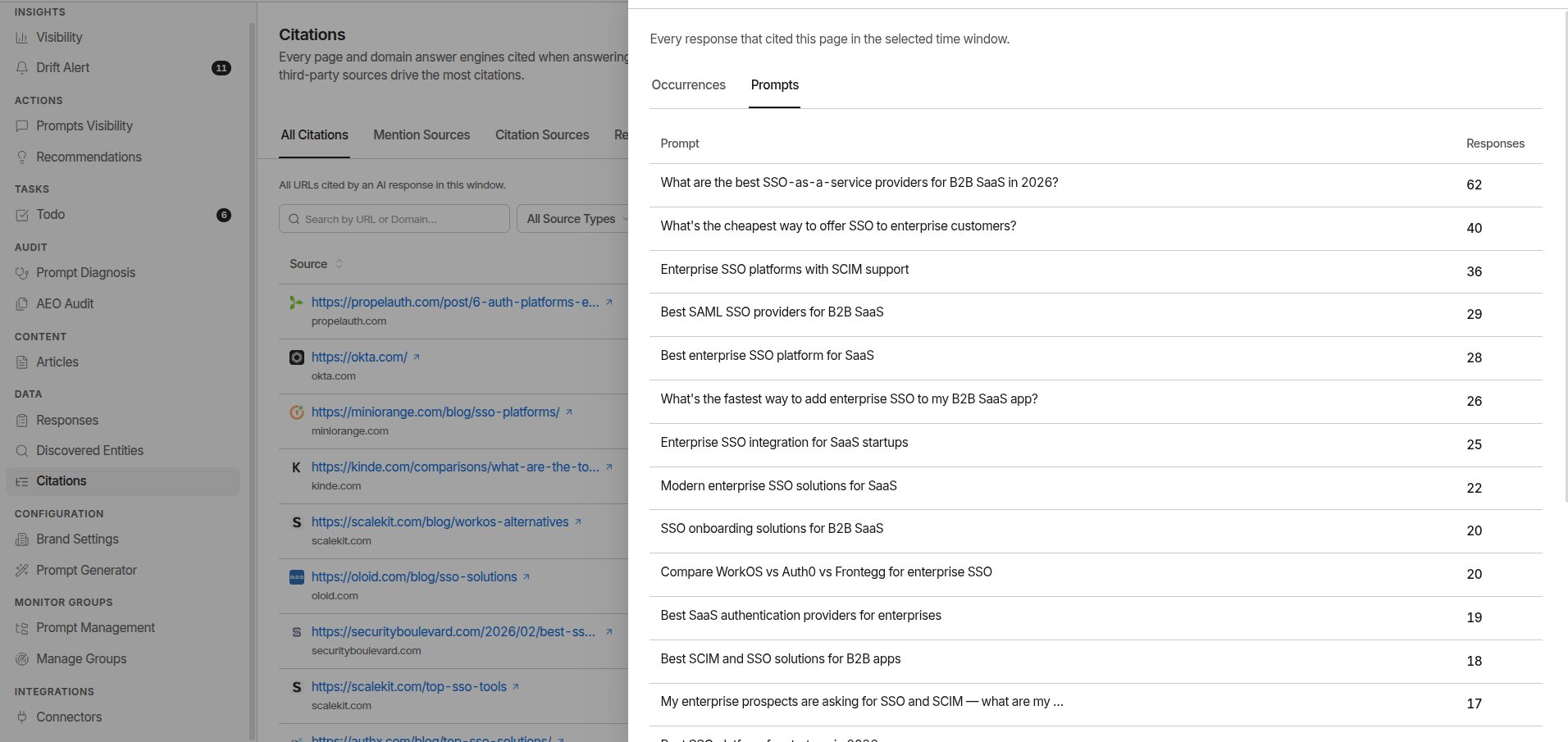
Click a row's Occurrences or Prompts count to open the exact list of citing responses behind that number.
Export: Click Export to download the full citation table as an XLSX file.
Five Citation Patterns to Recognise
Workflows
Authority Audit (Quarterly, 30 min)
- Check which domains appear in your Top Cited list
- Search your own domain in the Citation Table - find which of your pages are being cited
- Identify which 3–5 of your pages do most of the citation work
- Note which competitor pages rank above yours - plan content to outperform them
New Domain Alert (Weekly, 5 min)
- Check the New Domains section each week
- Flag any new domains with 10+ occurrences for immediate investigation
- If it's a competitor asset, add it to your competitive tracking