Best Searchable Alternatives for AI Visibility Monitoring

TL;DR
- The best Searchable alternatives for AI visibility monitoring in 2026 are GrackerAI, Profound, Scrunch AI, Goodie AI, Otterly AI, Peec AI, Knowatoa, Ahrefs Brand Radar, and AirOps, compared on verified pricing, AI engine coverage, and what each does best.
The best Searchable alternatives for AI visibility monitoring in 2026 are GrackerAI, Profound, Scrunch AI, Goodie AI, Otterly AI, Peec AI, Knowatoa, Ahrefs Brand Radar, and AirOps. GrackerAI is the strongest overall alternative for B2B SaaS and cybersecurity teams, Otterly AI and Knowatoa are the most affordable entry points, and Profound and Scrunch AI are the closest enterprise equivalents.
Searchable is a capable AI visibility platform, but its entry plan caps you at a single project, and teams in technical categories like B2B SaaS and cybersecurity often find the recommendations too generic for the buyers they are trying to reach.
This guide compares all nine platforms on verified pricing, AI engine coverage, and what each one actually does best, so you can shortlist in an afternoon instead of sitting through six demos.
What Searchable Does, and Where It Falls Short
Searchable is a UK-based AI search visibility and analytics platform. It tracks brand mentions and citations across up to nine answer engines, benchmarks share of voice against competitors, runs technical site audits, and generates AI-optimized articles. The engines are selected during onboarding rather than unlocked by tier, which is a genuinely good design choice that several competitors do not match.
The gaps show up in three places:
- Project limits on the entry plan. Pro at $125 per month gives you one project. If you run two products, two regions treated separately, or a single client on the side, you are pushed to Scale at $400 per month.
- Generic recommendations. Searchable serves e-commerce, B2B software, agencies, and enterprise marketing teams from the same models. Teams selling SIEM, zero trust, CNAPP, or identity software consistently report that the guidance reads like it was written for a retail catalog.
- Monitoring-first architecture. You get visibility data, audits, and content generation, but the connective tissue between "here is a gap" and "here is who fixes it by Friday" is thin.
If none of those apply to you, Searchable is a reasonable platform. If one or more do, the alternatives below solve for them directly.
Quick Comparison: Searchable Alternatives at a Glance
Platform | Starting Price | AI Engines | Content Generation | Best For |
|---|---|---|---|---|
Searchable (baseline) | $125/mo | Up to 9 | Yes, 20-200/mo | Agencies and e-commerce brands wanting broad engine coverage |
GrackerAI | $99/mo | Up to 10 | Yes, plus rewrites | B2B SaaS and cybersecurity teams wanting diagnosis and execution |
Profound | Free trial / Custom Enterprise | 1 (Trial) to 9 (Enterprise) | No | Enterprise teams wanting clean citation reporting, no paid self-serve tier |
Scrunch AI | $250/mo | 4 (Core) to 9 (Enterprise) | No | Mid-market teams needing persona-based analysis |
Goodie AI | $399/mo | 5 to 13 | Optimization actions | Enterprise retail, travel, and commerce brands |
Otterly AI | $29/mo | 4 + add-ons | No | Budget-conscious teams wanting pure AI rank tracking |
Peec AI | $95/mo | 3 (13 on Ent.) | No | SEO teams wanting a simple, fast AI analytics layer |
Knowatoa | $59/mo | 3 to 7 | AI agent drafting | Small teams wanting affordable multi-engine monitoring |
Ahrefs Brand Radar | $129/mo (bundled) / $199/mo (standalone) | Up to 6 | No | Teams already paying for Ahrefs |
AirOps | Free to start (task-based, no published $) | 1 (Solo) to 7+ (Pro) | Yes, workflow-based | Content teams needing large-scale workflow automation |
Pricing verified August 2026. Always confirm current rates on each vendor's pricing page before committing.
1. GrackerAI: Best Overall Alternative for B2B SaaS and Cybersecurity
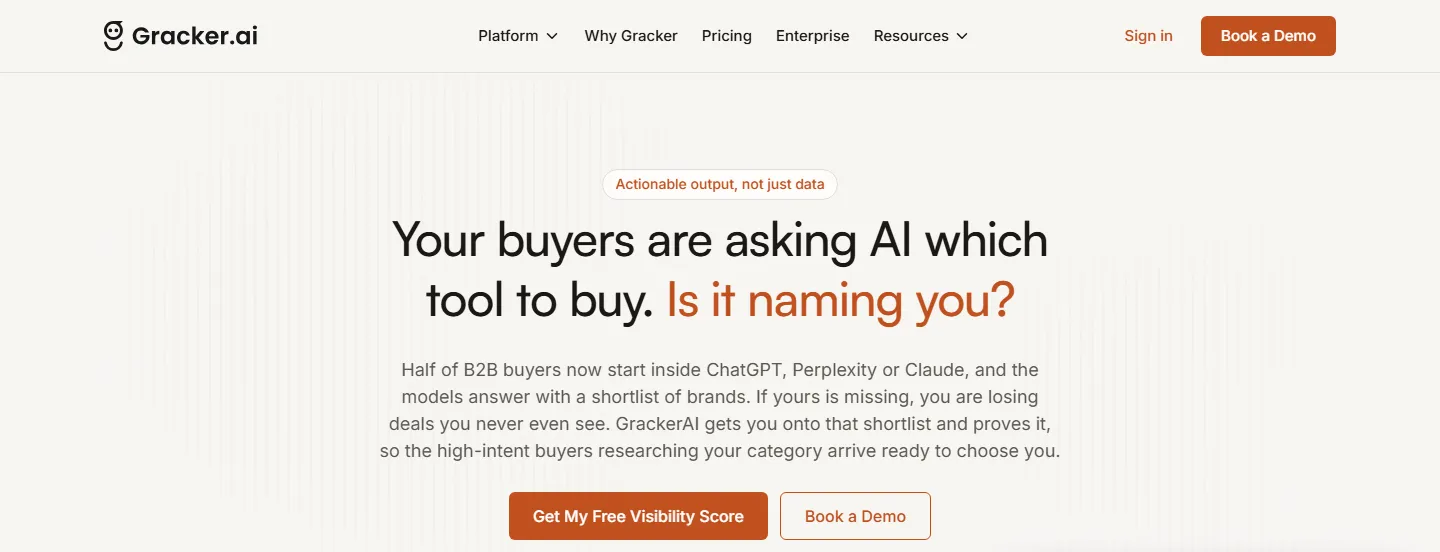
GrackerAI is an AEO and GEO platform built for cybersecurity and B2B SaaS companies. Where Searchable spreads across e-commerce, enterprise, and agency use cases from one set of models, GrackerAI goes narrow and deep on technical B2B: vertical-tuned analysis models, a cybersecurity prompt library, real buyer prompts sourced from data partners, and diagnostic agents that explain why a page lost a citation instead of only reporting that it did.
The structural difference matters more than the feature list. Searchable tells you where you stand. GrackerAI tells you where you stand, why, and hands the fix to a named person with a due date.
Key Features:
- Tracks up to 10 AI engines: ChatGPT, Perplexity, Google AI Mode, Microsoft Copilot, Google AI Overviews, Google Gemini, DeepSeek, Grok, Claude, and Brave Leo
- Prompt Mining that surfaces real buyer questions with estimated search volume, pulled from People Also Ask and community threads
- Prompt Diagnose to check whether you are even tracking the right prompts
- Visibility Diagnosis that runs an agent on any prompt you are missing from and returns either a content brief or a prioritized gap report
- AEO Site Audit that crawls your full sitemap and grades every page on AEO Health and Technical Health
- Recommendations split into On Page and Off Page so prioritization is obvious
- Built-in Tasks with one-click capture from nearly every screen, plus syncing to Asana, ClickUp, Notion, and Jira
- Read-only MCP connector so you can query your own visibility data from Claude and other MCP clients
- Reddit citation rollups by subreddit, plus Top, New, and Lost Citation Sources
- Content engine that generates LLM-optimized articles and rewrites existing pages that are failing to earn citations
- Connectors for Google Search Console, Bing Webmaster Tools, GA4, and WordPress
Pricing:
Plan | Monthly | Annual | What You Get |
|---|---|---|---|
Starter | $99/mo | $79/mo ($948/yr) | 100 prompts weekly, 3 engines, 3 articles/mo, 1 seat |
Scale | $499/mo | $399/mo ($4,788/yr) | 200 prompts daily, 4 engines, 10 articles/mo, 4 seats, crawlability and topic depth audits, task management |
Enterprise | Custom | Custom | 1,000+ prompts hourly, all 10 engines, unlimited articles, page-level monitoring up to 100K+ pages, multi-product tracking, SSO/SAML, API, white-label |
A 7-day free trial runs on both self-serve plans (credit card required to start, not charged during the trial). You can also start with a free, no-card AI visibility score before committing to a plan. Pricing verified against gracker.ai/pricing, September 2026.
Best for: B2B SaaS and cybersecurity marketing teams who are tired of buying a dashboard and still not knowing what to publish next. See verified results in GrackerAI's customer case studies.
Where Searchable still wins: unlimited seats on every tier, and unlimited domains on Pro. If seat count is your binding constraint, price both.
2. Profound: Best for Clean Enterprise AEO Reporting
Profound is the best-funded platform in the category and the most common name on enterprise shortlists. Its reporting is clean, its citation data is trustworthy, and its agent analytics show how AI crawlers actually behave on your site.
The catch is pricing architecture: Profound no longer publishes a paid self-serve tier at all. As of this pricing page it's a free Trial (10 one-time prompts, ChatGPT only) or a custom Enterprise plan; the previously reported $99 Starter and $399 Growth tiers are gone. Full coverage of up to nine engines requires an Enterprise conversation.
Key Features:
- Citation and mention tracking with per-engine breakdowns
- Agent analytics showing AI crawler behavior on your domain
- Agent credits for deeper on-demand analysis
- SOC 2 compliance and SSO/SAML on Enterprise
- Multiple company tracking on Enterprise
Pricing: Trial: Free (10 one-time prompts, ChatGPT only, limited AI Marketer credits, no SSO or support). Enterprise: Custom (tailored prompt volume, up to 9 engines, SSO/SAML, SOC 2, dedicated support).
Best for: enterprise teams that want defensible citation reporting and are not buying content generation.
Versus Searchable: Searchable's $125 Pro gives you 100 prompts and 9,000 answers across your chosen engines with a real paid entry tier. Profound currently has no equivalent paid self-serve option at all — it's free (10 prompts, one-time) or a custom Enterprise contract. On self-serve accessibility, Searchable wins outright. On enterprise polish and crawler analytics, Profound still has an edge for teams already in a sales conversation. We break the tradeoffs down further in our guide to Profound alternatives.
3. Scrunch AI: Best for Persona-Based Visibility Analysis
Scrunch AI approaches AI visibility through buyer personas rather than flat prompt lists. Instead of asking how a brand performs on 300 prompts, it asks how the brand performs for a security architect versus a procurement lead versus an end user, then reports separately.
That framing is genuinely useful for complex B2B sales where several people influence the same purchase. It is also the most expensive entry point on this list outside Goodie AI.
Key Features:
- Persona-based visibility analysis, 3 to 5 personas by tier
- Custom prompts plus a large library of industry prompts
- Page audits
- Coverage across ChatGPT, Claude, Gemini, Perplexity, Google AI Mode and AI Overviews, and Meta
Pricing: Core $250/mo (125 unique prompts, 5 site audits/mo, 1 brand workspace, 5 user licenses, 4 LLMs: ChatGPT, Perplexity, Google AI Overviews, Copilot). Enterprise custom (9 LLMs, adding Claude, Gemini, Meta AI, Google AI Mode, and Grok; API access, SSO). A 7-day free trial is available on Core.
Best for: mid-market teams with multi-stakeholder buying committees.
Versus Searchable: Scrunch's persona layer has no Searchable equivalent. Searchable delivers roughly double the prompt volume for half the price. Choose on whether persona segmentation changes your decisions.
4. Goodie AI: Best for Enterprise Retail and Commerce Brands
Goodie AI targets large consumer-facing brands in travel, retail, and commerce, with agentic commerce visibility as a differentiator. It tracks shopping-specific surfaces like Rufus and Sparky that no other platform on this list covers.
It is also the priciest starting point here at $399 per month for three models.
Key Features:
- Up to 11 models on Enterprise, including Rufus and Sparky for retail
- Optimization actions rather than raw article generation
- Page-level tracking
- Custom revenue modeling on Enterprise
Pricing: Core $399/mo (5 models, 120 prompts, 50 optimizations/mo, 5 seats). Pro $999/mo (8 models, 250 prompts, 100 optimizations/mo, unlimited seats). Enterprise custom (up to 13 models). A 7-day free trial is available on Core.
Best for: enterprise commerce brands where AI shopping surfaces drive revenue.
Versus Searchable: Searchable's Pro tier costs less than a third of Goodie's entry plan and covers more engines. Goodie earns its price only if agentic commerce matters to you. For a fuller breakdown, see our comparison of Goodie AI alternatives.
5. Otterly AI: Best Budget AI Rank Tracker
Otterly AI is the cheapest credible way to start tracking AI visibility. Lite runs $29 per month and covers four engines with daily tracking and 1,000 GEO URL audits.
The tradeoff is depth. Fifteen prompts on Lite is a sample, not a program, and important engines are paid add-ons: Claude runs $29 to $439 per month depending on tier, with Google AI Mode and Gemini at $9 to $149 each.
Key Features:
- ChatGPT, Google AI Overviews, Perplexity, and Microsoft Copilot on all plans
- Unlimited team members on every tier
- GEO URL audits
- API and MCP access from Standard up
- Agency partners receive bonus prompts
Pricing: Lite $29/mo ($25 annual, 15 prompts). Standard $189/mo ($160 annual, 100 prompts). Premium $489/mo ($422 annual, 400 prompts). Enterprise from $1,000/mo. Extra prompts cost $99/mo per 100.
Best for: solo marketers and small teams validating whether AI visibility deserves budget at all.
Versus Searchable: Otterly Standard at $189 gives you 100 prompts on four engines. Searchable Pro at $125 gives you 100 prompts per model across your chosen engines. Once you add Claude and Gemini to Otterly, Searchable is usually cheaper.
6. Peec AI: Best Simple Analytics Layer for SEO Teams
Peec AI has built a following among European SEO teams by deliberately doing less. Set up prompts, see visibility, act on top citations. No sprawling feature surface.
Every paid tier includes unlimited users and daily tracking, which is unusually generous. The constraint is models: you choose three, and additional models cost $30 to $140 per month each depending on tier.
Key Features:
- Choose 3 from ChatGPT, AI Mode, AI Overviews, Microsoft Copilot, Perplexity, and Gemini
- Unlimited users on every plan
- Daily tracking across the board
- Multi-country and Looker Studio integration on Advanced
- Up to 13 models plus API, MCP, and SSO on Enterprise
Pricing: Starter $95/mo (50 prompts, 1 project). Pro $245/mo (150 prompts, 2 projects, 3 countries). Advanced $495/mo (350 prompts, 5 projects, 3 countries). Enterprise custom.
Best for: SEO teams that want AI visibility data without a platform migration.
Versus Searchable: Searchable Pro at $125 gives 100 prompts per model against Peec Starter's 50 prompts across 3 models. Peec counters with unlimited users and a simpler interface. If prompt volume drives your decision, Searchable wins on paper.
7. Knowatoa: Best Affordable Multi-Engine Monitoring
Knowatoa sits between Otterly's bare-bones tracking and the mid-market platforms. Starter at $59 per month covers ChatGPT, AI Overviews, and AI Mode with competitor gap analysis, weekly insights, and multi-language and market tracking.
Growth at $199 per month expands to seven platforms and removes topic tracking limits, which is a strong deal at that price.
Key Features:
- Competitor gap analysis on the entry plan
- Weekly insights and publishing recommendations
- Multi-language and multi-market tracking
- AI agent research and drafting
- Reputation monitoring
- API, MCP server, Looker Studio, and NinjaCat integrations on Growth
Pricing: Starter $59/mo. Growth $199/mo (7 platforms, unlimited topic tracking, dedicated account rep). Annual billing available, month-to-month cancellation supported.
Best for: small teams that want real multi-engine coverage without a four-figure commitment.
Versus Searchable: Knowatoa Growth at $199 covers seven engines with unlimited topics. Searchable Pro at $125 offers deeper audit and article volume. Knowatoa is the better pure monitoring value; Searchable is the better production tool.
8. Ahrefs Brand Radar: Best If You Already Pay for Ahrefs
If Ahrefs is already in your stack, Brand Radar is the lowest-friction way to add AI visibility. It researches brands across a database of 455M+ organic prompts and tracks your own prompts alongside your existing backlink and keyword workflows.
Standalone it starts at $199 per month, which is not cheap for a feature rather than a platform.
Key Features:
- Brand research across a very large prompt database
- Prompt tracking integrated with existing Ahrefs reporting
- Web visibility on the Advanced tier
- Custom prompt packages: Basic $50/mo (+2,500 checks), Growth $100/mo (+7,000), Scale $250/mo (+25,000)
Pricing: Ahrefs plans run Lite $129/mo, Standard $249/mo, Advanced $449/mo, Enterprise $1,499/mo. Brand Radar AI standalone starts at $199/mo. Annual billing saves up to 17%.
Best for: SEO teams with an existing Ahrefs contract who want one login.
Versus Searchable: Brand Radar is a module, not a platform. It will not generate content, run AEO-specific audits, or produce white-label client reports.
9. AirOps: Best for Content Workflow Automation at Scale
AirOps is a content workflow automation platform that added AI visibility monitoring, rather than a visibility platform that added content. If your bottleneck is producing thousands of pages rather than knowing where you rank, that ordering is an advantage.
Visibility monitoring is the weaker half. The free tier tracks ChatGPT only, and broader engine coverage sits behind custom-priced Pro.
Key Features:
- Workflow-based content generation at high volume
- 30+ AI models and 10+ CMS integrations
- Brand Kits and knowledge bases for consistency
- Tracked prompts and monitored pages bundled with content tasks
- Weekly opportunity reports on Pro
Pricing: Solo is free to start (ChatGPT insights only, 35,000 tasks/mo, 1 brand kit, 3 knowledge bases). Pro is also free to start (7+ answer engines, 100,000 tasks/mo, unlimited seats, 5 knowledge bases). Neither publishes a dollar price — billing is task-based once you exceed the free allotment. Enterprise is custom.
Best for: content teams whose primary constraint is production volume.
Versus Searchable: AirOps produces far more content; Searchable measures far more precisely. They solve adjacent problems.
How GrackerAI Is the Best Alternative to Searchable
Searchable answers the question "where do I appear?" GrackerAI answers "where do I appear, why not there, what exactly do I publish, and who on my team owns it?"
That gap is the whole argument. Here is what it looks like in the product.
Built for Cybersecurity and B2B SaaS, Not Everyone
Searchable serves e-commerce, B2B software, agencies, and enterprise teams from one set of models. GrackerAI is tuned for two related audiences instead: cybersecurity vendors and the wider B2B SaaS market, including DevOps, fintech, martech, HR tech, and healthtech.
For security teams that means a prompt library covering EDR, SIEM, XDR, zero trust, CASB, CSPM, and CNAPP, plus compliance query tracking across SOC 2, HIPAA, NIST, ISO 27001, PCI DSS, and GDPR. For B2B SaaS more broadly it means citation scoring that understands long evaluation cycles, buying committees, and comparison-driven research rather than transactional shopping intent.
Why it matters: when an AI engine answers "best zero trust vendors for mid-market," a generic model scores that citation the same way it scores "best running shoes." A vertical-tuned model understands that a Gartner mention, a CVE writeup, and a compliance-mapped comparison page carry different weight. You stop optimizing for the wrong signals. See our breakdown of GEO tools for cybersecurity and our guide to AEO for B2B SaaS for how much that specialization changes outcomes.
Prompt Mining: Track Questions Buyers Actually Ask
Most platforms hand you a prompt box and wish you luck. Prompt Mining pulls the real questions from Google's People Also Ask, two levels deep, and from forum and community threads, groups them by topic, and attaches an estimated search volume to each one.
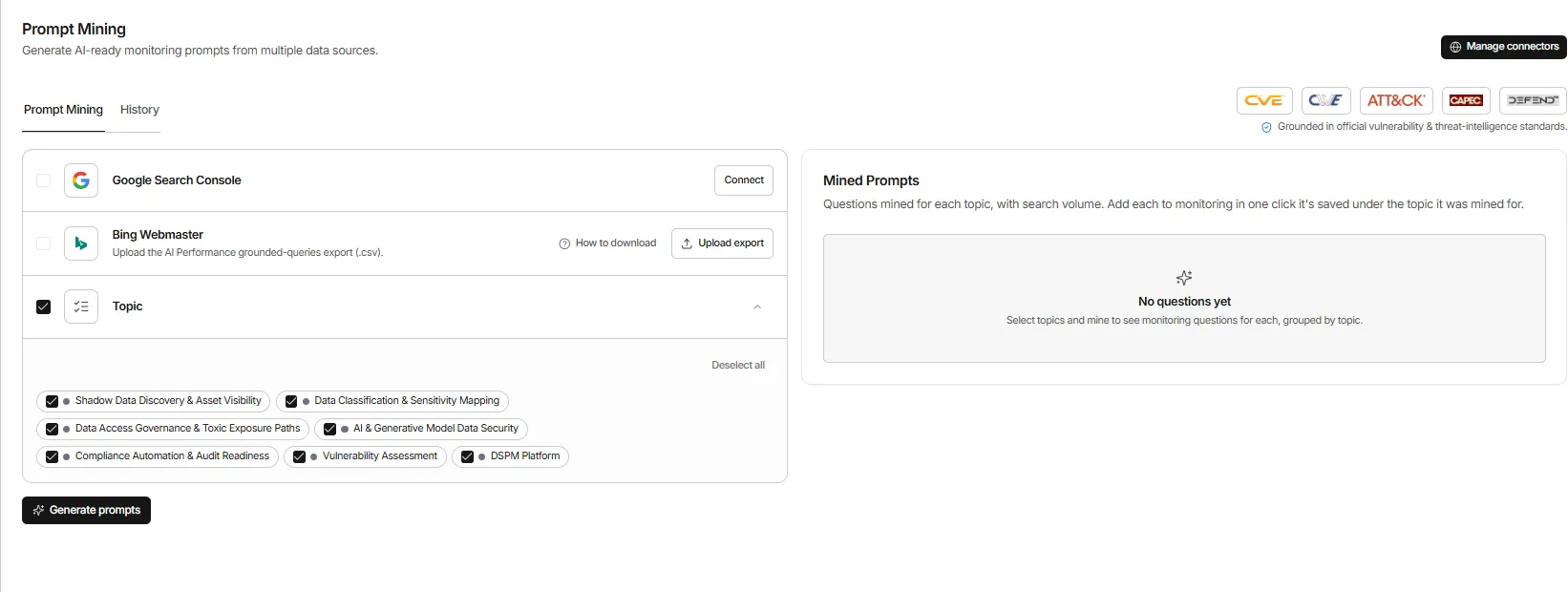
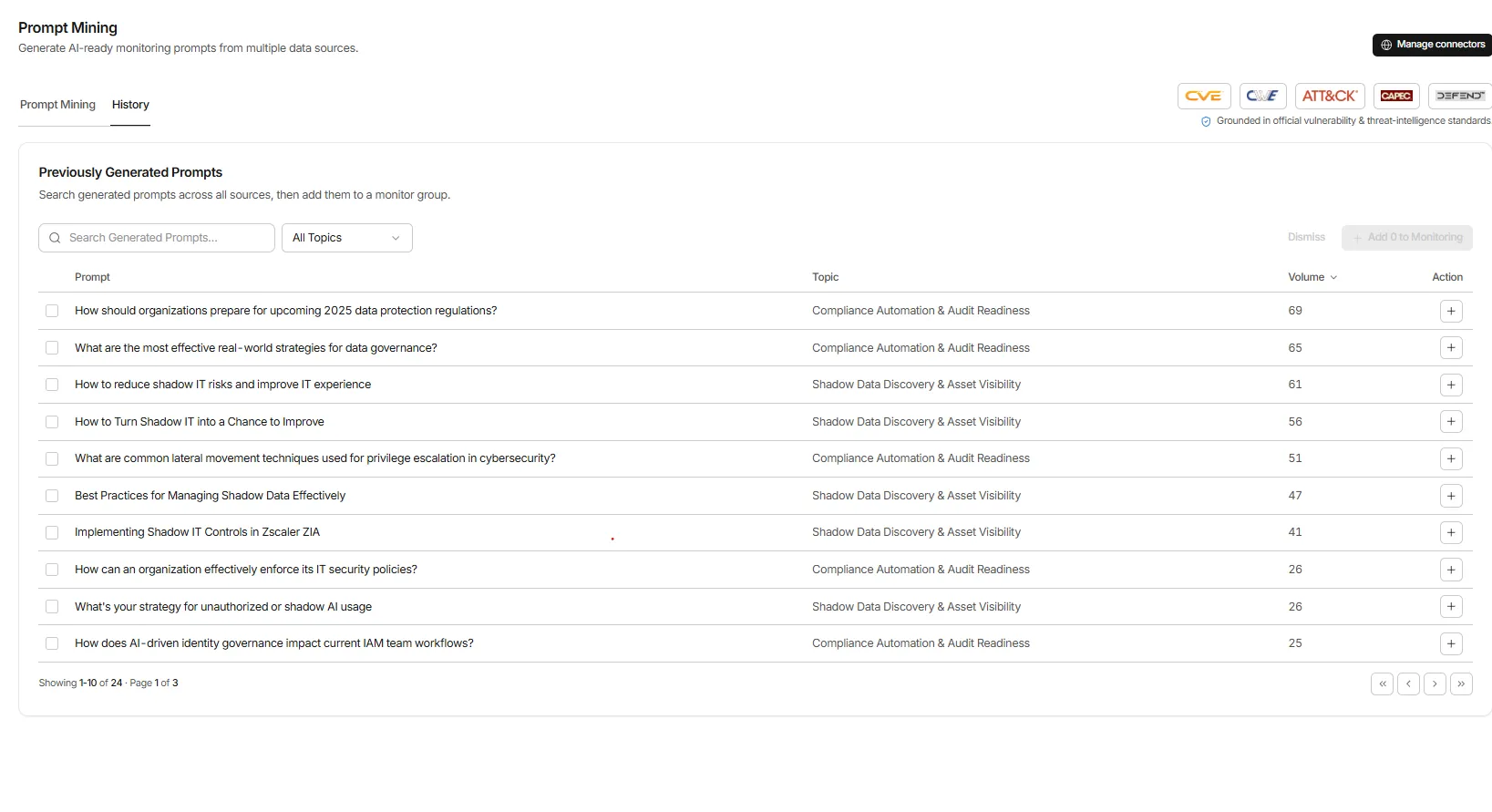
Why it matters: prompt lists built from internal brainstorming reflect how your team talks, not how buyers ask. Volume data lets you sort by demand instead of by whoever spoke loudest in the planning meeting. This is the front end of proper AEO keyword research.
Prompt Diagnose: Stop Tracking the Wrong Prompts
Prompt Diagnose audits your existing prompt set and flags prompts that are too broad, too narrow, commercially irrelevant, or already saturated by an incumbent you will not displace this quarter.
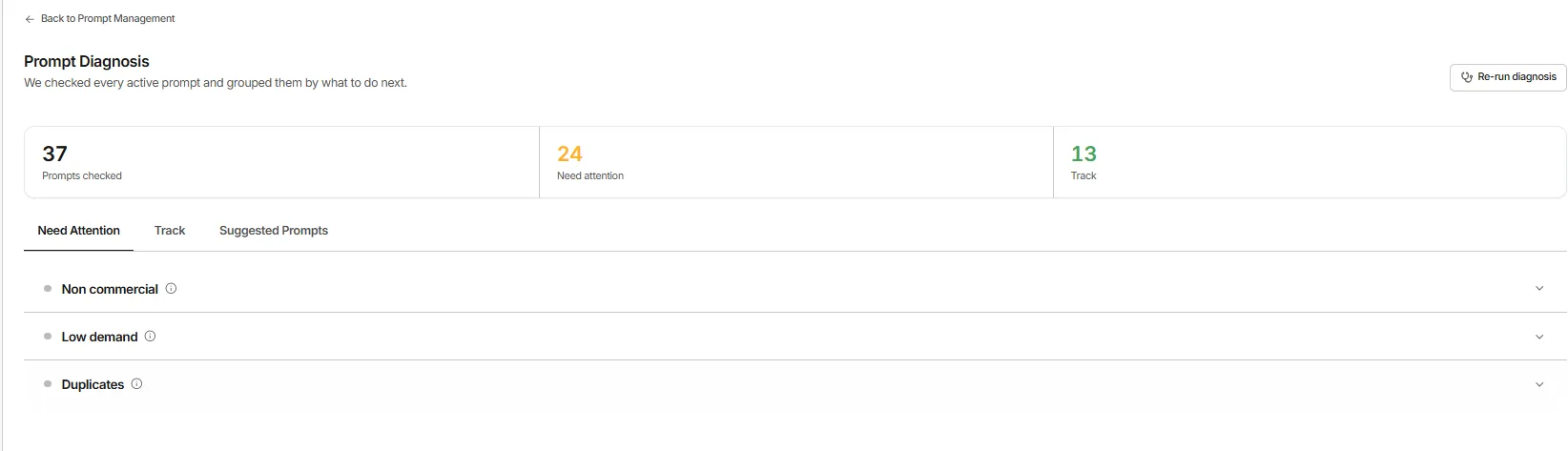
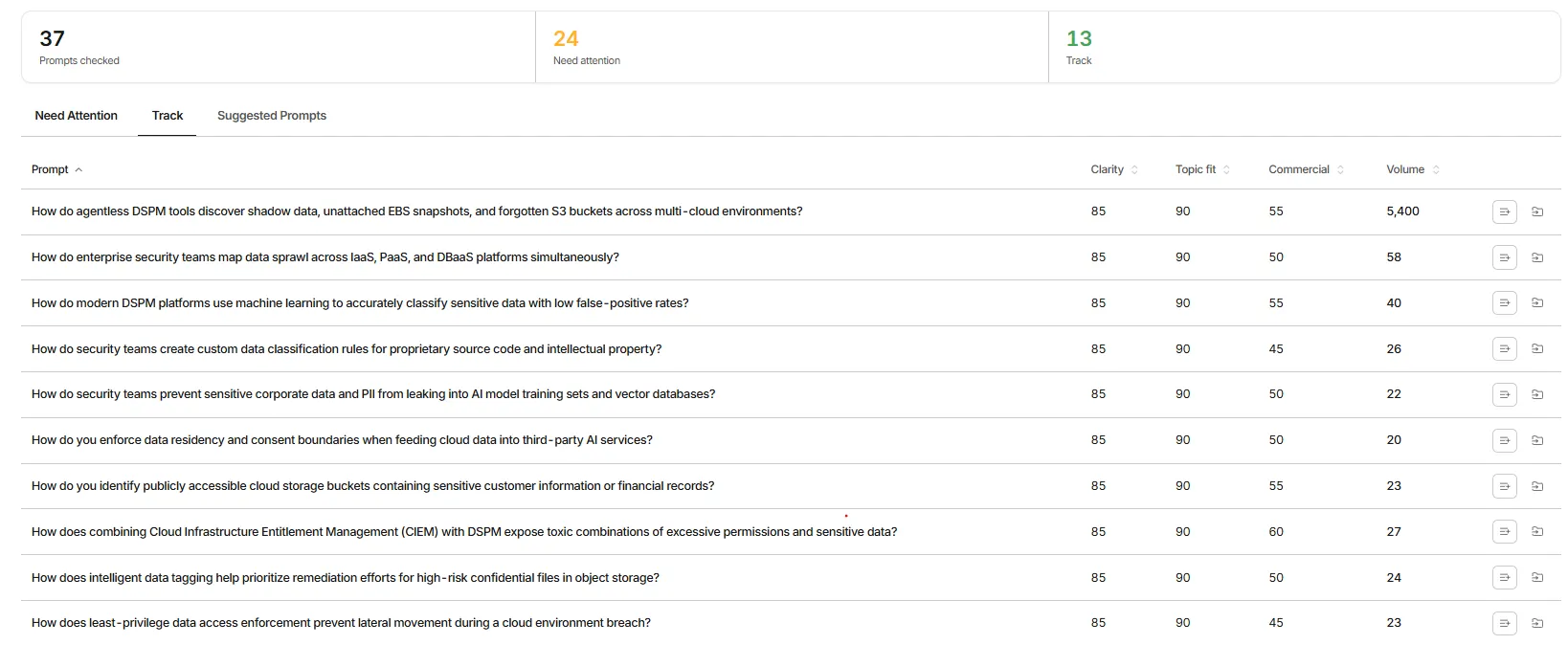
Why it matters: every platform on this list bills by prompt volume. Searchable Pro gives you 100 per model, Peec Starter gives 50, Profound Starter gives 50. If a third of yours are dead weight, you are paying full price for two-thirds of a program. This is the only feature here that reduces your bill.
Visibility Diagnosis: Find the Gap and Get the Brief
Point Visibility Diagnosis at any prompt you are not cited on. It searches your site for a page targeting that prompt, scores how well the page matches, and pulls the competitor pages AI engines actually cited over the last 30 days. Then it branches:
- No strong page exists: it writes a content brief with title, angle, outline, the points that must be covered, the claims that earn citations, and where the competitor's page is weak.
- A page exists but a competitor wins: it returns a gap report with prioritized fixes, missing topics, structure and evidence gaps, and a freshness comparison.
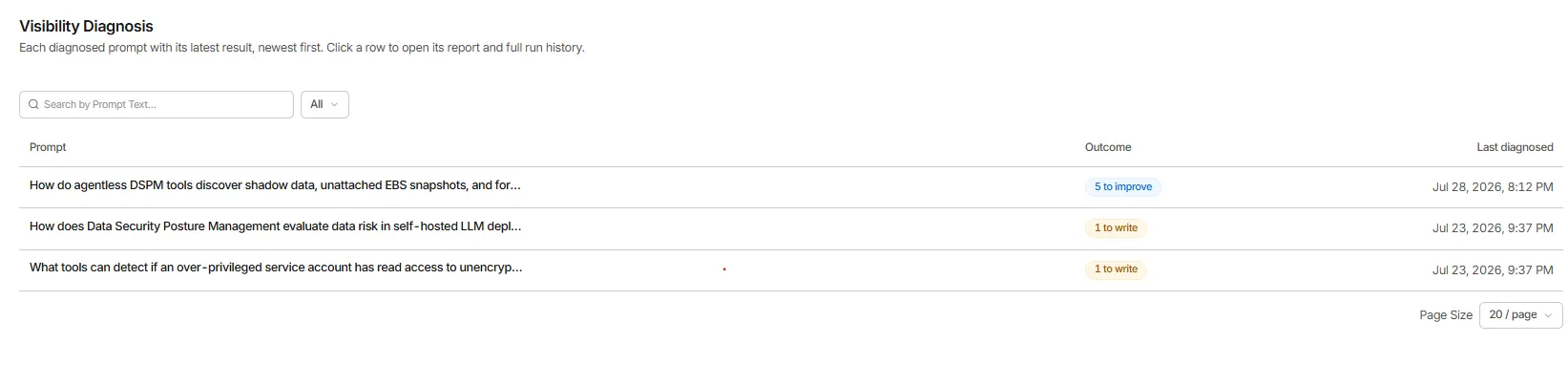
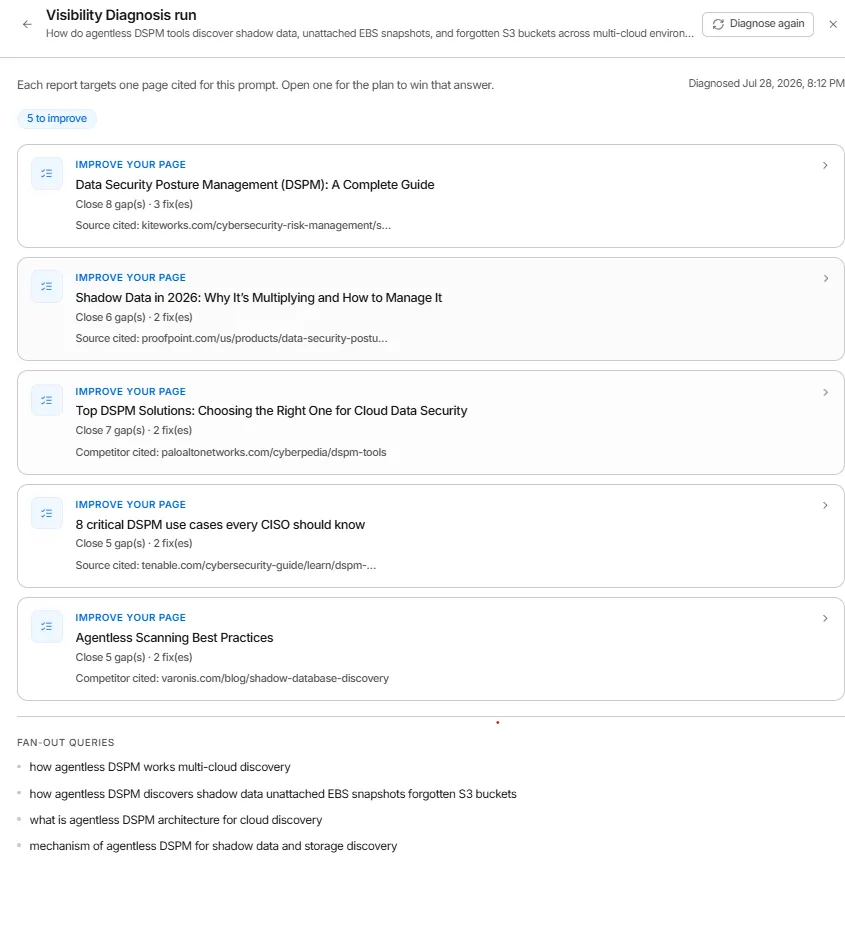
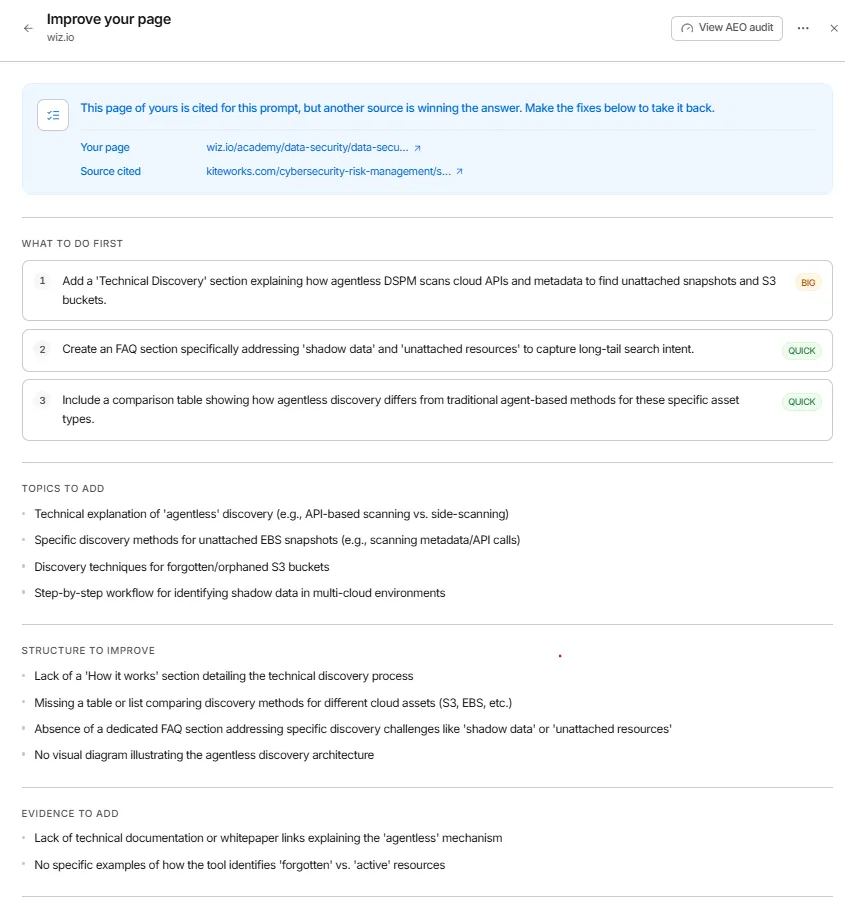
Why it matters: Searchable's recommendations tell you to improve content structure. Visibility Diagnosis tells you that the competitor winning your prompt published 400 words more on a subtopic you skipped, refreshed the page six weeks ago, and carries schema you are missing. One is advice. The other is a work order. Either output feeds straight into article generation, a page rewrite, or a Task.
AEO Site Audit: Know Which Page to Fix First
Four in ten B2B security buyers now start their research inside ChatGPT, Perplexity, or Claude rather than a search engine. When an assistant is asked for the best SIEM for a mid-market team, it answers with a shortlist and citations, not a page of blue links.
Marketing teams can usually tell when their brand is missing from that shortlist. What they cannot easily tell is why. Is the page technically unreachable to an AI crawler, thin on evidence, missing schema, or simply out of date? Without an answer, teams rewrite pages on a guess and often watch the citation go to a competitor anyway.
AEO Site Audit crawls your full sitemap and scores every page on two dimensions. AEO Health covers off-page authority, content structure, evidence, retrievability including AI crawler access and page speed, freshness, and schema. Technical Health covers Lighthouse performance, SEO, best practices, accessibility, and Core Web Vitals.
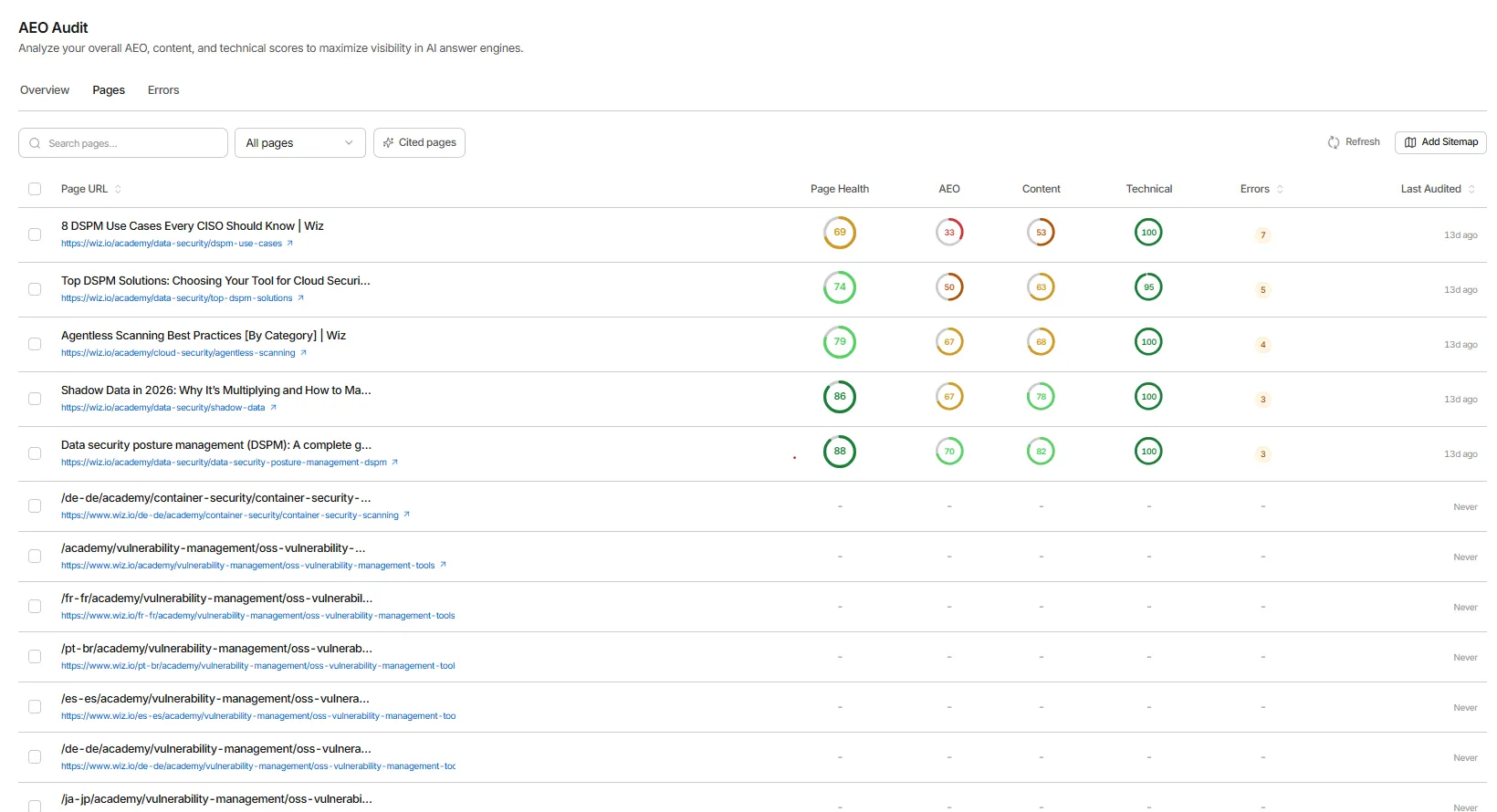
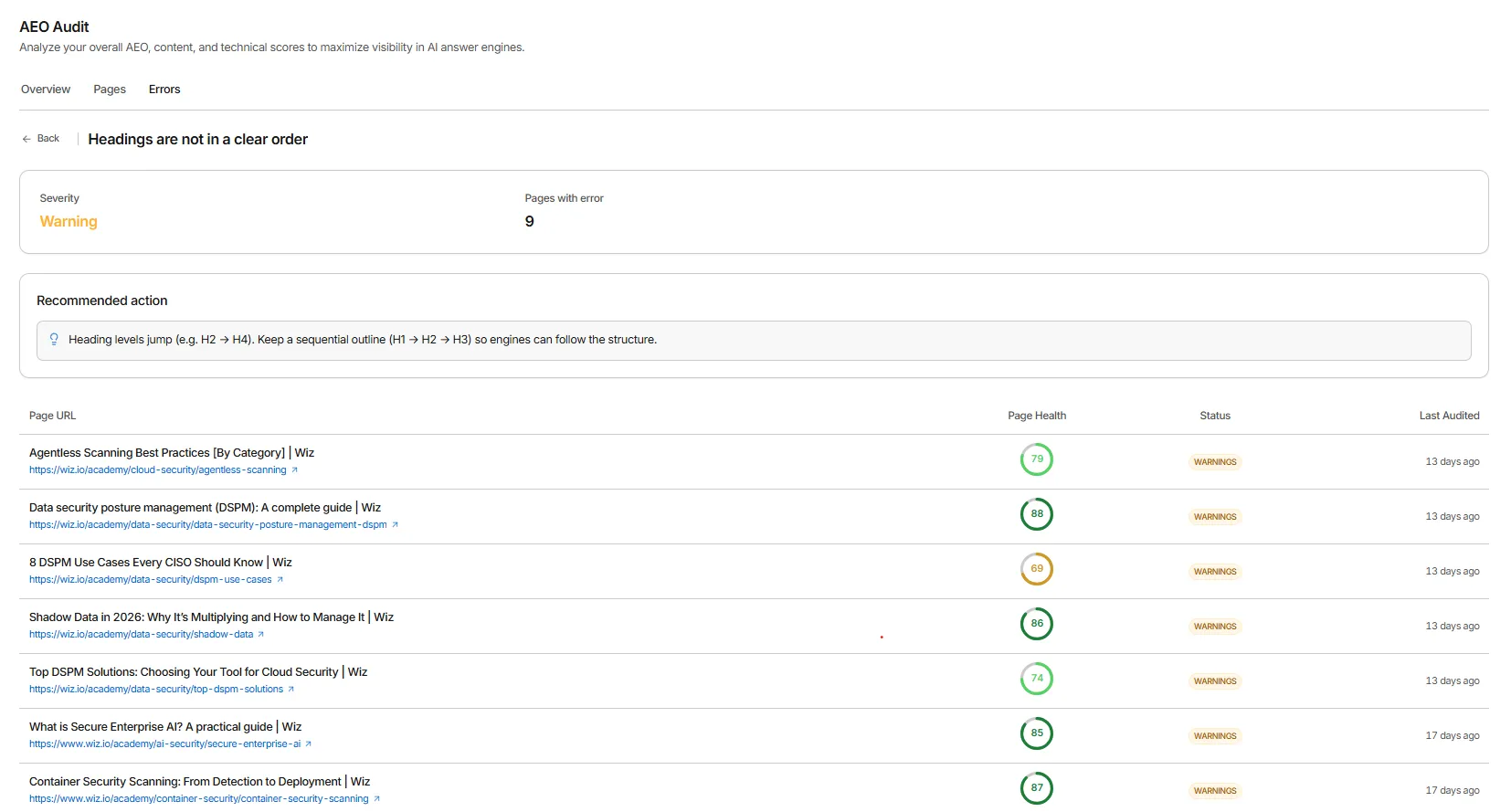
Every issue comes back with a severity rating and a stated fix, not just a number. A brand-wide view rolls results into average scores, flags how many pages remain unaudited, and ranks worst first.
"Teams don't need one more score sitting in a dashboard. They need to know which page to fix first, and why," said Govind Kumar, CTO and co-founder of GrackerAI. "AEO Site Audit reads a page the way an answer engine reads it: what it can access, what it offers as evidence, how fresh it is. Then it hands that back as a graded list instead of a mystery."
Why it matters: Searchable gives you 200 site audits per month on Pro that identify schema, crawlability, and structure issues. GrackerAI grades every page on two separate axes and ranks your entire site worst-first, so Monday morning starts with a list instead of a debate. One click turns any page's issues into an assignable Task. Full detail lives in the AEO Audit documentation.
Recommendations Split Into On Page and Off Page
Most marketing teams are not short on data. Between visibility scores, citation counts, competitor mentions, and audit results, there is plenty to look at. What is missing is a starting point.
Should the team rewrite an underperforming page, or go earn a mention on a forum an AI engine keeps citing? Both are valid. Presented as one undifferentiated list, neither gets prioritized, and teams default to whatever feels urgent that day.
GrackerAI's Recommendation Engine splits into two tabs:
- On Page surfaces your own weak spots: prompts with low visibility, prompts worth optimizing, and pages with low AEO or technical scores, fed by AEO Site Audit and Visibility Diagnosis.
- Off Page surfaces external opportunities: domains cited on prompts where you are absent, and competitors appearing alongside you that you are not yet tracking, fed by the Discovered view and by Top, New, and Lost Citation Sources.
Every card states the problem, states the action, and links straight to where that action happens.
"Most teams have more monitoring data than they know what to do with. The question we kept hearing was simple: what do I do first?" said Deepak Gupta, CEO and co-founder of GrackerAI. "Splitting Recommendations into On Page and Off Page answers that directly: fix what's yours, then go earn citations where you're not yet present."
Why it matters: this is the single clearest structural advantage over Searchable. Searchable produces recommendations. GrackerAI produces a prioritized queue with an obvious split between work you control and work you have to go earn. See the Recommendations documentation for how cards are generated.
Tasks: Findings That Do Not Die in a Screenshot
Monitoring tells a team what is wrong. It rarely tells them who is going to fix it. A visibility drop gets flagged, someone screenshots it into Slack, a content gap gets mentioned on a call, and a week later nobody remembers whether it was assigned, ignored, or fixed twice by two different people.
Tasks is a built-in task manager with a one-click "Add task" button on nearly every screen: citations, prompts, responses, alerts, content gaps, discovered competitors, diagnosis reports, and page audits. Each task arrives pre-filled with source context and a checklist, and supports assignees, priority, status, and due dates. Overdue items flag automatically, and de-duplication stops one finding from spawning two tickets.
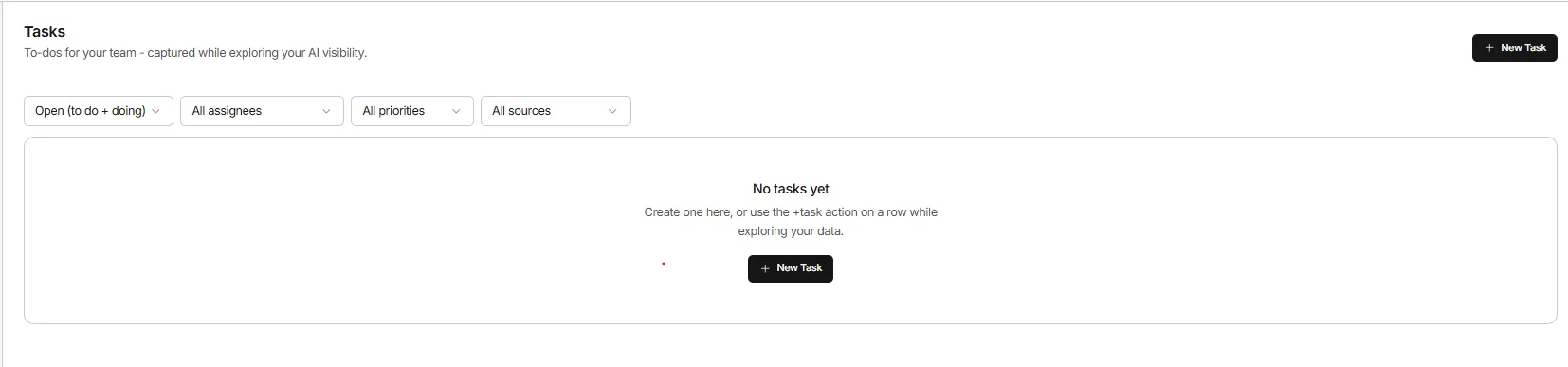
"A finding that doesn't turn into a ticket doesn't turn into a fix," said Deepak Gupta, CEO and co-founder of GrackerAI. "We built Tasks so every citation gap, every audit issue, every alert gets an owner and a due date the moment it's discovered, not three meetings later."
Why it matters: no other platform on this list closes this loop natively. Searchable, Profound, Peec, and Knowatoa all hand you findings and assume you have a separate system for follow-through. GrackerAI syncs to Asana, ClickUp, Notion, and Jira, so the distance between "we found a problem" and "it is fixed" is one button rather than a re-briefing. Details in the Tasks documentation.
MCP Connector: Ask Your Visibility Data a Question
AI visibility data has a habit of getting stuck. It lives in a dashboard one person checks weekly, then gets summarized into a Slack message or a slide before it reaches anyone else. By the time a founder or agency partner asks "which subreddits are AI engines citing for us this month," the honest answer is usually "let me pull that and get back to you."
GrackerAI's MCP connector exposes your visibility data to any Model Context Protocol client, including Claude, over a read-only connection scoped to the brands you authorize. Instead of logging in, clicking through several views, and exporting a CSV, you ask the question in natural language and get an answer grounded in your own tracked prompts, citations, and competitor data.
"Visibility data that only lives behind a login gets checked once a week, if that," said Govind Kumar, CTO and co-founder of GrackerAI. "Once it's available over MCP, anyone on the team can ask Claude which domains are winning citations on a given prompt, or how a brand's share of voice moved this week, and get the answer in the same place they're already working."
Why it matters: because the connection is read-only and brand-scoped, agencies managing several clients can grant access without handing over write permissions or unrelated data. Searchable and Otterly both offer MCP; the difference is what sits behind it. Querying diagnosis output and audit grades is a different conversation than querying a rank table. See the MCP documentation for setup.
Citation Source Intelligence, Including Reddit
Knowing you lost a citation is half the story. Knowing which domain took it is the other half.
GrackerAI tracks Top Citing Domains, New Citation Sources, and Lost Citation Sources, so a slipping position shows up as a named source rather than a falling line. A dedicated Reddit tab rolls citations up to one row per subreddit, summing every cited post per community across all your tracked prompts.
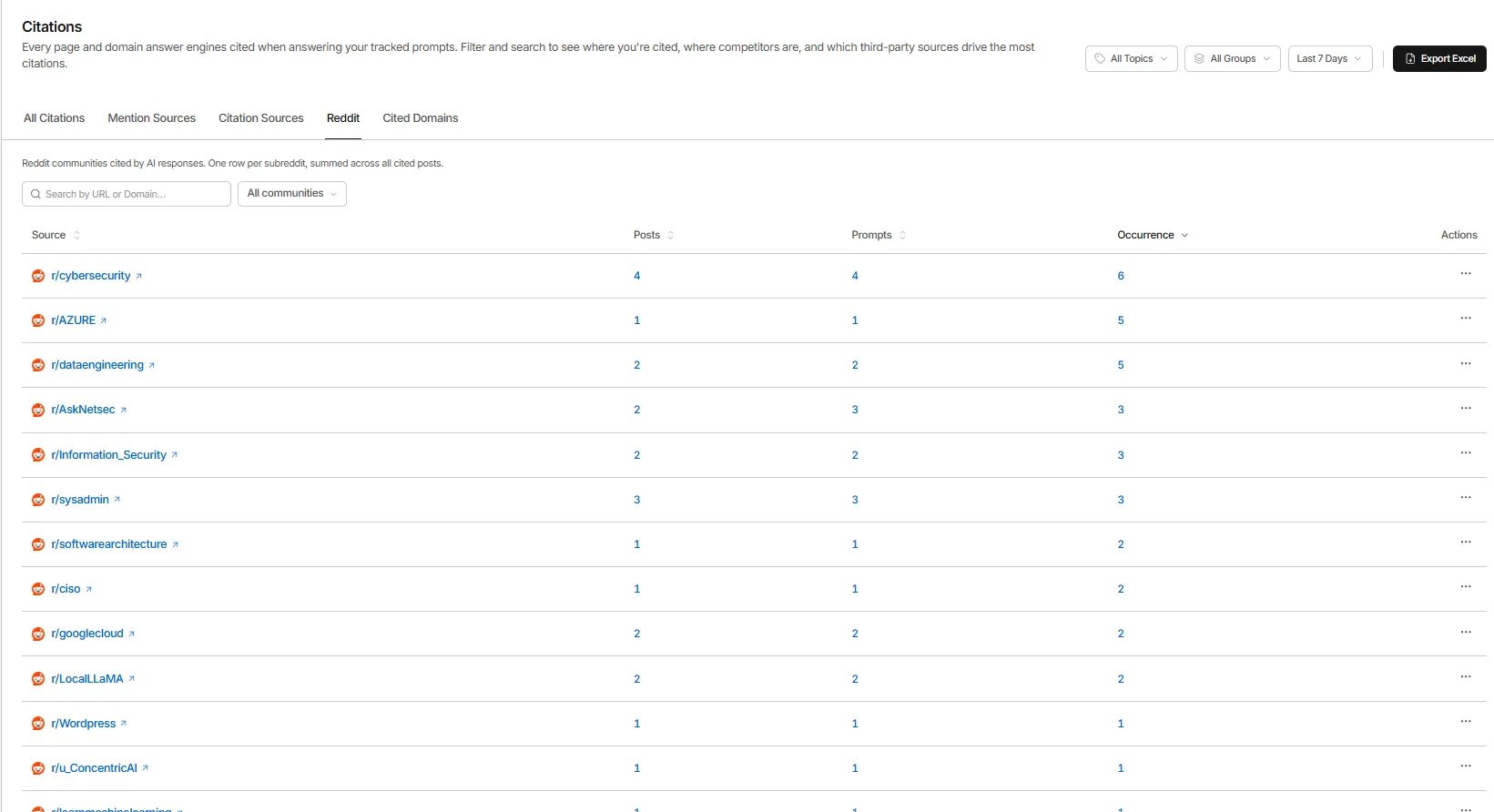
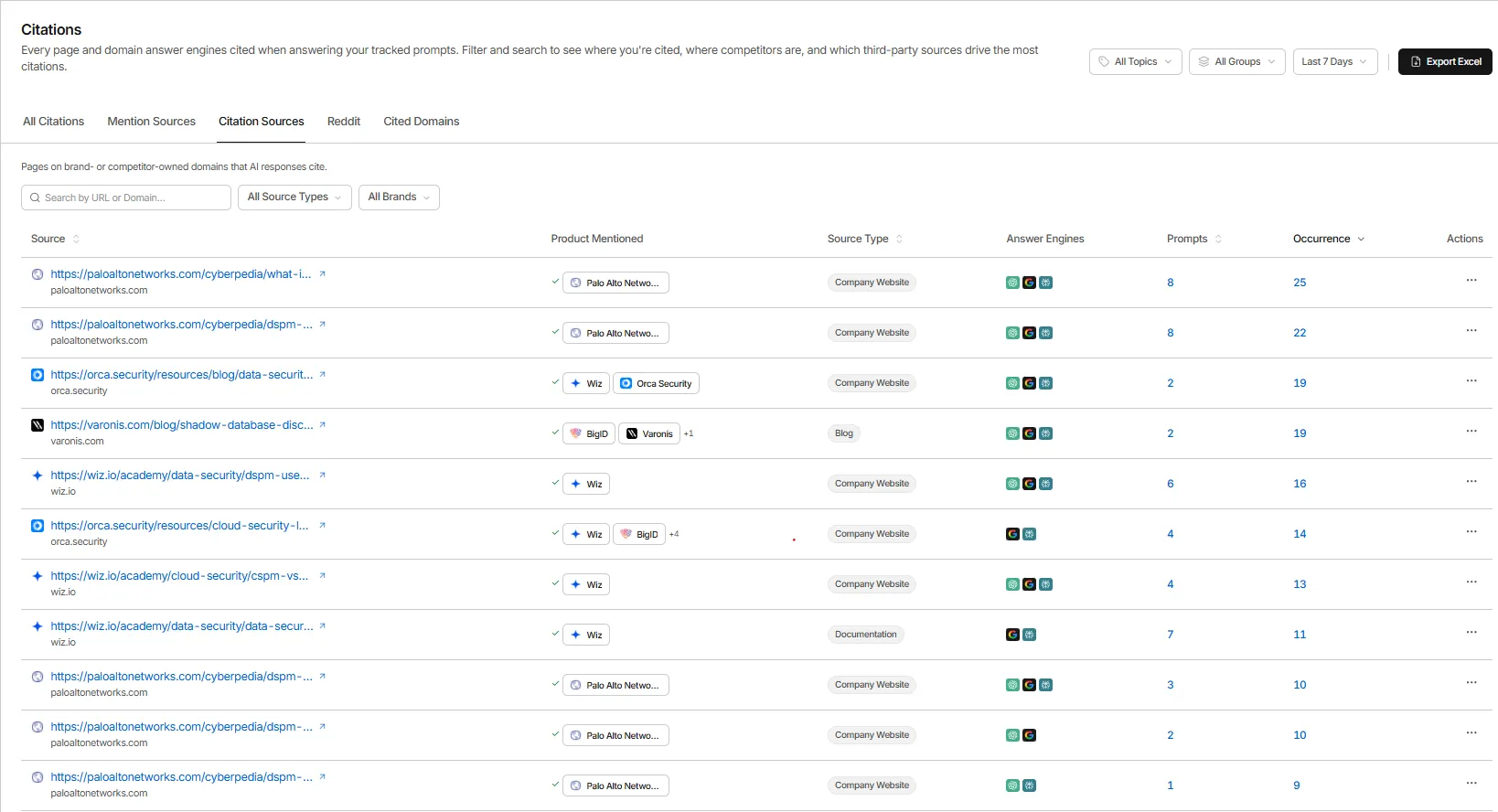
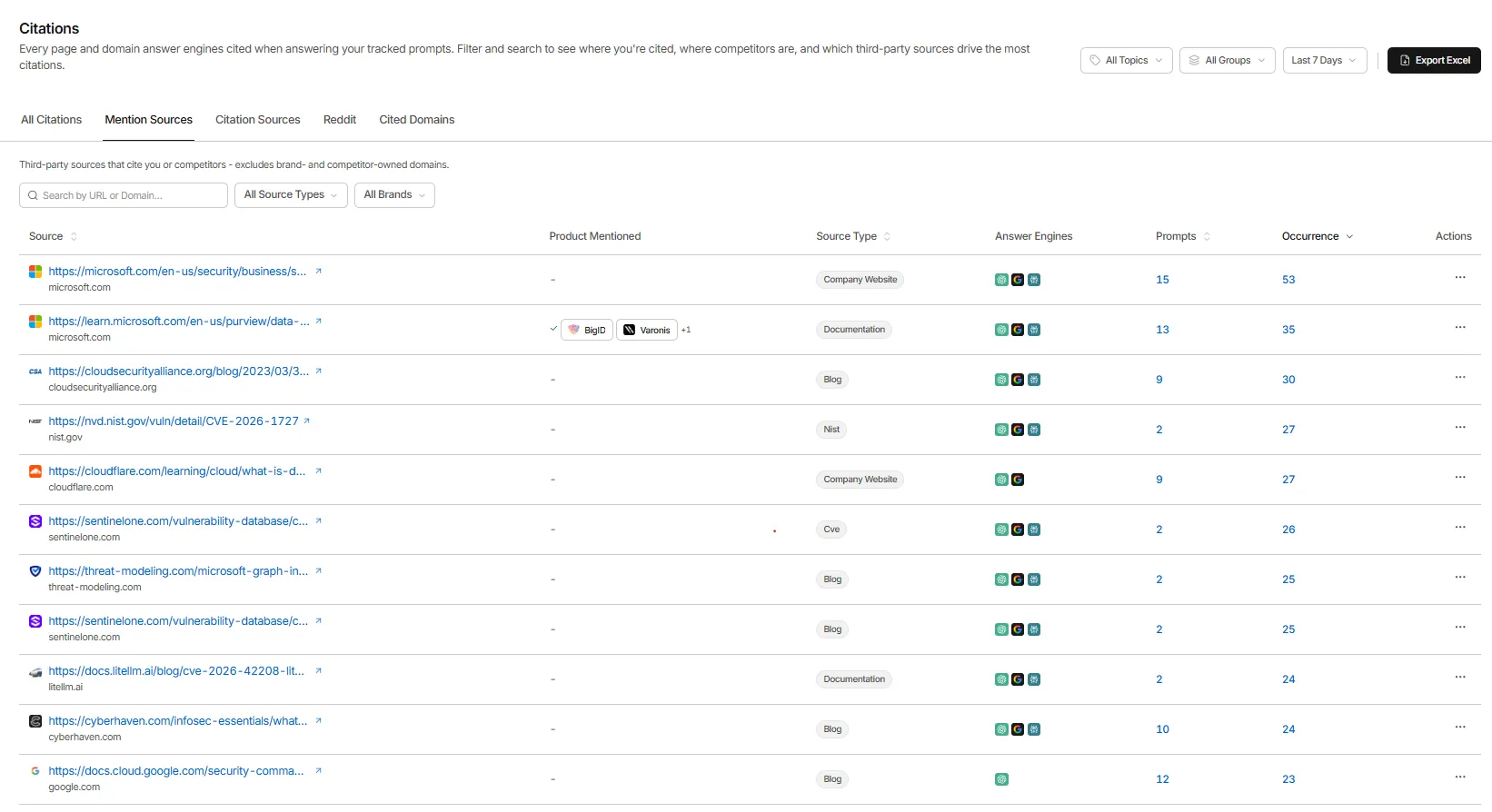
Why it matters: Lost Citation Sources is an early warning system. A source that stopped citing you this month is a visibility drop that has not shown up in your score yet. And the Reddit rollup answers a question every security marketer asks eventually: which communities do AI engines actually lean on in my category, and is it worth showing up there? More on this in our guide to tracking AI citations and mention sources.
Competitor Content Citation Analysis
See exactly which competitor pages AI engines are citing, on which prompts, and what those pages do that yours does not.
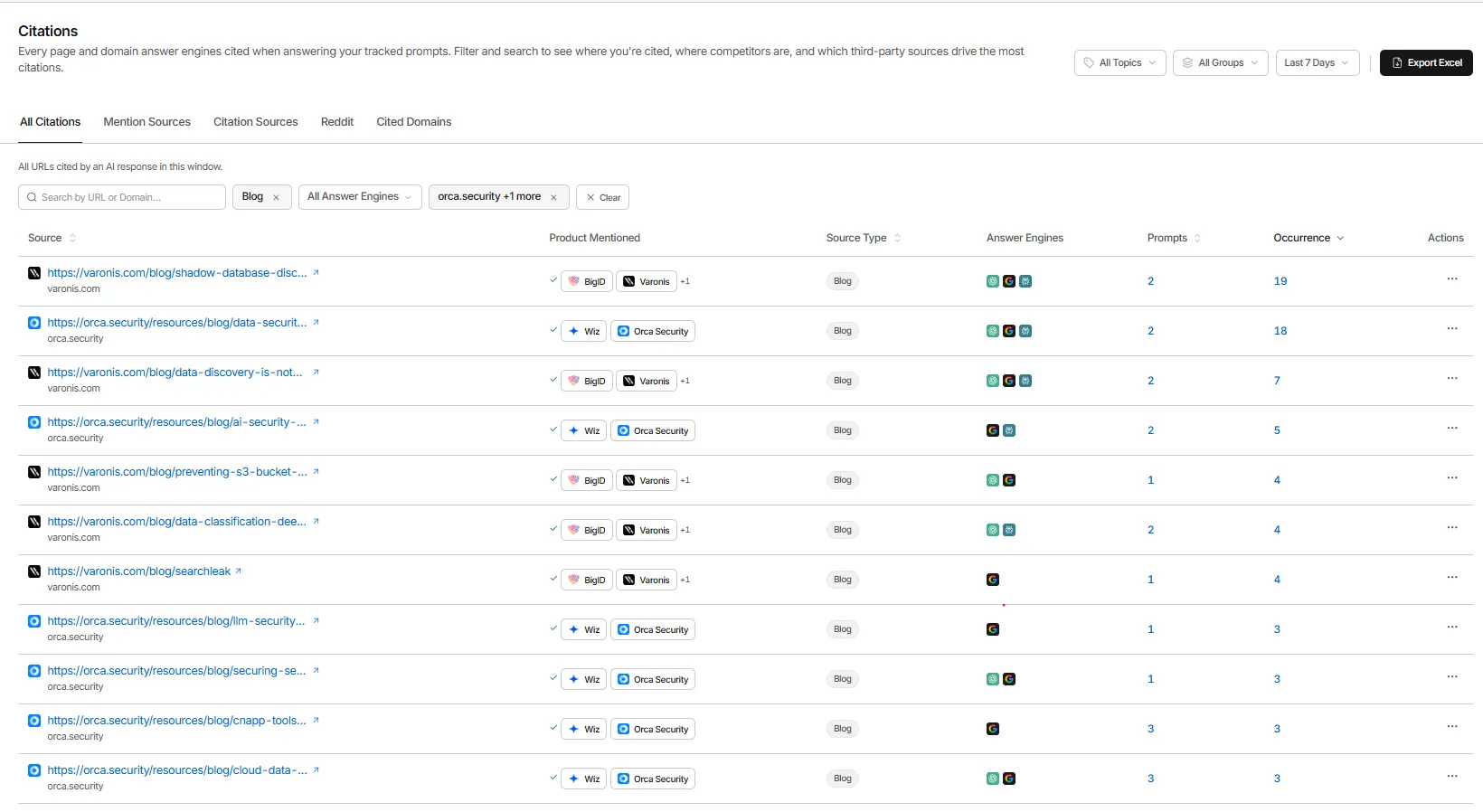
Why it matters: share of voice tells you that a competitor is winning. This tells you which specific URL is winning and why, which is the difference between a metric and a plan. Pair it with our competitor AI search analysis framework.
Content Engine: Generate New Pages and Fix Old Ones
The content engine generates cybersecurity and B2B SaaS articles structured for how AI engines extract and cite information. It also rewrites existing pages that are failing to earn citations, which matters more than net-new generation for most established sites.
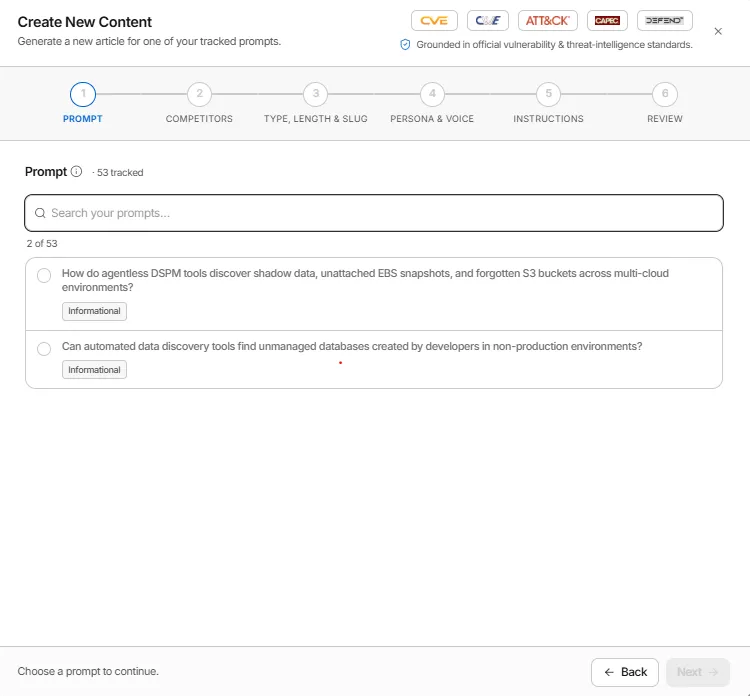
Brand Voice saves your tone, positioning, key messages, and explicit do's and don'ts once. Every generated article writes in that voice automatically, treating the always and never rules as hard constraints.
Why it matters: Searchable caps articles at 20 per month on Pro and 80 on Scale, and generates net-new content. If your problem is 200 existing pages that no longer get cited, generating more pages does not fix it. Rewriting the ones you have does.
Feature Comparison: Searchable vs Top Alternatives
Capability | Searchable | GrackerAI | Profound | Otterly AI | Peec AI |
|---|---|---|---|---|---|
Entry price | $125/mo | $99/mo | Free (Trial) / Custom (Enterprise) | $29/mo | $95/mo |
Engines on entry plan | Pick at onboarding | 3 | 1 (ChatGPT, Trial only) | 4 | 3 |
Max engines | 9 | 10 | 9 | 7 (add-ons) | 13 |
Content generation | Yes | Yes, plus rewrites | No | No | No |
Diagnostic agents | No | Yes | Agent credits | No | No |
Built-in task management | No | Yes, native | No | No | No |
Vertical specialization | General | Cybersecurity + B2B SaaS | General | General | General |
MCP access | Yes | Yes | No | Standard and up | Enterprise |
Seats on entry plan | Unlimited | 1 | Unlimited (Trial) | Unlimited | Unlimited |
Free trial | 14 days | 7 days | No time-limited trial (free 10-prompt Trial tier) | Yes | Contact sales |
How to Choose the Right Searchable Alternative
Work through these in order. Most teams find their answer by the third question.
1. What vertical are you in? If you sell cybersecurity, identity, compliance, or technical B2B SaaS, vertical tuning is worth more than any other feature on this list. Generic models mis-score the citations that matter in your category. Start with GrackerAI.
2. Do you need content, or only measurement? If you already have writers and just need data, Profound, Peec, Otterly, and Knowatoa are cheaper. If content production is the bottleneck, look at GrackerAI, Searchable, or AirOps.
3. How many brands or products do you track? Searchable's Pro tier gives one project. Peec Starter gives one. If you run multiple products or clients, price the tier that actually covers you, not the headline number. GrackerAI Enterprise handles multi-product tracking with per-product reporting, and agencies should read our GEO playbook for agencies.
4. What is your real budget? Under $100 per month: Otterly Lite or Knowatoa Starter. $100 to $250: GrackerAI Starter, Searchable Pro, Peec Starter, Knowatoa Growth, or Scrunch Core. $400 to $500: GrackerAI Scale, Searchable Scale, or Peec Advanced. Profound and Goodie AI Pro no longer publish tiers in this range — Profound is free (Trial) or custom Enterprise, and Goodie AI's next tier up is $999/mo Pro. Above $500, you are in Enterprise conversations.
5. Who fixes what the tool finds? If findings currently go to Slack and die there, prioritize a platform with native task management. This is the most common reason AI visibility programs stall in year one.
Still weighing options? Our AEO and GEO platform buying guide and our framework for choosing an AI visibility provider go deeper on evaluation criteria.
See Where You Stand Before You Buy Anything
You do not need a full rollout to find out whether this is a problem worth solving. Get a free AI visibility score and see how AI engines describe your brand today, then decide which platform on this list fits how your team actually works.
Frequently Asked Questions
What does Searchable do?
Searchable is an AI search visibility and analytics platform that tracks brand mentions and citations across up to nine answer engines including ChatGPT, Google AI Overviews, Perplexity, Copilot, Claude, Gemini, Grok, DeepSeek, and Google AI Mode. It also runs technical site audits, generates AI-optimized articles, and benchmarks share of voice against competitors. Pricing starts at $125 per month for the Pro plan.
Why do teams look for a Searchable alternative?
The three most common reasons are project limits on the entry plan (Pro covers a single project), recommendations that read as generic for technical verticals like cybersecurity, and the absence of a workflow layer that turns findings into assigned work. Price is rarely the trigger on its own, since Searchable is competitively priced against Profound and Scrunch.
Is there a cheaper alternative to Searchable?
Yes. Otterly AI starts at $29 per month for 15 prompts across four engines, and Knowatoa starts at $59 per month with competitor gap analysis included. Both trade prompt volume and content generation for a lower entry price. GrackerAI Starter at $99 per month sits closest to Searchable Pro on capability while costing less.
Which Searchable alternative is best for cybersecurity companies?
GrackerAI. It is the only platform on this list with cybersecurity-tuned analysis models, a security prompt library covering EDR, SIEM, XDR, zero trust, CASB, CSPM, and CNAPP, and compliance query tracking across SOC 2, HIPAA, NIST, ISO 27001, PCI DSS, and GDPR. Every other platform here scores security citations with general-purpose models.
Which alternative tracks the most AI engines?
Peec AI lists up to 13 models on Enterprise, and Goodie AI lists up to 13 on its Enterprise tier. GrackerAI covers 10 on Enterprise, including ChatGPT, Perplexity, Google AI Mode, Microsoft Copilot, Google AI Overviews, Google Gemini, DeepSeek, Grok, Claude, and Brave Leo. Searchable covers up to 9 selectable engines. Engine count alone is a weak selection criterion, since most B2B buyer research still concentrates in three or four engines.
Can GrackerAI replace Searchable for AI visibility monitoring?
Yes, for B2B SaaS and cybersecurity teams. GrackerAI matches Searchable on core monitoring (multi-engine tracking, citation analysis, competitor share of voice, site audits, content generation) and adds diagnostic agents, vertical-tuned models, On Page and Off Page recommendations, and native task management. Searchable retains an advantage on unlimited seats across all tiers and unlimited domains on Pro.
How long does it take to see results from an AI visibility platform?
Most teams see initial visibility movement in four to six weeks and meaningful citation gains within two to three months, regardless of platform. The variable is not the tool, it is whether findings turn into published changes. Programs that pair monitoring with an execution loop move faster, which is the main argument for platforms that include content generation and task management rather than measurement alone.
Does switching platforms mean losing historical data?
Usually yes. Searchable retains 12 months of data on Pro and unlimited on higher tiers, but that history does not transfer. Export your data before cancelling, and expect a fresh baseline on the new platform. Run both in parallel for one month if the comparison matters to your reporting.
Related Comparisons
Shopping Searchable against a wider field? These cover the rest of the AI visibility category:
![10 Best Local Rank Tracker Tools: In-Depth Comparison Guide [2025]](https://cdn.pseo.one/6abcb68a626591c40e1c8aa6/687e1c1ef6fe799d288518df/68809c373eb8562bcf68975d/10-best-local-rank-tracker-tools-comparison-guide/feature-image.jpg)