How to Track AI Citations, Mentions & Sources Across ChatGPT, Claude, Gemini & Perplexity

According to the Pew Research Center, 2025, Google users who saw an AI summary clicked a traditional search result in just 8% of visits, compared with 15% when no AI summary appeared. That gap is why tracking AI citations now matters as much as tracking keyword rankings did a decade ago.
To track AI citations, you query each engine with the same buyer prompts on a fixed schedule, log whether your brand is named and which domains the engine cites as sources, then score share of voice, citation frequency, and sentiment per engine over time. Do it manually for a handful of prompts, or automate it across every engine you track so the data stays comparable week to week.
AI citations: AI citations are the moments when an answer engine like ChatGPT, Claude, Gemini, or Perplexity names your brand or links to your content while answering a user's question. They are the AI-era equivalent of a search ranking, except the engine decides what to surface and the user rarely sees a list of blue links.
Key Takeaways
AI citations are when an engine names your brand or links your content in an answer. They replace the click that the Pew Research Center, 2025 found dropped to 8% of visits once an AI summary appeared.
Each engine cites differently: Perplexity shows numbered sources inline, Gemini ties to Google AI Overviews, ChatGPT cites when browsing is on, and Claude cites when it uses web search.
Track three metrics per engine: share of voice (how often you appear versus competitors), citation frequency, and average sentiment of the mention.
Use a fixed prompt set and a fixed schedule. Inconsistent prompts produce noise, not a trend you can act on.
Gartner predicts traditional search volume will fall 25% by 2026, so citation data is becoming a primary visibility signal, not a side metric.
Tracking across multiple engines by hand does not scale past a few dozen prompts, which is where purpose-built monitoring earns its place.
What Are AI Citations and Why Do They Matter for Your Brand?
AI citations are the references an answer engine makes to your brand or your content while answering a question, and they matter because buyers increasingly act on the answer instead of clicking through to your site.
According to Gartner, 2024, search engine volume will drop 25% by 2026 as buyers shift queries to AI chatbots and virtual agents. When a security buyer asks ChatGPT "what's the best SIEM for a mid-market SOC," the brands the model names are the shortlist. If you're not cited, you're not considered.
There's a second reason this is urgent. The Pew Research Center, 2025 found that around one in five Google searches in March 2025 produced an AI summary, and only 1% of those visits resulted in a click on a link inside the summary. The answer is the destination now. Tracking how AI engines pick the sources they cite tells you whether your content is doing its job in that new destination.
How Does Each Engine Handle Citations Differently?
Each engine surfaces sources in its own way, so a single tracking method that ignores those differences gives you a blended score that hides where you're actually winning or losing. Perplexity attaches numbered footnotes to nearly every sentence and lists source domains openly.
Gemini grounds many answers in Google Search and overlaps heavily with Google AI Overviews, so a Gemini citation often signals an AI Overviews citation too. ChatGPT cites named sources when its browsing tool is active and leans on training data when it is not. Claude cites web sources when its search tool runs and otherwise answers from its training, which means a Claude "mention" without a link is still a brand signal worth logging.
Treat these as four separate scoreboards. A brand can dominate Perplexity, where fresh, well-structured pages get cited fast, while being invisible in ChatGPT, where older training data still drives many answers. Blending the two into one number erases the insight. This is the core reason per-engine depth beats a single blended visibility score.
How Do You Set Up an AI Citation Tracking Workflow?
Setting up a tracking workflow takes three decisions before you query anything: which prompts, which engines, and how often. Lock those three and your data becomes comparable across weeks. Skip them and you get a pile of one-off screenshots. Here is the step-by-step process, with concrete actions for each of the four engines named in the title.
Step 1. Build Your Buyer Prompt Set
List the 20 to 50 questions your buyers actually ask an AI assistant. For a cybersecurity vendor, that includes category prompts ("best email security tools"), comparison prompts ("Vendor A versus Vendor B"), and problem prompts ("how do I stop phishing that bypasses MFA"). Pull real wording from your Google Search Console queries so the prompts mirror how people phrase things, not how you'd phrase them internally. Save this set in a spreadsheet with one prompt per row. This set is your control variable, so freeze it and only add prompts deliberately.
Step 2. Query ChatGPT and Log Named Mentions
Open ChatGPT with browsing enabled and paste each prompt exactly as written. For every response, record three things: whether your brand is named, which competitors are named, and any source links the model shows. ChatGPT often answers from training data without links, so log brand mentions even when no URL appears, because a mention still shapes the buyer's shortlist. Note the position of your mention too. Being named first reads very differently to a buyer than being named eighth. For a deeper look at what six years of ChatGPT tracking taught us about citation behavior specifically, see our best tools for ChatGPT brand mention tracking.
Step 3. Query Perplexity and Capture Cited Domains
Run the same prompts in Perplexity. Because Perplexity lists numbered sources for almost every claim, this is where you'll get the cleanest citation data. For each answer, copy the cited source domains into your sheet and flag which of them are yours, which are competitors', and which are third-party sites like review platforms or industry publications. Those third-party domains are your top citing sources to target for placements. Perplexity refreshes fast, so re-running a prompt a week later often shows movement you can tie to a content change.
Step 4. Query Gemini and Cross-Check Google AI Overviews
Run your prompts in Gemini, then run the same queries in Google Search and inspect the AI Overview. Because Gemini and AI Overviews both ground in Google's index, a citation in one frequently predicts a citation in the other. Log the cited links from both surfaces. If a competitor appears in the Gemini answer and the AI Overview but not in ChatGPT, that tells you their Google-indexed content is strong while their broader brand presence is weaker, which is useful competitive intelligence.
Step 5. Query Claude and Record Source Usage
Paste each prompt into Claude with its web search tool available. Claude cites the pages it retrieves, so capture those source URLs the same way you did for Perplexity. When Claude answers from training data without searching, log the brand mention without a link. Claude tends to reward clearly structured, factual content, so pages with strong schema markup and a quotable structure often get pulled in here first.
Step 6. Score Share of Voice, Frequency, and Sentiment
Now turn the raw log into metrics. For each engine, calculate share of voice as the number of prompts where you're named divided by the total prompts. Calculate citation frequency as how many times your domain is cited as a source. Score sentiment on a simple scale: positive, neutral, or negative, based on how the engine characterizes you. Track all three per engine, per week. The trend line is the point. A single snapshot tells you almost nothing; eight weeks of the same prompts tells you whether your content work is moving the needle.
Want to see how AI search engines describe your brand today?
Get your free AI visibility score in about 60 seconds, with no signup required. Trusted by 500+ security teams.
How Do You Track AI Citations, Mentions & Sources With GrackerAI?
The six steps above work by hand. GrackerAI automates the same workflow end to end, from building the prompt set to identifying exactly which competitor pages are winning a citation you lost.
Generate Real Buyer Prompts Instead of Guessing Them
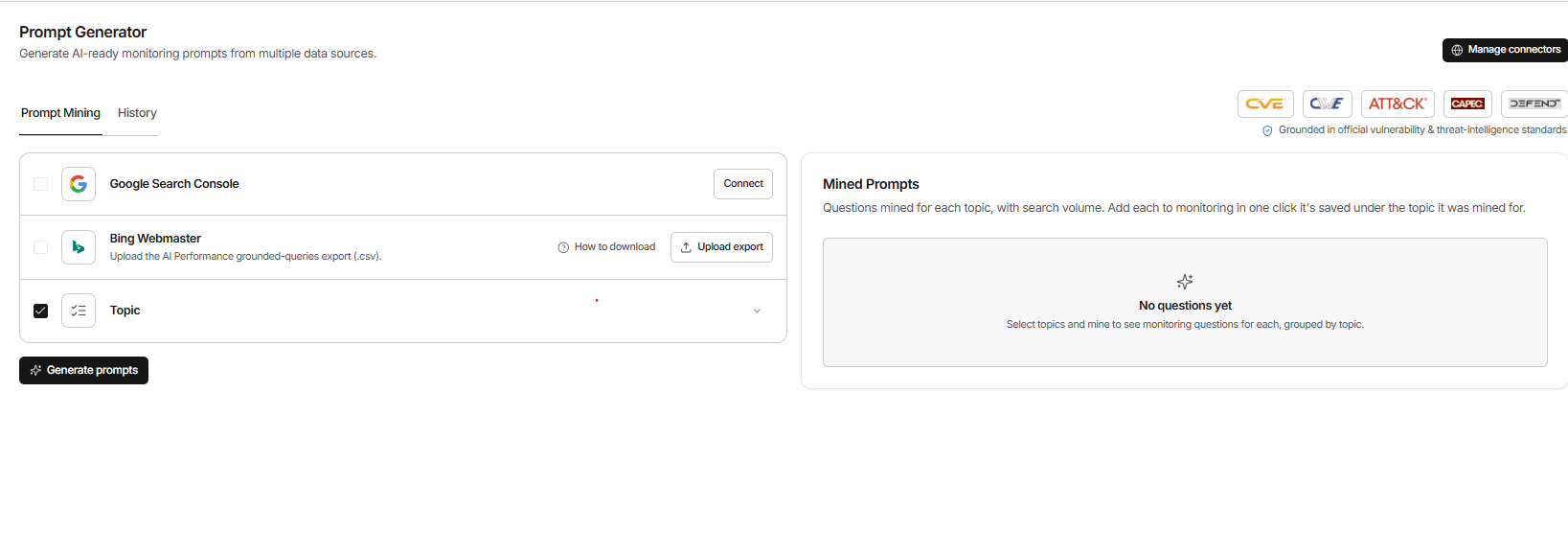
Step 1 above asks you to write 20 to 50 buyer prompts from memory or Search Console exports. GrackerAI's Prompt Generator does this for you: it mines real buyer search questions and their search volume, so you know which prompts actually matter instead of guessing.
Connect Google Search Console and Bing Webmaster Tools and the engine pulls your real queries directly and turns them into tracked prompts, so you're tracking actual buyer search behavior, not assumptions about how buyers phrase things. If you sell into a B2B SaaS audience specifically, our guide to AI search analytics for SaaS brands covers how to connect that data to pipeline.
See Every Source an AI Response Cites
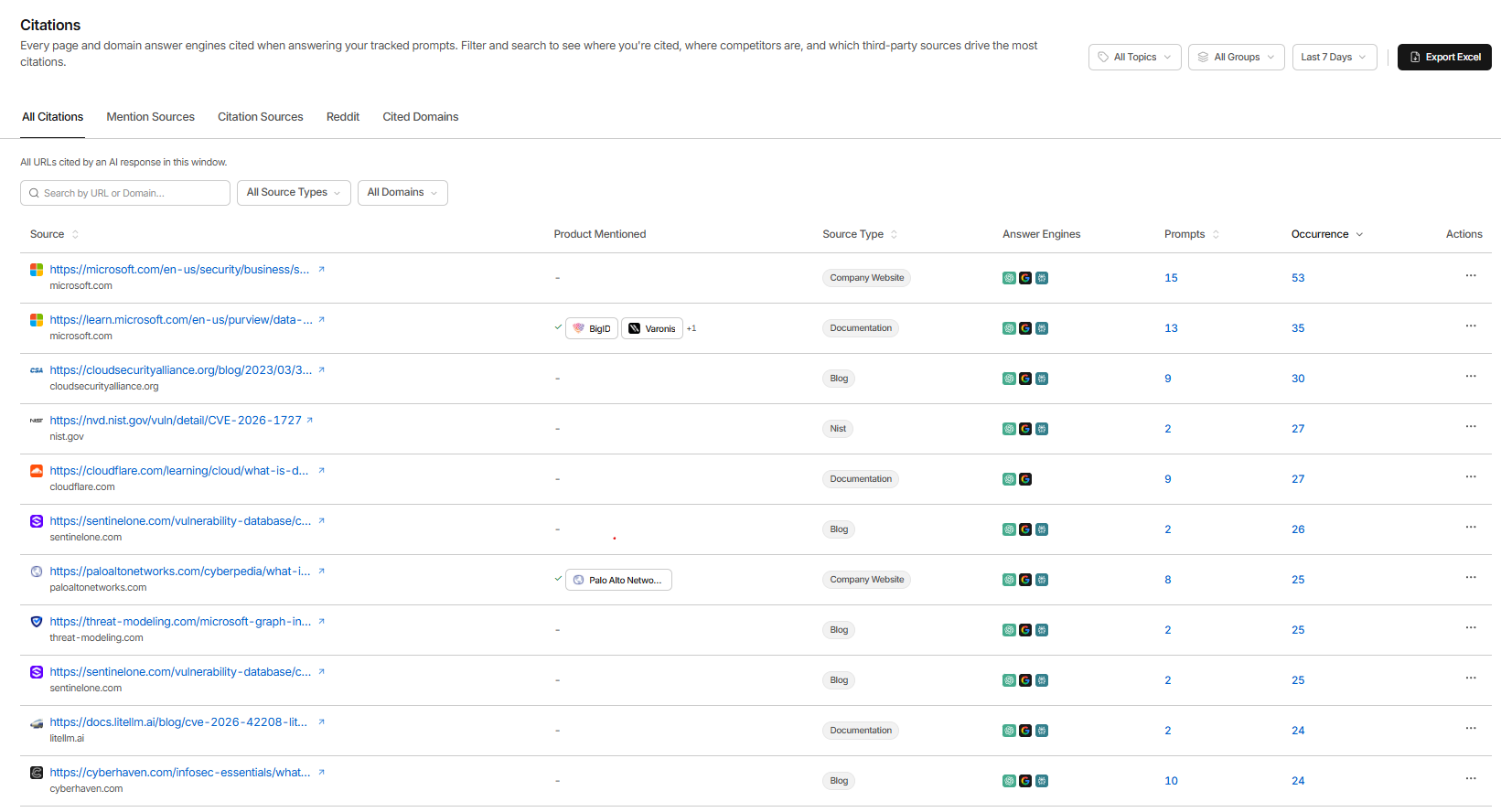
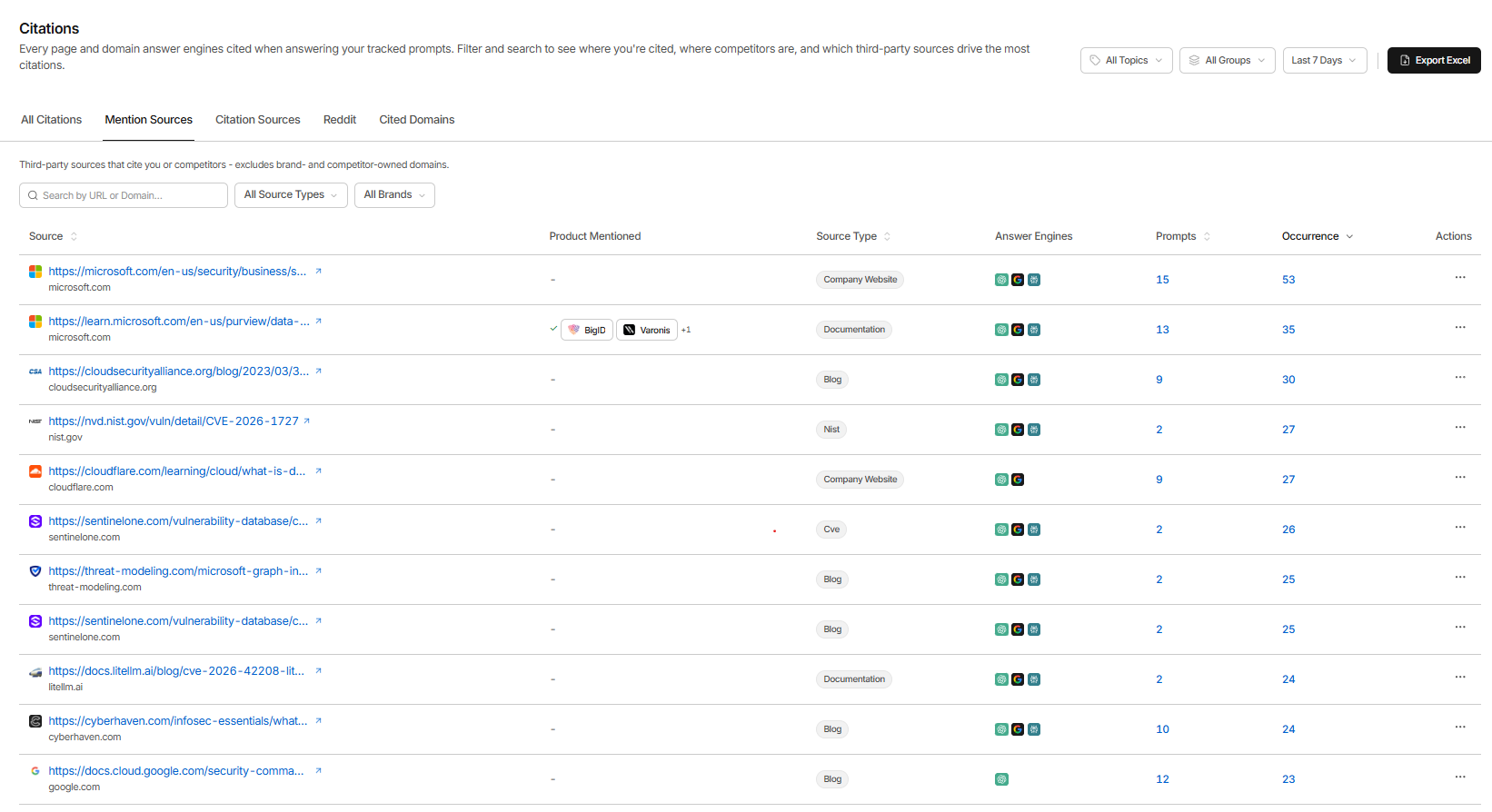
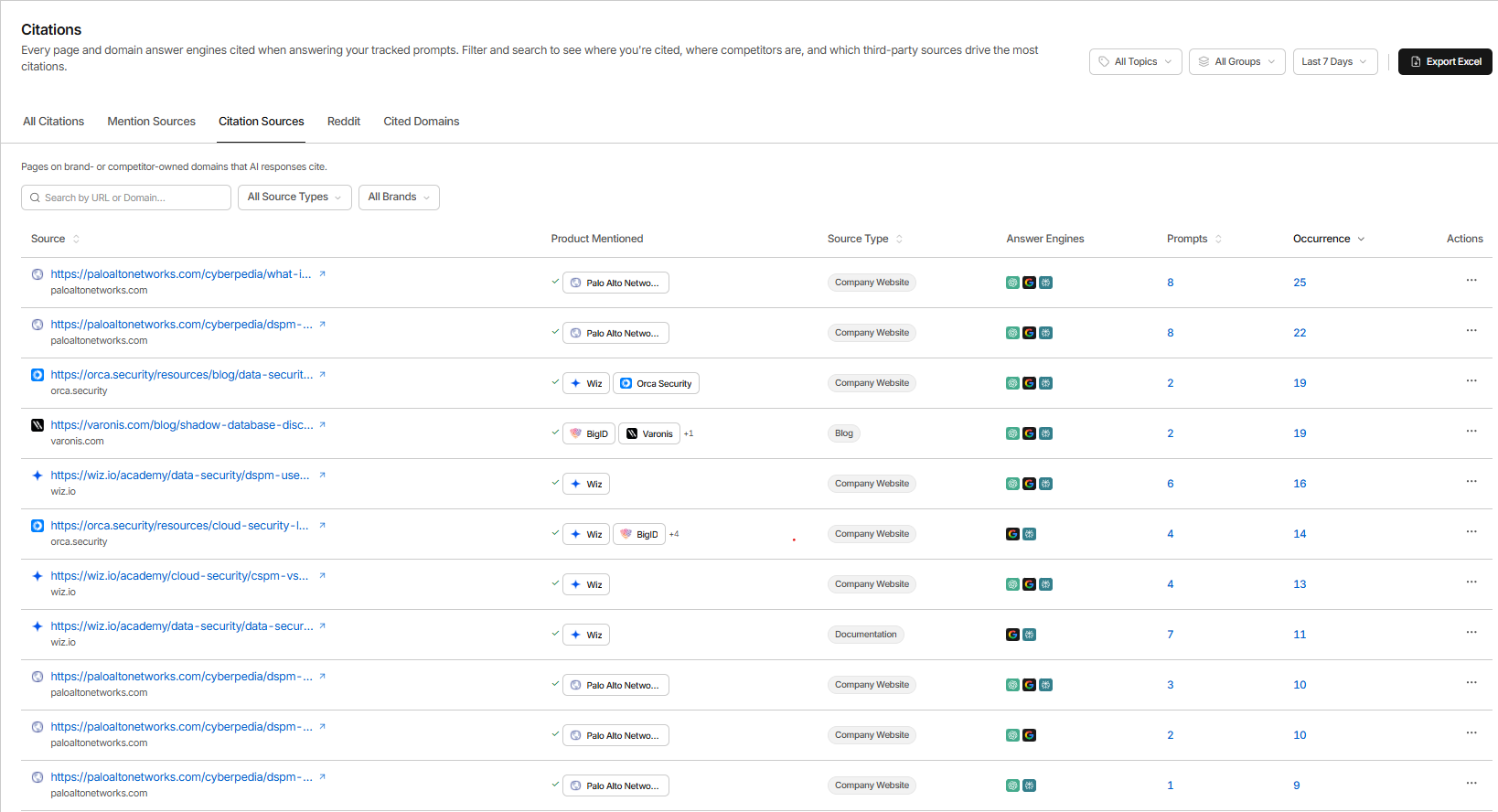
Once your prompts are tracked, GrackerAI logs three distinct layers of sources for every AI response, which map onto the different citation types Steps 2 through 5 above ask you to record by hand:
1. All Citation Sources. Every URL cited by an AI response within your tracked window, the complete source list before any filtering. You can filter it by source type (academic, blog, CVE, company website, comparison site, directory, and more) or by domain type, your own domains versus competitor domains, to narrow the full picture down to what matters for a specific question.
2. Mention Sources. Third-party sources that cite you or a competitor, without your own and competitor-owned domains. Since Step 3 above notes that third-party domains are what you should target for placements, this view isolates exactly that list without you having to manually filter out brand-owned results. The same source-type and domain filters apply here.
3. Citation Sources. Pages on your own or a competitor's domain that AI responses cite directly. This is where competitive intelligence gets specific: you can see exactly which competitor pages are being cited for a prompt you're losing, open them, and see what they do that your page doesn't.
GrackerAI's content engine can then generate a new page or re-optimize an existing one in your brand voice to close that specific gap, rather than leaving you to write it from scratch.
Track Reddit Citations Separately
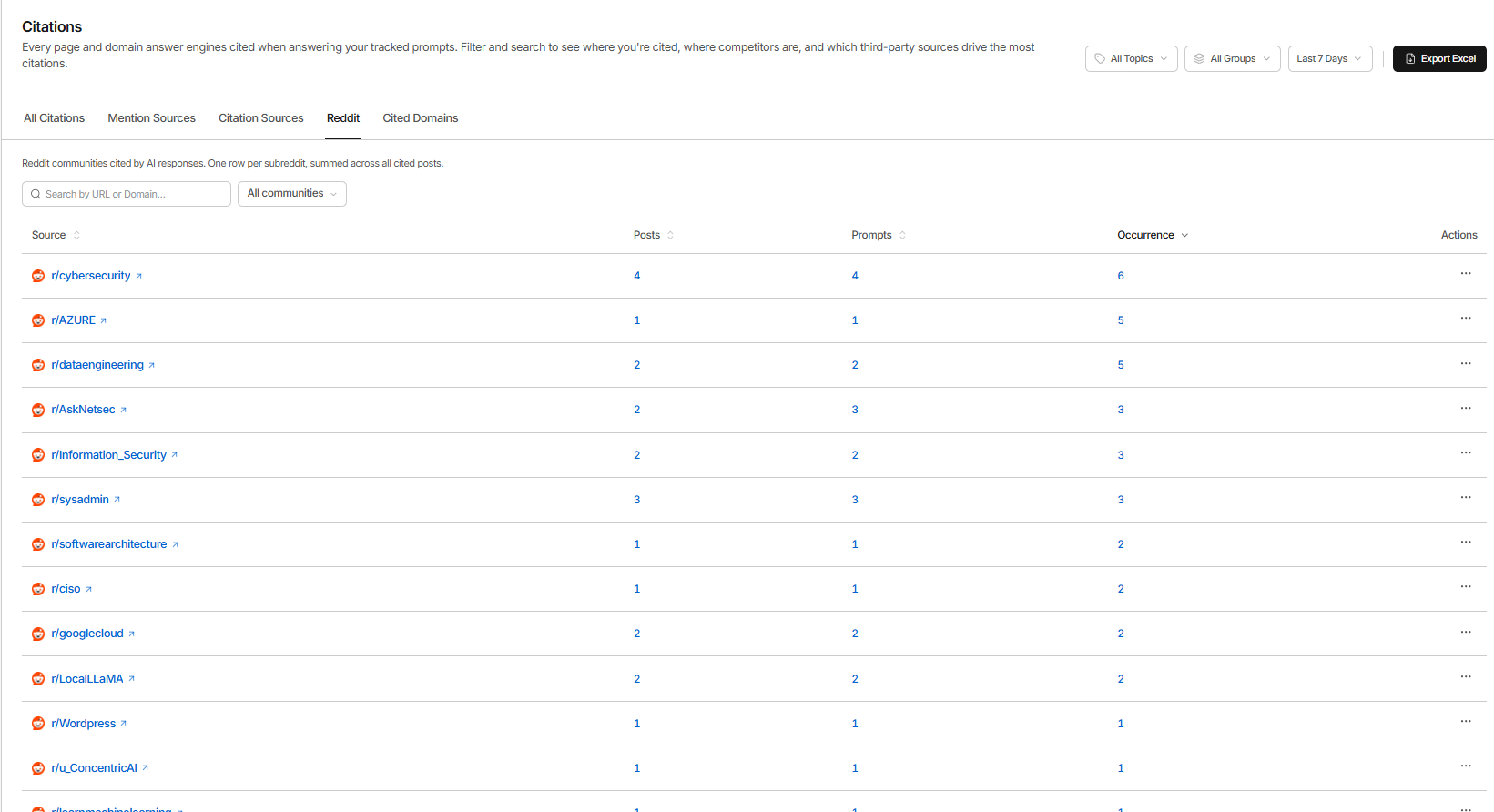
Reddit shows up as a citation source far more than most brands expect, which Step 3 above already flags as something to watch for. GrackerAI tracks Reddit citations as their own view: one row per subreddit, summed across all cited posts, so you can see which communities AI engines are actually pulling from in your category rather than treating Reddit as one undifferentiated source.
What Should You Do With the Citation Data Once You Have It?
Once you have a few weeks of data, you act on the gaps, which are the prompts where competitors are cited and you are not. Pull the source domains the engines cite for those losing prompts and study what those pages do that yours don't: clearer structure, a direct answer in the first paragraph, original data, or schema markup that makes extraction easy. Then improve or create the content to match, and watch whether your citation frequency climbs on the next run. Typical timelines run 4 to 6 weeks for initial movement and 2 to 3 months for meaningful citation gains, based on how often the engines re-crawl and re-rank fresh content. This gap-closing loop is exactly what security vendors run for competitive intelligence — see how cybersecurity companies use GEO tools to dominate AI search for how that plays out against named competitors in a technical category.
What Are the Most Common Mistakes When Tracking AI Citations?
The most common mistake is changing the prompt wording between runs, which makes every week's data incomparable and turns a trend into noise. Lock your prompt set. The second mistake is blending all engines into one score, which hides the per-engine reality where you might lead Perplexity and trail ChatGPT. The third is tracking only links and ignoring unlinked brand mentions, even though an unlinked mention in ChatGPT still puts you on the buyer's shortlist. The fourth is checking once and calling it done. Citation positions shift as engines update, so a quarterly check misses most of the movement. Run a consistent weekly cadence and log everything so the data compounds into something you can act on.
Frequently Asked Questions
What are AI citations and how are they different from backlinks?
AI citations are mentions or links to your brand that answer engines include in responses. Unlike backlinks, which are fixed links between websites, AI citations change with each query. Backlinks are static, while AI citations need to be earned continuously.
How often should I track AI citations across ChatGPT, Claude, Gemini, and Perplexity?
Track them weekly using the same set of prompts. This helps you catch changes as engines update their results. Keep the process consistent so you can compare results over time.
Can I track AI citations for free without a paid tool?
Yes. You can manually check each engine and log mentions, sources, and sentiment in a spreadsheet. This works for a small set of prompts, but becomes difficult to manage at scale.
Which AI engine is easiest to track citations on?
Perplexity is the easiest because it shows clear source links. ChatGPT and Claude are harder since they often do not show sources. Gemini is somewhere in between.
What metrics matter most when measuring AI citations?
Focus on share of voice, citation frequency, and sentiment. Track these for each engine separately to get a clear picture of your performance.
Turning Tracking Data Into Claude-Specific Fixes
Once you have a few weeks of Claude-specific tracking data from Step 5 above, the next move is content, not more measurement. See how to optimize for Anthropic's Claude for the structural and technical changes -- extractable answer blocks, llms.txt, MCP -- that this tracking loop is meant to validate.
Final Thoughts
AI citations are the new ranking signal, and the brands that measure them now will out-position the ones that wait. Pick your prompts, query all four engines on a schedule, log mentions and sources, and act on the gaps. The workflow is simple to start by hand and worth automating once it proves its value. For B2B tech brands specifically, tracking is only half the picture — see our guide to earning AI citations and outranking competitors in B2B tech search for how to build the underlying authority those citations depend on.
![10 Best Local Rank Tracker Tools: In-Depth Comparison Guide [2025]](https://cdn.pseo.one/6abcb68a626591c40e1c8aa6/687e1c1ef6fe799d288518df/68809c373eb8562bcf68975d/10-best-local-rank-tracker-tools-comparison-guide/feature-image.jpg)