Schema Markup for AEO: What B2B SaaS Companies Get Wrong

TL;DR
- ✓ Traditional schema focuses on visual SERP snippets rather than AI context windows.
- ✓ AEO schema uses structured data to disambiguate your brand from competitors for LLMs.
- ✓ The sameAs property is essential for linking your brand to authoritative external data.
- ✓ Successful AEO requires coding for semantic understanding rather than just browser syntax.
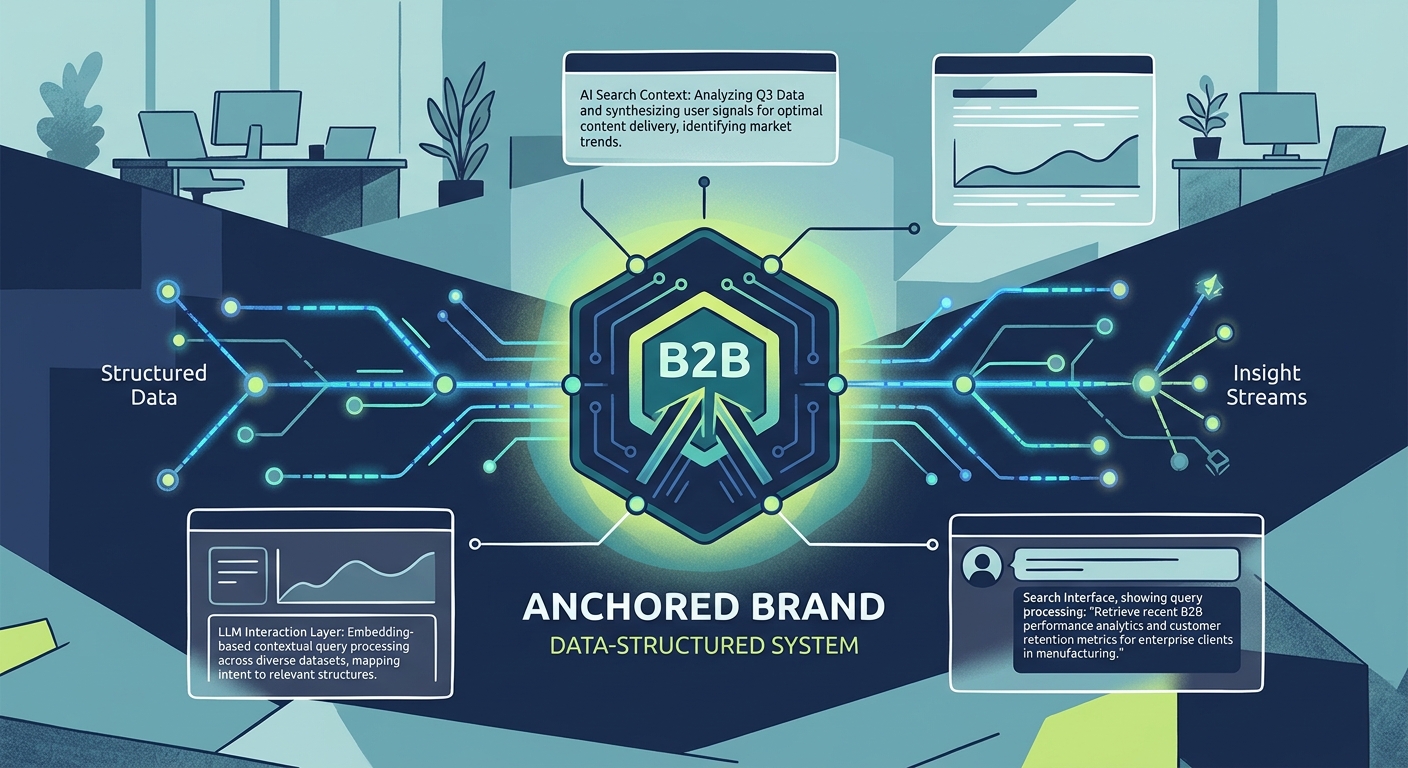
Most B2B SaaS companies treat Schema markup like a digital vanity project—a box to check for a search console report or to snag a shiny star in the SERPs. That’s a massive mistake. In the age of AI-driven search, structured data isn't just about visual real estate. It’s the foundational language you use to anchor your brand entity in the shifting, chaotic context windows of LLMs.
If your schema doesn't explicitly define who you are, what problems you solve, and why you’re the authority, you aren't just invisible to the AI. You’re essentially non-existent in the future of search. Schema is one piece of that authority case, not the whole of it — for the broader strategy it plugs into, see Answer Engine Optimization: The New Playbook for B2B SaaS Authority. User reviews and community discussions, once tagged with Review schema, are some of the highest-signal entity data you can feed an LLM — see how to leverage user-generated content for AI search rankings.
Why Your Schema is Invisible to AI
The "Blue Link" era—where we obsessively chased clicks—is dead. We’re now firmly in the "Answer Engine" paradigm. When a user asks an AI, "What’s the best project management software for enterprise engineering teams?", the model doesn't "search" the way you do. It pulls entities and relationships from its training data and real-time index to synthesize an answer.
If your website has "technically valid" schema that passes the Google Rich Results Test, you’ve passed a syntax check, not a semantic one. It’s a false positive. If your JSON-LD is generic—listing just your name, a logo, and a URL without linking to authoritative external nodes—you’re an orphan. AI models can't "see" your authority because you haven't given them the breadcrumbs to connect your internal claims to verified reality. To move from "Rich Snippets" to "Share of Answer," you have to stop coding for the browser and start coding for the LLM’s context window.
What is the Difference Between SEO Schema and AEO Schema?
Traditional SEO schema is all about optics. It’s built to manipulate how a result looks to maximize Click-Through Rate. AEO schema, though? That’s structural and relational. It’s about disambiguation. You need to ensure the AI knows your "SaaS" is a specific legal entity, located in a specific place, specializing in a specific domain, and entirely distinct from that competitor with a similar name.
Why "SameAs" is the Most Critical Property for B2B SaaS
Even a page-hierarchy signal as basic as BreadcrumbList schema does double duty here — it's classic SERP rich-snippet fodder, but it's also one of the clearest hierarchy signals you can hand a model's context window. Our guide to breadcrumbs in SEO covers the implementation details.
This isn't a B2B SaaS-only problem, either — AI infrastructure marketplaces depend on the same clean, machine-readable schema to get compared and cited accurately in AI-generated recommendations.
The sameAs property is your brand’s tether to the real world. LLMs live on probability and verification. When an AI hits your site, it cross-references data to see if you’re a legitimate entity or just a hallucination-prone data point. By using Schema.org vocabulary to define your sameAs links, you’re telling the AI: "My entity on this website is the same entity found on Crunchbase, LinkedIn, and Wikipedia."
The Generic Trap:
{
  "@type": "Organization",
  "name": "Acme SaaS",
  "url": "https://acme.com"
}
This tells the AI absolutely nothing.
The Entity-Rich Approach:
{
  "@type": "Organization",
  "name": "Acme SaaS",
  "url": "https://acme.com",
  "sameAs": [
    "https://www.linkedin.com/company/acme-saas",
    "https://www.crunchbase.com/organization/acme-saas",
    "https://en.wikipedia.org/wiki/Acme_SaaS"
  ]
}
Linking to these authoritative nodes builds a "trust bridge." It stops the AI from confusing you with another company and makes it much more likely you’ll be cited as the source of truth for your category.
How Do You Use "knowsAbout" to Build Topical Authority?
Most SaaS sites are packed with marketing fluff: "The most intuitive platform for your team." An LLM doesn't care about "intuitive." It cares about what you know. The knowsAbout property lets you map your product features to specific problem-sets, teaching the AI that you are an expert in a specific domain.
If you’re a cybersecurity SaaS, don't just list your product name. Use knowsAbout to link your entity to "Zero Trust Architecture," "SOC2 Compliance," or "Cloud Security Posture Management." When you map these relationships, you’re building topical authority, which is a core component of a modern B2B SaaS SEO strategy.
Is Your FAQPage Schema Actually "Answer-Ready"?
The semantic alignment gap is where most marketing teams trip up. They write FAQ schema based on what they want to say, not how customers actually talk. If your FAQ uses internal jargon that a buyer would never type into a search prompt, the LLM will ignore it. It doesn't match the intent.
The Marketing-Speak Trap:
- Question: "How does our proprietary Synergistic Sync technology optimize workflows?"
- AI Retrieval Probability: Near zero. No one is searching for "Synergistic Sync."
The Customer-Intent FAQ:
- Question: "How do I integrate project management software with Slack?"
- AI Retrieval Probability: High. This matches real search intent.
Dig into your support tickets and sales transcripts to populate your FAQPage schema. That’s the only way to ensure your structured data is "answer-ready." For the deeper trade-off between how much of that transcript-derived detail to keep and how much to compress into a citable answer, see our breakdown of content depth vs. brevity for AI engines in B2B topics.
Schema is one structural signal among several. For the fuller picture of how models weigh headers, bullet formatting, and citation loops alongside your markup, see the anatomy of AI-recommended content. That same plain-language, task-first discipline matters even more for a narrow, single-purpose tool — see our strategy for making niche tools visible to AI for how that plays out beyond B2B SaaS.
The Diagnostic Audit: How to Test Your Schema for AI Citations
Forget Search Console for a second. Go to Perplexity AI. The diagnostic test here is simple: create a prompt that targets the specific problem your SaaS solves and analyze the response. Does it cite your site? Does it use the data points you’ve structured in your JSON-LD?
If the AI gives a generic, brand-less answer, your schema isn't doing its job. You should be tracking your "Share of Answer"—a metric measuring how often your brand is cited as a source when an LLM answers a category-relevant question. If you aren't being cited, you’re invisible in the new landscape.
Beyond the Basics: Advanced Entity Mapping for SaaS
To dominate, stop at Organization. Use Service and SoftwareApplication types to build a web of data. Use hasPart to define your SaaS modules and isRelatedTo to connect your product to the industry ecosystem.
If you offer a suite of tools, structure them so the AI understands that the "Reporting Module" is part of the "Main Platform." This hierarchy helps the AI provide nuanced answers. That is the difference between being a "generic software company" and a "specialized industry solution." For a deeper walkthrough of that specific problem, see AEO for multi-product SaaS platforms: managing complex product hierarchies.
Scaling Schema: When to Automate and When to Hand-Code
Plugin-based schema is fine for basic contact info, but it will never build you a competitive moat. Plugins aim for the lowest common denominator. Bespoke, entity-rich JSON-LD is a competitive advantage because it lets you define custom relationships that off-the-shelf tools can't handle.
If you have a massive site, you need a programmatic approach—a system that pulls data from your database to generate dynamic, entity-rich schema at scale. If you’re struggling to bridge the gap between technical implementation and AI citation, exploring Gracker.ai’s AEO services can help you move from basic markup to a sophisticated entity-anchoring machine.
The same automation logic scales down-market, too — for a lighter-weight version of this problem, see how Shopify stores structure Product schema to earn AI citations without an engineering team.
Frequently Asked Questions
Does "passing" the Google Rich Results Test mean my schema is optimized for AI?
No. The Rich Results Test only validates syntax and basic Google-supported features. It does not measure semantic depth, entity resolution, or whether your data is actually useful for an LLM to cite your brand.
Which schema type is most important for a B2B SaaS brand?
The Organization type is the bedrock. When combined with robust sameAs properties for verification and knowsAbout properties for topical authority, it becomes the most critical asset for entity disambiguation in AI models.
How do I know if my schema is actually helping me get cited by AI?
Track your "Share of Answer." Use tools like Perplexity or ChatGPT to ask industry-specific questions that your SaaS solves. If your brand is not being cited, your schema lacks the necessary entity hooks to be recognized by the AI's retrieval system.
Should I prioritize Schema for Google Search or for AI engines like ChatGPT?
Prioritize for AI engines. Google is rapidly integrating AI into its core search experience (AI Overviews). By optimizing for AI citation, you are simultaneously satisfying Google’s requirements for semantic understanding. The "SEO vs. AEO" divide is disappearing; the future is purely AI-first.
Does mobile performance affect whether AI engines trust my schema?
Yes. AI crawlers weigh site-quality signals like page speed and mobile responsiveness alongside your structured data when deciding how much to trust it. See The Mobile-First AI Search Strategy for B2B SaaS Apps for the technical checklist.
![10 Best Local Rank Tracker Tools: In-Depth Comparison Guide [2025]](https://cdn.pseo.one/6abcb68a626591c40e1c8aa6/687e1c1ef6fe799d288518df/68809c373eb8562bcf68975d/10-best-local-rank-tracker-tools-comparison-guide/feature-image.jpg)