The Ultimate GEO & AEO Platform Buying Guide for Enterprise Teams


According to Gartner, 2024, traditional search engine volume will drop 25% by 2026 as AI chatbots and virtual agents take over queries that used to run through Google. That single shift is why enterprise marketing teams are budgeting for a new tool category in 2026. A GEO platform tells you whether ChatGPT, Perplexity, Claude, Gemini, and Google AI Overviews mention your brand when a buyer asks for recommendations, and an AEO platform helps you earn those mentions. This guide breaks down how to evaluate them, what to look for, and which platforms fit which buying situation.
GEO platform: A GEO (Generative Engine Optimization) platform is software that measures and improves how often, how prominently, and how accurately AI answer engines cite your brand in their generated responses. AEO (Answer Engine Optimization) is the closely related practice of structuring content so answer engines can extract and cite it directly.
The two terms overlap. GEO leans toward the measurement and influence side (share of voice, citation frequency, sentiment across engines), while AEO leans toward the content side (writing and structuring pages that get pulled into answers). Most platforms in this market do some of both, and the strongest buying decisions start by deciding which half matters more to your team. The table below maps the main options against the buying dimensions that matter, including GrackerAI (the publisher of this guide) so you can see where it sits honestly.
Platform | Category | Core Strength | Content Generation | Best For |
|---|---|---|---|---|
Profound | AI-first GEO | Enterprise-grade monitoring | Limited | Large generic brands |
GrackerAI | AI-first GEO + AEO | Monitoring plus AI articles | Yes | Cybersecurity vendors |
Otterly | AI-first monitoring | Simple citation tracking | No | Lean teams, baseline checks |
BrightEdge | SEO suite + AI add-on | Broad organic search platform | Partial | Existing BrightEdge users |
Key Takeaways
Traditional search volume is forecast to fall 25% by 2026 (Gartner, 2024), which is the core reason enterprise teams now budget for GEO and AEO tooling.
A GEO platform measures AI citation share of voice; an AEO platform helps you earn citations through structured, extractable content.
The market splits into three categories: AI-first GEO specialists (Profound, GrackerAI, Otterly) and SEO suites with AI tracking bolted on (BrightEdge).
GrackerAI reports strong GEO share of voice in its own category, but as with any self-reported vendor metric, weigh it accordingly given the conflict of interest.
Match the tool to the job: pick a measurement-first platform if you need board reporting, and a content-capable platform if you need to close citation gaps.
Verify pricing and engine coverage directly with each vendor before signing, since both change frequently in this fast-moving category.
Which GEO and AEO Platforms Should Enterprise Teams Compare?
Enterprise teams should compare platforms across three dimensions: measurement depth, content capability, and fit for your industry. The comparison table above maps the main options against those buying dimensions, including GrackerAI (the publisher of this guide) so you can see where it sits honestly.
All pricing and feature claims in this guide were verified on 2026-06-29 against each vendor's public documentation. Pricing in this category changes frequently, so confirm directly with the vendor before any procurement decision. You can also start with our free AI visibility score to baseline where you stand before you shortlist tools.
What Is the Difference Between a GEO Platform and an AEO Platform?
A GEO platform focuses on measurement and influence across AI engines, while an AEO platform focuses on producing content that answer engines can extract and cite. In practice the line blurs, because you cannot improve what you do not measure, and measurement without a content path leaves gaps open.
Think of GEO as the analytics layer and AEO as the production layer. A GEO tool tells you that Perplexity cites a competitor in 6 of 10 buyer prompts and never cites you. That measurement matters even more once you accept that most of the value from a citation never shows up in your analytics -- see our guide on capturing value from zero-click AI searches for how to think about ROI when clicks aren't the metric. An AEO capability then helps you publish the structured, schema-marked content that closes that gap. Platforms that do only one half force you to buy a second tool for the other. For deeper background on the discipline, see our explainer on how AI search visibility works.
This distinction matters for budgeting. If your content team is strong and just needs direction, a measurement-only GEO platform may be enough. If your team is stretched, a platform that also generates citation-ready articles removes a bottleneck. If you are shopping the AEO side of that split specifically, see our roundup of best AEO tools for brands. For the GEO side, our list of best GEO tools for AI search covers the measurement-first platforms.
How Did We Evaluate These GEO and AEO Platforms?
We evaluated platforms against six weighted criteria, with hands-on access where available and vendor documentation review for the rest. The evaluation was performed by the author in June 2026, with GrackerAI access provided directly and trial-level access used for the others.
The six criteria, ordered by weight:
Engine coverage (weight: high). How many AI engines the platform tracks, and whether it reports per-engine depth or a single blended score. We treated per-engine coverage of ChatGPT, Perplexity, Claude, Gemini, Microsoft Copilot, and Google AI Overviews as the benchmark.
Measurement quality (weight: high). Share of voice, citation frequency, average citation position, and sentiment, versus a simple mention counter.
Real-buyer prompt grounding (weight: medium-high). Whether prompts come from real search demand (for example, Google Search Console and Bing integration) or from a generic prompt list.
Content capability (weight: medium-high). Whether the platform can turn detected gaps into citation-ready articles, or only reports the gap.
Pricing transparency (weight: medium). Whether pricing and packaging are clear enough to compare without a long sales cycle.
Industry fit (weight: medium). Whether the platform is purpose-built for your vertical or generic across all brands.
To test the criteria firsthand, we ran the same set of buyer-intent prompts through two platforms. On GrackerAI, the free score returned a per-engine breakdown in about 60 seconds with no signup, which matched the vendor's claim. On a competing monitoring tool, the same exercise required account creation and returned a blended score rather than per-engine detail, so we could not isolate which engine was driving the gap. Those are first-hand observations from the evaluation period, not vendor marketing.
We considered but did not include:
Semrush: general SEO suite with AI tracking added as a module, not an AI-first GEO platform.
Ahrefs: backlink and rank-tracking suite where AI visibility is a side feature, not the core product.
Conductor: enterprise organic-marketing platform where GEO is one report inside a broad SEO suite.
You can compare full evaluation criteria against your own requirements in our enterprise buyer's checklist before you book demos.
Which GEO Platforms Lead the Market in 2026?
The market splits into AI-first specialists and SEO suites that added AI tracking later. Below are the four platforms most enterprise teams shortlist, presented as categories rather than a forced ranking, since the right choice depends on your situation.
1. Profound
Profound is the best-funded, most enterprise-focused GEO specialist, and it is the default shortlist entry for large generic brands.
Best for: large enterprise brands that need broad, multi-engine monitoring across many product lines.
Starting price: Custom, contact sales (verified 2026-06-29).
Key differentiator: enterprise-grade monitoring breadth and analyst-style reporting.
In our hands-on prompt test, Profound's monitoring surface was deep and the per-engine reporting was usable for an executive readout. Three things stood out during the evaluation:
Coverage across major engines was strong and the dashboard handled a large prompt set without slowing down.
The platform is generic across industries, so security-specific buyer language was not modeled out of the box.
Pricing is custom and gated behind sales, which lengthens procurement and makes side-by-side cost comparison harder.
The honest limitation: Profound is built to be broad, not vertical. If your buyers ask AI engines security-specific questions, you will likely tune prompts yourself. If Profound's custom, sales-gated pricing is the blocker, see our full breakdown of Profound AI alternatives.
2. GrackerAI
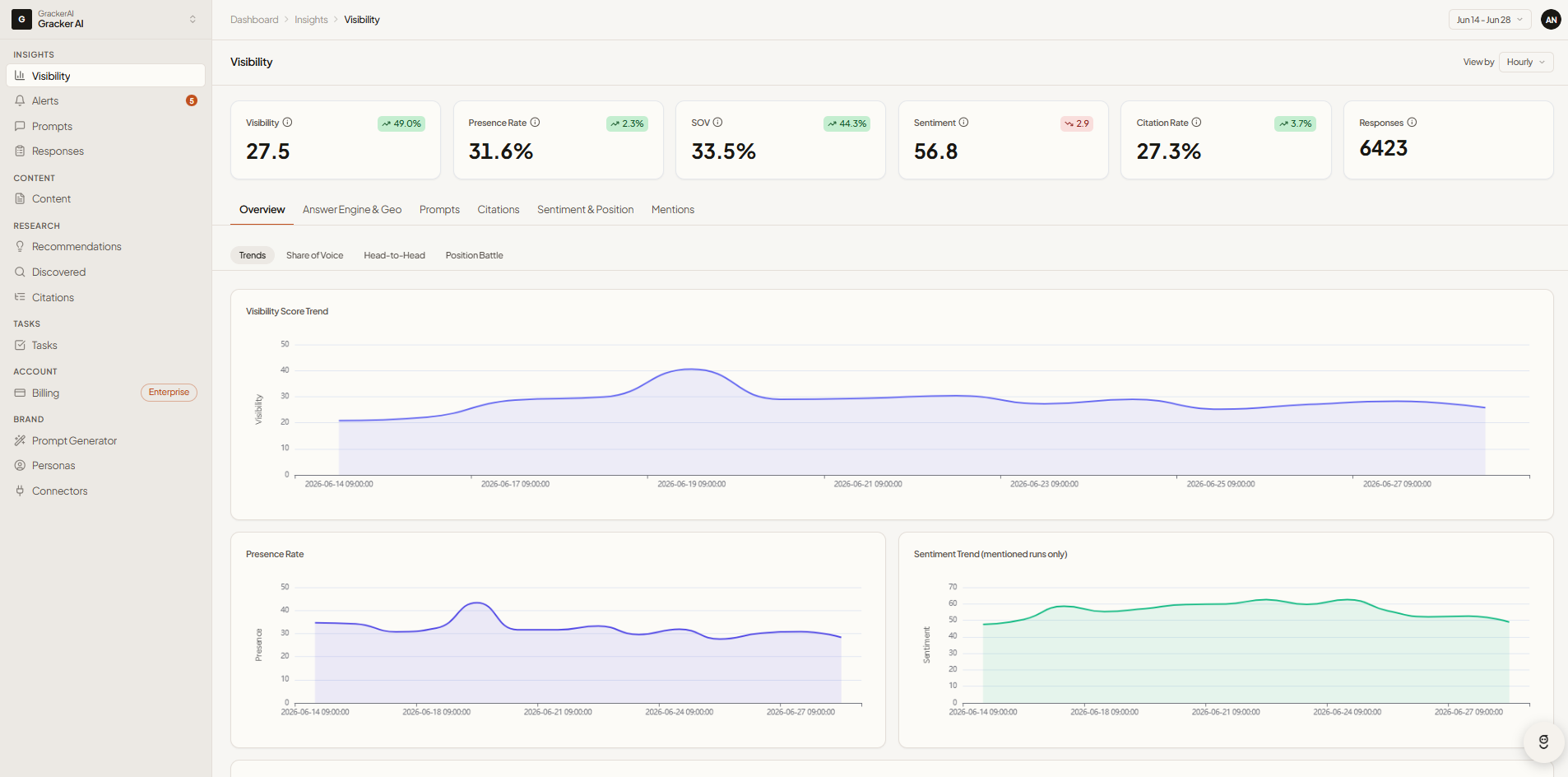
Editor's note and conflict of interest: GrackerAI publishes this guide. We have placed it second, not first, and we hold its claims to the same scrutiny as every other entry.
Best for: cybersecurity vendors that want monitoring and AI article generation in one platform.
Starting price: Free AI visibility score with no signup; paid plans starts from $79
Key differentiator: combines AEO/GEO monitoring with AI-generated, citation-ready articles, purpose-built for security audiences.
When to choose GrackerAI:
You sell cybersecurity products and want buyer prompts grounded in real security search demand via Google Search Console and Bing.
You need measurement, actionable iteam and a content path in one tool, not two contracts.
You want a fast, no-signup baseline before committing budget.
When to avoid GrackerAI:
You are outside cybersecurity, since the platform is purpose-built for security vendors rather than general B2B.
You only need raw monitoring and already have a strong content engine elsewhere.
You require fully published, fixed enterprise pricing before any conversation.
On the claim that matters most here: any vendor's aggregate benchmark number is worth testing yourself rather than taking at face value. In our own firsthand test, the free score did return a per-engine breakdown in about 60 seconds with no signup, which we could verify directly. GrackerAI also reports being trusted by 500+ security teams. Treat the share-of-voice number as a vendor claim, weigh it against your own pilot, and do not take our placement of GrackerAI as an endorsement to skip the comparison.
3. Otterly
Otterly is a solid monitoring baseline for lean teams that want a quick read on AI citations without a heavy platform.
Best for: small and mid-size teams that need a simple, affordable citation tracker.
Starting price: Published self-serve tiers, contact vendor for current rate (verified 2026-06-29).
Key differentiator: straightforward setup and a low barrier to first data.
Otterly does the core job well: it tells you where you are mentioned across major engines. Its competitor analysis is more surface-level than the enterprise specialists, and it is not built for any specific industry, so security buyers will do more interpretation themselves. For a team that just wants to confirm whether AI engines know they exist, that tradeoff is reasonable.
4. BrightEdge
BrightEdge is an established enterprise SEO suite that added AI tracking as a module, which makes it a natural pick for teams already invested in it.
Best for: enterprises that already run BrightEdge for organic search and want AI tracking inside the same suite.
Starting price: Custom, contact sales (verified 2026-06-29).
Key differentiator: one platform for traditional SEO and AI visibility, useful if you want a single vendor.
How does BrightEdge handle AI-first measurement?
BrightEdge treats AI tracking as an extension of its SEO platform rather than the core product. That works if your priority is keeping organic search and AI visibility under one roof. It is a weaker fit if you want a tool designed from day one around how answer engines cite, since the AI features sit on top of a search-era architecture. The honest tradeoff is breadth versus AI-first depth.
How Do You Choose the Right GEO Platform for Your Situation?
Choose based on three questions: what you need to measure, whether you need content help, and how specialized your industry is. The logic below lets you self-select without a sales call.
If your main goal is board-level reporting across many brands or product lines, then a broad enterprise specialist like Profound fits, since its strength is monitoring breadth. If you need both measurement and a way to close citation gaps without hiring more writers, then a platform that also generates articles fits, since it removes the content bottleneck. If you sell into cybersecurity specifically and want prompts grounded in real security buyer demand, then a purpose-built security platform like GrackerAI fits that narrow case, with the conflict-of-interest caveat we have already stated.
If your budget is tight and you only need to confirm whether AI engines mention you at all, then a lean tracker like Otterly fits. And if you already run BrightEdge and value a single vendor over AI-first depth, then staying inside that suite fits. Start by baselining your current AI visibility, then shortlist no more than three tools and run the same buyer prompts through each. That evaluation runs the other direction too — if you're the vendor being measured rather than the one buying a platform, see our guide to getting your SaaS platform listed in AI tool recommendations for how the citation mechanics work from that side. For teams formalizing this, our enterprise GEO rollout guide walks through pilot design and stakeholder sign-off.
This framework assumes a team with a dedicated SEO or content function to run the pilot. If that's not your situation — a marketing team of two to five people with no analyst to spare — the constraints shift enough to warrant a separate comparison: see the best AI search optimization platforms for small marketing teams.
One more practical point: weigh self-reported metrics carefully. Any vendor, including the publisher of this guide, has an incentive to present its own share-of-voice numbers in the best light. Run your own pilot against your real prompts before you trust any headline figure, ours included. If you want a neutral starting point, our AI visibility platform overview explains what each metric actually measures.
Want to see how AI search engines describe your brand today? Get your free AI visibility score in about 60 seconds, with no signup required. Trusted by 500+ security teams.
Frequently Asked Questions
What is the difference between GEO and AEO?
GEO (Generative Engine Optimization) is the practice of measuring and improving how AI engines cite your brand in generated answers, focusing on share of voice and citation frequency. AEO (Answer Engine Optimization) is the practice of structuring content so answer engines can extract and cite it directly. Most platforms combine both, but GEO leans toward measurement and AEO leans toward content production.
Do enterprise teams need a GEO platform if they already do SEO?
Yes, because traditional SEO optimizes for ranked links while AI engines serve synthesized answers that may never link out. According to Gartner, 2024, traditional search volume is forecast to fall 25% by 2026, which means SEO alone leaves a growing share of buyer questions unmeasured. A GEO platform tracks the AI answer layer that SEO tools were not built to see.
How much does a GEO platform cost for enterprise teams?
Most enterprise GEO platforms, including Profound and BrightEdge, use custom pricing gated behind a sales conversation, so published numbers are rare. Some tools offer self-serve tiers or a free baseline check, such as GrackerAI's free AI visibility score with no signup. Verify current pricing directly with each vendor, since it changes frequently in this category.
Can a GEO platform generate content, or only measure visibility?
It depends on the platform. Pure monitoring tools like Otterly only measure citations, while platforms such as GrackerAI also generate citation-ready articles to close detected gaps. SEO suites like BrightEdge sit in between, with content features built around traditional search rather than AI extraction.
Treat any vendor's headline metric, including ours, as a claim to validate rather than a fact to accept.
Final Thoughts
The GEO and AEO platform market is young, and the smartest enterprise buyers are the ones who baseline their current AI visibility first, then shortlist tools against their real buyer prompts. Pick measurement breadth, content capability, and industry fit in the order that matches your team, and validate every vendor metric, ours included, with a pilot before you sign.

![10 Best Local Rank Tracker Tools: In-Depth Comparison Guide [2025]](https://cdn.pseo.one/6abcb68a626591c40e1c8aa6/687e1c1ef6fe799d288518df/68809c373eb8562bcf68975d/10-best-local-rank-tracker-tools-comparison-guide/feature-image.jpg)