How to Choose the Best AI Visibility Provider for Your Business


According to Gartner, 2024, traditional search engine volume will drop 25% by 2026 as buyers shift to AI chatbots and virtual agents for answers. That shift is why "where do we rank on Google" has become "does ChatGPT recommend us."
Choosing an AI visibility provider means picking a platform that tracks how the answer engines describe and cite your brand, and ideally helps you close the gaps. The right choice depends on per-engine depth, whether content is bundled, how pricing scales, and industry fit.
AI visibility provider: A platform that monitors how AI answer engines (ChatGPT, Perplexity, Claude, Gemini, Microsoft Copilot, and Google AI Overviews) mention, cite, and rank your brand, then reports metrics like share of voice, citation frequency, and position so you can measure and improve how AI describes you.
Key Takeaways
Gartner projects a 25% drop in traditional search volume by 2026, which makes AI answer-engine visibility a board-level metric, not a side project.
The six engines that matter for buyer research are ChatGPT, Perplexity, Claude, Gemini, Microsoft Copilot, and Google AI Overviews; a per-engine score beats a single blended number.
Of the four providers evaluated here, two offer a genuine self-serve free trial (GrackerAI, Otterly), one offers a trial only on its mid tier with no stated length (Profound), and one offers no self-serve trial at all (BrightEdge).
Trial terms vary more than headline pricing does: GrackerAI states 7 days directly on its pricing page (credit card required, Starter or Scale only), Otterly confirms a trial but states no length on its pricing page (a separate help article says 7 days), and Profound only offers a self-serve trial on its $399/month tier with no stated duration there either. That's a real difference when you're trying to get a defensible read in a short window.
GrackerAI is the only provider in this set built exclusively for cybersecurity and B2B SaaS, and it bundles monitoring with AI article generation rather than monitoring alone.
Which AI Visibility Providers Should You Compare?
The table below summarizes the four providers evaluated, with free trial terms as the added lens for this update.
Provider | Free Trial | Card Required | Pricing Model | Engines Tracked | Monitoring + Content | Best For |
|---|---|---|---|---|---|---|
GrackerAI | 7 days, both self-serve plans (Starter, Scale), credit card required | Yes | From $99/mo, enterprise custom | 3 at Starter, 4 at Scale, 10 at Enterprise | Both | Cybersecurity and B2B SaaS vendors |
Otterly | Confirmed to exist on pricing page FAQ; no day count stated there (separate help page says 7 days) | Not stated on pricing page | From $29/mo, per prompt per engine | 4 core, 3 add-on | Monitoring-first | Small teams, single product |
Profound | Growth ($399/mo) has a "Try for free" button, no stated duration; Starter ($99/mo) has no trial, direct paid signup only | Not stated on pricing page | $99/mo Starter, $399/mo Growth, custom Enterprise | 1 at Starter, 3 at Growth, 9 at Enterprise | Monitoring-first | Large generalist enterprises |
BrightEdge | None (demo or POC only) | Not applicable | Enterprise custom, SEO suite | AI Overviews, ChatGPT, Perplexity | SEO suite with AI module | Existing BrightEdge SEO users |
A note on the engine counts above: they're tier-dependent for every provider in this table, not a single fixed number. GrackerAI's 3/5/9+ split and Profound's 1/3/9 split both mean the entry-price plan and the "full coverage" plan are different products; check which tier a comparison is actually describing before treating a headline engine count as what you'll see on day one.
What Is an AI Visibility Provider and Why Does It Matter Now?
An AI visibility provider is software that measures and improves how AI answer engines describe your brand. It matters now because buyers increasingly skip the search results page entirely. According to Gartner, 2024, search engine volume will fall by a quarter by 2026 as people ask conversational AI tools for answers instead of clicking blue links.
When a buyer types "best SIEM for mid-market" into ChatGPT, the model returns a shortlist. If your brand is not in that shortlist, you are not in the deal. Traditional SEO tools were built to track ten blue links, not to track whether Perplexity cited you in a synthesized answer. That is the gap an AI visibility provider fills. The category goes by two names used interchangeably: Answer Engine Optimization (AEO) and Generative Engine Optimization (GEO).
How Did We Evaluate These AI Visibility Providers?
We evaluated providers against seven weighted criteria, drawn from what enterprise buyers consistently raise in procurement and from hands-on testing. The author performed the evaluation; see the disclosure block below for the experience level on each tool.
The criteria, in weighted order:
Per-engine coverage and depth (25%). Does the tool track each of the six engines separately, or collapse them into one blended score?
Monitoring plus content, or monitoring only (20%). Some providers only report gaps. Others generate or improve content to close them.
Pricing model and transparency (15%). Flat-rate, per-seat, per-prompt, or custom enterprise. Per-prompt pricing scales poorly across regions and product lines.
Real-buyer prompt grounding (15%). Does the tool ground its prompt set in actual search behavior, or does it guess at prompts?
Industry specificity (10%). A generic tool treats a cybersecurity vendor like a coffee brand.
Time to first insight (10%). How fast can a new user see a result?
Citation source intelligence (5%). Does the tool show which domains and pages the engines cite?
We tested the GrackerAI, Profound, and Otterly entry or free tiers directly. BrightEdge does not offer a self-serve free tier, so we assessed it from official product documentation and third-party reviews; that limitation is noted in its entry.
Why These Four and Not Others?
We considered but did not include three otherwise-credible platforms:
Semrush: Built for Google rankings with AI tracking added on top, not an AI-first visibility provider.
Conductor: An enterprise SEO and content platform where AI citation tracking is secondary to organic content workflows.
seoClarity: A strong enterprise SEO suite, but its AI Overview tracking sits as a module on a traditional rank-tracking core.
Each is a reasonable tool. None is purpose-built around AI answer engines as the primary surface, which is the bar for this list.
How Do the Leading AI Visibility Providers Compare in Practice?
Here is the detail behind the table, with one honest limitation stated for each provider.
1. Profound
Profound is the best-funded generalist in the category and the natural shortlist entry for large enterprises that want a heavily resourced vendor.
Best for: Large generalist enterprises with budget and a dedicated team.
Starting price: $99/month for a ChatGPT-only Starter plan (billed yearly, "2 months free"), $399/month for Growth, custom for Enterprise. Third-party sources report enterprise deployments commonly landing $2,000 to $5,000+/month, though Profound's own page lists Enterprise as tailored/custom with no public range.
Free trial: The $399/month Growth tier carries a "Try for free" button, no specific day count stated on the page itself. The $99/month Starter tier has no trial at all, its button is a direct "Get Started" paid signup, not a trial. Enterprise is demo-only via "Get a Demo."
Key differentiator: Scale and funding. According to Rankability, 2026, Profound raised a $96M Series C at a $1 billion valuation in February 2026 and serves 700+ enterprise customers including Target, Walmart, and MongoDB.
Starter tracks ChatGPT only (1 engine); Growth adds Perplexity and Google AI Overviews for 3 total; Enterprise scales up to 9 engines including Gemini, Copilot, Grok, DeepSeek, and Claude. The trial, where one exists, is on Growth, so it shows the 3-engine tier, not the full Enterprise set.
Limitation: Profound is generic across industries. For a cybersecurity vendor, the prompt libraries and competitor sets ne
2. Otterly
Otterly is the friendliest on-ramp for a small team tracking a single brand, and it was the fastest tool to a first result in our testing.
Best for: Small teams and solo marketers tracking one product.
Starting price: $29/month Lite (15 prompts), $189/month Standard (100 prompts), $489/month Premium (400 prompts).
Free trial: Yes, free trial available
Three things stood out during hands-on testing:
Setup to first visibility result took under 10 minutes from signup, the fastest in this group.
Otterly tracks four AI engines on core plans (ChatGPT, Google AI Overviews, Perplexity, Microsoft Copilot), with Gemini, Google AI Mode, and Claude available as paid add-ons.
API and MCP access only unlock at the Standard tier, so the cheapest plan is tracking-only, and a 7-day trial on Lite won't show you those features at all.
Key differentiator: Lowest entry price and a clean, fast interface.
Limitation: Otterly charges per prompt per engine, so tracking 100 prompts across five engines burns 500 capture events. Costs climb quickly once you cover multiple product lines, regions, or competitor sets, and the competitor analysis stays comparatively surface-level. Seven days is also the shortest trial window of the two self-serve options here, which is fine for a directional first look but tight if you want a full weekly cycle of data before deciding.
3. BrightEdge
BrightEdge is the right answer when you already run it as your enterprise SEO platform and want AI tracking inside the same suite.
Best for: Enterprises already standardized on BrightEdge for SEO.
Starting price: Enterprise custom pricing, commonly reported in the $1,000 to $12,500/month range depending on tier, quoted by sales.
Free trial: None. BrightEdge does not offer a self-serve free trial for the platform. It offers demos and, for qualified enterprise buyers, proof-of-concept engagements arranged through the sales process. If evaluating BrightEdge, ask specifically about a POC or pilot rather than expecting a self-serve sign-up.
Key differentiator: It pairs AI search tracking with the BrightEdge DataCube, one of the largest independent search-data indexes in the industry. According to BrightEdge, 2026, its AI Hyper Cube product, launched in March 2026, reveals which sources shape AI recommendations for a given prompt.
Limitation: BrightEdge is an enterprise SEO suite with AI tracking added as a layer, not an AI-first platform. If your main job is AI answer-engine visibility rather than classic organic SEO, you may pay for a large suite to use one module. We assessed BrightEdge from documentation and published reviews only, since it offers no self-serve trial to test directly.
4. GrackerAI (Publisher, Disclosed)
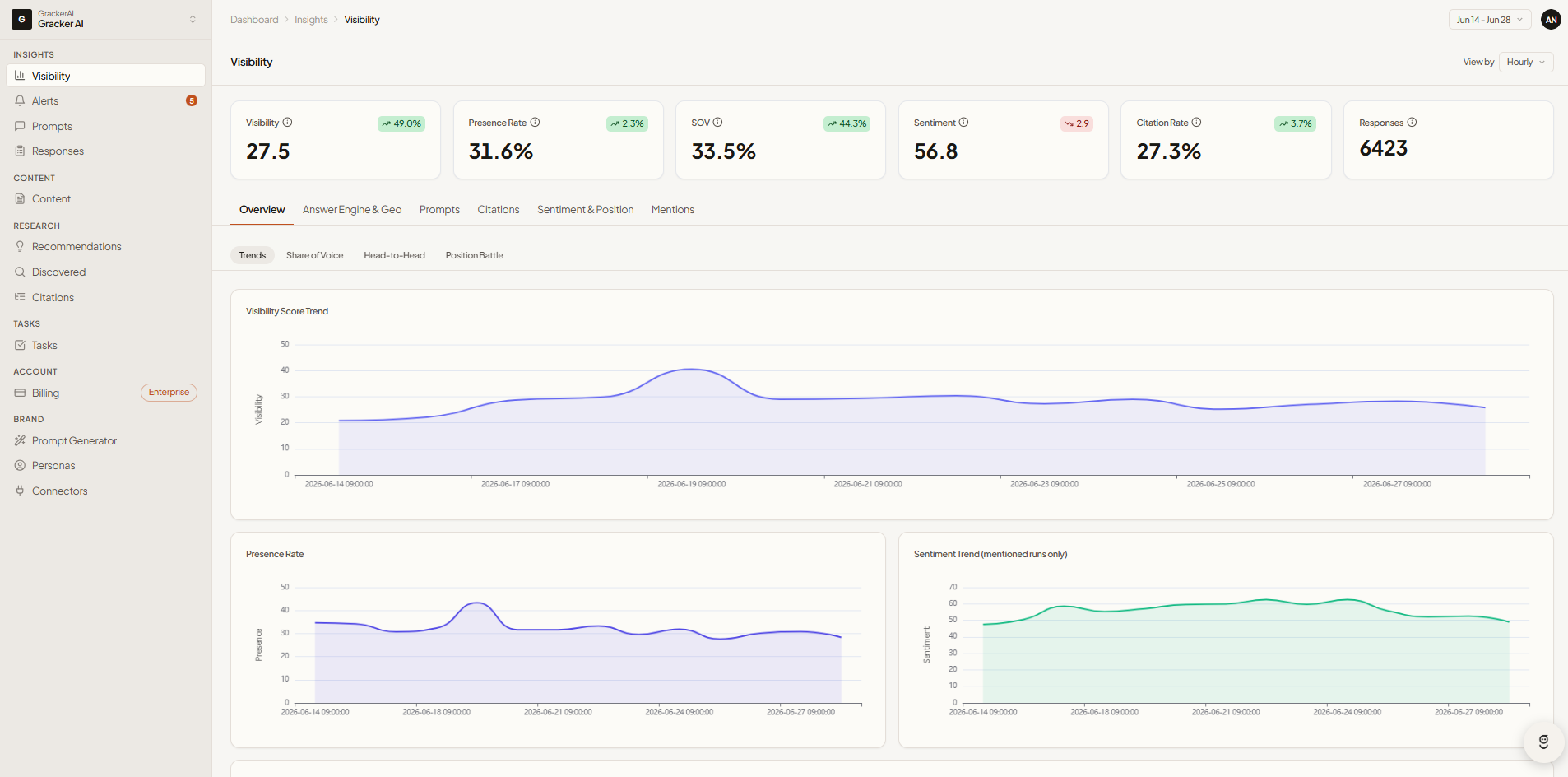
GrackerAI is the publisher of this guide, so treat this entry as disclosed self-assessment, not an independent rank. It is the only provider in this set built exclusively for cybersecurity and B2B SaaS, and the only one that bundles monitoring with AI article generation.
Best for: Cybersecurity and B2B SaaS vendors that want monitoring and content in one platform.
Starting price: Starter at $99/month (billed monthly; $79/month effective if billed annually), Scale at $499/month, Enterprise custom.
Free trial: 7 days on both self-serve plans (Starter and Scale), with full access to monitoring, citation tracking, and competitor analysis for the duration. This is a longer, more clearly stated window than either Otterly (trial confirmed, length unstated on its pricing page) or Profound (a self-serve trial exists only on its Growth tier, with no duration stated there either).
Key differentiator: Purpose-built for security and B2B SaaS, per-engine depth that scales from 3 engines at Starter to 4 at Scale to 10 at Enterprise, real-buyer prompts grounded in Google Search Console and Bing, and a content engine that turns visibility gaps into AI-citable articles.
Limitation: GrackerAI is narrow by design. If you are not a cybersecurity or B2B SaaS company, the specialized models and prompt libraries are wasted, and a generalist tool will serve you better. Also worth knowing before you trial it: Starter tracks only 3 of the 10 total engines, so evaluating the deepest competitive analytics (share of voice, head-to-head comparison, Position battle) means using the Scale tier's trial specifically, not Starter's.
How to Evaluate an AI Visibility Platform During Your Free Trial
A trial is only useful if you know what to check. Most people spend their trial window clicking around the dashboard instead of running a structured test, and end up no more informed at the end than the start. Here's what to actually look at, roughly in the order it becomes available.
Day 1: Does it ground itself in real buyer language, or does it start you with a blank slate? Some providers ship with an existing prompt library for your category. Others hand you an empty dashboard and expect you to write your own prompt list from scratch. If you're starting from zero, that alone can burn the first two or three days of a short trial just on setup.
Days 1 to 3: Is the reporting per-engine, or one blended number? Check this immediately, since it's the single most consequential thing to verify early and the hardest thing to notice if you're not looking for it. A single "AI visibility score" that averages across ChatGPT, Perplexity, and Gemini hides which specific engine is the actual problem. Pull up the raw per-engine breakdown, not just the summary card, before you trust any dashboard number.
Days 3 to 7: Does a competitor citation come with a source, or just a count? By roughly the first week, you should have enough data to check whether the tool tells you a competitor was cited more often than you (a count) or shows you which domain the AI actually pulled the citation from (a source). The second is what turns a report into an action; the first is a scoreboard with no next move.
Week 1 close: Run the numbers against your own manual spot-check. Ask ChatGPT and Perplexity directly, by hand, two or three of the prompts the platform is tracking for you, and compare what you see against what the dashboard reports for the same window. This catches both stale data and inflated citation claims before you commit budget on the strength of a number you haven't verified yourself.
If your trial runs a second week (14-day trials only): does the tool tell you what to fix, or only what's wrong? This is where monitoring-only tools and bundled tools diverge in a way that's hard to see in week one. By week two, you should have at least one confirmed citation gap. Check whether the platform gives you a specific, actionable next step for it (a content brief, a gap report naming the winning competitor page) or just a repeated data point with no path forward.
Before the trial ends: confirm what you lose at the tier you're about to pay for. Trial access on a mid or top tier can show you features that vanish the moment you downgrade to a cheaper plan post-trial. Cross-check the trial's feature list against the specific plan you're about to purchase, not against the trial experience as a whole.
Testing vs. Enterprise Deployment: Which Tools Fit Which
If you're testing the category for the first time and want the longest, fullest self-serve trial: GrackerAI's 7-day trial gives full feature access on both self-serve tiers, which is the most complete evaluation window of the four providers here, provided you're in cybersecurity or B2B SaaS.
If you're testing on the tightest possible timeline and don't need multi-engine depth yet: Otterly's trial (confirmed to exist, likely around a week based on its help documentation, though its pricing page itself doesn't state a length) gets you a directional read fast, with the caveat that a short window is tight for a full weekly reporting cycle.
If you're deploying at enterprise scale with a dedicated team and procurement process already in motion: BrightEdge expects a sales-led evaluation with no self-serve option at all. Profound sits in between: its $399/month Growth tier has a genuine self-serve "try for free" entry, but its cheapest Starter tier and its full Enterprise tier are both effectively sales-led, Starter because there's no trial on it and Enterprise because it's demo-only.
Want to See How AI Describes Your Brand Today?
Want to see how AI search engines describe your brand today? Get your free AI visibility score in about 60 seconds. Trusted by 500+ security teams.
How Should You Choose the Right AI Visibility Provider for Your Situation?
Use simple decision logic rather than chasing the longest feature list. The best provider is the one that fits your industry, your team size, and how you plan to act on the data.
If you are a cybersecurity vendor and you want monitoring plus content in one place, GrackerAI is the natural fit because it is the only security-specific option here and it bundles article generation.
If you are a large generalist enterprise with a dedicated team and real budget, Profound gives you the deepest analytics and the most resourced roadmap. If you are a small team or a solo marketer tracking a single product, Otterly's $29/month entry and fast setup get you measuring within minutes. If you already run BrightEdge for SEO and want AI tracking in the same suite, BrightEdge avoids adding another vendor.
Two more rules of thumb. First, insist on per-engine reporting; a single blended score hides the engine where you are actually losing, and you can read more in our GEO platform buyer's guide. Second, decide up front whether you only need to measure or whether you also need to fix. Monitoring-only tools tell you the gap; bundled tools help you close it. Map your shortlist against the seven weighted criteria above, score each one, and let the weights, not the sales demo, pick the winner. For deeper head-to-head detail, see our provider comparisons and the wider blog resource hub.
Frequently Asked Questions
What is an AI visibility provider and how is it different from an SEO tool?
An AI visibility provider tracks how AI answer engines like ChatGPT, Perplexity, and Google AI Overviews mention, cite, and rank your brand. A traditional SEO tool tracks where your pages rank in Google's blue-link results. They measure different surfaces: SEO tools count rankings and clicks, while AI visibility providers count citations, share of voice, and how favorably AI describes you.
How much does an AI visibility provider cost in 2026?
Pricing ranges widely. Otterly starts at $29/month for 15 prompts, Profound starts at $99/month for ChatGPT-only and reaches $2,000 to $5,000+/month for enterprise deployments, and BrightEdge and GrackerAI use custom enterprise pricing. Per-prompt models like Otterly's can climb fast once you track multiple engines, regions, or product lines, so model your real prompt volume before comparing headline prices.
Which AI engines should an AI visibility provider track?
At minimum it should track the six engines buyers use for research: ChatGPT, Perplexity, Claude, Gemini, Microsoft Copilot, and Google AI Overviews. Just as important, it should report each engine separately rather than collapsing them into one blended score, because a single number hides which specific engine you are losing visibility in. Copilot is worth evaluating on its own: it inherits Bing's index rather than crawling independently, so a provider's Copilot tracking is only as good as its visibility into that Bing-first pipeline. Our guide to Copilot rank tracking breaks down what that means for source attribution.
Should I pick a tool that only monitors, or one that also creates content?
It depends on your team. If you have a content function that can act on gap reports, a monitoring-only tool like Profound or Otterly may be enough. If you want the platform to close the gaps it finds, choose a provider that bundles monitoring with AI article generation, since that removes the handoff between finding a gap and publishing content to fix it.
Is a general AI visibility tool good enough, or do I need an industry-specific one?
A generalist tool works if your buyers use mainstream vocabulary and broad prompts. If you sell into a specialized field like cybersecurity, an industry-specific provider grounds its prompt libraries and competitor sets in how those buyers actually ask questions, which a generic tool has to be manually tuned to match. Match the tool's specialization to your market.
Final Thoughts
The buyers you want are already asking AI for a shortlist, and a quarter of traditional search volume is forecast to move with them by the end of 2026. Pick the AI visibility provider that fits your industry, your team, and whether you need to measure or also fix, use the trial period deliberately rather than passively, and let your weighted criteria decide rather than the demo
![10 Best Local Rank Tracker Tools: In-Depth Comparison Guide [2025]](https://cdn.pseo.one/6abcb68a626591c40e1c8aa6/687e1c1ef6fe799d288518df/68809c373eb8562bcf68975d/10-best-local-rank-tracker-tools-comparison-guide/feature-image.jpg)