10 Best Google AI Overview Tracking Tools


TL;DR
- Most Google AI Overview trackers only confirm an overview appeared; buy on whether the tool shows the overview text, the sources it cited and the competitor page cited instead of yours.
Ten tools claim to track Google AI Overviews. Only four of them will actually show you the text of the overview, the sources it cited, and the competitor page it pulled from instead of yours. The rest tell you an overview appeared and leave you to guess why you were not in it.
Here is what each one costs, what it genuinely shows you for Google specifically, and who should ignore it.
Google AI Overview Tracking Tools Compared
Tool | Cost to track AI Overviews | Cost per prompt | Who it suits |
|---|---|---|---|
Otterly.AI | $29/mo | $1.93 | Anyone testing AI visibility for the first time |
Searchable | $125/mo | $1.25 | Agencies and commerce brands |
Nightwatch | EUR 79/mo | EUR 1.58 | Teams that lead with rank tracking |
Semrush | $199/mo | $3.98 | Teams already inside Semrush |
SE Ranking | $218/mo combined | Not published | Agencies already on SE Ranking |
Profound | $399/mo | $3.99 | Enterprise GEO programs |
Ahrefs Brand Radar | $398/mo | $0.16 per check | Research-led SEO teams |
GrackerAI | $99/mo (Starter) | $1.25 | Cybersecurity and B2B SaaS teams |
BrightEdge | Custom | Not published | Large in-house SEO teams |
Conductor | Custom | Not published | Enterprise content teams |
Cost per prompt divides the monthly price by the prompts included on that plan. Ahrefs is priced per custom prompt check rather than per tracked prompt, so it is not directly comparable. Pricing as of August 2026.
What Each Tool Shows You Once You Log In
Every guide compares cost and engine count. Almost none compare what you can actually see once you log in, which is where these tools diverge most.
Four capabilities decide whether a tool helps you fix your visibility or just reports on it:
- Per-engine split. Can you isolate Google AI Overview performance, or is it averaged with ChatGPT and Perplexity into one number?
- Response text. Can you read what Google actually said, or only whether an overview appeared?
- Cited sources. Can you see the domains Google pulled from?
- Competitor pages. Can you see the specific rival URL that won the citation?
Tool | Per-engine split | Response text | Cited sources | Competitor pages |
|---|---|---|---|---|
GrackerAI | Yes | Yes | Yes | Yes |
Ahrefs Brand Radar | Yes | Partial | Yes | Yes |
Profound | Yes | Yes | Yes | Partial |
Searchable | Yes | Yes | Yes | Partial |
Otterly.AI | Yes | Yes | Yes | No |
Nightwatch | Yes | Partial | Yes | No |
Semrush | Partial | No | Partial | No |
SE Ranking | Yes | Partial | Yes | No |
The pattern is consistent. SEO suites log AI Overviews as a SERP feature, so they answer "did an overview appear?" Purpose-built platforms answer "what did it say, who did it cite, and which page beat mine?" The second question is the one you can act on.
10 Best Google AI Overview Tracking Tools, Ranked by Cost
1. Otterly.AI
The cheapest way to find out whether you have a problem at all.
- Price: $29/mo Lite, $189 Standard, $489 Premium
- Prompts: 15 on Lite, 100 on Standard, 400 on Premium
- Google AI Overviews: included on every plan
Otterly covers ChatGPT, Perplexity, Google AI Overviews and Microsoft Copilot on the base plan with no per-engine upcharge, which almost nobody else does at this price. Annual billing saves 15%.
Two things to know before you buy. Gemini and Google AI Mode cost extra, between $9 and $149 per month each. And 15 prompts disappears fast, so treat Lite as a diagnostic rather than a program.
2. Searchable
The broadest engine coverage per dollar, with pricing you can actually read before a sales call.
- Price: $125/mo Pro, $400 Scale, $999+ Enterprise
- Prompts: 100 per model on Pro, 9,000 answers analyzed monthly
- Google AI Overviews: one of nine engines you pick during onboarding
Choosing your engines at onboarding rather than unlocking them by tier is a genuinely good design decision. Pro also includes 20 articles, 200 site audits and unlimited seats.
Pro covers one project, so a second product or client moves you to $400. We compare the field in our guide to the best Searchable alternatives.
3. Nightwatch
Rank tracking first, AI visibility connected to it.
- Price: EUR 79/mo Starter, EUR 159 Professional, EUR 399 Agency
- Prompts: 50, 150 and 500 AI prompts respectively
- Google AI Overviews: bundled on every plan
Citation Intelligence links Google SERP movement to shifts in AI visibility, working from the premise that models tend to cite what already ranks. Every plan includes unlimited users, which matters if your team is larger than your budget.
Pricing is in euros, so your dollar cost moves with the exchange rate.
4. Semrush
Convenient if you are already paying for it, expensive if you are not.
- Price: $199/mo Starter, $299 Pro+, $549 Advanced
- Prompts: 50, 100 and 200 tracked daily
- Google AI Overviews: in Position Tracking and Sensor
Position Tracking flags every tracked keyword that produced an AI Overview and whether you were featured. Per Semrush's documentation, a cited domain is recorded as a number-one ranking. Sensor shows how often overviews appear across your industry.
Check which plan you are on before assuming you have this. The $139 SEO plan covers traditional SEO only, and prompt-level AI tracking begins at $199. At 50 prompts on that tier you pay $3.98 per prompt, the highest ratio on this list.
5. Ahrefs Brand Radar
The deepest research database, priced accordingly.
- Price: $398/mo selected platforms, $699 all platforms
- Included: 2,500 custom prompt checks monthly
- Google AI Overviews: roughly 312 million prompts in the index alone
Brand Radar runs on 470 million-plus monthly prompts drawn from real search behavior rather than synthetic lists, and the AI Overviews index is by far its largest. It also maps YouTube, TikTok and Reddit as sources feeding AI answers, which is useful when your category lives in communities.
It is research rather than monitoring. You can look up any domain instantly, but you are querying a database rather than running a program against your own prompt set, and it does not produce content.
6. Profound
Built for enterprise programs with a dedicated GEO owner.
- Price: $99/mo Starter, $399 Growth, custom Enterprise
- Prompts: 50 on Starter, 100 on Growth
- Google AI Overviews: from Growth up
Starter tracks ChatGPT only with a single seat, so $399 Growth is the real entry point for Google coverage. Growth adds Perplexity and Google AI Overviews, and full nine-engine coverage needs Enterprise. Agent analytics showing how AI crawlers behave on your site is the standout feature.
Profound is horizontal by design, so specialized categories get less domain-specific prompt intelligence than a vertical tool provides. See our breakdown of Profound alternatives.
7. GrackerAI
An AI visibility engine for cybersecurity and B2B SaaS companies that want to be discovered through AI search rather than traditional Google rankings.
Buyers increasingly research tools by asking ChatGPT, Perplexity, Gemini and Claude, and most brands stay invisible in those answers without knowing it. GrackerAI tracks your AEO and GEO visibility, analyzes where competitors are being cited, and identifies the openings you are missing in AI search.
It then acts on what it finds. The platform generates long-form articles, listicles, comparisons and FAQs structured the way AI systems parse and cite, so the gaps it surfaces turn into published pages rather than a backlog. The combination of visibility analytics and automated content is what it sells: more AI citations, higher-intent buyers, lower content cost.
- $99/mo Starter: 100 prompts weekly across 3 engines, ChatGPT, Perplexity and Google AI Mode. No Google AI Overviews on this tier.
- $499/mo Scale: 200 prompts daily across 4 engines, ChatGPT, Perplexity, Google AI Mode and Microsoft Copilot.
- Custom Enterprise: 1,000+ prompts hourly across all 10 engines, adding Google AI Overviews, Gemini, Claude, DeepSeek, Grok and Brave Leo.
Annual billing drops Starter to $79 and Scale to $399 (see current GrackerAI pricing). Every tier includes citation tracking, competitor benchmarking and article generation.
Disclosure: GrackerAI publishes this article. It sits at #7 rather than #1, and the capability matrix above applies the same four tests to every tool.
Google AI Overview tracking starts on the $499 Scale plan, not the $99 Starter plan, so it is not the cheap way to watch this one engine. It is also built for cybersecurity and B2B SaaS, so a horizontal suite will read a general keyword set better.
What it does differently is covered in the next section.
8. SE Ranking
Still capable, no longer cheap.
- Price: $129/mo Core, plus an $89/mo AI Search add-on
- Real cost: $218/mo at monthly rates, $174.40 annually
- Google AI Overviews: in the AI Results Tracker add-on
The AI Results Tracker covers AI Overviews, AI Mode, Perplexity and ChatGPT, and the underlying rank tracking remains solid for agencies managing many clients.
AI tracking is sold separately from the base plan, so budget both lines. Buying SE Ranking for AI Overview tracking alone means paying for a full SEO suite to reach the add-on you actually want.
9. BrightEdge
Enterprise SEO with AI tracking layered on.
- Price: Custom
- Google AI Overviews: tracked with sentiment inside Data Cube X
BrightEdge folds AI Overview tracking and sentiment analysis into Data Cube X, part of its existing enterprise SEO suite. For large teams the draw is one contract covering AI tracking, sentiment and traditional SEO.
It was an SEO suite before it was an AI tool, and custom pricing means no self-serve entry.
10. Conductor
Enterprise content workflow with AEO reporting attached.
- Price: Custom
- Google AI Overviews: in the AI Search Performance report
Conductor surfaces AI Overview presence inside its AI Search Performance report and ties it to recommended content actions. The pitch is connecting AI findings to content changes in one system.
Same caveat as BrightEdge: custom pricing and a sales cycle, which rules it out if you want to start this week.
How to Track Google AI Overview with GrackerAI
A blended AI visibility score of 40% might mean you are strong in Perplexity and absent from Google, or the exact reverse. Those two situations need opposite fixes, and an average tells you neither.
Here is what separating Google AI Overviews out actually looks like, using GrackerAI as the worked example.
How to Track Google AI Overview KPIs by Engine
Every core KPI reports per engine in the AI visibility monitoring dashboard, so Google AI Overview performance stands on its own rather than being folded into an average.
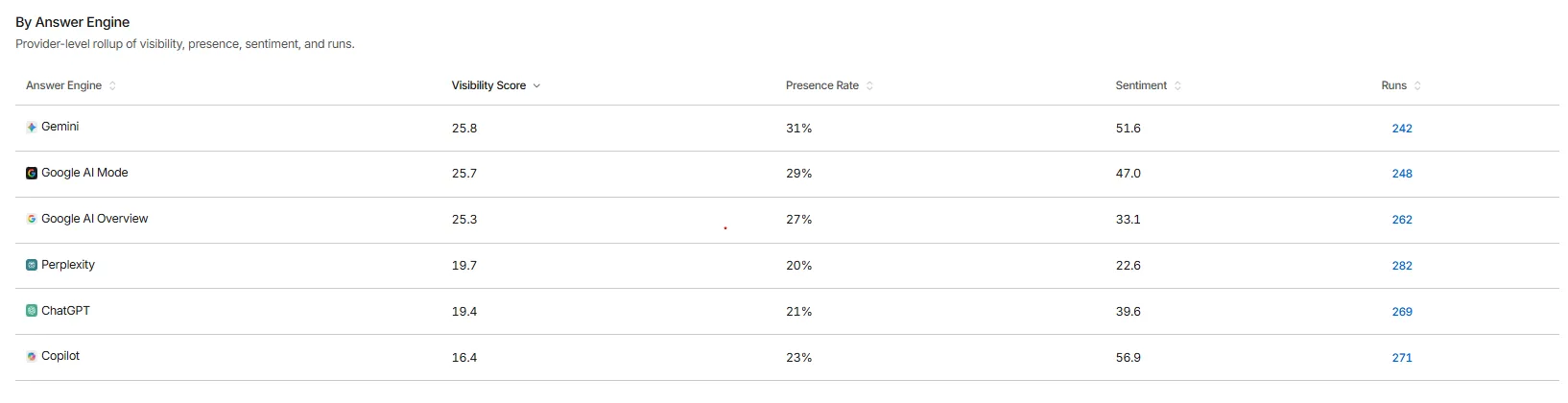
This tells you which engine to work on this quarter. Our guide to GEO KPIs covers which numbers move first, and how the visibility score is calculated explains what sits behind them.
How to Read Every Google AI Overview Response
Pull every Google AI Overview response for your tracked prompts across any date range, as full answer text rather than a score.
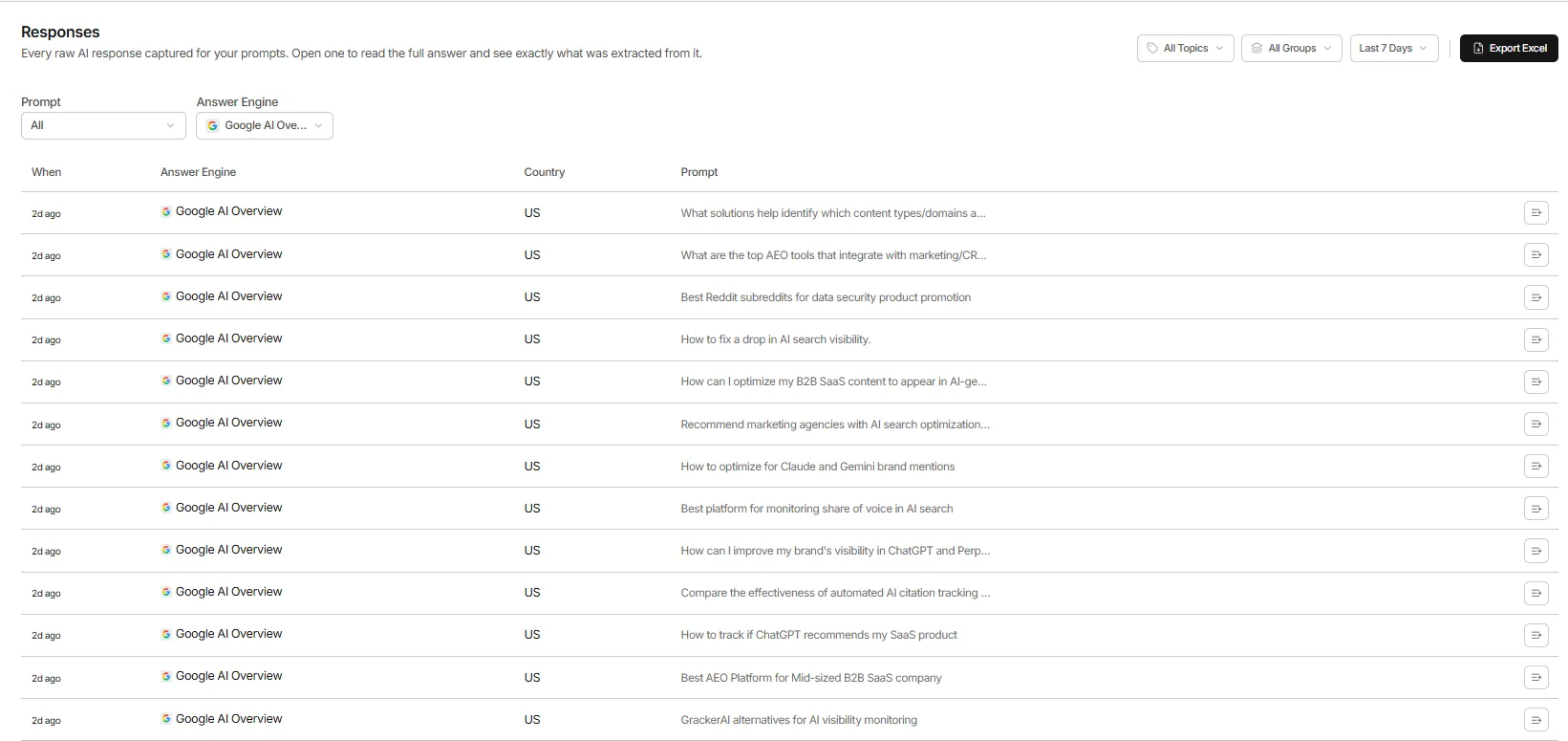
The response is ground truth. It shows which claims Google treats as settled and which framing it repeats, which tells you whether to rewrite the page you have or write a new one. The content engine can build either straight from the gap, and how to structure content for Google AI Overviews covers the formatting that gets pulled.
How to See Every Source Google AI Overview Cites
All sources cited by Google AI Overviews on your prompts, in one list.
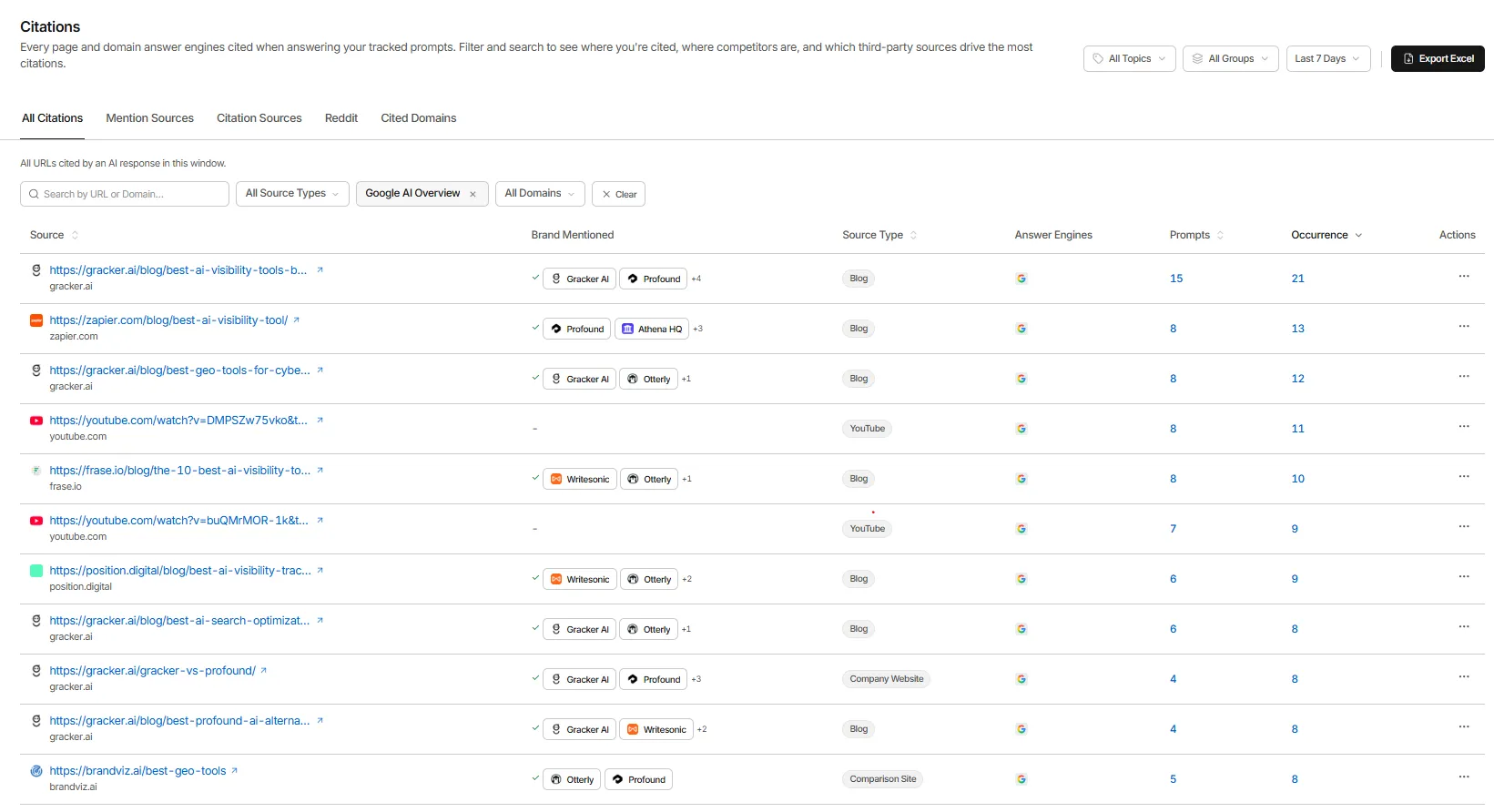
Once you can see the cited set, the work becomes concrete: get your brand into those sources. That is an assignable task, not a vague instruction to build authority. Filter to one engine or view all engines together. More in our guide to tracking AI citations and mention sources.
How to Track Third-Party Sources Cited by Google AI Overview
Separate out the review sites, forums, docs hubs and publications Google leans on for your category.
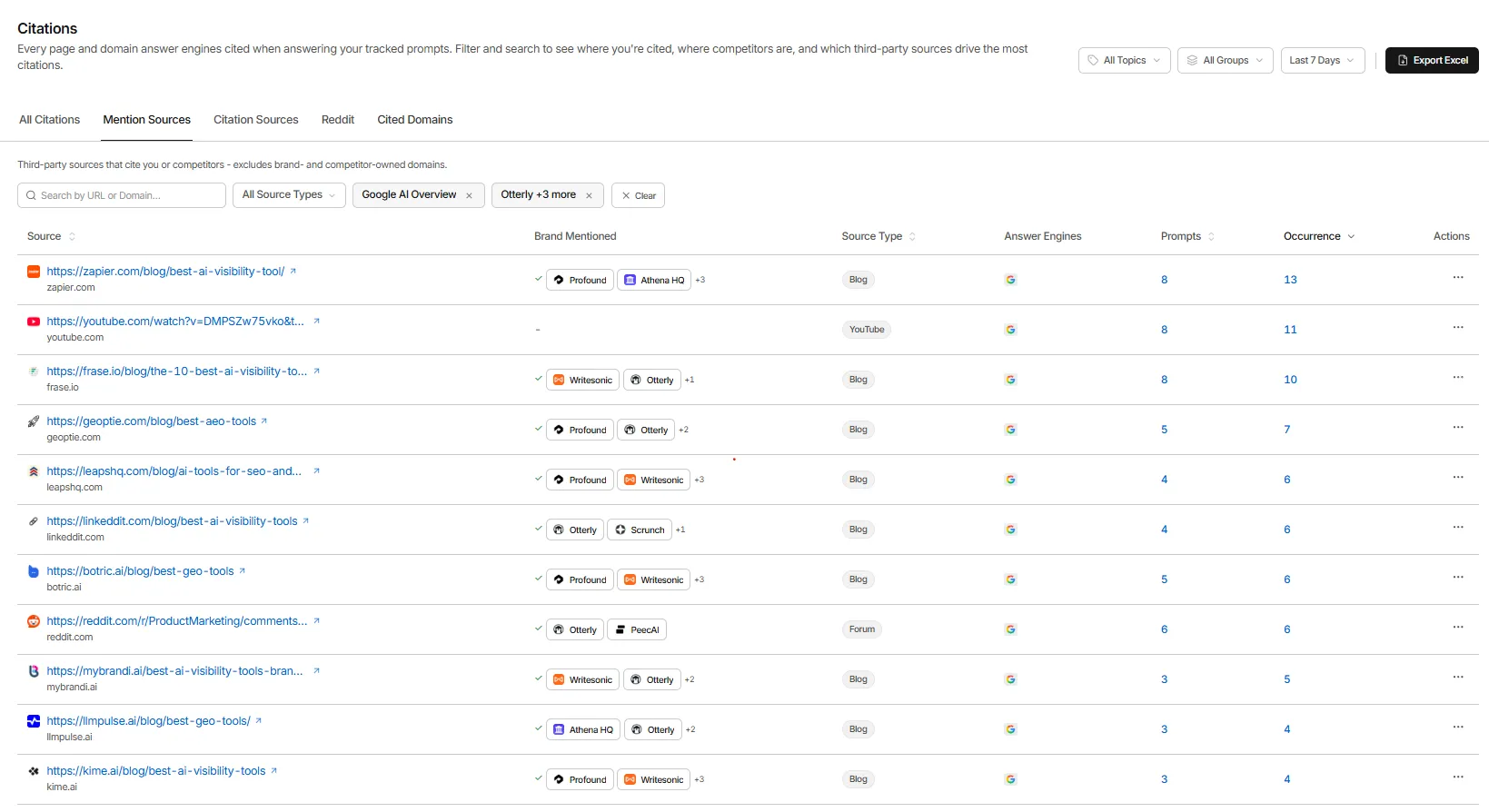
Getting named inside a source Google already trusts is usually faster than outranking an incumbent with your own page.
How to Find Competitor Pages Cited by Google AI Overview
The exact rival URL Google cited on each of your prompts.
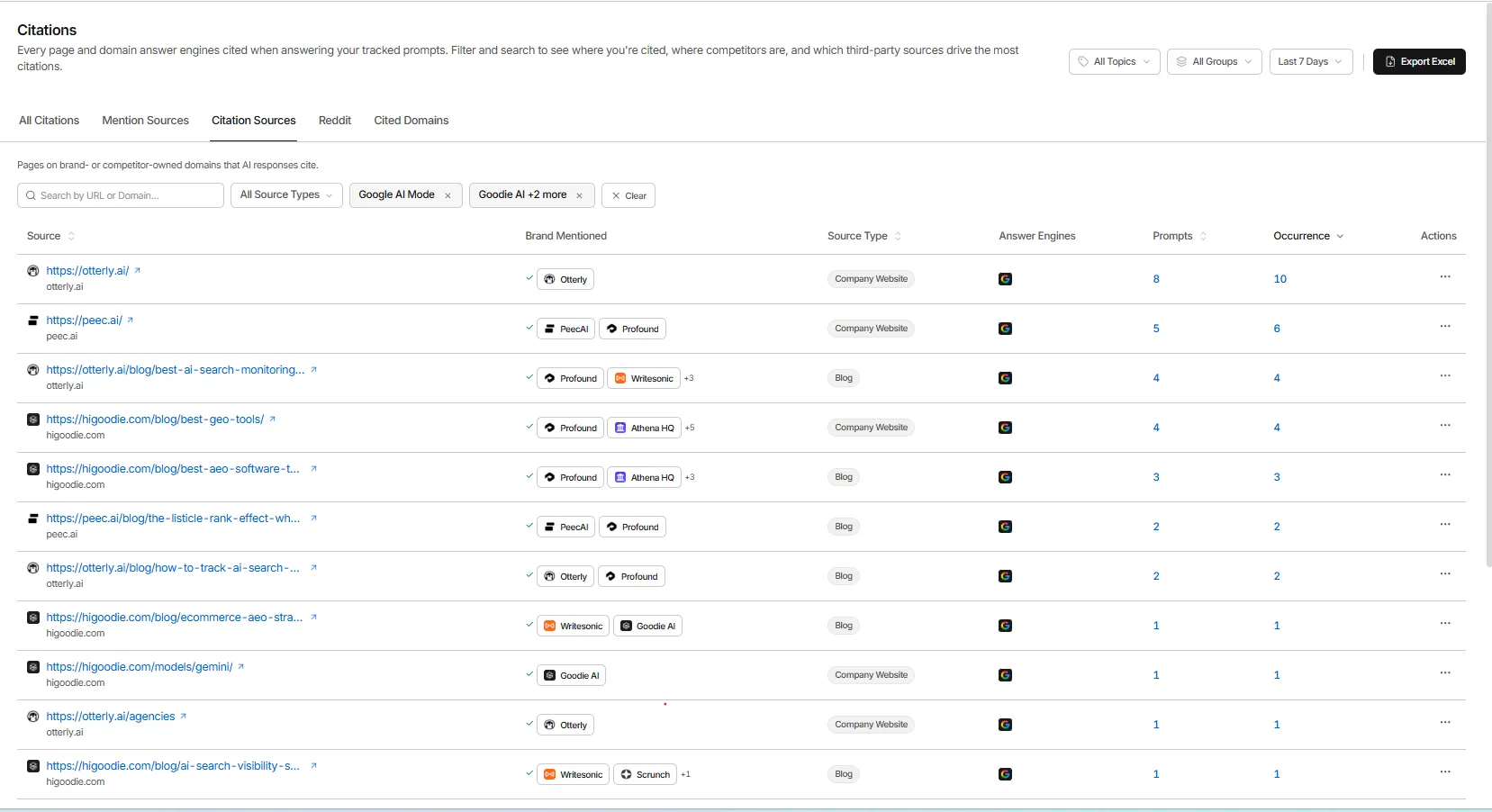
This is the clearest content brief available anywhere: the page format Google rewards for that specific prompt, whether that is a comparison table, a definition-led explainer or a structured FAQ. Pair it with our competitor AI search analysis framework.
Together these turn "our visibility dropped" into "Google cited this competitor page on this prompt, sourced from these three domains, and here is the brief to beat it."
Try it on your own domain in the GrackerAI portal. A 7-day free trial runs on the self-serve plans.
Which One Should You Buy?
Testing whether you have a problem: Otterly.AI at $29. Lowest cost, Google AI Overviews included, no commitment.
Best coverage per dollar: Searchable at $125 for 100 prompts per model across engines you choose.
Already paying for an SEO suite: Semrush if you are on Starter or above, SE Ranking if you will budget the $89 add-on. Neither is worth buying fresh for AI Overviews alone.
Researching a market rather than monitoring your own: Ahrefs Brand Radar. Nothing else has 312 million AI Overview prompts to query.
Running a formal enterprise program: Profound, BrightEdge or Conductor, with Profound the most AI-first.
Cybersecurity or B2B SaaS, and you need to act on what you find: a vertical tool built for cybersecurity and B2B SaaS marketing teams that separates engines and produces the fix. Our buying guide and notes on choosing an AI visibility provider go deeper, and GEO tools for cybersecurity covers why security prompts read differently.
Frequently Asked Questions
What is the best tool to track Google AI Overviews?
It depends on budget. Otterly.AI at $29 per month is the cheapest that includes them. Ahrefs Brand Radar has the largest index at roughly 312 million AI Overview prompts. GrackerAI is the only one that shows response text, cited sources and competitor pages for Google specifically, then generates the content to close the gap.
How much do these tools cost?
Self-serve plans run from $29 to $699 per month. Otterly.AI starts at $29, Searchable $125, Semrush $199, SE Ranking $218 combined, Ahrefs Brand Radar $398, Profound $399, GrackerAI starts at $99 (Starter) and reaches $499 on Scale. Nightwatch starts at EUR 79. BrightEdge and Conductor quote custom.
Are there free Google AI Overview tracking tools?
Only for spot checks. Ahrefs publishes a free AI Overviews Tracker and AI Visibility Checker, and several vendors offer a one-off visibility score. Continuous tracking starts around $29 per month.
Do AI Overviews reduce website traffic?
Yes. Per the Pew Research Center, 2025, users click a traditional result in 8% of searches showing an AI summary versus 15% without one, close to half the click rate.
Why track engines separately instead of one blended score?
Because engines disagree. Google AI Overviews, ChatGPT and Perplexity cite different sources and reward different page structures, so one average can hide total absence in one engine behind strength in another.
Can I see which competitor pages Google AI Overviews cites?
Yes, on tools that expose citation-level data. Ahrefs Brand Radar shows cited pages from its database. GrackerAI shows the specific competitor pages cited on your own tracked prompts, filtered to Google. SEO suites that log AI Overviews as a SERP feature do not.
What is the difference between AI Overview tracking and AEO tools?
AI Overview tracking tells you whether you appear in Google's overviews. AEO tools track citations across ChatGPT, Perplexity, Gemini and Copilot too, and often generate content to close gaps. See our GEO guide for where the two overlap.
Two Tests Before You Buy
Run any shortlist through two questions.
Does it confirm citations, or only presence? A tool that reports "an AI Overview appeared for this keyword" has told you nothing you can act on. You need to know whether you were cited, and if not, who was.
Does it separate Google from the other engines? One blended score averages away the problem. Google AI Overviews reward different page structures than ChatGPT does, so you need to see them apart to know what to fix.
Tools that fail either test will tell you that you have a problem without ever telling you which page to fix.
![10 Best Local Rank Tracker Tools: In-Depth Comparison Guide [2025]](https://cdn.pseo.one/6abcb68a626591c40e1c8aa6/687e1c1ef6fe799d288518df/68809c373eb8562bcf68975d/10-best-local-rank-tracker-tools-comparison-guide/feature-image.jpg)