What Is an AI Visibility Score and How Do You Calculate It?


TL;DR
- An AI visibility score is one 0-to-100 number composed of four signals — presence, prominence, sentiment and citation — and presence is the first lever because nothing else applies until the engine names you.
An AI visibility score is a single number, usually 0 to 100, that measures how well a security brand shows up when AI search engines like ChatGPT, Perplexity, Claude, and Gemini answer questions in categories like SIEM, endpoint, IAM, cloud security, or GRC. It is built from four underlying signals: whether you were mentioned at all (presence), how early in the answer you appeared (prominence), whether the mention was positive or negative (sentiment), and whether your site was cited as a source (citation). A higher score means AI engines name and recommend your security product more often, more favorably, and closer to the top of the answer.
Security buying committees now start research inside AI assistants before they ever fill out a form. A CISO evaluating vendors asks ChatGPT "best SIEM for a mid-market team," or a security architect asks Perplexity "top zero trust vendors." An AI visibility score tells you one thing: were you even in that answer, or did the shortlist form without you.
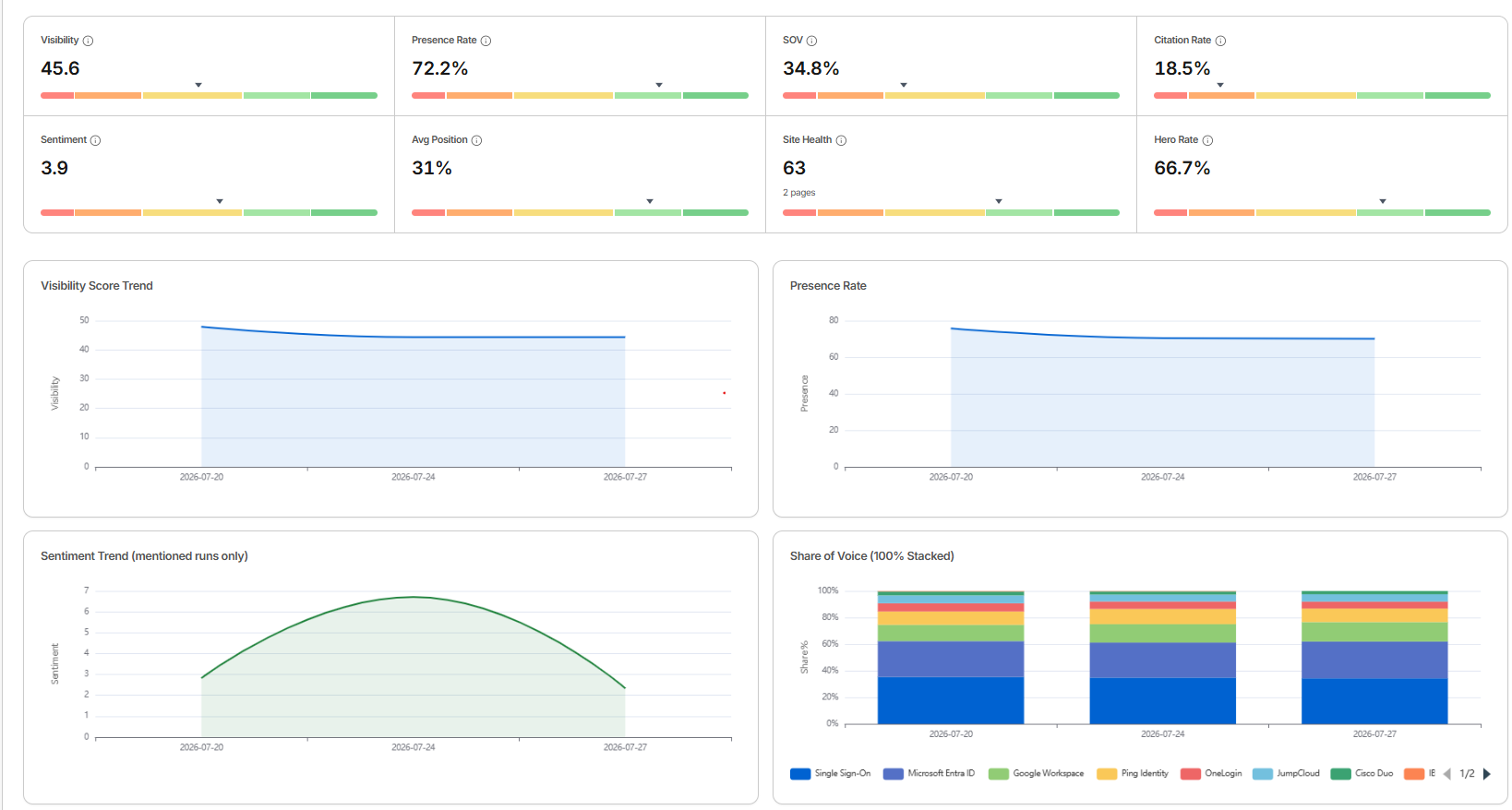
GrackerAI's Visibility dashboard, showing all eight scores at a glance
Why this metric exists
Search used to end in a list of blue links. If your endpoint protection page ranked third for "best EDR for healthcare," you could see it, screenshot it, and put it in a board deck. See why blue link SEO is dying for security vendors for the broader picture of what's replacing that ranked list.
AI search doesn't work that way. When a buyer asks Perplexity or ChatGPT which SOC platform to shortlist, the engine reads dozens of sources, synthesizes an answer, and names a handful of vendors inside that answer. Google's own documentation confirms its AI features pull from a wider, more diverse set of supporting pages than a classic search results page, generated through its core Search ranking systems rather than a separate process (Google Search Central, "AI features and your website", retrieved 2026-09-16). There's no rank 1 through 10 to check. There's just: were you named, or weren't you.
That's the exact problem an AI visibility score is built to solve. It turns "did AI mention us when someone asked about zero trust vendors" from a guess into a tracked, repeatable number you can watch move week over week, category by category.
The four signals behind the score
According to GrackerAI's documentation, four signals feed into the composite Visibility Score. Improving any one of them moves the number.
Presence. Was your brand mentioned at all when someone asked about IAM platforms, SIEM tools, or cloud security posture management? This is the most basic form of visibility and the easiest lever to pull. If you're not mentioned, nothing else matters yet.
Prominence. How early in the response did you show up? A CISO reading an AI answer about "top PAM vendors" is more likely to shortlist whoever's named first than whoever's buried in the fourth sentence.
Sentiment. Was the mention positive, neutral, or negative? Security buyers are risk-averse by training. Being named next to language about a past breach, a compliance gap, or a negative review isn't the win it looks like on paper.
Citation. Did the AI engine link to your website as a source, or just recall your brand name from general knowledge? In security specifically, citations often trace back to compliance documentation, technical whitepapers, or CVE-related content, since AI engines lean heavily on documentation-style pages as trusted sources.
Presence is usually the right place to start. If you're not mentioned at all, there's no point fine-tuning for prominence or sentiment yet. Fix coverage first.
The eight scores you'll actually see on a AI Visibility Software dashboard
A single composite number is useful for a headline, but it hides where the problem actually lives, and in security specifically that's often the difference between "buyers don't know we exist" and "buyers know we exist but AI keeps citing our competitor's SOC 2 whitepaper instead of ours." That's why a proper AI visibility dashboard breaks the score into its parts.
Score | Range | What it tells you |
|---|---|---|
Visibility | 0 to 100 | The composite score. Blends presence, prominence, sentiment, and citations into one number. |
Presence Rate | 0 to 100% | The share of tracked AI responses that mention your brand at all, regardless of position or tone. Your raw coverage. |
Share of Voice (SOV) | 0 to 100% | Your share of all brand and competitor mentions combined. 100% means you were the only brand named. 50% means an even split with competitors. |
Citation Rate | 0 to 100% | The share of responses that cite a source backing your brand, not just naming you. |
Sentiment | -100 to +100 | The average tone of your mentions. Negative means AI is naming you but not recommending you. |
Avg Position | 0 to 100% (percentile) | Where you typically land in a response. Lower is better. 0% means first, 100% means last. |
AEO Audit | 0 to 100 | How well your pages are structured for AI answer engines to read and cite. |
Technical Health | 0 to 100 | Standard technical SEO health: performance, accessibility, best practices, Core Web Vitals. |

Each of the eight scores updates independently, so a drop in one doesn't get hidden inside a stable-looking average
The first five of these follow whatever date range you're looking at. AEO Audit and Technical Health are point-in-time snapshots from a site crawl, and they stay blank until that crawl runs at least once.
How to read the score once you have it
A number on its own doesn't tell you if you're in trouble or in good shape. Rough benchmarks help:
0 to 10%: Not visible. AI barely knows your brand exists in this category. This is normal for a security vendor in its first 90 days of tracking.
10 to 30%: Emerging. AI knows you exist but rarely leads with you.
30 to 55%: Competitive. You're a regular option AI considers.
55 to 75%: Strong. AI leads with you in many answers. Worth defending.
75%+: Dominant. You own the category in AI answers.
Cybersecurity vendors with strong compliance content often start higher than the average B2B SaaS company, in the 15 to 25% range, because AI engines already lean on established compliance documentation as a trusted source.
What actually moves the score, week to week
A 5 to 10 point swing in a week is normal noise. A drop of 15 points or more in seven days is worth investigating before you assume something is broken. Common causes:
An AI model update. A new version of ChatGPT or Gemini can reshuffle citations across an entire category within days.
A competitor's content push. A funding announcement, a product launch, or a wave of new comparison content can shift the citations AI is pulling from.
Indexing lag. New content typically takes four to six weeks to propagate into AI answers, so a fix you shipped last week may not show up in the score yet.
Seasonal query shifts. Compliance topics spike around audit season. Security topics spike after major breach disclosures.
The important habit here: don't act on a score drop until you've read the actual AI responses behind it. A drop caused by a model update needs a different response than one caused by a competitor's new page.
How to actually improve it
Sort your tracked prompts by score, lowest first. For most security vendors, this surfaces gaps around specific subcategories, like "SOAR vs SIEM" or "best IAM for healthcare compliance," where a competitor has a dedicated page and you don't.
Open the worst-performing prompts and read what AI is actually saying, word for word.
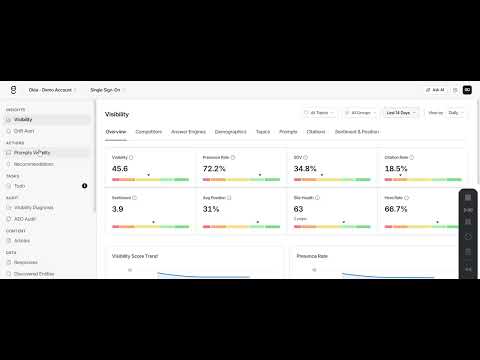
Sorting prompts by score surfaces exactly where AI is skipping your brand, and reading the actual response tells you why
Identify what content is getting cited instead of yours. In security, this is almost always a comparison page, a compliance-mapped technical guide, or a "best X for Y regulation" listicle.
Build or rewrite content that matches the format that's winning. A generic product page rarely earns a citation next to a competitor's SOC 2 Type II breakdown or a detailed zero trust architecture guide.
Recheck in four to six weeks. Indexing lag means this is not a same-day fix.
How GrackerAI tracks this
This is exactly the metric GrackerAI's Visibility dashboard is built around. It tracks hundreds of prompts daily across ChatGPT, Perplexity, Claude, Gemini, Microsoft Copilot, Google AI Overviews, Google AI Mode, DeepSeek, Grok, and Brave Leo — 10 engines on Enterprise — and reports all eight scores per-engine rather than as one blended number. That per-engine breakdown matters, because a brand can be dominant on Gemini and invisible on Perplexity, and a single average hides that entirely. Other GEO-focused platforms take a similar per-engine approach — see our review of Bear AI for how one alternative structures its own visibility tracking.
If you run marketing for a cybersecurity company and haven't checked this yet, you can get a free AI visibility score in about 60 seconds, no signup required. See how AI sees your brand today, and use the benchmarks above to know whether that number is a crisis or a starting point.
Frequently asked questions
Is a higher AI visibility score always better?
Yes, but check sentiment alongside it. A high presence rate with negative sentiment means AI is naming you often but not recommending you, which is a different problem than not being mentioned at all.
How often does an AI visibility score update?
It depends on how often prompts are re-run. Weekly tracking is standard, since AI answers can shift meaningfully within days of a model update or a competitor's content launch.
Can a small security vendor outscore a much larger competitor?
Yes. AI visibility score correlates with content structure and citation-worthiness, not company size or ad spend. A smaller IAM or endpoint vendor with sharper, better-structured technical content, like a detailed compliance mapping or a real architecture walkthrough, can out-cite a larger, better-funded competitor that hasn't adapted its content for AI answer engines yet.
Once you have a single score, growth teams usually want the fuller picture behind it — mention frequency, share of voice, and how the brand is framed within a response, not just whether it appears. See AI visibility metrics: a practical overview for growth teams for how those pieces fit into a reporting model.
![10 Best Local Rank Tracker Tools: In-Depth Comparison Guide [2025]](https://cdn.pseo.one/6abcb68a626591c40e1c8aa6/687e1c1ef6fe799d288518df/68809c373eb8562bcf68975d/10-best-local-rank-tracker-tools-comparison-guide/feature-image.jpg)