Perplexity Rank Tracking: Tools to Monitor Your Visibility

TL;DR
- Traditional SEO is evolving into Generative Engine Optimization (GEO).
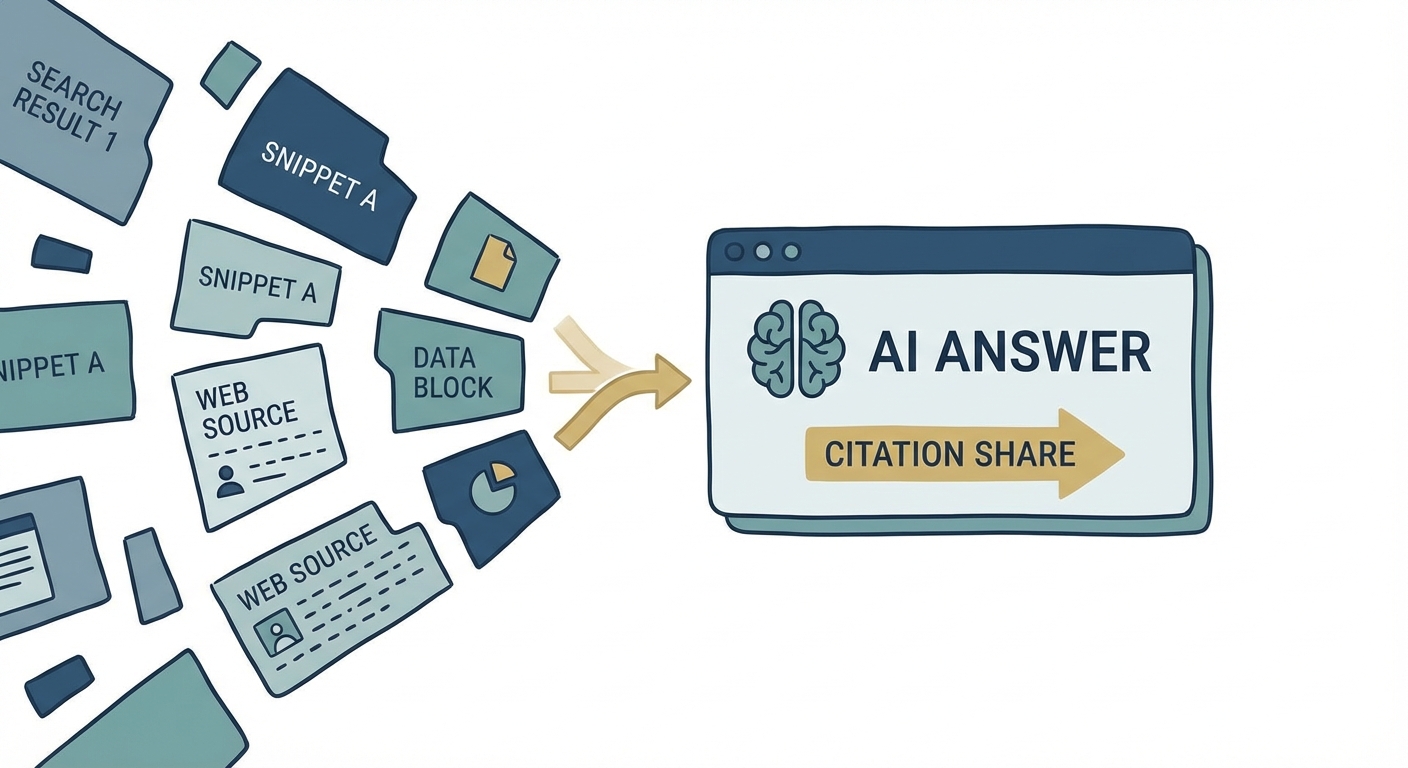
- Success in AI search is measured by 'Citation Share,' not blue links.
- Perplexity prioritizes trust signals, authority, and semantic relevance over keywords.
- New citation intelligence tools are essential for monitoring AI-driven search visibility.
Is There Such a Thing as "Rank" in Perplexity?
No, not in the Google sense. Perplexity doesn't return a ranked list of ten links you climb toward position one. It returns a synthesized answer with two to seven numbered citations, and your brand either appears in that citation set or it doesn't. The metric that replaces "rank" is citation frequency, how often your domain is one of the sources Perplexity cites for a given query, tracked across the specific prompts your buyers actually ask.
Key Takeaways
Perplexity has no static ranking position. The comparable metric is citation frequency, how often your domain is cited as a source, not where you sit on a results page.
"Citation share" (your citations as a percentage of all citations on a prompt) and "citation frequency" (raw count of times you're cited) are related but different numbers; track both, since a high frequency with low share still means a competitor dominates the same prompts.
Legacy SEO tools scrape static search results pages and can't see inside a conversational AI answer, so they're structurally unable to track this. You need tools built specifically for citation intelligence.
Perplexity's index refreshes fast, often within about a week of a content update, which makes freshness a bigger lever here than in traditional SEO.
Weekly monitoring against a fixed set of "seed prompts" is the workable cadence; changing prompts between checks makes the data incomparable.
How Does Perplexity Decide What to Cite?
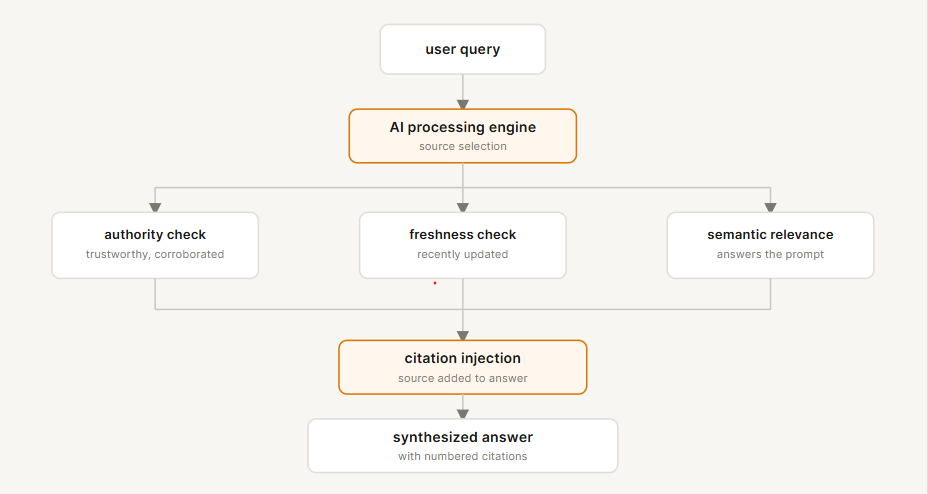
Perplexity evaluates a query against its index and weighs three things before selecting sources: authority (does this domain look trustworthy and well-corroborated), freshness (was this updated recently enough to still be accurate), and semantic relevance (does this passage actually answer what was asked, not just contain matching keywords). All three run in the time it takes to generate a response, and a page that's thin, stale, or only tangentially relevant gets passed over for one that isn't, regardless of that page's Domain Authority or backlink count in a traditional SEO sense. Our guide to how AI engines decide what to cite covers this same mechanism across engines beyond Perplexity.
This means "ranking" as a static, earned position doesn't exist here. You're either selected as a source for a given prompt, or you're not, and that answer can change the next time the same prompt is asked if the index has refreshed.
Why Legacy SEO Tools Can't Track This
Most SEO tools were built to scrape a static search engine results page and record which URL sits in which position. That approach doesn't work on Perplexity, because there is no results page to scrape, only a generated paragraph with inline citations. A tool needs to actually query the model, capture the response, and parse out which domains got cited, which is a fundamentally different technical approach than a rank-position crawler.
Feature | Legacy SEO Tools | AI-First Citation Tools |
|---|---|---|
Primary metric | Keyword position | Citation frequency |
Data source | Static SERP scrape | Live queries against the AI model |
Context evaluated | Single keyword intent | Full semantic query intent |
What moves the number | Meta tags, content updates | Authority signals, schema, freshness |
Tools to Track Your Perplexity Citations
A handful of tools are built specifically for this, not adapted from a rank-tracking crawler. Here's an honest look at each, including GrackerAI, since a comparison that pretends competitors don't exist isn't a useful one.
Tool | Starting Price | Perplexity Coverage | Other Engines | Free Trial | Content Generation |
|---|---|---|---|---|---|
GrackerAI | $99/mo | Yes, plus domain-level citation source | Up to 10 more | 7 days | Yes |
Otterly AI | $29/mo | Yes | 3 more on core plans | Confirmed, length not stated on pricing page | No |
SE Ranking (Perplexity tracker) | $129/mo | Yes, as an add-on module | Multiple via SE Visible | 14 days | No |
Otterly AI was an early mover in this category and shows brands exactly which queries trigger a citation for their domain, with a clean, simple interface built around that one job. It's a reasonable, affordable starting point if Perplexity tracking alone is your immediate need. Its Lite plan starts at $29/month with 15 tracked prompts; deeper multi-engine coverage and any content-gap tooling aren't part of the entry tier.
SE Ranking's Perplexity visibility tracker adds citation tracking as a module inside SE Ranking's existing SEO suite, via its SE Visible add-on. It's the right fit if you're already using SE Ranking for keyword and backlink tracking and want AI visibility inside the same dashboard rather than standing up a separate tool, though the AI-tracking layer here is generally less deep than a purpose-built citation tool, since it's a secondary feature on a keyword-first platform.
GrackerAI tracks Perplexity citations at every tier, and at $99/month also identifies the specific domain a citation came from on a given prompt, not just whether you were cited.
It scales to up to nine other engines depending on plan (ChatGPT, Claude, Gemini, Copilot, Google AI Overviews, Google AI Mode, DeepSeek, Grok, Brave Leo), and pairs the tracking with a content engine that generates the specific pages, comparisons, and FAQ content known to close a citation gap once you've found one.
It's purpose-built for B2B SaaS and cybersecurity brands rather than general-purpose, with a 7-day free trial (credit card required to start; you are not charged during the trial and can cancel anytime before it ends).
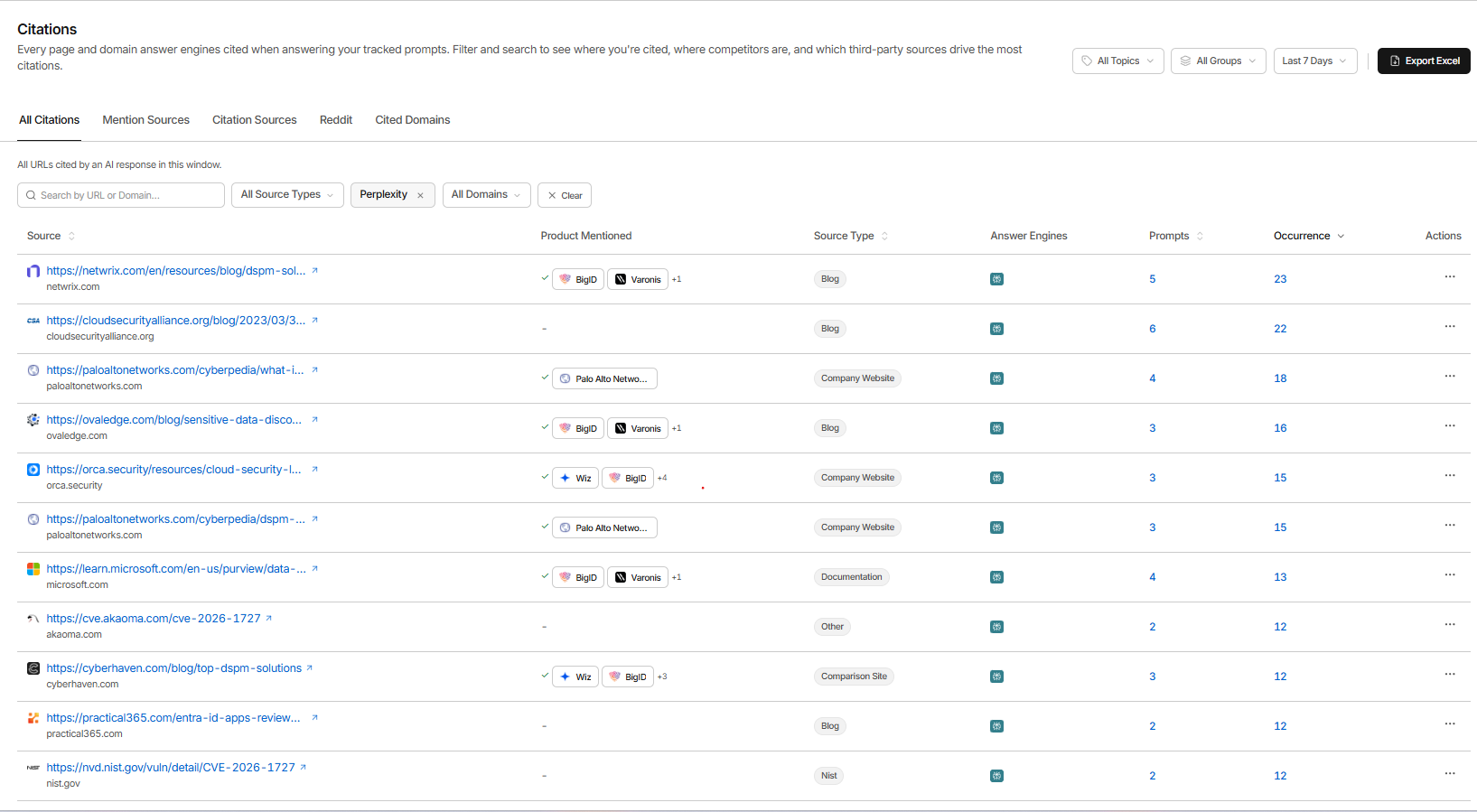
This view shows the sources Perplexity cites for a given tracked prompt.
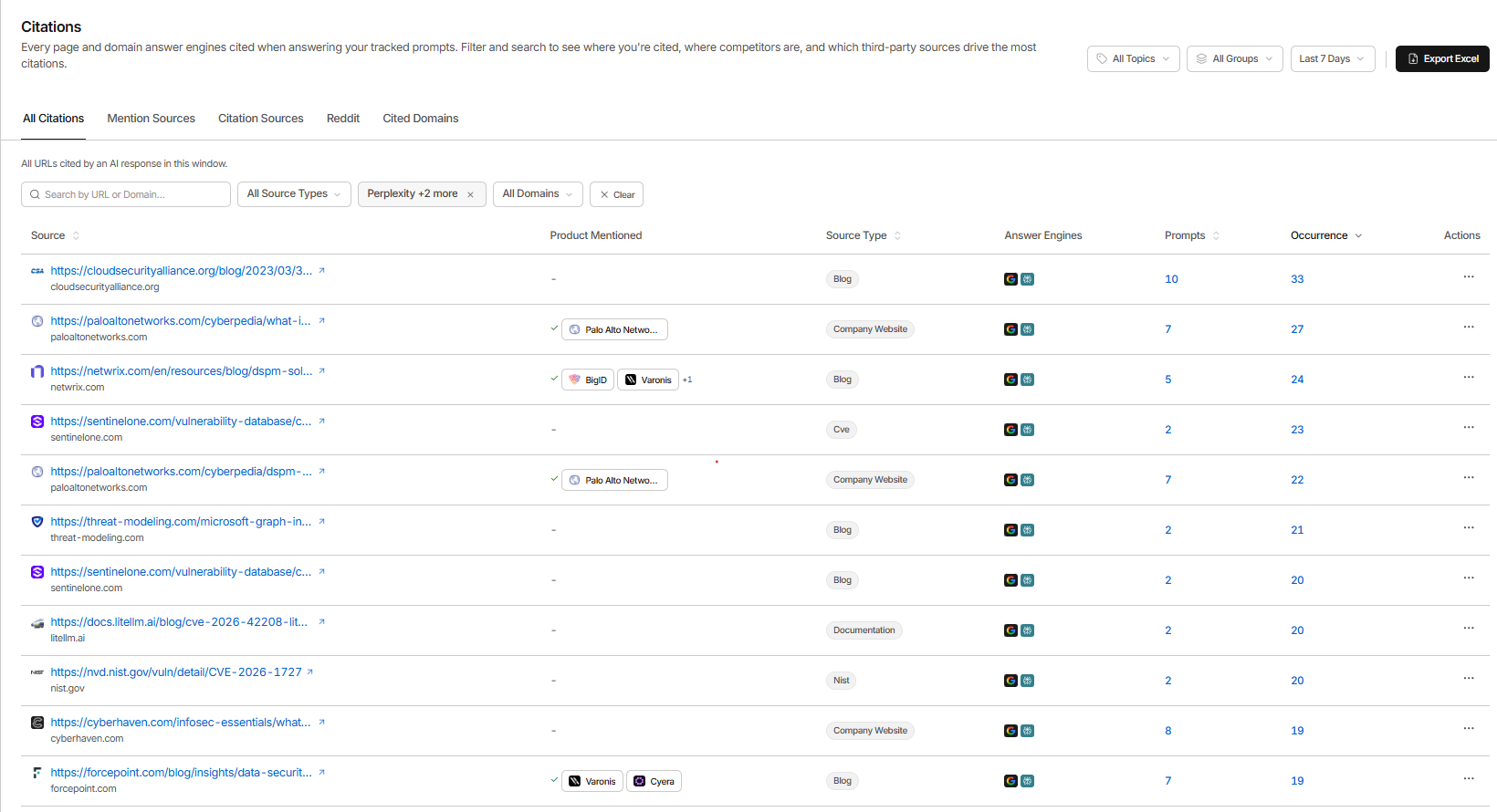
Other tracked engines that cite the same sources as Perplexity, for comparison.
Which one to pick: Otterly if Perplexity tracking alone is genuinely all you need and budget is the deciding factor. SE Ranking if consolidating into an existing SEO suite matters more than depth. GrackerAI if you want to go from "here's the gap" to "here's a draft that closes it" without handing the finding off to a separate content team, especially if you're in B2B SaaS or cybersecurity specifically.
Building Your Perplexity Tracking Workflow
Step 1. Define Your Seed Prompts
Skip keyword research tools for this step. Talk to sales and support instead, and pull the actual questions buyers ask: "how do I fix X," "why is Y better than Z," "what's the best tool for [use case]." These are your seed prompts. Save them in a fixed list. Pulling real queries from Google Search Console is another reliable source if you want the prompt wording to mirror actual search behavior rather than guessed phrasing.
Step 2. Run Your Prompts and Log What's Cited
Feed your seed prompts into whichever tool you've picked, or query Perplexity directly if you're doing this by hand, and record which domains get cited for each one, including your own. A single run tells you almost nothing on its own; the point is repeating this on a fixed schedule so the numbers become a trend rather than a snapshot.
Step 3. Find and Close Citation Gaps
A citation gap is a prompt where a competitor is cited and you aren't, despite your content being objectively comparable or better. Pull the page that's winning the citation and check what it has that yours doesn't: is it fresher, better structured, missing schema, or just more directly answering the question in its first paragraph. Structuring content the way AI engines extract it is worth reading before you rewrite anything, since the fix is rarely just "add more words." Freshness matters more here than in most engines: Perplexity's index refreshes fast enough that a content update can show up in citations within about a week. This step-by-step process is Perplexity-specific; for the full cross-engine workflow, see our complete guide to tracking AI citations.
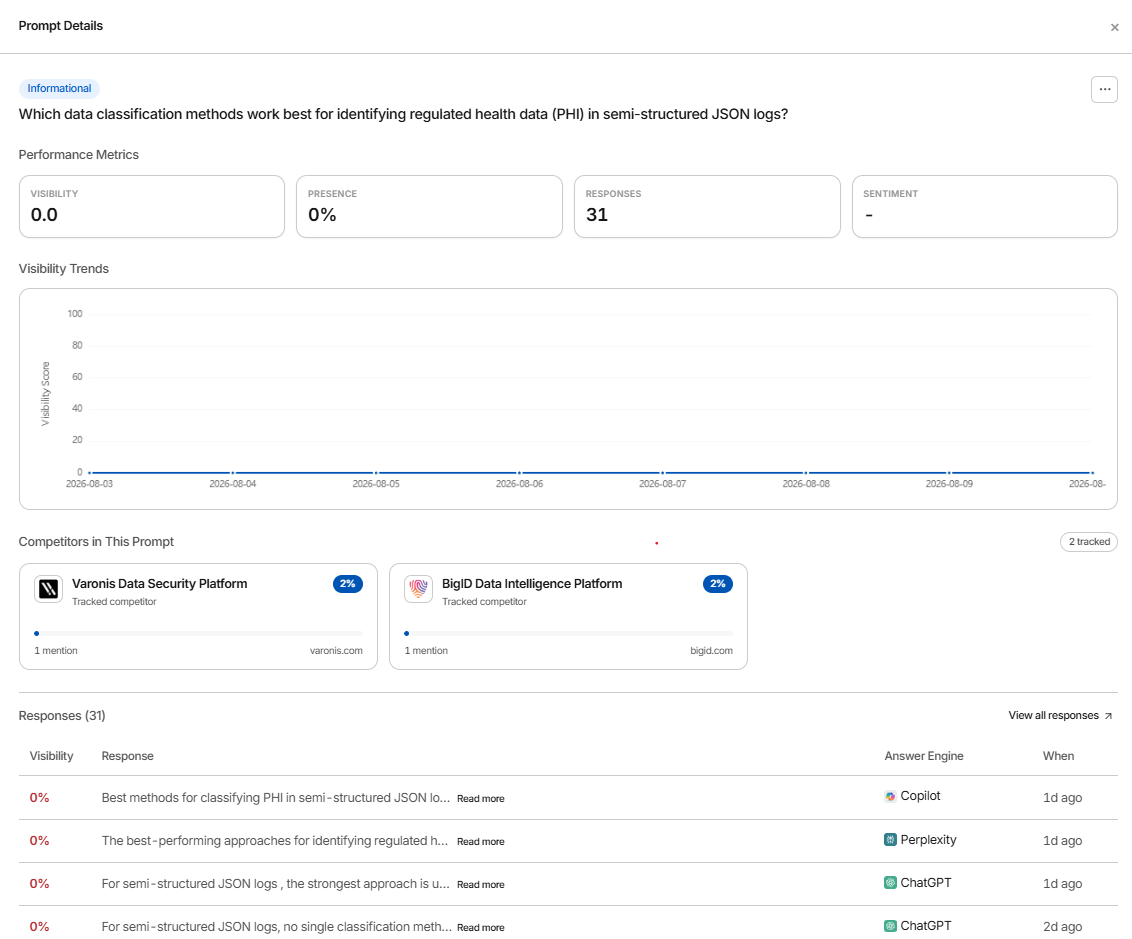
GrackerAI's Prompt Details view for a tracked prompt where the brand has zero visibility (0.0 score, 0% presence across 31 responses), while two tracked competitors, Varonis and BigID, are being mentioned on the same prompt across Copilot, Perplexity, and ChatGPT. This is what a real citation gap looks like before it's closed.
Frequently Asked Questions
Is there a "rank" in Perplexity like there is on Google?
No. There's no static position 1. The comparable metric is citation frequency, how often your domain is selected as a source for a given query. You're either cited or you're not, and that can change each time the index refreshes.
What's the difference between citation share and citation frequency?
Citation frequency is the raw count of times your domain is cited across your tracked prompts. Citation share is that count expressed as a percentage of all citations on those same prompts, which shows you how you stack up against competitors on the same query set rather than just an absolute number.
Can I use standard SEO tools to track Perplexity?
No, not reliably. Standard SEO tools look for your URL in a list of ranked links on a results page. Perplexity's citations are embedded inside a generated response, so tracking them requires a tool that actually queries the model and parses the citations out of the answer, not a page-scraping crawler.
What's the most important factor for getting cited in Perplexity?
Authority and freshness. Perplexity needs to trust that your site is a credible source and verify that the information is current. Stale content loses to a more recently updated, equally credible source even if your page was originally more comprehensive.
How often should I check my Perplexity visibility?
Weekly, using the same fixed set of seed prompts each time. Perplexity's index refreshes often enough that weekly tracking catches real movement, while changing your prompt wording between checks makes the data incomparable and turns a trend into noise.
Do I need a different tool for Perplexity than for ChatGPT and Gemini?
Not necessarily. Several tools, including GrackerAI, Otterly, and SE Ranking, track Perplexity alongside other engines in one dashboard. A single cross-engine view is generally more useful than a Perplexity-only tool, since it shows whether a citation gap is specific to one engine or a broader pattern across all of them. If ChatGPT is your other priority engine, our breakdown of ChatGPT brand mention tracking tools covers what six years of tracking it taught us. If Microsoft Copilot matters more for your buyers, our Copilot rank tracking guide walks through its Bing-first retrieval pipeline and how "Share-of-Model" differs from Perplexity's citation-frequency metric. None of these citation-frequency numbers mean much if the SERP or citation-scraping infrastructure behind the tracker is cutting corners — see the hidden cost of bad SERP data on SEO strategy for how scraping quality quietly distorts the numbers teams build strategy on.
![10 Best Local Rank Tracker Tools: In-Depth Comparison Guide [2025]](https://cdn.pseo.one/6abcb68a626591c40e1c8aa6/687e1c1ef6fe799d288518df/68809c373eb8562bcf68975d/10-best-local-rank-tracker-tools-comparison-guide/feature-image.jpg)