How to Measure AI Share of Voice (AI SOV): Metrics, Tools & Best Practices


According to Gartner (2024), traditional search engine volume will drop 25% by 2026 as buyers shift queries to AI chatbots and other virtual agents. That shift is already pulling brand discovery out of blue links and into AI answers, which means the old share-of-voice math no longer tells you who is winning.
To measure AI share of voice, you track how often your brand is mentioned and cited in AI engine answers for a fixed set of buyer prompts, then express it as your share of all brand mentions across competitors. You do it per engine, across ChatGPT, Perplexity, Claude, Gemini, Microsoft Copilot, and Google AI Overviews, because each one cites different sources.
AI share of voice (AI SOV): the percentage of brand mentions or citations your company earns, out of all brand mentions across a defined set of prompts, inside AI answer engine responses. It measures how much of the AI conversation about your category you own, the same way traditional SOV measured your slice of paid or organic search visibility.
Key Takeaways
AI share of voice measures your percentage of brand mentions across AI engine answers for a fixed prompt set, not keyword rankings.
Measure it per engine. The six engines cite different sources, so a blended score hides real gaps.
The core formula: your brand mentions divided by total brand mentions across tracked competitors.
Citation frequency and average citation position matter as much as raw mention count.
A free AI visibility score takes about 60 seconds and gives you a baseline.
The core metrics that make up an AI share of voice score:
Metric | What It Measures | Why It Matters | How to Track It |
|---|---|---|---|
Mention frequency | How often your brand name appears in answers | Raw presence in the AI conversation | Count brand mentions per prompt set |
Citation frequency | How often your domain is cited as a source | Direct AI-referred traffic and trust | Track cited URLs per engine |
Average citation position | Where you rank inside list answers | First-named brands convert better | Record list order across prompts |
Prompt coverage | Share of buyer prompts where you appear | Breadth across the buyer journey | Appearances divided by total prompts |
What Is AI Share of Voice and Why Does It Matter Now?
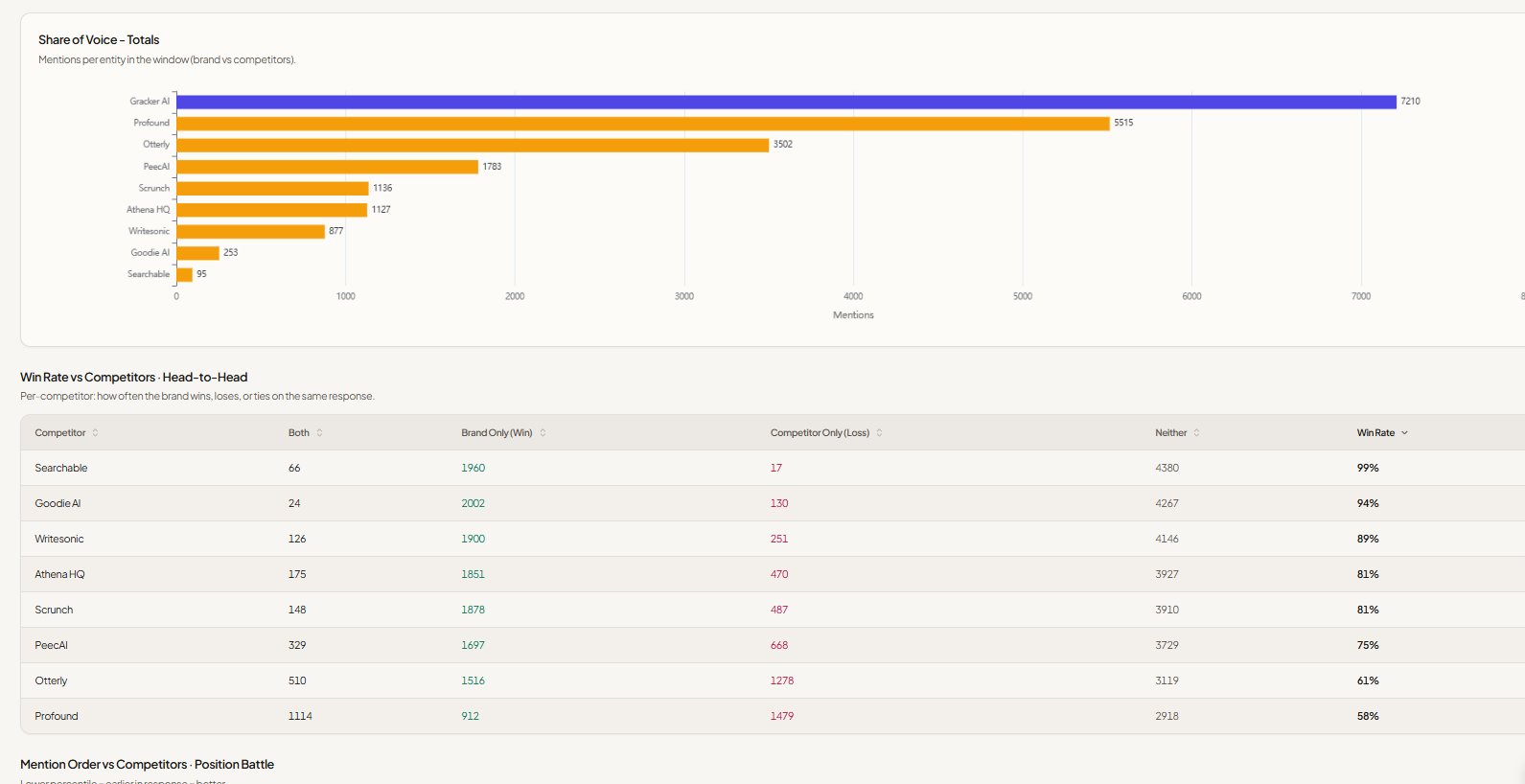
AI share of voice is your portion of brand mentions inside AI answer engine responses, measured across a fixed set of category prompts. It matters now because buyers are asking AI engines for vendor shortlists instead of scrolling search results, and the brands that get named are the ones that get evaluated.
The behavior change is not speculative. According to Gartner (2024), traditional search engine volume will drop 25% by 2026 as buyers shift to AI chatbots. On the demand side, OpenAI CEO Sam Altman confirmed at the company's October 2025 DevDay that ChatGPT reached 800 million weekly active users, up from roughly 400 million seven months earlier. When that many people ask an AI for recommendations, your presence in those answers becomes a pipeline input, not a vanity metric.
Traditional SEO optimized for blue links. AI doesn't serve links, it serves answers. So you can rank #1 on Google and still be invisible in ChatGPT, because the engine pulled its shortlist from a Reddit thread and two analyst pages that never mention you. AI share of voice is the metric that catches that gap. If you run a cybersecurity GEO program, this is the single number your leadership will ask about first. EDR challengers use exactly this metric to counter a budget-dominant incumbent — Beating CrowdStrike at Their Own Game: Alternative SEO Strategies for EDR Startups walks through what that looks like in practice.
How Is AI Share of Voice Different From Traditional Share of Voice?
Traditional share of voice measured your slice of a fixed surface: ad impressions, keyword rankings, or social mentions. AI share of voice measures your slice of generated answers, which are non-deterministic and vary by engine, by prompt phrasing, and by the day you ask.
That difference changes the math in three ways. First, the surface is the answer text itself, so a mention only counts if the model actually names your brand or cites your domain. Second, the same prompt produces different answers across the six engines, so you cannot average them into one trustworthy figure without losing signal. Third, position inside the answer carries weight, because a brand named first in a list of five gets disproportionate buyer attention compared to one buried at the end. You can read more about position distribution from Hero to Tail when you set up scoring.
What Metrics Make Up an AI Share of Voice Score?
AI share of voice is built from four measurable components: mention frequency, citation frequency, average citation position, and prompt coverage. Together they tell you not just whether you appear, but how often, how prominently, and across how many of the questions your buyers actually ask. The comparison table near the top of this article lays out what each one measures and how to track it; our GEO metrics and KPIs reference covers these alongside the rest of the GEO measurement stack.
Mention frequency is the headline number most people mean by "share of voice." Citation frequency is stricter, because being cited as a source sends real AI-referred traffic and signals that the engine trusts your content enough to link it. Track both. A brand with high mentions but low citations is talked about but not driving clicks.
How to Measure AI Share of Voice: A Step-by-Step Framework
You measure AI share of voice by defining a prompt set, querying every engine, counting mentions and citations, calculating your share against competitors, and tracking the trend on a fixed cadence. Here are the concrete steps.
Step 1: Build a Representative Prompt Set
Start with 30 to 100 prompts that mirror how real buyers ask AI engines about your category. Pull them from sales call notes, your Google Search Console query data, and the literal questions prospects type. Cover the full journey: category-defining prompts ("best email security platforms"), comparison prompts ("CrowdStrike vs SentinelOne"), and problem prompts ("how do I stop phishing emails"). A prompt set that only covers branded queries will overstate your share badly.
Step 2: Query All Six Engines With the Same Prompts
Run every prompt through ChatGPT, Perplexity, Claude, Gemini, Microsoft Copilot, and Google AI Overviews. Use the same wording each time so results stay comparable. Run each prompt more than once, because answers are non-deterministic and a single query can miss a mention that shows up two-thirds of the time. This is the step where manual tracking breaks down fast, and why most teams move to a tracking tool after their first audit.
Step 3: Count Brand Mentions and Citations Per Engine
For each answer, record two things: whether your brand is named in the text, and whether your domain is cited as a source. Do the same for every competitor you track. Keep the engine labels separate. You will almost always find that your Perplexity presence looks nothing like your Google AI Overviews presence, because Perplexity leans on different citing domains. A blended average would erase that, and the gap is exactly what you want to fix.
Step 4: Calculate Your Share of Voice
Apply the core formula per engine, then roll it up:
AI Share of Voice = (Your brand mentions) / (Total brand mentions across all tracked competitors) x 100
Run the same calculation for citations to get your citation share. Do it per engine first, then look at the spread between engines before you look at the single blended number — the spread is usually where the actionable gap is.
Step 5: Track the Trend and Set a Cadence
A single snapshot is a baseline, not a program. Re-run the same prompt set on a fixed cadence, weekly or monthly, so you can attribute movement to specific content or PR actions. Watch for new citing domains appearing, old citation sources disappearing, and competitors gaining position inside list answers. Set alerts on big swings. An AI visibility analytics dashboard should show you week-over-week deltas, not just a static number; our guide on tracking AI citations over time covers the manual version of the same workflow.
What Tools Can Measure AI Share of Voice?
You can measure AI share of voice manually with a spreadsheet and a lot of patience, or you can use a dedicated AEO/GEO platform that queries the engines and scores the results for you. The manual path works for a one-time audit; the tooled path is the only sustainable option for a real cadence.
Manual tracking means copying prompts into each engine, logging answers, and tallying mentions by hand. It is honest and free, but it does not scale past a handful of prompts, and it cannot run the repeat queries that non-deterministic answers require. Dedicated AEO/GEO platforms automate the querying, mention detection, and scoring across engines instead. When evaluating one, look at how many AI engines it covers, whether it re-runs prompts to account for non-deterministic answers rather than treating a single query as fact, whether it reports results per engine instead of collapsing everything into one blended score, and whether it is built for your industry's prompts and sources or treats every vertical the same. GrackerAI is purpose-built for cybersecurity brands and tracks up to 10 AI engines depending on plan (Starter covers ChatGPT, Perplexity, and Google AI Mode; Scale adds Microsoft Copilot; Enterprise adds Google AI Overviews, Gemini, DeepSeek, Grok, Claude, and Brave Leo), with per-engine depth and real-buyer prompts pulled through Google Search Console and Bing Webmaster. For a step-by-step framework for tracking your standing against the brands you actually compete with in AI search, see algorithmic competitor analysis: how to reverse-engineer competitors' AI visibility.
Want to see how AI search engines describe your brand today? Get your free AI visibility score in about 60 seconds, with no signup required. Trusted by 500+ security teams.
What Are the Most Common Mistakes When Measuring AI SOV?
The most common mistake is blending all six engines into one score, which hides the per-engine gaps that actually cost you citations. The second is using a prompt set that is too small or too branded to represent real buyer behavior.
A few more traps worth naming. Teams measure mentions but ignore citation position, so they celebrate appearing in an answer while sitting last in a five-brand list that buyers skim past. They query each prompt once and treat the result as fact, when answers shift run to run. They forget to track competitors, so they have a numerator with no denominator and no real share. And they measure once, declare victory or defeat, and never set a cadence, which means they cannot tell whether last quarter's content actually moved anything. If you want the deeper playbook, the GrackerAI blog covers each of these failure modes with examples.
Frequently Asked Questions
What is AI share of voice?
AI share of voice is the percentage of brand mentions or citations your company earns out of all brand mentions across a defined set of prompts inside AI answer engine responses. It measures how much of the AI conversation about your category you own. You calculate it by dividing your brand mentions by the total brand mentions across all tracked competitors, per engine.
How do you calculate AI share of voice?
Divide your brand's mentions by the total brand mentions across every competitor you track, for the same prompt set, then multiply by 100. Run the calculation separately for each engine, ChatGPT, Perplexity, Claude, Gemini, Microsoft Copilot, and Google AI Overviews, because each cites different sources. Run the same math on citations to get your citation share alongside your mention share.
Why measure AI share of voice per engine instead of one blended score?
Each AI engine pulls from different citing domains, so the same prompt produces different brand mentions across them. A blended average erases those differences and hides the specific engine where you are losing. Measuring per engine shows you exactly where to focus content and citation-building work, which a single number never could.
What tools measure AI share of voice across ChatGPT and Perplexity?
Dedicated AEO/GEO platforms automate querying and mention scoring across AI engines instead of doing it by hand. GrackerAI tracks up to 10 AI engines depending on plan, with per-engine depth, and is purpose-built for cybersecurity brands. You can also measure manually with a spreadsheet for a one-time audit, though it does not scale to a regular cadence.
How often should you measure AI share of voice?
Re-run your prompt set weekly or monthly on a fixed cadence so you can attribute changes to specific content or PR actions. A single snapshot only gives you a baseline. Consistent cadence lets you spot new citing domains, lost citation sources, and competitors gaining position inside list answers before those shifts cost you pipeline.
Final Thoughts
AI share of voice is becoming the visibility metric that matters most, because buyers now ask engines for shortlists and the named brands win the evaluation. Define your prompts, measure per engine, track the trend, and you will know exactly where you stand. Start with a baseline number, then build the cadence that turns it into a program.
Share of voice is one input into a larger reporting model — growth teams also need to weigh mention frequency, prompt relevance, and how a brand is framed within the answer itself. See AI visibility metrics: a practical overview for growth teams for how those pieces fit together.
![10 Best Local Rank Tracker Tools: In-Depth Comparison Guide [2025]](https://cdn.pseo.one/6abcb68a626591c40e1c8aa6/687e1c1ef6fe799d288518df/68809c373eb8562bcf68975d/10-best-local-rank-tracker-tools-comparison-guide/feature-image.jpg)