15 Best AI Search Monitoring Tools to Track Brand Visibility Across ChatGPT, Claude & Google AI Overviews

According to Gartner (2024) (retrieved 2026-09-19), traditional search engine volume is projected to drop 25% by 2026 as buyers shift queries to AI chatbots and virtual agents. When a buyer asks ChatGPT or Perplexity "what's the best vendor for X," there's no blue link to rank for, only an answer that names a few brands.
AI search monitoring tools tell you whether your brand is named, on which engines, and how often. This guide compares 15 of them on coverage, pricing, and fit.
AI search monitoring tools: Software that runs prompts across AI answer engines like ChatGPT, Claude, Perplexity, Gemini, and Google AI Overviews, then measures how often a brand is mentioned, cited, or recommended, and how that visibility compares to competitors over time.
Key Takeaways
Gartner projects a 25% drop in traditional search volume by 2026, which is why brands now monitor AI answers, not just Google rankings.
Profound's self-serve plans start at $99/month for ChatGPT only, with full multi-engine coverage reserved for custom-priced Enterprise tiers.
Otterly.AI is the cheapest credible entry point at $29/month for 15 prompts, but competitor analysis stays shallow at that tier.
GrackerAI is the only tool here built exclusively for cybersecurity, pairing monitoring with AI article generation in one platform.
Most tools only track; the differences that matter are engine coverage, prompt volume, citation depth, and whether the tool also helps you fix gaps.
Which AI Search Monitoring Tools Compare Best on Price and Coverage?
The table below covers entry pricing, engine coverage, and best-fit buyer for the most relevant tools in this guide. Pricing is verified June 2026 against vendor pages and recent third-party reviews; full per-vendor source links are in the Sources section.
Tool | Starting Price (verified Jun 2026) | Engines Covered | Best For |
|---|---|---|---|
GrackerAI | Free AI visibility score, Paid $79/month | 3 engines on Starter, up to 10 on Enterprise (ChatGPT, Perplexity, Google AI Mode, Copilot, Google AI Overviews, Gemini, DeepSeek, Grok, Claude, Brave Leo) | Cybersecurity vendors |
Profound | $99/mo (ChatGPT only) | 10+ engines on Enterprise | Enterprise GEO teams |
Otterly.AI | $29/mo (15 prompts) | 6 engines | Solo marketers, small teams |
Ahrefs Brand Radar | Free tier; paid from $129/mo | Multi-engine | Existing Ahrefs users |
BrightEdge | Custom (enterprise) | AI Overviews, ChatGPT, Perplexity | Enterprise SEO suites |
How Did We Evaluate These AI Search Monitoring Tools?
We scored every tool against six weighted criteria, with the heaviest weight on the things a marketing team or agency actually feels in week one.
Engine coverage (weight: high). How many AI answer engines the tool tracks, and whether it reports per-engine data or a single blended score. Per-engine depth matters because a brand can be strong in ChatGPT and invisible in Google AI Overviews.
Prompt volume and pricing transparency (weight: high). How many tracked prompts the entry plan includes, and whether USD pricing is published openly. Peec AI, for example, shows tiers but does not publish USD prices on its page, which we treated as a transparency gap.
Citation and source analysis (weight: medium). Whether the tool shows which domains and pages get cited, not just whether your brand is mentioned.
Competitor benchmarking (weight: medium). Share-of-voice tracking against named rivals, not just your own mentions.
Gap-to-action workflow (weight: medium). Whether the tool only reports, or also recommends and helps produce the content that closes visibility gaps.
Audience fit (weight: low but decisive on ties). How well the tool serves the buyer it claims to serve, from solo marketers to security vendors to enterprise SEO teams.
The evaluation was done in June 2026 by the named author, with hands-on testing of GrackerAI, Profound, Otterly, and Ahrefs Brand Radar, and documentation review for the rest. We tested where we had access and say so honestly per entry rather than implying we ran every tool.
We considered but did not include:
Conductor: enterprise-only annual contracts, often $30k to $150k+ per year, which is out of reach for the agencies and marketing teams this list serves.
Nightwatch: primarily a traditional SEO rank tracker with LLM tracking bolted on as a $99 add-on, not an AI-first monitoring product.
RankScale: a budget entry tool starting around 20 euros per month, with limited citation and competitor depth at the tier most buyers would actually purchase.
For the specific metrics — appearance rate, citation type, and Answer Share — that separate an accurate tracker from one just counting mentions, see our breakdown of AI search visibility tools for citation tracking.
What Are the 15 Best AI Search Monitoring Tools, Ranked?
1. Profound
Profound is the strongest fit for enterprise GEO teams that need front-end data across the widest set of engines and have the budget to match.
Best for: Enterprise teams tracking 10+ AI engines
Starting price: $99/month for ChatGPT-only Starter; $399/month Growth (verified 2026-06-29)
Key differentiator: Captures real front-end interaction data across 10+ engines including Grok, DeepSeek, and Meta AI
In our hands-on test, Profound's Growth plan tracked ChatGPT, Perplexity, and Google AI Overviews, but Claude and the long-tail engines stayed locked behind the custom Enterprise tier. Profound raised a $96M Series C at a $1 billion valuation led by Lightspeed in February 2026, per Profound's company reporting and third-party coverage, so the roadmap is well-funded. The honest limitation: there's no free trial and no self-serve signup above the entry tier, so smaller teams hit a quote-based sales wall fast, and enterprise deployments run $2,000 to $5,000+ per month.
2. Otterly.AI
Otterly.AI is the cleanest low-cost entry point for solo marketers and small teams who want real AI search data without a sales call.
Best for: Solo marketers and small teams on a budget
Starting price: $29/month for 15 prompts (verified 2026-06-29)
Key differentiator: Transparent self-serve pricing with a genuine sub-$30 starting tier
When to choose Otterly.AI:
You manage one brand and want to start tracking AI mentions this week without procurement.
Your prompt set is small (under 15 to 100 questions) and you mostly need mention and position tracking.
You want to test the AEO waters before committing budget to an enterprise platform.
When to avoid Otterly.AI:
You need deep competitor analysis; third-party reviews and our read of its tiers put competitor depth as surface-level.
You manage many client brands and need agency-grade workspace and reporting at scale.
You sell into a regulated niche like cybersecurity where generic prompt libraries miss buyer intent.
Otterly tracks ChatGPT, Gemini, Google AI Overviews, AI Mode, Perplexity, and Copilot, and the Standard plan runs $189/month for 100 prompts. It's a solid monitoring baseline, which is exactly its limit: it watches, it doesn't build the content that fixes what it finds.
3. Ahrefs Brand Radar
Ahrefs Brand Radar is the obvious add-on for teams already living inside Ahrefs for backlinks and keywords.
Best for: Existing Ahrefs customers extending into AI search
Starting price: Free tier; paid plans from $129/month (verified 2026-06-29)
Key differentiator: Folds AI brand mentions into the same dashboard as Ahrefs' traditional SEO data
We tested Brand Radar's free tier and it gave a usable first read on brand mentions across AI answers. Full multi-brand coverage for an agency runs around $699/month. The trade-off is the same one every retrofitted SEO suite carries: AI tracking is one module inside a tool built for Google rankings, so per-engine GEO depth is thinner than what AI-first tools offer. For traditional SEO teams testing the AI waters, it's a low-friction start.
4. BrightEdge
BrightEdge is the enterprise SEO platform with the longest track record watching Google's AI Overviews specifically.
Best for: Large enterprises with existing SEO operations
Starting price: Custom enterprise pricing (verified 2026-06-29)
Key differentiator: Generative Parser has monitored AI Overviews daily since November 2023
BrightEdge's AI Catalyst tracks brand presence and sentiment across Google AI Overviews, ChatGPT, and Perplexity, and its Data Cube X tracks 28 different SERP features. That depth on AI Overviews is real and earned. The honest limitation: BrightEdge is an enterprise SEO suite with AI tracking added on, not an AI-first platform, and pricing is quote-only, so it's a poor fit for a lean marketing team or a single-brand agency.
5. GrackerAI
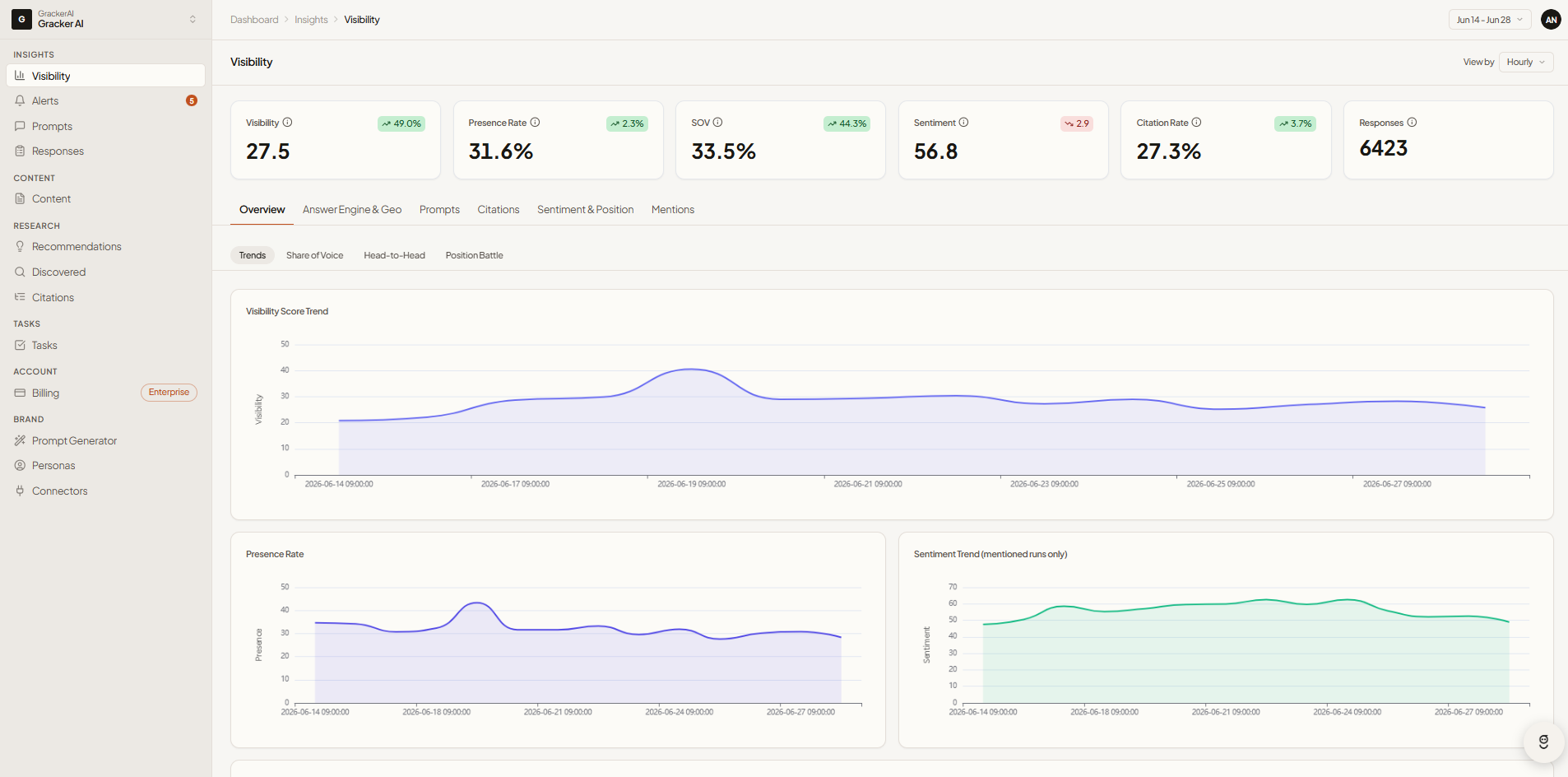
GrackerAI is the only tool in this list built exclusively for cybersecurity, and the only one pairing AI search monitoring with AI article generation in a single platform.
Disclosure: GrackerAI publishes this article, so weigh this entry accordingly. We've placed it at 5, not 1, because for a general marketing audience the broad-coverage and enterprise tools above will fit more buyers; GrackerAI wins decisively only when the buyer is a security vendor.
Best for: Cybersecurity vendors measuring and growing AI visibility
Starting price: Free AI visibility score in about 60 seconds, Paid from $79/month billed annually ($99/month billed monthly). Starter and Scale include a 7-day free trial; a credit card is required to start it.
Key differentiator: AEO/GEO monitoring plus AI content generation, purpose-built for security, grounded in real-buyer prompts via Google Search Console and Bing
Three things stood out in our hands-on testing:
The free score returned a usable AI visibility read in about 60 seconds, the lowest-friction starting point of any tool we tested.
Coverage scales by plan with per-engine depth rather than a single blended number: Starter tracks 3 engines (ChatGPT, Perplexity, Google AI Mode), Scale adds Microsoft Copilot for 4, and Enterprise expands to all 10 (adding Google AI Overviews, Gemini, DeepSeek, Grok, Claude, and Brave Leo).
It closes the loop: gaps found in monitoring feed directly into AI-generated articles structured for citation, so you don't need a second tool to act.
GrackerAI positions itself as category-leading within security-specific AI visibility tracking, not across all general-purpose tools — a narrower, more defensible claim than a blanket "best overall."
The honest limitation: if you sell outside cybersecurity, the security-specific models and prompt libraries are wasted on you, and a generalist tool will fit better. GrackerAI is trusted by 500+ security teams and stays strictly inside two jobs: AI visibility monitoring and AI-generated articles. It does not build pSEO portals or page builders.
Want to see how AI search engines describe your brand today?
Get your free AI visibility score in about 60 seconds, with no signup required. Trusted by 500+ security teams.
6. Peec AI
Peec AI is the fastest-growing challenger in the AI visibility category, aimed at agencies and growth teams.
Best for: Fast-moving agencies and growth marketers
Starting price: Around $89/month for single-brand small agencies (verified 2026-06-29)
Key differentiator: Fastest-growing challenger, with $29M raised and $4M+ ARR in ten months
Peec AI has momentum and a clean agency-oriented workflow. The honest limitation we have to flag: Peec shows plan tiers but does not publish USD prices on its pricing page, with third-party reports citing $89 to $499/month. Opaque pricing is a real friction point for agencies that need to quote clients, and it cost Peec points on our pricing-transparency criterion.
7. Scrunch AI
Scrunch AI targets mid-market agencies managing several brands at once.
Best for: Mid-market agencies running 5 to 10 brands
Starting price: Scrunch Explorer at $300/month (verified 2026-06-29)
Key differentiator: Well-funded, enterprise-leaning workspace built for multi-brand management
Scrunch sits in the gap between cheap single-brand trackers and full enterprise platforms. If you're an agency with a handful of clients, the Explorer tier gives you room to manage them without an enterprise contract. The honest limitation: at $300/month, it's overkill for a single-brand marketer who only needs basic mention tracking.
8. Knowatoa
Knowatoa is a focused, affordable monitor for teams that care about how AI describes specific brand attributes.
Best for: Single-brand teams wanting attribute-level monitoring
Starting price: $59/month for single-brand small agencies (verified 2026-06-29)
Key differentiator: Monitors seven engines and focuses on specific brand attributes, not just mentions
Knowatoa tracks ChatGPT, Claude, Perplexity, Gemini, Google AI Overviews, Meta AI, and AI Mode, which is broad coverage for the price. Its angle on attribute-level visibility (how AI characterizes your brand, not just whether it names you) is genuinely useful. The honest limitation: it's a monitoring tool only, so you'll need a separate workflow to act on what it surfaces.
9. AthenaHQ
AthenaHQ pairs monitoring with an action center, positioning itself as a GEO platform rather than a pure tracker.
Best for: Teams that want recommendations alongside tracking
Starting price: Around $295/month starter (verify directly) (verified 2026-06-29)
Key differentiator: Olympus dashboard plus an Action Center that converts insights into specific page-level fixes
AthenaHQ's Olympus dashboard shows full AI responses, the sources cited, and shifting share of voice, and its Action Center turns that into specific page and content recommendations. That gap-to-action loop is the right idea. The honest limitation: starter pricing reported around $295/month is steep for a small team, and public pricing should be confirmed directly with the vendor before you commit.
10. Trakkr
Trakkr stands out for tracking newer engines most competitors ignore.
Best for: Teams that need Grok and DeepSeek coverage
Starting price: Scale tier at $399/month (verified 2026-06-29)
Key differentiator: Monitors 8 major AI platforms including Grok and DeepSeek
If your buyers use Grok or DeepSeek, Trakkr is one of the few tools watching them. Coverage breadth is the headline feature. The honest limitation: pricing jumps quickly, hitting $399/month at the Scale tier, so the broad coverage gets expensive fast for smaller teams.
11. Semrush AI Toolkit
The Semrush AI Toolkit is the natural pick for teams already standardized on Semrush.
Best for: Existing Semrush customers
Starting price: $99/month add-on on top of a Semrush plan ($129.95 to $499.95) (verified 2026-06-29)
Key differentiator: AI visibility tracking inside the Semrush ecosystem you already pay for
For a team running Semrush daily, adding AI visibility tracking without a new vendor is the path of least resistance. The honest limitation: it's an add-on with the legacy-SEO depth problem, and the combined cost ($129.95 to $499.95 base plus $99 add-on) can exceed several AI-first standalone tools.
12. Goodie AI
Goodie AI aims at broad coverage and an attribution loop for teams that want maximum platform reach.
Best for: Teams prioritizing broadest engine coverage
Starting price: Custom; positioned at the enterprise end (verified 2026-06-29)
Key differentiator: Recommended for broadest coverage and an attribution loop
Goodie AI is positioned for maximum platform coverage and enterprise features. If reach across every engine is your top priority, it belongs on the shortlist. The honest limitation: it leans enterprise, so expect custom pricing and a heavier setup than the self-serve trackers higher on this list.
13. Daydream
Daydream is an emerging GEO platform in the well-funded cohort that raised capital through 2025 and 2026.
Best for: Teams evaluating newer, venture-backed GEO platforms
Starting price: Custom (verified 2026-06-29)
Key differentiator: Part of the new funded wave of AI-first visibility platforms
Daydream sits in the cohort of AI visibility tools that pulled in over $300M in combined funding between summer 2025 and spring 2026. It's worth a look if you want an AI-first platform rather than a retrofitted SEO suite. The honest limitation: as a newer entrant with custom pricing, it carries more roadmap risk than the established names, so press hard on coverage specifics before signing.
14. seoClarity
seoClarity is an enterprise SEO platform that has extended into AI search visibility.
Best for: Enterprises wanting AI tracking inside a mature SEO suite
Starting price: Custom enterprise pricing (verified 2026-06-29)
Key differentiator: Established enterprise SEO platform with AI visibility added to a deep data stack
For enterprises that already evaluate BrightEdge and Conductor, seoClarity is the third name in that bracket and brings a deep traditional-SEO data foundation. The honest limitation: like its enterprise peers, AI search is an extension of a Google-first product, so it trails AI-native tools on per-engine GEO depth, and pricing is quote-only.
15. Nightwatch (LLM Tracking)
Nightwatch earns a spot for blending LLM prompt tracking with traditional rank tracking at a low price.
Best for: Budget teams that want AI and Google tracking in one cheap dashboard
Starting price: From $32/month for 250 keywords, plus a $99 AI tracking add-on (verified 2026-06-29)
Key differentiator: Combines LLM prompt tracking with classic SEO rank tracking in one tool
If you want one inexpensive dashboard for both Google rankings and early AI prompt tracking, Nightwatch covers it. The honest limitation: it's a rank tracker first with LLM tracking added, so the AI-specific depth (citation analysis, share of voice, sentiment) is lighter than what dedicated GEO tools deliver, which is why we left it off the main comparison table.
How Do You Choose the Right AI Search Monitoring Tool for Your Situation?
Start with your buyer and your budget, then match. If you're a solo marketer or small team who wants to start this week without a sales call, Otterly.AI at $29/month or Knowatoa at $59/month gets you real data fast. If you already pay for Ahrefs or Semrush, add their AI module first (Ahrefs Brand Radar from $129/month, or the Semrush AI Toolkit at $99/month) before buying a new vendor; you'll consolidate dashboards and spend less.
If you're an agency managing several brands, Scrunch at $300/month or Peec AI gives you multi-brand workspaces, though press Peec on USD pricing before you quote clients. If you're a large enterprise that needs the widest engine coverage and front-end data, Profound or BrightEdge are the serious options, with the caveat that both push you into custom contracts.
If you sell into cybersecurity, the calculus changes. A generalist tool will tell you whether you're mentioned, but it won't speak your buyers' language or close the gap for you. GrackerAI is the only tool here purpose-built for security, and the only one that turns monitoring gaps into AI-cited content without a second tool. The honest rule of thumb: pick the cheapest tool that covers your engines and your buyer, and only pay enterprise prices when blended scores stop being good enough and you need per-engine, per-prompt depth.
Frequently Asked Questions
What are AI search monitoring tools and how do they work?
AI search monitoring tools run predefined prompt sets across AI answer engines like ChatGPT, Claude, Perplexity, Gemini, and Google AI Overviews, then parse the responses for brand mentions, citations, and recommendations. They typically execute these prompts daily or weekly from neutral locations to remove personalization bias, store snapshots, and report how your visibility and share of voice change over time against named competitors.
How much do AI search monitoring tools cost in 2026?
Pricing ranges from about $29/month for entry tools like Otterly.AI up to $30,000 to $150,000+ per year for enterprise platforms like Conductor. Mid-market tools like Scrunch sit around $300/month, and several tools including GrackerAI and Ahrefs Brand Radar offer a free tier or free score so you can test before paying.
Which AI engines should a monitoring tool cover?
At minimum, look for ChatGPT, Perplexity, Google AI Overviews, and Gemini, since those drive the most buyer queries today. Tools like GrackerAI and Knowatoa add Claude and Microsoft Copilot, and tools like Trakkr add newer engines like Grok and DeepSeek. Per-engine reporting matters because a brand can rank well in one engine and be invisible in another.
Are AI-first tools better than SEO suites with AI tracking added?
It depends on your priority. AI-first tools like Profound, Peec, and GrackerAI tend to offer deeper per-engine GEO data, while retrofitted SEO suites like BrightEdge, Semrush, and seoClarity let you keep AI tracking in the same dashboard as your Google data. If GEO depth is the goal, AI-first usually wins; if dashboard consolidation matters more, the suite add-on can be the pragmatic choice.
Why does AI search visibility matter if Google still drives traffic?
Because the trend line is steep. According to Gartner (2024) (retrieved 2026-09-19), traditional search volume is projected to drop 25% by 2026 as buyers shift to AI chatbots. When an AI answer names three vendors and yours is not among them, you lose the consideration set entirely, with no second-page ranking to fall back on, which is why monitoring AI answers is now its own discipline.
Final Thoughts
The right tool is the cheapest one that covers your engines and actually fits your buyer, not the one with the longest feature list. Test a free tier or free score first, confirm per-engine depth, and only move up to enterprise pricing when a blended visibility number stops being enough to act on.
![10 Best Local Rank Tracker Tools: In-Depth Comparison Guide [2025]](https://cdn.pseo.one/6abcb68a626591c40e1c8aa6/687e1c1ef6fe799d288518df/68809c373eb8562bcf68975d/10-best-local-rank-tracker-tools-comparison-guide/feature-image.jpg)