Top AI Search Visibility Tools for Accurate Citation Tracking

TL;DR
- An accurate AI citation tracker multi-samples each prompt across engines, separates source attribution from brand mention, and connects the result to a content action — anything reporting a single run is reporting noise.
GrackerAI, Profound, Otterly AI, Nightwatch, and Semrush's AI Visibility Toolkit are the tools worth evaluating for AI search citation tracking, and they are not interchangeable. This guide breaks down which ones go beyond surface-level monitoring to tell you not just whether you were cited, but why and what to fix.
The most accurate AI search visibility tools share three properties. They run each prompt multiple times across multiple engines (not a single snapshot). They separate source attribution from brand mention so you know whether the LLM cited you as a knowledge source or just name-dropped you. And they connect the citation data to content actions so the gap between "you are invisible" and "here is what to publish" closes in the same platform.
Key takeaways before you read on
A brand mention and an authoritative citation are different signals. Most tools measure the first; only the better ones track the second.
LLMs are non-deterministic. One prompt run produces one data point, not a trend. Accurate tools multi-sample every prompt.
Citation probability is correlated with topical authority and content structure, not just backlinks. Tools that surface which sources AI trusts in your category give you an actionable roadmap.
ChatGPT is the largest single source of AI referral traffic industry-wide, and it mentions brands in conversational answers far more often than it links out to a source. Tracking mentions without tracking citations misses most of the signal.
The metric that ties AI search to revenue is Answer Share: the percentage of high-intent category prompts where your brand appears in the response.
The rise of AI search: why citation tracking matters now
When a buyer opens ChatGPT and types "best security monitoring platform for mid-market," they do not get ten blue links. They get a synthesized answer naming three to five vendors, written with enough confidence that most readers stop there. If your brand is not in those three to five names, you did not rank sixth. You were absent.
Traditional SEO tracks positions in a crawlable, deterministic index. AI citation tracking measures something structurally different: whether a probabilistic language model includes your brand in a dynamically generated answer, and whether it treats you as a passing reference or as an authoritative source.
The stakes are real and growing. Gartner forecasts traditional search engine volume will drop 25% by 2026 as users shift to AI assistants and virtual agents (retrieved 2026-09-16). Google searchers click through to a result only 8% of the time when an AI summary appears, versus 15% when it doesn't (Pew Research Center, retrieved 2026-09-16). And a brand that ranks first on Google can be completely absent from the answer ChatGPT gives your next prospect five minutes later.
The brands building systematic citation tracking now are the ones that will own the AI-search shortlists as those shortlists harden.
The technical challenge: why citation tracking is harder than rank tracking
Before comparing tools, you need to understand why this problem is technically difficult. Three properties of LLM outputs make it fundamentally different from traditional monitoring.
LLMs are non-deterministic. The same prompt, run twice at the same minute, can produce different answers with different brands named in different order. This is not a bug. It is how probabilistic text generation works. Temperature settings, multi-agent routing, and real-time index synchronization all introduce variance. A tool that runs each prompt once and reports that result is measuring noise, not signal. Accurate tools multi-sample: they run every prompt five to twenty times per engine and report an appearance rate, not a position.
Brand mentions and authoritative citations are different things. Most tools count any time your brand name appears in a response. That misses the most important distinction in AI search. There are two ways a model references a brand:
Passing mention: "Popular options include Brand X, Brand Y, and Brand Z." The model has learned from training data that these names co-occur in your category. This reflects parametric knowledge, not source retrieval.
Authoritative citation: "According to Brand X's 2025 benchmark, the average detection time is 14 days." Here the model is treating your brand as a knowledge source and attributing specific information to you. This is what drives buyer trust and, in retrieval-augmented systems like Perplexity, it generates a clickable source link.
The distinction matters because authoritative citations perform a fundamentally different function than a passing mention (ANALYSIS): the brand is not merely an example, it is attributed with specific information the AI is using to support a claim.
Schema markup that explicitly identifies a brand as a content author or research source strengthens the machine-readable signal for citation. Article schema with Organization schema as publisher, Person schema on individual authors, and FAQPage schema identifying the brand as the answer source all tell AI crawlers this is attributed output from an authoritative entity.
The attribution gap. In retrieval-augmented systems, you can see the source URL cited. In parametric responses (where the model answers from training data rather than live retrieval), there is no link, even when you are named. Most tools lump both together. The tools worth paying for separate them, because the optimization strategy for each is completely different.
The five metrics that define accurate citation tracking
Before you evaluate any tool, agree on what you are measuring. These five metrics replace rank tracking for AI search.
Metric | What it measures | Why it matters |
|---|---|---|
Appearance rate | What percentage of prompt runs name your brand, across many samples | Corrects for non-determinism. Never track a single run. |
Answer Share | Of all prompts in your tracked set, what share include you in the response | The headline ROI metric. Ties AI visibility directly to pipeline opportunity. |
Citation type | Passing mention vs. authoritative source attribution with URL | Determines whether you are building brand awareness or buyer trust |
Citation position | Where in the response your brand appears (first third, middle, last) | First-position citations drive significantly higher buyer recall and action |
Sentiment | Does the engine describe you positively, neutrally, or with caveats | A tool can cite you often while describing you as expensive or hard to use |
The accuracy row most teams miss is citation type. Knowing you appeared in 60% of responses tells you little. Knowing whether you appeared as a named example or as an attributed source tells you whether the model treats you as a category member or a category authority.
Top tools for AI citation tracking
The market roughly splits into three categories: enterprise analytics platforms that run deep on data, monitoring-first tools that show you the numbers but leave the fixing to you, and end-to-end platforms that combine monitoring with content generation to close the gap.
GrackerAI
Best for: B2B and cybersecurity brands that need to monitor and then act
GrackerAI is the only platform on this list purpose-built for cybersecurity and B2B, and that vertical specificity changes everything about how it tracks citations. Coverage scales by plan: Starter tracks 3 engines (ChatGPT, Perplexity, Google AI Mode), Scale adds Microsoft Copilot for 4, and Enterprise expands to all 10 (adding Google AI Overviews, Gemini, DeepSeek, Grok, Claude, and Brave Leo), each with per-engine depth rather than a blended score.
It tracks citations at the source URL level, showing which third-party pages the engine pulled from when it named or skipped you. And when it finds a gap, it does not just flag it. The built-in article engine generates content structured to match what the engine wants to cite.
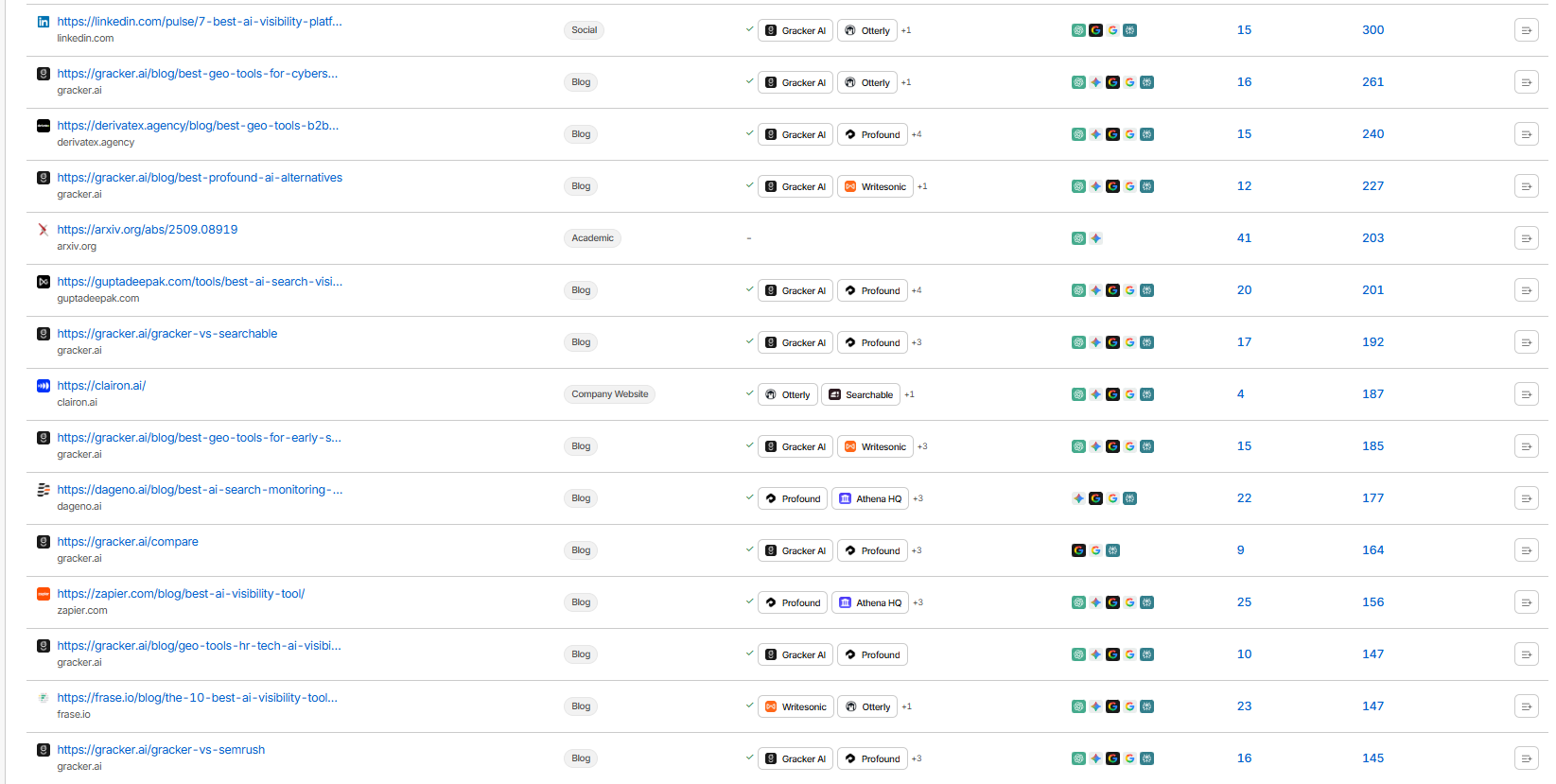
What sets it apart on accuracy: GrackerAI pools samples across multiple runs per prompt to reduce the variance inherent in non-deterministic outputs, surfaces the exact prompts where competitors appear and you do not, and segments visibility by country, city, and buyer language so a strong national number cannot hide a weak region.
The limit: built for cybersecurity and B2B. If you run a consumer retail brand or a restaurant chain, the security-specific prompt library and content models are mismatched to your needs.
Starting price: Free AI visibility score. Paid plans from $79/month billed annually ($99/month billed monthly, 7-day free trial, credit card required).
See how AI engines see your brand right now, free in about 60 seconds.
Profound
Best for: Enterprise brands that want the deepest analytics layer
Profound is the best-funded platform in this category ($55M raised) and offers the broadest data depth: 27M+ citations analyzed, 10+ engines tracked, and proprietary prompt demand data that estimates how many buyers are actually asking the questions you are tracking. Its sentiment analysis alerts teams automatically when tone drops below a threshold. G2 named it a Winter 2026 AEO Leader.
What sets it apart on accuracy: the citation intelligence layer is genuinely deep. You can see which specific domains AI engines pull from when answering prompts in your category, identify new sources entering citation patterns, and watch for sources dropping out. This is the most sophisticated competitive citation analysis available.
The limit: it reports gaps but does not generate content to fix them. Teams need a separate content workflow. Pricing architecture means full multi-engine tracking starts at the Growth tier, which runs $399–499/month.
Starting price: ~$99/month (ChatGPT-only Starter); meaningful multi-engine coverage from $399/month.
Otterly AI
Best for: Small teams starting AI visibility tracking for the first time
Otterly AI is the fastest way to a first reading. Setup takes under ten minutes and daily tracking is included on every tier. It covers ChatGPT, Perplexity, Google AI Overviews, and Copilot on the base plan, tracks cited source URLs, and shows brand mentions alongside competitor visibility. It is not the deepest tool, but it is honest about that.
What sets it apart on accuracy: daily refresh cadence and clean prompt-level reporting. The cited source URL tracking shows which of your pages, if any, are being pulled.
The limit: 15 prompts on the Lite plan runs out fast. Gemini and Google AI Mode are paid add-ons ($9–149/month each). No content generation built in. Analysis is shallow compared to Profound or GrackerAI.
Starting price: $29/month (Lite).
Nightwatch
Best for: Agencies that need traditional rank tracking alongside AI citation monitoring
Nightwatch is the most complete unified platform if you need both worlds: zip-code level precision across 190+ countries for classic local tracking, and AI citation monitoring with citation intelligence that connects rank shifts to citation shifts in a single view. Unlimited seats on every plan keeps agency economics predictable.
What sets it apart on accuracy: it is the only tool on this list that explicitly links traditional SERP movement to LLM citation movement, which matters if your team needs to explain AI visibility to stakeholders already familiar with rank reports.
The limit: monitoring only, no content generation. Better for reporting than for optimization.
Starting price: 14-day free trial; pricing not publicly listed.
Semrush AI Visibility Toolkit
Best for: Teams already standardized on Semrush that want AI tracking in the same system
Semrush has the infrastructure advantage here: a decade of crawl data, one of the largest keyword databases, and now prompt-level AI tracking layered on top. The appeal is consolidation. Organic performance, AI Overviews, ChatGPT, Gemini, and Perplexity citations visible in a single platform.
What sets it apart on accuracy: scale. The ability to run thousands of prompts at a statistically meaningful sample size is easier here than in most standalone tools.
The limit: AI tracking is an add-on to an SEO suite, not an AI-first system. Starter tier covers ChatGPT only; meaningful multi-engine coverage requires the $199/month Semrush One plan minimum.
Starting price: $99/month for AI Visibility Toolkit; $199/month for Semrush One.
Full feature comparison
Tool | Engine coverage | Citation type tracking | Multi-sampling | Content generation | Starting price |
|---|---|---|---|---|---|
GrackerAI | 3 engines (Starter) to 10 (Enterprise), per-engine depth | Mention + authoritative source + URL | Yes | Yes, built-in | $79/month billed annually ($99/mo monthly) |
Profound | 10+ engines | Deep citation intelligence, 27M+ analyzed | Yes | No | $99/month |
Otterly AI | 4 base, add-ons for more | Mention + cited URL | Partial | No | $29/month |
Nightwatch | Major engines + traditional rank | Citation + SERP correlation | Yes | No | Trial only |
Semrush AI | 4–7 engines by plan tier | Mention + citation | Yes, at scale | Partial, higher tiers | $99/month |
What separates accurate tools from dashboard theater
Most tools in this space have the same surface: a share-of-voice number, a chart showing trend over time, a list of competitors. The difference between accurate and inaccurate tracking comes down to four questions.
Does it multi-sample or spot-check? A single run of a prompt is not data. It is one coin flip. The minimum for reliable appearance rate data is five runs per prompt per engine, and professional monitoring tools run substantially more. If a tool shows you "your brand appears" without telling you what sample that is based on, the number is unreliable.
Does it separate mention from citation? (ANALYSIS) A brand mentioned positively across several non-affiliated sources gives a model more independent signal to draw on than the same volume of content concentrated on one owned site, which plausibly makes it more likely to be named. But being mentioned on your own website does not move that number. A tool that counts your homepage as a citation source is flattering you with noise. Accurate tools distinguish between self-referential signals and third-party attribution.
Does it tell you why you were skipped? The most actionable output from any citation tracker is not your own score. It is the list of prompts where competitors appear and you do not, ranked by buyer intent, with the source URLs the engine cited instead of you. That is the entire content gap roadmap. Most tools show you what is missing. The better ones show you what you need to produce to fill it.
Does it connect to content? Measurement is valuable. Measurement plus action is a system. The gap between "we are invisible in Perplexity for this prompt" and "here is the article that closes that gap" is where most monitoring-only tools leave you on your own. End-to-end platforms like GrackerAI close that loop without requiring a second tool.
How to use citation data in your content strategy
Tracking is the diagnostic. Here is what to do with the results.
For a step-by-step walkthrough of this process, our 6-step method for auditing AI citations covers exactly how to pull this report and turn it into a prioritized content list.
Start with the source URL report, not the score. Export the list of domains and pages the engine is citing when answering your category's high-intent prompts. Those pages are your competitors' content strategy, made visible. They show you the format (long-form guides, original data, comparison tables), the angle (objective analysis, problem-framing), and the domain (authoritative third-party vs. owned), that earns a citation.
Distinguish the gap type before you create content. There are three failure modes and each requires different work:
Model does not recognize your brand - signal-strength problem. You need more consistent third-party mentions across authoritative domains (publications, review platforms, structured directories) before any content adjustment will move the needle.
Model mentions but does not cite you - authority problem. The model knows you exist but does not treat you as a source. The fix is original data and research that third parties cite, so the engine has attributed claims to extract.
Model cites you but sentiment is flat or negative - positioning problem. The citations you have are accurate but not favorable. That requires auditing what third-party sources say about you, not just whether they mention you.
Structure every key page for extraction. LLM retrieval systems pull self-contained chunks of 50–150 words. Every important page on your site should open with a 40–60 word direct answer to its core question. Use FAQ schema to make those answers machine-readable. Use Organization schema and Author schema to tell crawlers that the content has a source. (ANALYSIS) Structured data gives AI crawlers an explicit, machine-readable signal about authorship and sourcing, which plausibly supports citation likelihood, though no independent controlled study isolates schema markup's effect size on AI citation rates specifically.
Track Answer Share, not just appearance rate. Calculate what percentage of the high-intent prompts in your tracked set include your brand. That number is your AI search revenue exposure. Improving it by ten percentage points is equivalent to expanding your top-of-funnel reach across every buyer who starts their research in AI. Smaller challenger brands can use this same "Share of Model" logic to compete with category giants without matching their budget — see how one cybersecurity vendor approaches outranking Palo Alto Networks for a worked example.
How to choose the right tool for your marketing stack
The decision comes down to three questions in this order.
Do you need monitoring, or monitoring plus action? If you have a content team that can take gap reports and build content independently, a monitoring-only tool (Otterly, Nightwatch, Profound) gives you the data you need. If you need the gap-to-content loop automated, pick a platform with a built-in generation layer.
Which engines do your buyers actually use? B2B security buyers skew toward ChatGPT and Perplexity. Developer audiences live in Claude and Perplexity. Consumer brands need Google AI Overviews and Gemini. Do not pay for ten-engine coverage if your buyers concentrate in two or three. Do pay for per-engine depth, because a blended score across engines hides the one where you are collapsing.
What is your team's analytical bandwidth? Profound and Semrush surface enormous amounts of data. That data is only valuable if someone has time to interpret and act on it. For lean teams, a tool that distills monitoring into a prioritized action list (and ideally executes some of those actions) has higher practical ROI than a richer dashboard no one has time to use.
Frequently asked questions
What is the difference between a brand mention and an authoritative citation in AI search?
A brand mention is when an LLM includes your name in a list or reference based on what it learned during training. An authoritative citation is when the engine attributes specific information to your brand as a source: "According to Brand X's research..." The second signals to buyers that you are a knowledge authority, not just a category participant. Tracking tools that count both as the same signal overstate your actual AI authority.
Why do AI citation tracking tools give different numbers for the same brand?
Because LLMs are non-deterministic. The same prompt produces different outputs on different runs. Tools that run each prompt once and report that result are measuring a single random sample. Tools that run each prompt many times and report an appearance rate are measuring a reliable signal. When comparing platforms, always ask how many times each prompt is sampled before a number is reported.
What is Answer Share and how do I calculate it?
Answer Share is the percentage of your tracked high-intent prompts where your brand appears in the AI response. If you track 100 prompts that represent your category's key buyer questions, and your brand appears in 34 of those responses, your Answer Share is 34%. It is the closest proxy in AI search to the market share concept: not how well you rank, but how often you are the recommended answer.
How does content structure affect citation probability?
LLMs retrieve content in chunks. Pages that open with a concise direct answer, use clear headings that mirror question phrasing, include original data or statistics that can be extracted and attributed, and implement structured data (FAQ schema, Organization schema, Article schema) earn citations at higher rates than pages optimized only for traditional keyword ranking. Citation probability is statistically correlated with topical authority of the source domain and structural clarity of the content. That means domain-level authority still matters, but page structure is now an independent lever that many brands have not pulled.
Which AI search visibility tool is most accurate?
Accuracy is determined by methodology, not by marketing claims. The most accurate tools multi-sample every prompt rather than running it once, separate direct source citations from parametric brand mentions, and track each engine independently rather than blending scores. On those criteria, GrackerAI and Profound lead for the B2B market, with Profound offering deeper analytics and GrackerAI offering a closed loop from monitoring to content. For teams starting out, Otterly AI provides reliable daily data at the most accessible price point.
How is AI citation tracking different from traditional brand monitoring?
Traditional brand monitoring tracks mentions on websites, social media, and news outlets: content created by humans and indexed in searchable databases. AI citation tracking monitors AI-generated responses, which are created algorithmically and may reference your brand based on training data, live retrieval, or both. The signals, tools, and optimization strategies are distinct. A brand can be absent from AI citations while dominating traditional brand monitoring, and vice versa.
See where you stand in AI search today
You cannot improve what you have not measured. The first step is running a baseline across the engines your buyers actually use, with enough prompt samples that the numbers are reliable.
Get your free AI visibility score in about 60 seconds to see how engines describe your brand right now. No signup required. Or book a demo to see the per-engine, per-prompt breakdown and the content gaps behind the score.
How This Guide Was Sourced
This guide is written by GrackerAI's research and content team, which builds one of the AI visibility platforms listed above — disclosed here since the post also recommends our own product. External statistics are sourced inline above to Gartner and Pew Research Center, with retrieval dates noted next to each. Competitor tools named above (Profound, Otterly AI, Nightwatch, Semrush) are described from their own public pricing and feature pages as of 2026-09-16, not cited as authorities on AI search behavior — verify current pricing against each vendor's site before purchasing, since it changes often. AI answer engines change frequently; pin your reading to the retrieval dates above. No GrackerAI account-level or prompt-level telemetry is published in this guide.
![10 Best Local Rank Tracker Tools: In-Depth Comparison Guide [2025]](https://cdn.pseo.one/6abcb68a626591c40e1c8aa6/687e1c1ef6fe799d288518df/68809c373eb8562bcf68975d/10-best-local-rank-tracker-tools-comparison-guide/feature-image.jpg)