Beyond Keywords: Why AEO is Replacing Traditional SEO for B2B SaaS

TL;DR
- ✓ Traditional search volume is declining as generative AI changes how users find information.
- ✓ Answer Engine Optimization prioritizes being the cited source over ranking for blue links.
- ✓ B2B SaaS success now depends on building entity authority rather than keyword stuffing.
- ✓ Traffic from AI-cited sources converts at a significantly higher rate than traditional search.
- ✓ Brands must restructure their knowledge to become immutable parts of AI training sets.
The days of obsessing over the "blue link" are over. If you’re running a B2B SaaS company, this isn’t just a minor update to your marketing playbook—it’s a total existential pivot. We’ve moved past the era of clicking through a web of links to find what we need. We are now living in a world of synthesized answers.
As Gartner’s 2024 search prediction points out, traditional search volume is set to crater as users ditch standard result pages for generative AI. In this new reality, if your brand isn’t the go-to source of truth, you aren’t just missing out on a click—you’re being cut out of the conversation entirely. Welcome to the era of Answer Engine Optimization (AEO). Forget keyword stuffing; it’s time to chase Entity Authority.
The Death of the "Click" and the Rise of the "Answer"
For twenty years, the B2B SaaS strategy was painfully predictable: find a high-intent keyword, churn out a 2,000-word fluff piece, sprinkle in some variants, and pray for the top spot on the SERP.
That game is rigged. Today, 69% of searches end without a single click. Think about it. The search engine used to be a librarian pointing you to a book. Now, it’s an expert who reads the book for you and gives you the highlights.
This isn’t the end of SEO; it’s a necessary evolution. We’re moving away from a metrics-obsessed culture—where CTR and bounce rates were the only things that mattered—to an authority-obsessed culture. In B2B, trust is the only currency that really moves the needle. Being the cited source in an AI response? That’s worth more than ranking #1 for a broad, high-volume term. When an enterprise buyer asks an AI, "Which CRM is best for mid-market manufacturing?", they don't want a list of ten blog posts. They want a data-backed recommendation. If your brand is the entity cited in that answer, you haven't just earned a visit. You’ve earned a seat at the table.
Defining the Shift: SEO vs. AEO
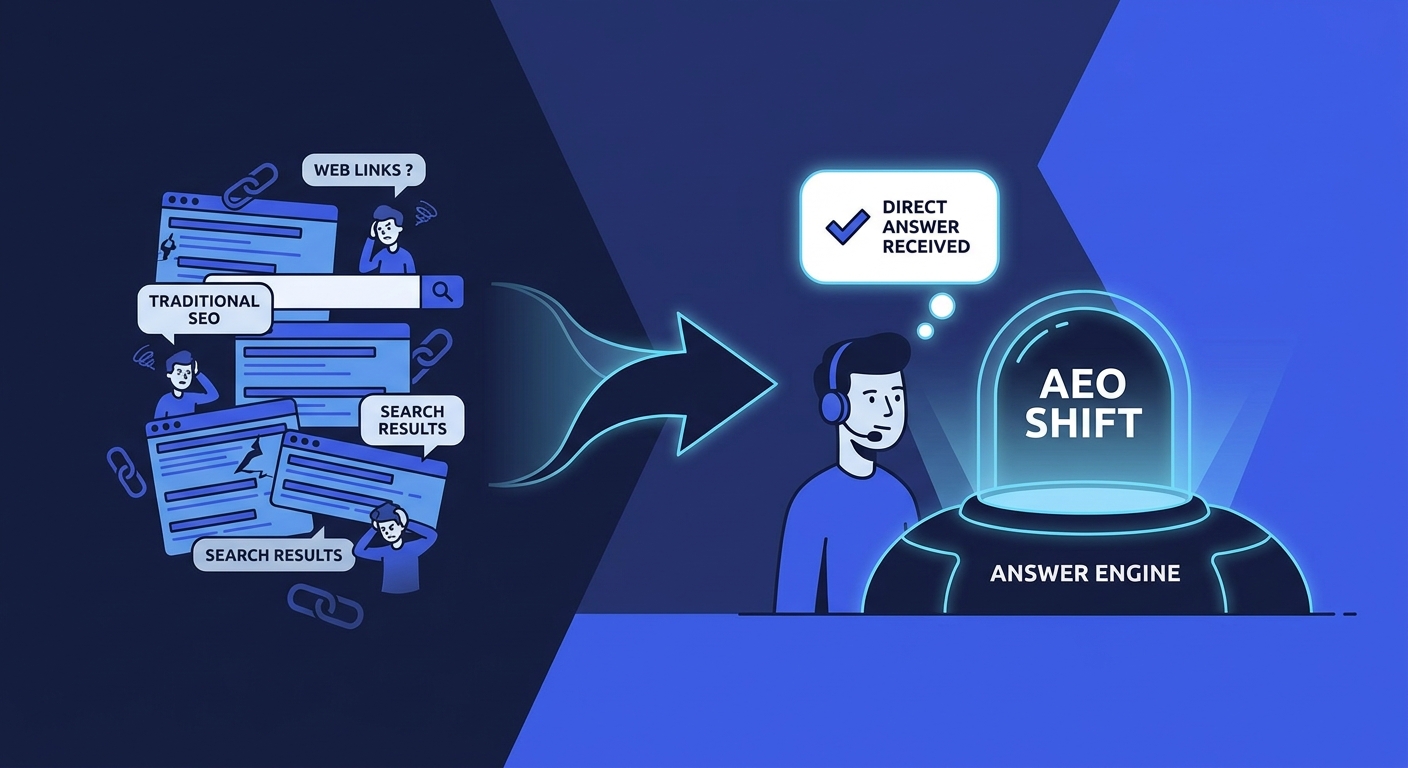
Traditional SEO is about accessibility and relevance. AEO is about credibility and synthesis.
It’s a subtle but massive distinction. SEO tries to game the algorithm to climb a list. AEO focuses on structuring your brand’s knowledge so it becomes an immutable part of the AI’s training set. Some people think this signals the death of organic search. That’s a dangerous oversimplification. Statistics show that traffic from AI-cited sources converts at 4.4x the rate of traditional search. This isn't just noise; it’s high-intent, pre-qualified traffic that has already been vetted by the AI’s logic.
How Do AI Search Engines Actually "Think"?
To master AEO, stop viewing the web as a collection of pages and start seeing it as a massive, interconnected graph of entities. When a user submits a query, an LLM doesn't just "scrape" a page. It retrieves relevant vectors from its index, synthesizes the facts, and attributes them to the most authoritative source it can find.
This process demands a radical rethink of content priorities. Static, evergreen content—the kind that sits untouched for years—is dead weight. AI models are obsessed with freshness. If your competitor’s case study has up-to-date benchmarks and yours hasn't been touched since 2022, the AI will ignore you.
And the "Crawler Mandate"? It’s non-negotiable. Blocking GPTBot or other LLM crawlers is, quite frankly, brand suicide. If you lock the engine out of your digital house, you’re ensuring you’ll never be cited when a buyer goes looking for a solution in your category.
From Keyword Density to Semantic Authority
The old tactic of "keyword density" is now a liability. AI models look for "semantic authority"—the depth and breadth of your expertise on a specific entity. If you sell cloud security, you shouldn't just be blogging about "cloud security." You need to be the source of truth for the messy sub-entities: "SOC2 compliance workflows," "zero-trust architecture for remote teams," and "automated vulnerability patching."
Structuring for machines means front-loading your answers. In the first 100 words of any piece of content, you must explicitly state the answer to the query. AI models are efficient; they don't want to dig through your long-winded intro to find the "why." You must also use robust Schema markup to help LLMs parse your content accurately. As noted in Google’s AI Overview documentation, structured data is the primary bridge between your raw content and the AI’s ability to categorize your brand as an expert.
The "Off-Site" Factor: Building Consensus
AEO isn't just an on-page game. AI models are trained on the entire internet, which means they are constantly cross-referencing your site with third-party signals. If your website claims you’re the industry leader, but your G2 profile is thin, your LinkedIn is a ghost town, and you’re nowhere to be found on Reddit, the AI will view your claim with skepticism.
You need to build a "Social Proof Loop." When an AI model evaluates which brand to cite, it looks for consensus. Is your brand mentioned in reputable industry pubs? Are your customers discussing your tool on neutral ground? You should be auditing your "Citation Share of Voice"—tracking how often your brand appears in AI answers compared to competitors. If you aren't appearing, you need to go where the AI is looking for validation.
The AEO Implementation Framework
Transitioning to an AEO-first strategy requires a systematic approach:
- The AI-Native Content Audit: Audit your existing library. Kill content that is "AI-unfriendly"—anything vague, fluff-heavy, or lacking specific data. If a page doesn't answer a distinct question, it’s dead weight.
- Optimizing for Citations: Rewrite your case studies and product pages to be "citation-ready." This means including clear, concise "data snippets" that an AI can easily lift and present as a definitive answer.
- Integrating Services: Your content strategy needs to pivot toward these new signals. For those who need help navigating this, our SEO services are built specifically to bridge the gap between traditional technical health and modern generative authority.
For the tactical version of this framework — seven concrete steps from featured-snippet formatting to entity-based SEO — see 7 Powerful Strategies to Win at Answer Engine Optimisation (AEO).
The Future of Publishing: Collaboration vs. Competition
We’re entering a phase where the old "traffic-at-all-costs" model is colliding with the reality of AI-assisted discovery. Programs like Perplexity’s "Publishers" program signal a shift toward a future where publishers are rewarded for expertise, not just pageviews.
The outlook is clear: the brands that win will be those that stop fighting the machines and start feeding them. By positioning your SaaS as the primary, high-quality source of truth, you aren't just surviving the transition—you’re defining the new standard of authority.
Frequently Asked Questions
Is traditional SEO dead in 2026?
No, it’s evolving. You still need technical health and site authority, but you must now optimize for machine synthesis rather than just human clicking. The foundation of good SEO—fast load times, secure architecture, and high-quality content—remains, but the application has changed toward entity recognition.
How do I measure AEO success if there are no clicks?
You measure it through "Citation Share of Voice." Use tools to track how often your brand is cited in AI responses, monitor brand-lift surveys, and keep an eye on referral traffic quality. The metric is no longer "visits," but "influence."
Does blocking GPTBot help or hurt my B2B SaaS?
It hurts. Blocking crawlers prevents your company from being represented in the AI-generated research phase, effectively silencing your brand for high-intent buyers who rely on AI to narrow down their vendor list.
What is the most important technical change for AEO?
The shift from keyword-stuffed meta tags to structured Schema markup and clear, concise, objective-driven content blocks that AI can parse without having to guess your core value proposition.
How does AEO affect my conversion rates compared to traditional SEO?
Traffic originating from AI-cited sources typically converts at a 4.4x higher rate than traditional organic search. This is because the AI acts as a pre-qualification filter, sending you users who have already had their specific questions answered by your content.
![10 Best Local Rank Tracker Tools: In-Depth Comparison Guide [2025]](https://cdn.pseo.one/6abcb68a626591c40e1c8aa6/687e1c1ef6fe799d288518df/68809c373eb8562bcf68975d/10-best-local-rank-tracker-tools-comparison-guide/feature-image.jpg)