How Zapier Built a 5.8M Monthly Visit SEO Empire with 50,000+ Integration Pages (And How GrackerAI Does It Better)

Zapier is one of the most-cited programmatic SEO case studies in B2B SaaS, built on a simple concept — app integrations — turned into tens of millions of monthly organic visits through 50,000+ integration pages. Third-party traffic estimates for Zapier's organic reach vary by tool and methodology and Zapier itself doesn't publish the figure, so treat any specific monthly-visit number (including the one in this post's title) as a widely-cited estimate rather than a confirmed count.
What is verifiable directly from Zapier's own site: as of this writing, Zapier's app directory lists 10,121+ connected apps (zapier.com/apps, retrieved 2026-09-18) — up substantially from the few thousand apps the platform listed in its earlier years. This case study dissects Zapier's programmatic SEO strategy layer by layer, revealing the mechanics behind their success, and then looks at how AI-powered approaches like GrackerAI's extend the same model with real-time data. For B2B tech companies looking to scale organic growth, understanding both the proven Zapier pattern and where AI-driven portals push past its limits is the useful takeaway here.
The Anatomy of Zapier's Two-Pronged Programmatic Strategy
Zapier transformed a simple concept — app integrations — into an SEO strategy that captures a very wide range of integration-related search queries. It does this with two distinct page types that work together.
Strategy Component 1: Individual App Profile Pages
Zapier's first pillar is a dedicated profile page for each app in its ecosystem — think of it as a digital business card for that app (for example, zapier.com/apps/slack/integrations). Each profile page explains what the app does, lists every available integration for it, shows user reviews and ratings, and links to integration tutorials and use cases.
This matters because it captures broad search intent in one place. Someone searching "Slack integrations" might want to know what's possible with Slack, which tools connect to it, or how to set up a specific workflow — a single comprehensive profile page can serve all three intents.
Strategy Component 2: App-to-App Integration Pages
The second pillar — where the real programmatic scale comes from — is a dedicated page for every viable app-to-app combination, like zapier.com/apps/slack/integrations/trello. Individually, each of these pages targets a narrow, low-volume query; collectively, they capture an enormous amount of long-tail search demand.
The math is straightforward. With 10,121+ apps in the directory, the number of theoretical unique pairwise combinations is in the tens of millions (n × (n−1) grows very fast). Zapier obviously does not publish a page for every mathematically possible pair — many combinations have no realistic use case or search demand — but even a modest fraction of that space, populated only where genuine demand exists, is enough to explain 50,000+ live integration pages. Each surviving page includes specific workflow examples, step-by-step setup instructions, pre-built automation templates ("Zaps"), and integration-specific testimonials, so template-based generation still produces genuinely useful pages rather than thin duplicates.
The Partner-Generated Content Model: Scaling Through Collaboration
One of Zapier's more effective decisions was turning app partners into content contributors. This solves one of programmatic SEO's hardest problems — maintaining content quality and accuracy at scale — by distributing the work to the people who know each app best.
How the Partner Onboarding Process Works
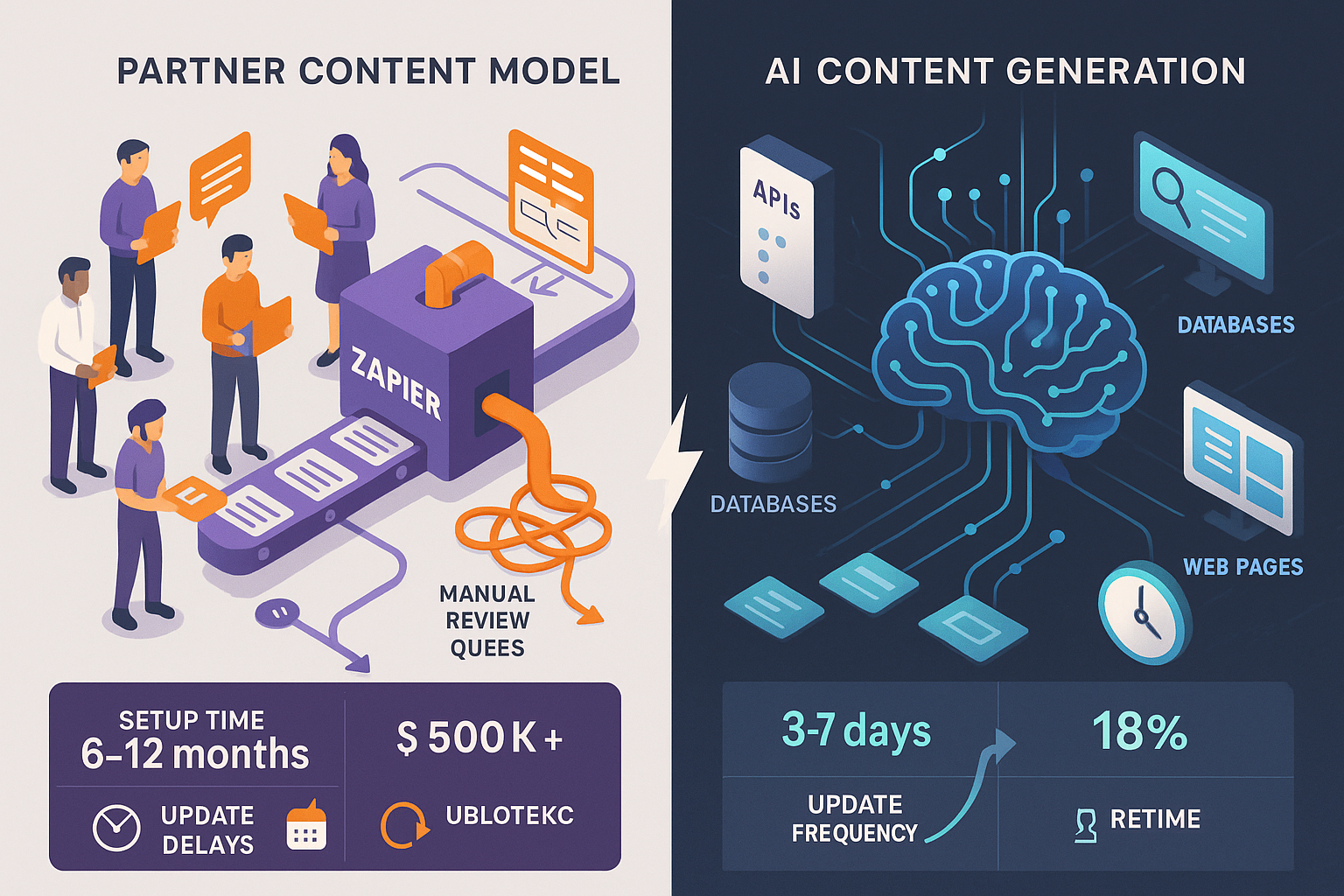
When a new app joins the platform, onboarding isn't just an API integration. Partners are asked to provide detailed descriptions and use cases, create integration examples and workflow suggestions, submit screenshots and visual assets, and write setup and troubleshooting documentation.
This accomplishes several things at once. Content accuracy improves because the app's own creators are the source. The content-creation workload spreads across thousands of partners instead of one internal team. Structured templates keep formatting consistent while still allowing app-specific detail. And the system gets stronger, not weaker, as more partners join.
The Hidden Challenges of Manual Updates
This system has a real weakness that grows with the ecosystem: manual update burden. When an app updates its API, every integration page referencing it potentially needs a revision. When a partner changes pricing or features, multiple pages need updates. Security issues or breaking changes need fast, coordinated fixes across affected pages.
The result is a constant maintenance backlog that requires real human resources — dedicated teams for content maintenance, partner communication, and quality assurance. Zapier's scale and revenue justify that investment. Smaller companies attempting the same model often find the maintenance burden is the part that doesn't scale.
How GrackerAI Extends the Programmatic Model With Real-Time Data
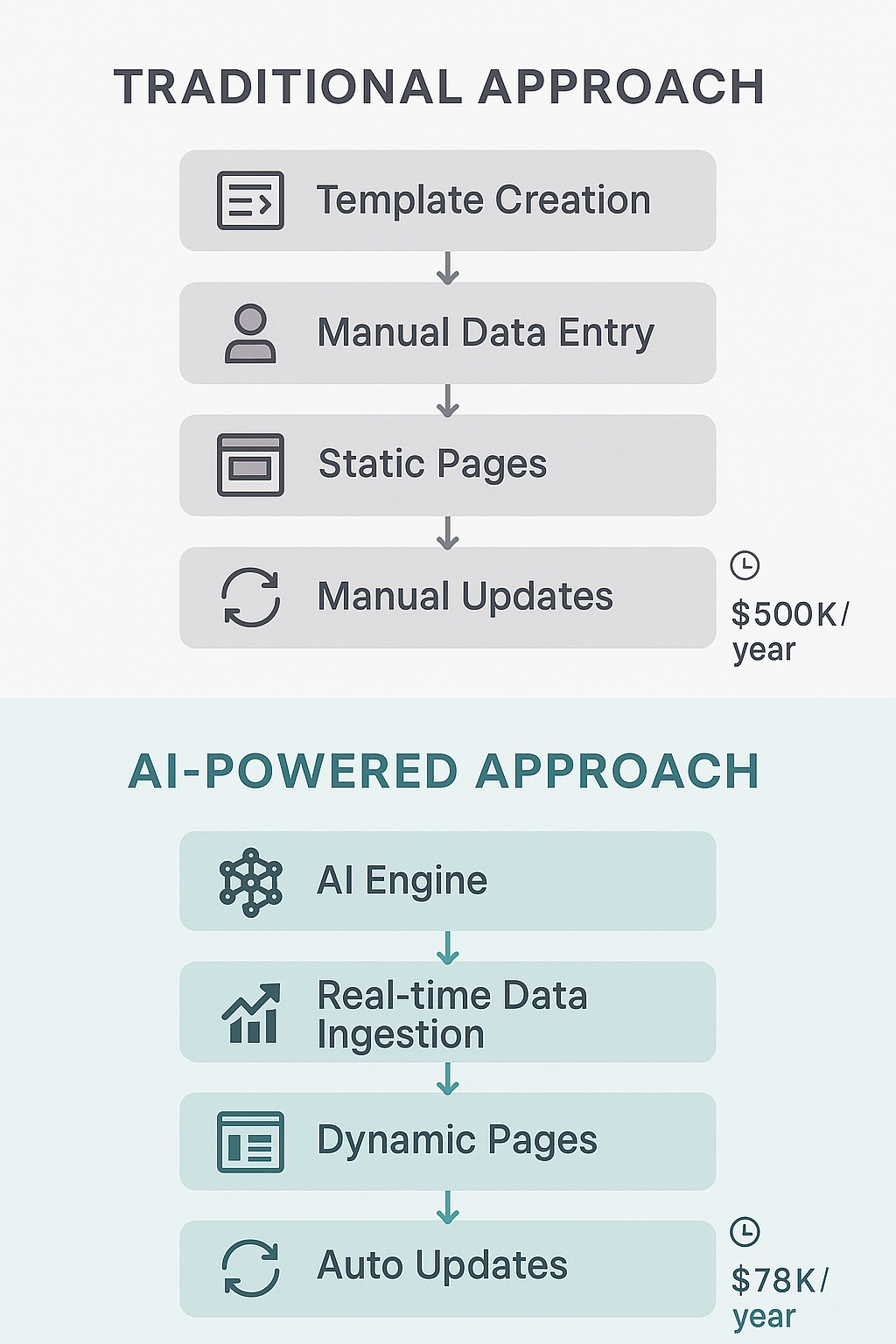
This is where AI-powered programmatic SEO picks up where the static-template model leaves off. GrackerAI takes the proven Zapier-style page architecture and adds continuous data ingestion, so portals stay current without a manual maintenance team.
Real-Time Content Generation vs. Static Templates
Traditional programmatic SEO, Zapier's approach included, relies on templates filled with database content — efficient, but static once published. An AI-driven system can instead generate content that adapts as its underlying data source changes: pulling current API documentation for technical accuracy, incorporating new security advisories or compatibility notes, and adjusting depth to the audience the page is written for.
Dynamic Updates: Why It Matters More in Fast-Moving Verticals
The gap between static and dynamic programmatic content is largest in industries where the underlying facts change constantly. Cybersecurity is the clearest example. Take a CVE (Common Vulnerabilities and Exposures) database portal: in a manually maintained model, every page needs a human edit when a severity score changes, a patch ships, or a new affected system is identified — which creates a real lag between a vulnerability's discovery and a reader learning about it.
A dynamically-updating portal instead ingests data directly from sources like NIST and MITRE and vendor security bulletins, and reflects severity-score and patch-availability changes without someone rewriting the page by hand. Readers see current information without manual intervention, and the operator doesn't need a standing content team to keep it that way.
Content Depth at Scale
Zapier solves the content-depth problem through partner contributions and user-generated content. An AI-driven system solves the same problem differently — by synthesizing multiple data sources into each page: technical specifications from authoritative documentation, real-world implementation patterns from community discussion, and common troubleshooting scenarios. The goal in both cases is the same: pages that would pass a human's "is this actually useful" test, produced at a scale no single content team could sustain manually.
Real-World Implementation: CVE Databases and Breach Trackers
To make this concrete: two portal types show what dynamic programmatic SEO looks like in practice for cybersecurity companies specifically.
CVE Database Portals: Living Security Intelligence
A static CVE database is a useful reference but a weak traffic and lead-generation asset, because it goes stale the moment a patch ships or a severity score changes. A dynamically-updating CVE portal keeps real-time severity scoring, affected-product version details, available patches and workarounds, related vulnerabilities, and industry-specific impact notes current as new information arrives, and can generate new pages automatically as CVEs are published.
For a cybersecurity company, that captures a specific mix of visitors: security professionals looking up a specific CVE, IT managers checking their own stack, compliance officers documenting controls, and developers researching secure coding practice — each one a high-intent visitor for a security vendor.
Breach Tracker Portals: Real-Time Threat Intelligence
Breach trackers work the same way. A dynamically-updating breach page can reflect the latest victim counts and impact assessments, investigation timeline updates, regulatory filing links, and industry-specific analysis as an incident develops, rather than freezing at the moment it was first published. That currency is what makes a breach tracker the resource executives, security teams, legal teams, and journalists keep returning to during a live incident.
GrackerAI's own live example portals — a CVE database, a breach tracker, and a news aggregator — report 100K+, 75K+, and 60K+ monthly visits respectively on GrackerAI's own site (self-published, not independently audited; see GrackerAI's Portal Showcase, retrieved 2026-09-18). Treat these the way you'd treat any vendor's own case-study numbers: directionally informative, not a guarantee of what any specific portal will achieve.
The Cost Picture: Build vs. Buy
Programmatic SEO is a business investment, and the honest comparison is build-your-own versus a managed platform — not a specific ROI multiplier neither approach can guarantee.
Building It Yourself (Zapier-Style)
ANALYSIS — illustrative, not a sourced benchmark: a custom-built programmatic SEO system at Zapier's scale typically involves real upfront engineering investment (custom CMS, template systems, initial content generation) plus ongoing costs for a content team, partner management, and technical maintenance. These figures vary enormously by company size and are not something we can point to a public, verifiable source for — Zapier doesn't publish its internal cost structure, and neither does any comparable company. Budget for a genuine, ongoing headcount commitment if you build this in-house; it is not a set-and-forget system.
A Managed AI-Powered Platform
GrackerAI's published pricing is public and verifiable: Starter at $99/month ($79/month billed annually), Scale at $499/month ($399/month billed annually), and custom Enterprise pricing, each with a 7-day free trial that requires a credit card to start (gracker.ai/pricing, retrieved 2026-09-18). That's the real number to compare against a build-it-yourself budget — not a specific ROI percentage, because ROI depends entirely on your vertical, your existing content assets, and how competitive your query space already is. Be skeptical of any programmatic SEO vendor, GrackerAI included, that quotes a specific conversion-rate or CAC-reduction multiplier without showing the underlying data and methodology.
What B2B Tech Companies Should Do: Your Programmatic SEO Playbook
Based on the Zapier pattern and where AI-powered approaches extend it, here's a practical playbook for programmatic SEO that generates real leads, not just indexed pages.
1. Start With a Data Asset Inventory
Before building anything, catalog what unique data your company has that competitors don't: customer usage patterns, proprietary research, integration/API data, or industry-specific benchmarks. Zapier's integration pages work because the data comes directly from its own platform — a competitor can't replicate it without rebuilding the same integration infrastructure. The most defensible programmatic SEO plays are always built on a genuine data moat, not a template.
2. Identify High-Intent Keyword Patterns
Not every programmatic opportunity is equally valuable. Prioritize patterns that signal buying intent: "[category] for [industry]" combinations, "[technical term] tools," and "[compliance standard] checklist" queries tend to convert better than generic informational terms. Use your existing Search Console data to find the pattern — if you're already getting impressions for "[product] for healthcare" and "[product] for finance," you likely have an opportunity across every major vertical you serve.
3. Design for User Value, Not Just Keywords
The most common programmatic SEO mistake is building pages that exist only for search engines. Every page should pass a "would a real user bookmark this?" test — through comprehensive information, interactive tools, real-time data, or actionable next steps. A CVE database that updates in real time gives users a reason to come back; a static keyword-stuffed page doesn't.
4. Implement Progressive Scaling
Don't launch 10,000 pages on day one. Start with a pilot of 100-500 pages to validate templates, data quality, and engagement, and to catch technical issues before they multiply across the whole set. Scale gradually from there while watching Search Console for crawl errors and engagement signals.
5. Build Quality Signals From Day One
Search engines have gotten better at detecting thin, low-quality programmatic content. Build in unique data visualization, comprehensive internal linking, genuine user engagement features, and a real freshness-update cadence from the start rather than retrofitting them later.
What B2B Tech Companies Should NOT Do: Critical Pitfalls to Avoid
These mistakes can stall your programmatic SEO effort or damage your domain's broader search performance.
- Don't create thin, duplicate content. Pages that are just keyword variations of each other with no unique content are the cardinal programmatic SEO sin, and search engines are explicitly tuned to detect and penalize this pattern.
- Don't ignore technical SEO requirements. Programmatic scale amplifies technical issues: poor URL structure, duplicate meta tags, slow page loads from unoptimized queries, and orphaned pages with no internal links.
- Don't neglect content maintenance. Static programmatic pages go stale fast in a fast-moving industry like cybersecurity. This is the specific gap AI-powered, continuously-updated systems are built to close.
- Don't chase vanity metrics. A hundred thousand indexed pages that don't drive qualified traffic or conversions are worse than useless — they're a maintenance liability. Focus on commercial-intent keywords and measurable engagement.
- Don't build in isolation. Programmatic pages need to connect to your actual conversion funnel, sales enablement, and product demos — traffic alone isn't the goal, qualified pipeline is.
The Future of B2B Tech SEO
Zapier's programmatic SEO strategy built a real, sustainable competitive advantage through systematic execution over years, not a one-time content push. That's the part worth copying regardless of company size.
But buyer expectations have moved: today's B2B tech buyers expect current information and resources that reflect what's actually true right now, not what was true when a template was last edited. Static programmatic pages, however well-built, increasingly fall short of that expectation in fast-moving categories. AI-driven, continuously-updated portals extend the Zapier pattern to close that gap — for cybersecurity specifically, that means CVE databases that reflect new threats as they're published and breach trackers that evolve with an investigation instead of freezing at first publish. For B2B tech companies evaluating this space, the honest framing is: the Zapier model proved programmatic SEO works at scale; the open question for your company is whether a static, manually-maintained version of it is sustainable for your team, or whether the maintenance burden is the actual bottleneck worth solving first.
Frequently Asked Questions
How many app integration pages does Zapier actually have?
Zapier's own directory lists 10,121+ apps as of this writing (zapier.com/apps, retrieved 2026-09-18). The commonly cited figure for live integration pages is 50,000+, though — like the traffic figure — Zapier doesn't publish an exact page count itself, so treat it as a widely repeated estimate. The theoretical maximum from pairwise combinations is far larger than that; Zapier only builds pages for combinations with real search demand.
Can a smaller B2B SaaS company replicate Zapier's programmatic SEO model?
Yes, at a smaller scale, if the company has a genuine data asset to build on — its own integration data, proprietary research, or usage patterns competitors can't replicate. The model doesn't require Zapier's app count; it requires a real data moat and a maintenance plan, whether that's a dedicated content team or a platform that automates the updates.
What's the biggest risk in programmatic SEO at scale?
Thin, duplicate content that search engines flag as low-value, and an update burden that outgrows the team maintaining it. Both are avoidable with a genuine data source behind each page and a plan — human or automated — for keeping pages current as the underlying facts change.
Is AI-generated programmatic content penalized by search engines?
Not for being AI-generated per se — search engines evaluate content on usefulness and originality, not on the tool used to produce it. Thin or duplicate content is penalized regardless of whether a human or a model wrote it; the safeguard is genuine data behind each page, not the absence of AI in the process.
How is a CVE database portal different from a general programmatic SEO page?
A CVE portal's value depends entirely on staying current — severity scores, patch availability, and affected systems change continuously after a vulnerability is first published. A static page goes stale within days; a portal that ingests updates from sources like NIST and MITRE directly stays useful as the situation develops.
How This Guide Was Sourced
Written by the GrackerAI research and content team (gracker.ai). Zapier's app count is drawn directly from zapier.com/apps (retrieved 2026-09-18). GrackerAI's pricing is drawn from gracker.ai/pricing (retrieved 2026-09-18) and its example portal traffic figures from gracker.ai/portal-showcase (retrieved 2026-09-18) — both are GrackerAI's own published figures, disclosed here as self-reported and not independently audited. Zapier's total monthly organic traffic is not something Zapier itself publishes; treat any specific figure you see cited for it, including in this post's title, as a third-party estimate rather than a confirmed number.
No independent GrackerAI customer telemetry is used in this guide beyond the self-published portal figures cited above with their source. See also is your startup ready for pSEO, building a pSEO engine for B2B leads, and pSEO vs. GEO: which growth strategy fits your SaaS for related frameworks, and GrackerAI's programmatic SEO solution page for the product itself.