How to Build a pSEO Engine That Actually Converts B2B Leads

TL;DR
- ✓ Abandon thin keyword-stuffed pages to avoid Google spam and thin content penalties.
- ✓ Prioritize proprietary data and interactive tools to drive high-intent B2B conversions.
- ✓ Replace static templates with modular content strategies using LLMs for bespoke insights.
- ✓ Focus on solving specific user problems rather than chasing vanity search volume metrics.
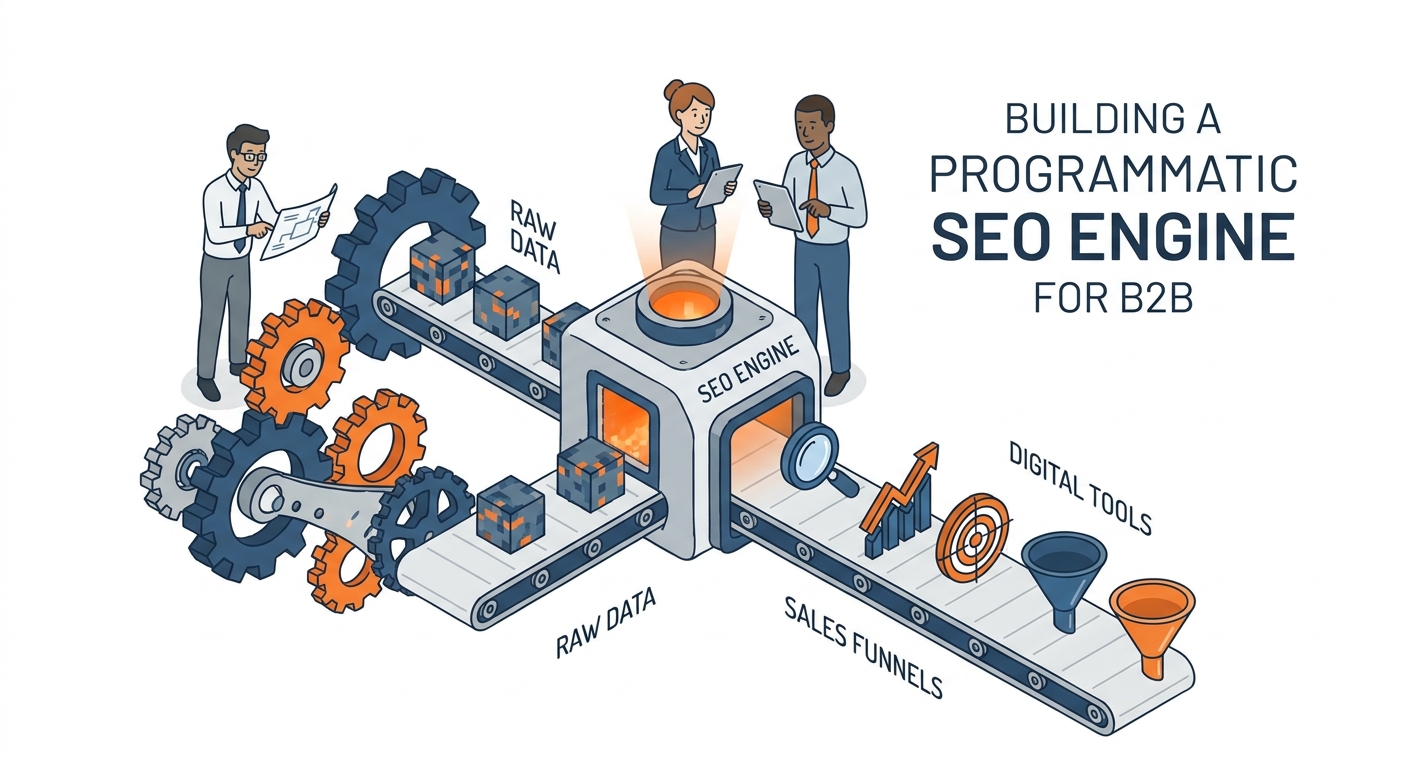
Stop treating your website like a digital library of keywords. It’s a graveyard for search traffic that never converts. If you want a programmatic SEO (pSEO) engine that actually feeds your sales funnel, you have to shift your mindset: stop building pages and start building tools.
The era of churning out thousands of thin, keyword-stuffed landing pages is dead. In 2026, Google’s spam filters are smarter, hungrier, and more unforgiving than ever. If your pages exist solely to capture a query without solving a problem, they aren't assets—they are liabilities. The only programmatic pages that survive today are those that provide immediate, data-rich utility to the person clicking the link.
Why the "Old Way" of pSEO is Killing Your B2B Pipeline
For years, the industry playbook was lazy. It was a race to the bottom: find a long-tail keyword, blast out three thousand pages using a rigid template, swap a few synonyms, and pray for a traffic spike.
That strategy is now a death sentence. Google’s Search Essentials are the new floor, not the ceiling. If your pages are carbon copies of each other—or if they’re just rephrasing a dictionary definition—you’re basically painting a target on your own back for the next core algorithm update.
The "old way" ignored the user entirely. It treated search volume as the holy grail, which is exactly why so many B2B teams saw their traffic graphs go vertical, only to watch their demo request forms sit empty. Today, success isn't about how many pages you launch. It’s about how many specific, burning problems you solve for your ideal customer profile (ICP).
The "Utility Shift": What Defines a "Conversion-First" Engine?
A conversion-first engine operates on what I call the "Utility Shift." Stop asking, "What keyword can I rank for?" Start asking, "What proprietary data can I put in front of this prospect to make their job easier today?"
Search volume is a vanity metric. A page that ranks for a niche term and offers an interactive ROI calculator, a side-by-side software comparison widget, or a live integration directory is worth ten thousand 2,000-word blog posts that just regurgitate Wikipedia. The goal is a scalable system that provides genuine value, not just search-engine bait. Your programmatic pages should function like mini-SaaS products, not just SEO bait.
The Architecture of Trust: How to Avoid "Thin Content" Penalties
To dodge the "thin content" trap, you have to kill the static template. If every page looks identical, you’re dead in the water.
You need a modular content strategy. Instead of a fixed layout with repetitive paragraphs, use LLMs to inject context-aware insights into every single page. Pull in real-world data—industry-specific benchmarks, regional regulatory updates, or verified user reviews—to make every page feel bespoke.
Pro-Tip: The "Human-in-the-Loop" Audit
Don't trust the machine blindly. Have a subject matter expert audit a sample of your programmatic set. If a human can’t tell the difference between your "San Francisco" page and your "New York" page, Google certainly won't either.
Step-by-Step: How to Build Your Data-Driven Engine
Where do you source your "Fuel"?
Your engine is only as good as the data you feed it. Proprietary data is your single greatest competitive advantage. If you’re a B2B SaaS company, look at your internal databases. Can you aggregate anonymized performance benchmarks? Can you pull API-based data regarding integration compatibility? If you don't have the data, partner with industry influencers to curate unique, expert-backed insights that you can programmatically inject into your templates.
How do you structure the template logic?
Designing for Generative Engine Optimization (GEO) requires a fundamental shift in how you structure your data. Modern search engines are increasingly focused on Generative Engine Optimization. This means your data needs to be structured in a way that AI models can easily parse and summarize. Use clear, semantic HTML, implement robust Schema markup (especially Product, SoftwareApplication, and FAQPage), and organize your data into clean, logical tables that provide direct answers.
How Do You Optimize for GEO and Answer Engine Optimization (AEO)?
"Direct answers" are the new top-of-funnel conversion. When a user asks an AI-powered search tool a question, they aren't looking for a list of links. They’re looking for a definitive answer. Your programmatic pages need to be the source of those answers.
By structuring your content for AI citation—using clear, concise data tables and semantic headers—you increase the likelihood of your content being used as the primary source in a generative response. If you’re struggling to map out this technical architecture, resources like GrackerAI's guide to programmatic SEO with AI go deeper into how these generative models prioritize content, which can help you refine your template logic for better visibility.
The Conversion Hybrid: Embedding CRO into Programmatic Pages
The biggest mistake teams make is building the engine and then forgetting the funnel. Don't build a programmatic page and just hope the user finds your contact form. You must embed Conversion Rate Optimization (CRO) directly into the template.
Use contextual anchors. If a user is on a page discussing "CRM integrations for manufacturing," the CTA shouldn't be a generic "Book a Demo." It should be "See how [Your Brand] streamlines manufacturing workflows." Furthermore, leverage firmographic data—if you can identify the visitor’s industry via tools like 6sense or Clearbit, swap the hero copy in real-time to speak directly to their specific pain points. For teams that need help bridging this gap, GrackerAI's content engine is built to turn high-volume programmatic pages into high-intent, AI-citable conversion hubs.
How Do You Track Thousands of Pages Without Losing Your Mind?
Stop obsessing over simple page-view metrics. You need advanced GA4 and GTM tagging that attaches metadata to every interaction. If your page has a calculator, track the input values as custom dimensions. If a user clicks a button, ensure the event carries the page category so you can see which specific segments are driving the most qualified leads.
By connecting your GTM events to your CRM, you can perform closed-loop attribution. You aren't just measuring "traffic"; you are measuring how many SQLs (Sales Qualified Leads) were generated by your "Integration A vs. Integration B" pages.
Frequently Asked Questions
How do I prevent Google from marking my programmatic pages as "spam"?
Focus on "Unique Value." If your pages are just boilerplate text with a keyword swapped out, they will be flagged. Each page must provide distinct, useful information—such as unique data, custom utility tools, or specific insights—that makes the page worth visiting regardless of its search ranking.
What is the minimum number of pages needed for a successful B2B pSEO strategy?
Forget the "more is better" myth. Start with a segment of 50 to 100 pages that target a specific high-intent cluster. If these pages convert, scale to the next cluster. A programmatic set of 50 high-converting pages is infinitely more valuable than 5,000 pages that drive no pipeline.
How do I track conversions on thousands of pages at once?
Use data-layer variables to pass contextual information (like page category, industry, or intent) into your analytics platform. Map these variables to your CRM so you can track the full lifecycle of the lead, from the programmatic landing page to the eventual closed-won deal.
Is pSEO still effective in the era of AI Overviews?
Yes, but only if you pivot to "Answer Engine Optimization." AI models prioritize sources that provide direct, authoritative, and structured data. If your programmatic pages provide the clear, concise, and accurate answers that AI models rely on, you will actually see an increase in visibility as you become the primary source for those generative summaries. Webinars are a practical starting point for that shift, since a single session's Q&A already maps closely to the direct-answer format AI models prefer. See our guide to converting webinars into permanent, AEO-ready assets.
![10 Best Local Rank Tracker Tools: In-Depth Comparison Guide [2025]](https://cdn.pseo.one/6abcb68a626591c40e1c8aa6/687e1c1ef6fe799d288518df/68809c373eb8562bcf68975d/10-best-local-rank-tracker-tools-comparison-guide/feature-image.jpg)