Is Your Startup Ready for pSEO? A Checklist for High-Growth Companies

TL;DR
- ✓ Traditional manual content marketing no longer scales for high-growth startups.
- ✓ Programmatic SEO transforms proprietary data into high-intent user utility at scale.
- ✓ Success requires unique, defensible data rather than generic scraped web content.
- ✓ Real pSEO combines structured data, template logic, and human oversight for quality.
- ✓ Evaluate your data maturity before investing in programmatic infrastructure development.
If you’re still paying a stable of freelancers to churn out generic "Top 10 Ways to Improve Productivity" posts, stop. Right now. You aren’t playing the SEO game; you’re just bleeding cash.
Programmatic SEO (pSEO) has evolved. It’s no longer about the "black hat" era of spamming thousands of keyword-stuffed pages that read like they were written by a malfunctioning robot. In 2026, pSEO is the dividing line between a startup that prays for an organic spike and one that builds a proprietary, high-intent traffic engine.
If you have the data, you can dominate. If you don’t, you’re just adding to the digital landfill.
Why Traditional Content Marketing is Hitting a Wall
The days of "blogging for traffic" are over. Seriously—look at your analytics. The cost of acquiring a visitor through manual, one-off content production has hit the stratosphere. You’ve felt the squeeze: you spend two weeks sweating over a "masterpiece" post, only for it to be buried by an AI summary or a competitor’s massive, automated hub of content that hits the mark faster and harder.
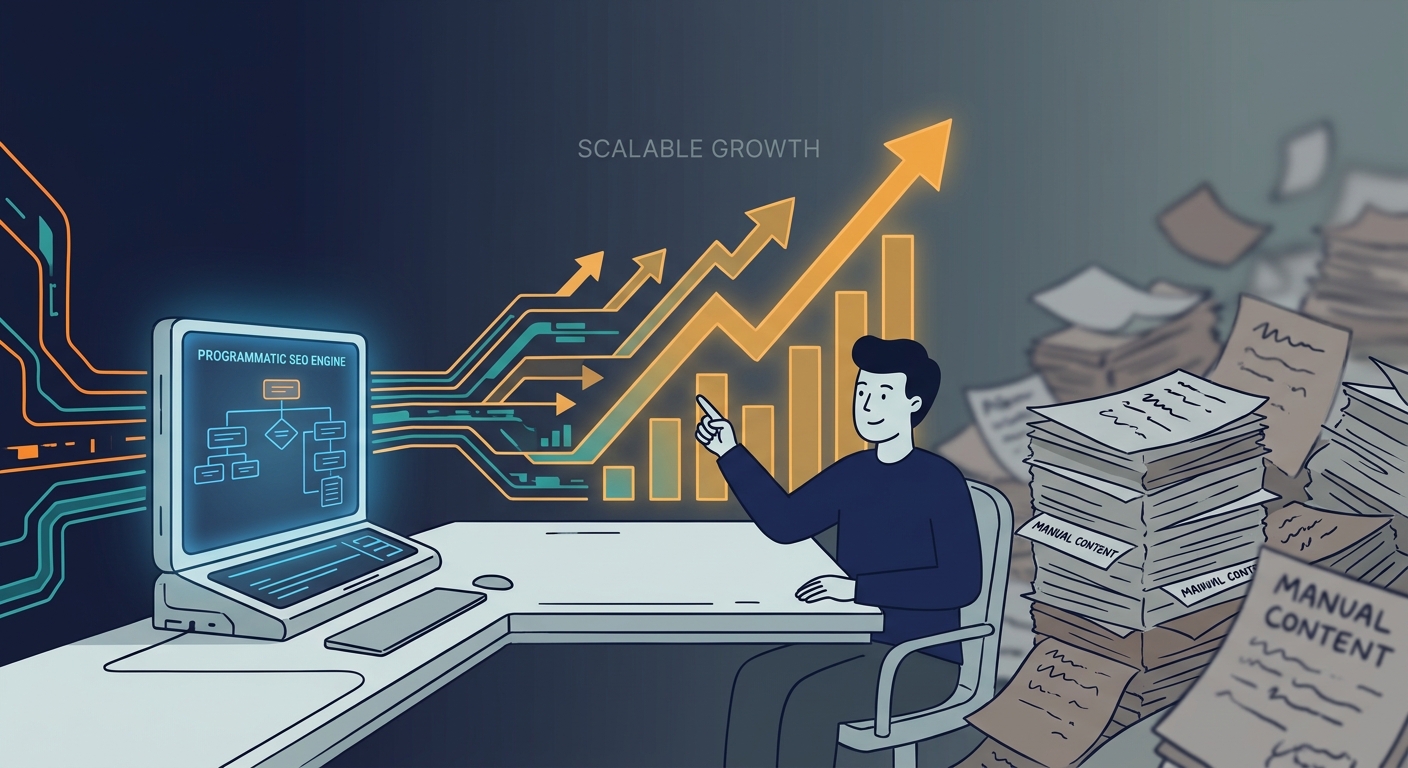
Manual production is linear. It doesn't scale without your overhead exploding — see the 90-day inbound engine for a month-by-month plan that builds a sustainable traffic system without burning out your content team. To win today, you have to pivot from "blogging for traffic" to "building for intent." You don't need to rank for broad, high-volume terms that convert at 0.01%. You need to capture the hyper-specific, long-tail intent of users who are already standing at the checkout counter.
What is Programmatic SEO in the Era of AI?
A lot of founders view pSEO as a "set it and forget it" content factory. That’s a one-way ticket to an algorithmic graveyard. Real programmatic SEO is about taking your unique data and turning it into a utility that solves specific user problems at scale. It’s a marriage of structured data, smart template logic, and, crucially, human oversight.
When done right, pSEO isn't spam. It’s a tool. It gives users exactly what they need—whether that’s a comparison of software by industry, an ROI calculator, or a database of benchmarks that were previously locked in a spreadsheet.
Do You Have the Data Maturity to Execute? (The Readiness Quiz)
Before you blow your budget on infrastructure, take a hard look at your data. pSEO is only as good as the raw material. If your "proprietary" data is just a bunch of web scrapes you pulled from a competitor, you’re building your house on sand.
The Data Liquidity Test: Do you actually own data that nobody else has? We’re talking about anonymized product usage patterns, unique industry benchmarks, or proprietary survey results. If you can buy the data from a third party, your competitors can too. Your moat needs to be built on internal, proprietary insights that grow as your product grows. Security vendors sitting on compliance mappings or CVE databases are a textbook case of this kind of proprietary data — see the product-led SEO framework for security for how one category applies this readiness checklist in practice.
The Intent-Match Test: Are you solving a real problem, or are you just chasing vanity metrics? If your programmatic pages don't offer a clear path to conversion or a genuine "Aha!" moment, they are just index bloat. Before you move an inch, read this guide on 2026 B2B SaaS Growth Strategy: Integrating GEO and AEO to understand how to align your data with what people are actually looking for.
The "Human-in-the-Loop" Audit: In 2026, pure automation is a liability. Your templates need to be audited by actual humans to ensure they meet Google's E-E-A-T Guidelines. If you aren't prepared to assign an editor to oversee these clusters, you are basically begging for a manual penalty.
Is Your Technical Foundation Ready for Index Bloat?
Here’s the trap: launching 5,000 pages that search engines flag as "thin" or redundant. If your site architecture isn't built for scale, you’ll burn your crawl budget on pages that don't drive a single cent of revenue.
You have to manage your index with an iron fist. Use canonical tags, clean structured data (Schema.org), and a rigid internal linking hierarchy that drips authority into your high-value nodes. If you treat every page as if it’s equal, Google will treat them all as mediocre. Prioritize your high-intent clusters and ensure your site can handle dynamic content without turning into a sluggish mess.
The 2026 Pivot: Moving from SERPs to Generative Engine Optimization (GEO)
Ranking #1 on a traditional search engine results page (SERP) is no longer the endgame. We’ve entered the age of Generative Engine Optimization (GEO). When a user asks Perplexity or ChatGPT a question, they aren't looking for ten blue links. They want a definitive answer.
Your programmatic strategy needs a "Citation Strategy." You need to structure your data so AI models can ingest and verify it easily. If your data is formatted as clean, queryable information, you become the primary source. When an AI cites you, you get an authority signal that’s worth ten backlinks. Stop obsessing over "keywords" and start thinking about "entities" and "answers."
How to Calculate the Unit Economics of pSEO
pSEO is an investment, not a cheap hack. You have to account for the cost of data cleanup, engineering, and the human oversight necessary to keep the quality high.
Start with a "Minimum Viable Cluster" (MVC). Don't try to build 10,000 pages out of the gate. Pick one high-intent cluster—say, "Accounting Software for [Specific Industry]"—and build 50 to 100 pages. Measure the CAC against the LTV of that traffic. If the MVC doesn't convert, the problem is your logic, not your volume. Once the unit economics turn green, scaling becomes a simple matter of adding more data clusters.
Avoiding the Common Pitfalls of Programmatic Scaling
"Duplicate Content" is the silent killer. If your page templates are identical save for one swapped-out variable, the search engines will filter you out of existence.
The "x-factor" is unique content injection. Your templates should pull in secondary data points—local reviews, specific price comparisons, or expert commentary—to ensure that every page offers a distinct value proposition. As noted in the Future of Search (2026 Report), the brands that win are the ones providing deep, unique insights, not just surface-level data aggregation.
Strategic Implementation: A Roadmap for Growth
- Identify the "Proprietary Data" Asset: Look at your database. What do you know about your industry that others don't?
- Define the Template Logic: Build a structure that prioritizes the user's question. What do they need to know to make a decision right now?
- Build the Human-in-the-Loop Review Cycle: Set up a process where an editor reviews a sample of every new cluster to ensure the tone is right and the facts hold up.
If your internal team doesn't have the technical bandwidth to pull this off, Gracker.ai Growth Services specializes in building exactly these kinds of programmatic ecosystems for high-growth SaaS companies.
Frequently Asked Questions
Does pSEO still work in the age of AI Overviews?
Yes, but only if your pages provide unique, factual, and structured data. AI models are hungry for primary sources. If your site is the best source of structured, accurate data, the AI will cite you, driving highly qualified traffic straight to your doorstep.
How much data do I need to start a pSEO project?
You don't need millions of rows. You need a high-intent, long-tail keyword cluster with consistent variables. Starting with 50 to 100 pages that target a specific "Software for X in Y" query is usually enough to prove the concept and test your data quality.
Will pSEO hurt my site's overall domain authority?
Only if the pages are thin, duplicate, or irrelevant. If your strategy focuses on building topical authority through high-value data, it actually reinforces your site's reputation as a category leader, which tends to boost your domain authority, not hurt it.
What is the biggest risk for startups starting pSEO in 2026?
The biggest risk is over-automation. If you rely on AI to generate content without a "human-in-the-loop" review process, you’re just creating brand sludge. If you prioritize volume over quality, you’re inviting a manual penalty from search engines and losing the trust of your customers. Webinar and event transcripts are one of the lower-risk places to start, since the underlying content is already reviewed and delivered by a real person. Our webinar evergreen strategy guide covers turning that material into a structured pSEO pipeline without the brand-sludge risk.
![10 Best Local Rank Tracker Tools: In-Depth Comparison Guide [2025]](https://cdn.pseo.one/6abcb68a626591c40e1c8aa6/687e1c1ef6fe799d288518df/68809c373eb8562bcf68975d/10-best-local-rank-tracker-tools-comparison-guide/feature-image.jpg)