Brand Monitoring in the AI Era: Complete Guide to Tracking Your Brand

Ankit Agarwal · Head of Marketing
· Updated September 21, 2026
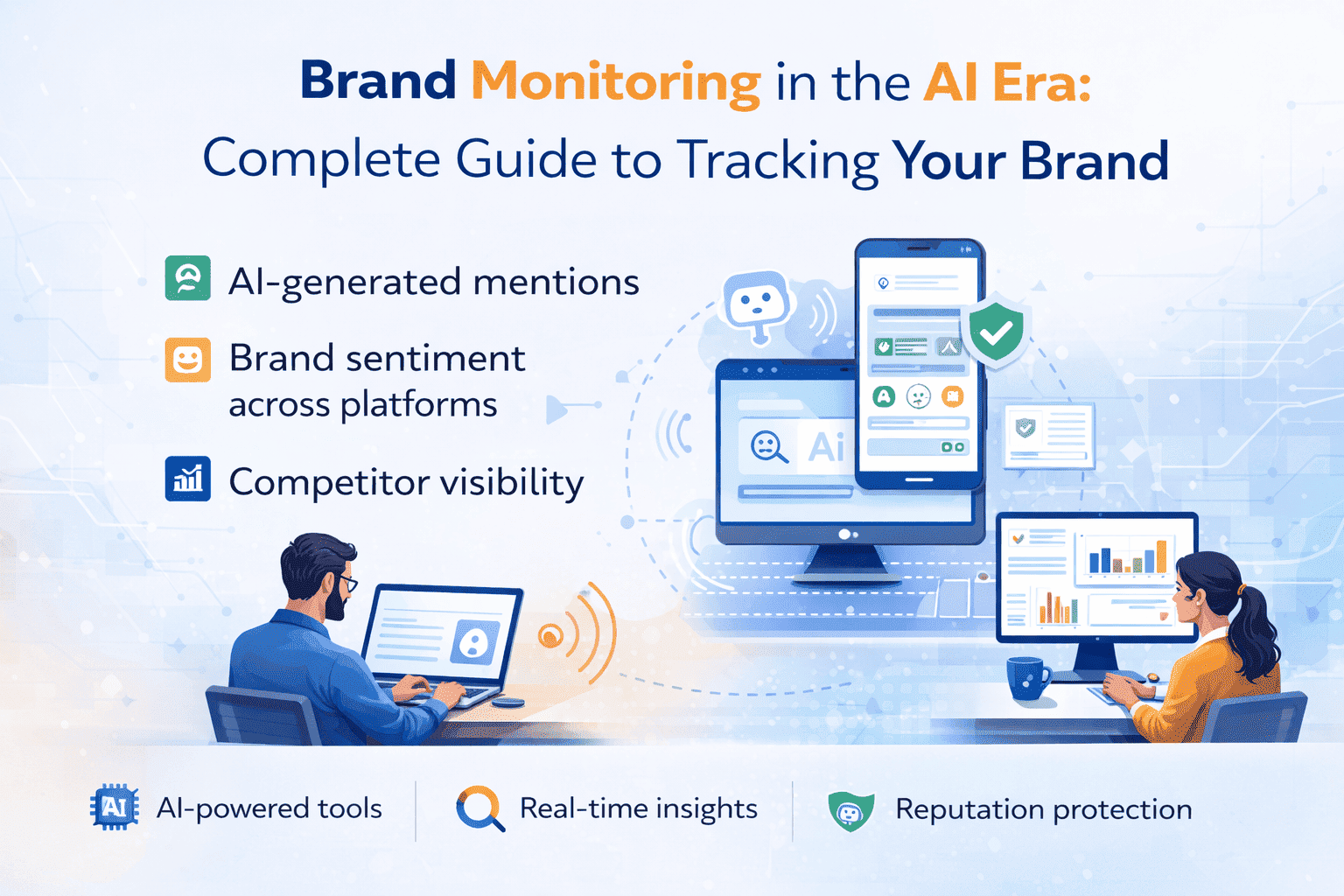
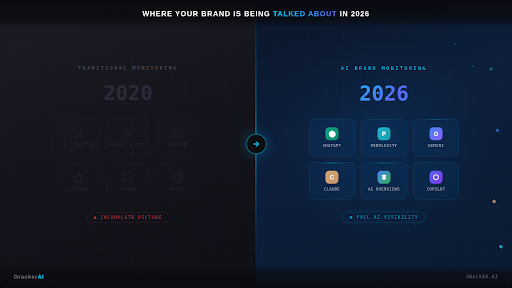
Your brand is being talked about right now — not just on social media or review sites, but inside AI-generated answers that millions of buyers read before ever visiting your website. If you’re not monitoring what ChatGPT, Perplexity, Gemini, and Google AI Overviews say about you, you’re missing half the conversation.
This guide covers everything you need to know about brand monitoring in 2026 - from traditional approaches to AI-powered tracking, the metrics that actually matter, and the tools that help you take control.
What Is Brand Monitoring and Why Does It Matter?
Brand monitoring is the practice of tracking mentions, conversations, and perceptions of your brand across digital channels. It helps you understand how customers, competitors, and - increasingly - AI systems talk about your business.
Traditionally, this meant scanning social media, news outlets, forums, and review sites. Many B2B teams also pull that monitored content into a live, on-site social feed to put the social proof to work, not just watch it. But the landscape has shifted dramatically. AI search platforms like ChatGPT (over 1 billion weekly active users as of August 2026, per OpenAI, retrieved 2026-09-18), Perplexity (780 million monthly queries), and Google AI Overviews (2.5 billion monthly users as of Google I/O 2026, per Google, retrieved 2026-09-18) now shape how buyers discover and evaluate brands. Learn how to improve your brand visibility in AI search engines to stay ahead of this shift.
Here’s why brand monitoring is non-negotiable in 2026:
-
Reputation protection: A single negative AI-generated answer can influence thousands of buying decisions before you even know it exists.
-
Competitive intelligence: Understanding where competitors get cited — and you don’t - reveals actionable content gaps.
-
Revenue impact: AI search traffic converts at 14.2% compared to Google’s 2.8%, according to Exposure Ninja — making AI visibility directly tied to pipeline.
-
Crisis prevention: Early detection of negative sentiment or misinformation in AI responses prevents reputation damage at scale.
Click-through to a cited source in Google AI Overviews rises with usage frequency: 50% for daily users, 28% for weekly users, and 14% for infrequent users (GWI research, cited by Dataconomy, retrieved 2026-09-18).
How Has Brand Monitoring Changed in the AI Era?
What Did Traditional Brand Monitoring Look Like?
Traditional brand monitoring focused on tracking your brand name across a defined set of channels. The typical workflow involved setting up Google Alerts, subscribing to social listening tools like Brandwatch or Mention, and manually reviewing media coverage.
Key activities included:
-
Social media listening — Tracking @mentions, hashtags, and brand keywords across Twitter/X, LinkedIn, Facebook, and Instagram.
-
Review monitoring — Watching platforms like G2, Capterra, TrustRadius, and Glassdoor for new reviews.
-
News and PR tracking — Monitoring press coverage, blog mentions, and industry publications. This often overlaps with reputation management, though the two serve different purposes.
-
Sentiment analysis — Gauging whether brand conversations skewed positive, negative, or neutral.
These methods still matter — see why social media monitoring matters for brand growth and reputation for the foundational case. But they only cover part of the picture.
What Makes AI Brand Monitoring Different?
AI brand monitoring tracks how large language models (LLMs) and AI search engines represent, reference, and recommend your brand when users ask questions. Instead of monitoring what people say about you, you’re now monitoring what AI systems say about you — to the people making buying decisions.
This is a fundamental shift because:
-
AI synthesizes, not links. When someone asks ChatGPT for the “best cybersecurity tools,” it doesn’t show 10 blue links. It generates a curated answer that may or may not include your brand.
-
You can’t see AI mentions in traditional tools. Brandwatch won’t tell you if Perplexity recommended your competitor over you.
-
AI responses change constantly. Research from Ahrefs (November 2025) found that AI Overview content changes 70% of the time for the same query, with 45.5% of citations getting replaced in each new answer.
-
26% of brands have zero mentions in Google AI Overviews, according to Passionfruit research — even some market leaders.
Factor | Traditional Brand Monitoring | AI Brand Monitoring |
|---|---|---|
What's tracked | Social posts, reviews, news articles | AI-generated answers across LLMs |
Channels | Twitter/X, LinkedIn, G2, news sites | ChatGPT, Perplexity, Claude, Gemini, AI Overviews |
Metric focus | Mentions, sentiment, reach | Share of voice, citation frequency, positioning |
Update frequency | Real-time social feeds | Varies: AI answers change with every query |
Competitive insight | Share of voice in media | Share of AI recommendations |
Action required | PR response, social engagement | Content optimization, structured data, authority building |
How Do AI Search Engines Decide Which Brands to Mention?
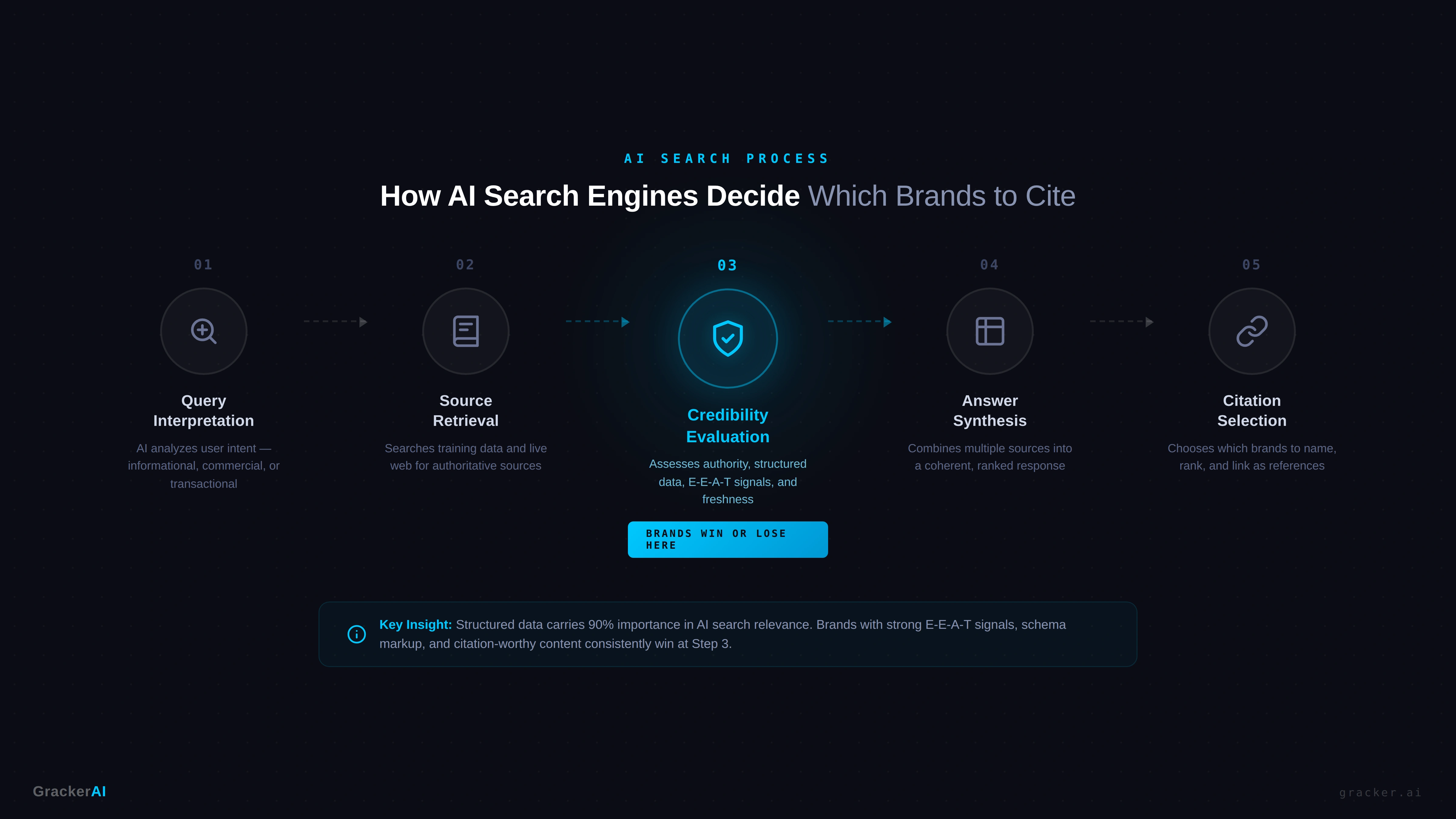
Understanding the mechanics behind AI citations helps you optimize for them. AI search engines follow a multi-step process when generating brand-related answers:
-
Query interpretation. The AI analyzes user intent — is this informational, commercial, or transactional? Commercial queries like “best CRM for startups” trigger brand-heavy responses.
-
Source retrieval. The system searches its training data and (for platforms with web access) current web content for relevant, authoritative sources.
-
Credibility evaluation. AI assesses source authority based on structured data, domain reputation, content freshness, expert signals (E-E-A-T), and cross-source consistency.
-
Answer synthesis. The model combines information from multiple sources into a coherent response, selecting which brands to name and in what order.
-
Citation selection. For platforms that provide references (like Perplexity and AI Overviews), the AI chooses which sources to link based on relevance and authority.
The key insight: AI doesn’t just look for keyword matches. It evaluates whether your brand has genuine topical authority. YouTube mentions and branded web mentions are among the top factors that correlate with AI brand visibility across ChatGPT, AI Mode, and AI Overviews, according to recent research from Position Digital.
This means brand monitoring in the AI era isn’t just about tracking — it’s about understanding the underlying signals that drive your visibility, and optimizing those signals systematically.
Why Should B2B SaaS Companies Prioritize AI Brand Monitoring?
B2B buying cycles are research-heavy — and that research increasingly starts with AI. When a VP of Engineering asks ChatGPT “What are the best SIEM tools for mid-market companies?” the answer shapes their shortlist before they ever visit your website.
Here’s what the data shows:
-
40% of B2B buyers now use AI assistants to research solutions (GrackerAI, retrieved 2026-09-18).
-
AI search traffic converts at up to 4.4x higher rates than traditional organic traffic, because users arrive already informed and ready to engage.
-
80% of sources cited by AI platforms don’t appear in Google’s traditional top 10 results (Passionfruit), meaning traditional SEO rankings alone won’t get you cited.
-
Brands are 6.5x more likely to be cited through third-party sources than their own domains (AirOps, October 2025).
-
Shopping queries on ChatGPT doubled in just six months from January to June 2025 (Bain & Company / Sensor Tower).
For B2B SaaS companies, especially, the stakes are high. If your competitor shows up in AI recommendations and you don’t, you’ve lost that prospect before the conversation even starts.
This is exactly the challenge GrackerAI was built to solve - giving B2B SaaS companies real-time visibility into how AI search engines perceive and cite their brand versus competitors, and improve AI search visibility of B2B SaaS and Cybersecurity brands by creating content or pSEO portals that are most cited by major LLMs.
What Metrics Should You Track for AI Brand Monitoring?
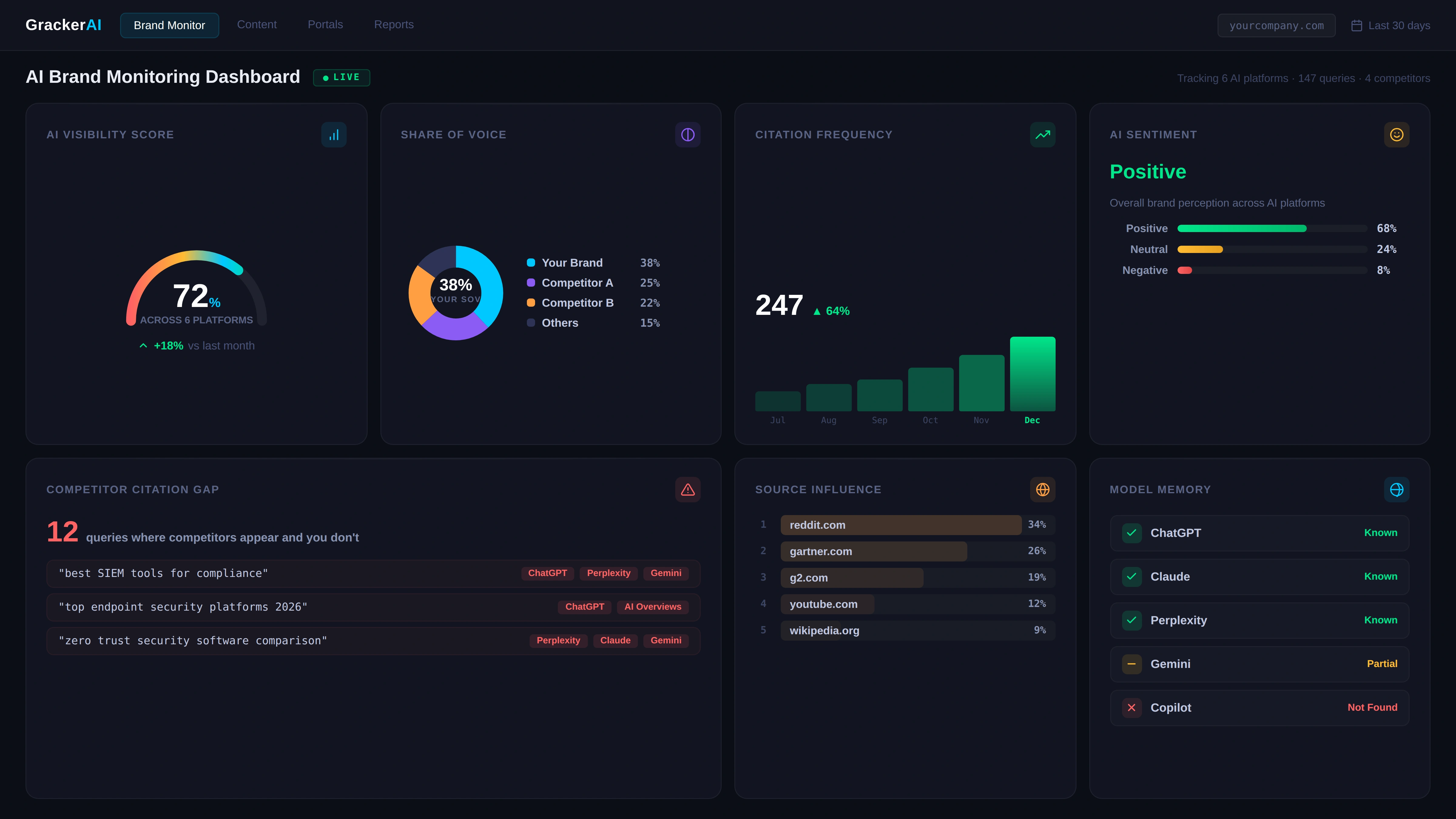
Tracking the right metrics is the difference between a vanity dashboard and actionable intelligence. Here are the seven metrics that matter most in 2026:
1. AI Visibility Score
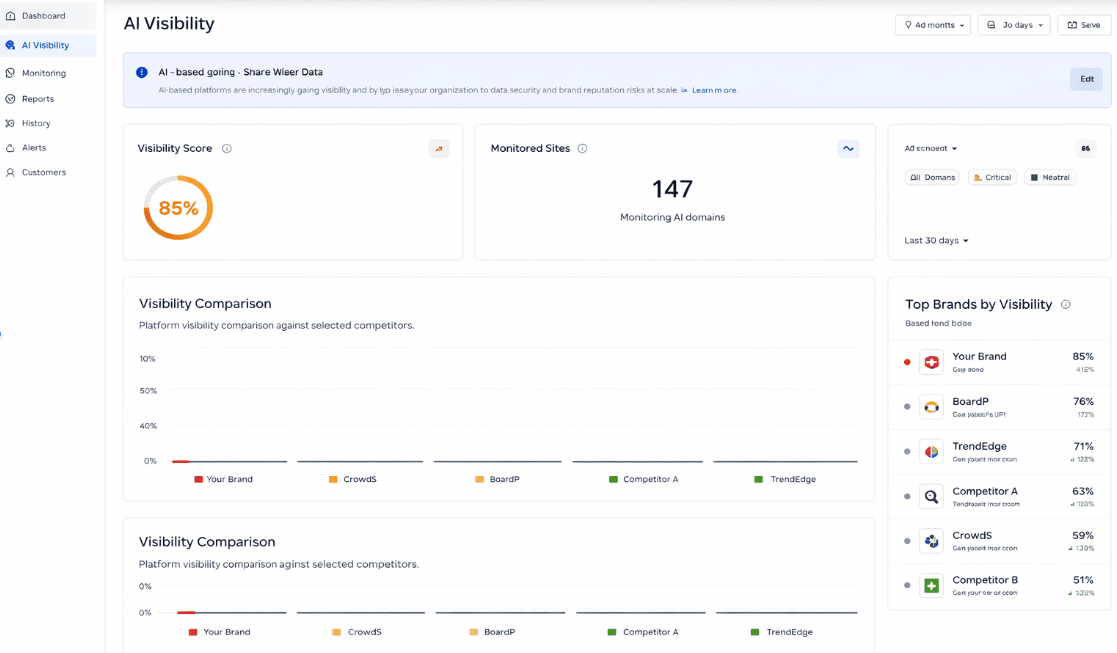
Your AI visibility score measures how frequently your brand appears in AI-generated responses for relevant queries. This is the single most important metric for understanding your AI presence.
How to track it: Run a set of 20-30 high-intent queries across ChatGPT, Perplexity, Claude, Gemini, and Google AI Overviews. Document whether your brand appears, in what position, and in what context. Platforms like GrackerAI automate this across all major AI engines with weekly visibility scores and trend analysis.
2. Share of Voice (SOV) in AI Responses
SOV measures your brand’s prominence relative to competitors in AI-generated answers. If a user asks “What are the top project management tools?” and the AI lists five brands, each brand owns roughly 20% of that answer’s share of voice — but positioning matters. Being mentioned first carries more weight.
3. Citation Frequency and Quality
Not all mentions are equal. Track:
-
Direct citations — AI explicitly names your brand
-
Source citations — AI links to your content as a reference
-
Contextual mentions — AI describes your product category without naming you
Research from Seer Interactive confirms that brands cited in AI Overviews see 35% higher organic CTR and 91% higher paid CTR.
4. Sentiment Analysis Across AI Platforms
AI models don’t just mention brands — they characterize them. Monitoring whether AI describes your brand positively, negatively, or neutrally is critical. Structured data now carries 90% importance in AI search relevance, and brand sentiment carries 85% weight in how AI engines present you, according to Riff Analytics’ 2025 monitoring dataset.
5. Competitor Citation Gap
This metric reveals the specific queries where competitors get mentioned and you don’t. It’s your roadmap for content strategy — showing exactly where to focus efforts to close visibility gaps.
6. Source Influence Mapping
AI systems pull from specific sources to form answers. Understanding which domains, URLs, and content types influence your brand’s AI representation helps you prioritize where to build presence. Reddit, YouTube, and Gartner consistently rank among the top citation sources across major AI platforms. That source hierarchy runs deeper than most monitoring dashboards capture — legal filings, regulatory records, and investigative journalism often carry more weight than owned content; see how AI search engines surface brand reputation signals for what to track instead.
7. Model Memory and Consistency
Does the AI “know” your brand from its training data, or does it only mention you when pulling from live web results? Brands with model memory — embedded in the AI’s core knowledge base — have a more durable competitive advantage.
Metric | What It Measures | Why It Matters |
|---|---|---|
AI Visibility Score | Frequency of brand appearance in AI answers | Core measure of AI presence |
Share of Voice | Your % of AI mentions vs. competitors | Competitive positioning |
Citation Frequency | How often AI cites your content directly | Content authority signal |
Sentiment | How AI characterizes your brand | Reputation in AI channels |
Competitor Gap | Queries where competitors appear and you don't | Content strategy roadmap |
Source Influence | Which domains drive your AI mentions | Outreach and PR prioritization |
Model Memory | Whether AI knows your brand natively | Long-term brand durability |
Model memory is only as reliable as the underlying data feeding it — inconsistent or outdated records erode that trust over time, which is why data integrity belongs in the same conversation as brand monitoring.
What Are the Best Brand Monitoring Tools in 2026?
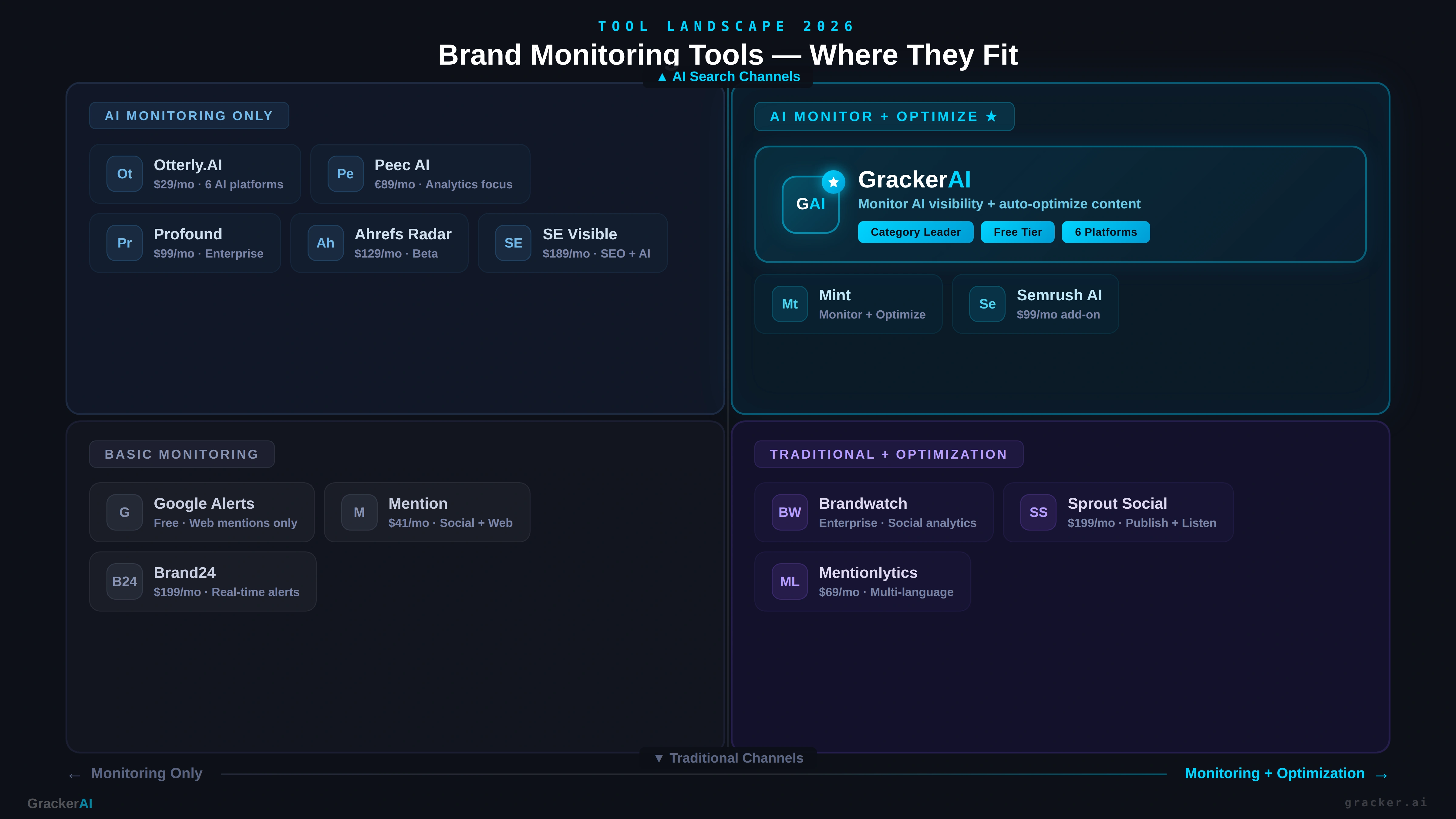
The brand monitoring landscape has split into two categories: traditional social/web monitoring tools, and AI-specific visibility tracking platforms. The most effective strategy uses both.
Traditional Brand Monitoring Tools
These tools excel at tracking social media, news, reviews, and web mentions:
Tool | Best For | Starting Price |
|---|---|---|
Brandwatch | Enterprise social listening and analytics | Custom pricing |
Mention | Social media and web mention tracking | $41/month |
Brand24 | Real-time mention alerts with AI-enhanced analysis | $199/month |
Mentionlytics | Multi-language monitoring with AI clustering | $69/month |
Google Alerts | Basic free web mention monitoring | Free |
Sprout Social | Social media management + listening | $199/month |
AI Brand Monitoring and Visibility Tools
These platforms specifically track how your brand appears in AI-generated answers:
Tool | AI Platforms Covered | Starting Price |
|---|---|---|
ChatGPT, Perplexity, Claude, Gemini, AI Overviews, Copilot | Free tier available | |
Semrush AI Toolkit | ChatGPT, Perplexity, Gemini, AI Overviews | $99/month per domain |
Otterly.AI | ChatGPT, Perplexity, Gemini, AI Overviews, Copilot | $29/month |
Peec AI | ChatGPT, Perplexity, AI Overviews, Gemini | €89/month |
Profound | ChatGPT, Perplexity, 10+ platforms (Enterprise) | $99/month |
SE Ranking Visible | ChatGPT, AI Overviews, AI Mode, Perplexity, Gemini | $189/month |
Ahrefs Brand Radar | ChatGPT, AI Overviews, Perplexity | Included with Ahrefs ($129+/month) |
What Makes GrackerAI Different for Brand Monitoring?
While most AI visibility tools stop at tracking, GrackerAI closes the loop between monitoring and action. Here’s what sets it apart:
-
Monitor + Optimize in one platform. Track visibility across ChatGPT, Perplexity, Claude, Gemini, and Google AI Overviews — then automatically generate the AI-optimized content needed to improve your citations.
-
Competitor citation analysis. See exactly where competitors get mentioned and you don’t, with actionable insights on how to close the gap.
-
Autopilot content creation. Automatically generate authoritative articles, listicles, comparison pages, and alternatives pages — all optimized for AI citation patterns.
-
Programmatic SEO portals. Build dynamic content portals (CVE databases, compliance centers, glossaries) that establish the topical authority AI engines reward.
-
Industry-specific AI models. Purpose-built for cybersecurity, fintech, and B2B SaaS — not generic one-size-fits-all monitoring.
-
Proven results. 25%+ average increase in AI visibility score within 90 days (GrackerAI, retrieved 2026-09-18), with 18% conversion rates from programmatic SEO portals vs. 0.5% from traditional blogs.
Start your free AI visibility analysis →
How Do You Respond to Brand Mentions in AI Search?
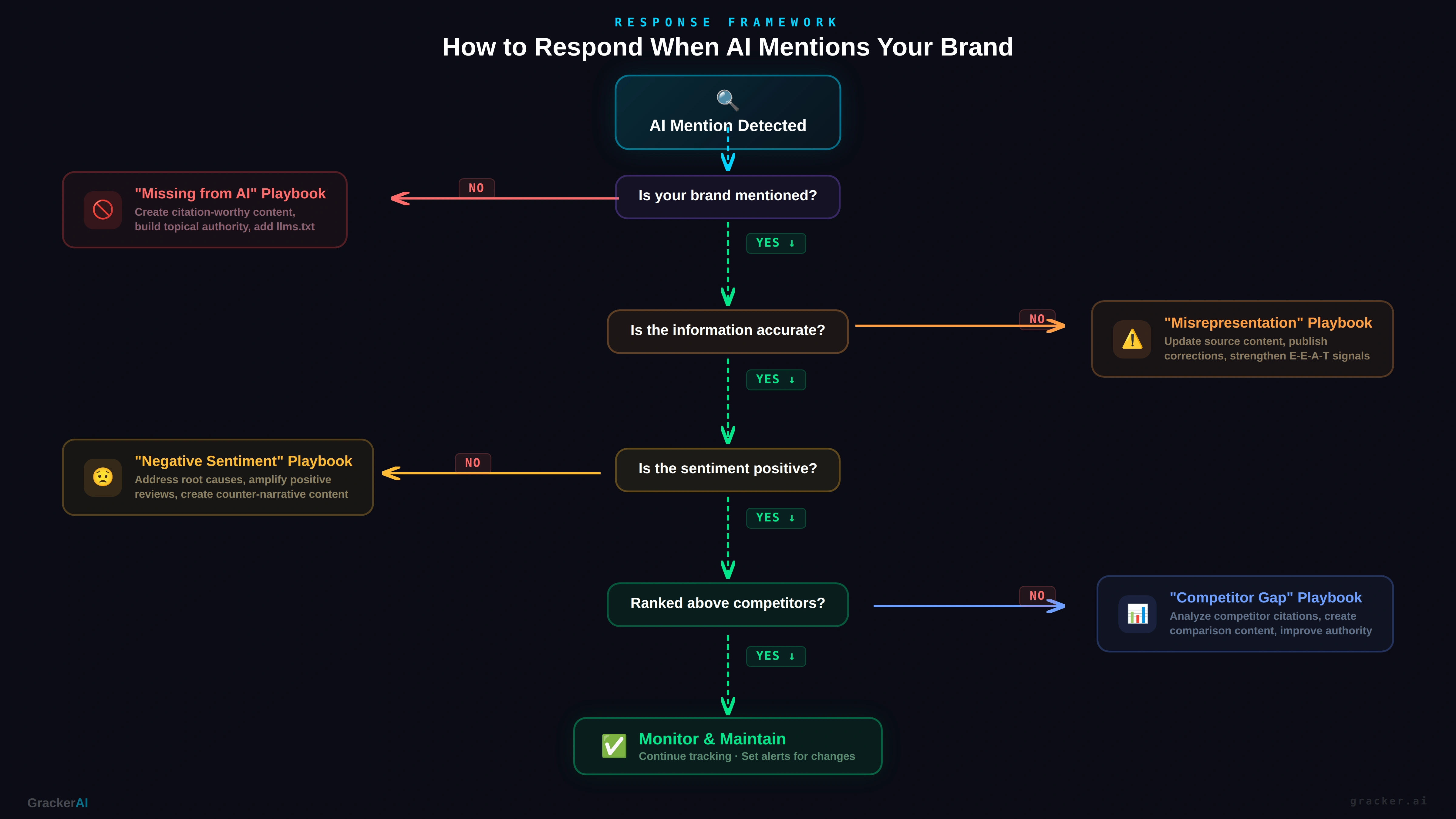
Monitoring is only valuable if you act on what you find. Here’s a framework for responding to different AI brand monitoring scenarios:
Scenario 1: Your Brand Is Missing from AI Answers
The problem: Users ask AI about your product category and your brand doesn’t appear.
What to do:
-
Audit the queries where you’re missing using your AI visibility tool.
-
Analyze what content the AI is citing — what sources, formats, and authority signals do those brands have that you don’t?
-
Create citation-worthy content targeting those specific queries: structured comparisons, detailed guides, FAQ-format content.
-
Build presence on the third-party sources AI trusts most: Reddit discussions, industry publications, review platforms.
-
Implement comprehensive schema markup to help AI engines understand your content.
Scenario 2: AI Is Misrepresenting Your Brand
The problem: AI provides outdated pricing, wrong feature descriptions, or attributes things to your brand that aren’t true.
What to do:
-
Document the specific inaccuracies across each AI platform.
-
Update your website content to clearly state correct information in AI-friendly formats (direct Q&A, structured data).
-
Create or update your
llms.txtfile — a machine-readable document that helps AI systems accurately understand your brand. (GrackerAI’sllms.txtis a good reference: gracker.ai/llms.txt) -
Ensure consistent NAP (Name, Address, Phone) and product information across all web properties.
-
Monitor for correction over subsequent weeks.
Scenario 3: Competitors Are Being Recommended Over You
The problem: AI consistently recommends competitors when users ask about your product category.
What to do:
-
Map the specific competitor citation gap — which queries, which platforms, which competitors.
-
Reverse-engineer their content strategy: what pages are being cited, what structured data do they use, where are they mentioned on third-party sites? Use competitive content gap analysis to find the exact topics and formats your competitors are winning with — and you’re not.
-
Create targeted alternatives and comparison content (e.g., “[Competitor] alternatives” pages).
-
Build authoritative listicle content where your product is naturally featured alongside competitors.
-
Invest in third-party mentions: guest posts, industry roundups, review sites, community discussions.
Scenario 4: Negative Sentiment in AI Responses
The problem: AI characterizes your brand negatively — mentioning past incidents, security issues, or customer complaints.
What to do:
-
Identify the source content driving the negative sentiment.
-
Create fresh, positive content that addresses concerns directly and transparently.
-
Amplify positive signals: case studies, customer testimonials, industry awards, analyst reports.
-
Engage on the platforms AI cites most (Reddit, forums, review sites) with genuine, helpful responses.Be aware that AI search penalties can compound quickly if negative UGC is left unaddressed — getting blacklisted from AI recommendations is harder to reverse than preventing it.
-
Track sentiment shifts weekly to measure improvement.
How Do You Build a Brand Monitoring Strategy for AI Search?
Building an effective AI brand monitoring strategy doesn’t require enterprise budgets. Follow this step-by-step framework:
Step 1: Define Your Monitoring Scope
Start with 20-30 high-intent queries that matter most to your business. These should include:
-
Category queries: “Best [your category] tools,” “Top [your category] software”
-
Comparison queries: “[Your brand] vs [competitor],” “[Competitor] alternatives”
-
Problem queries: “How to solve [problem your product addresses]”
-
Industry queries: Queries specific to your vertical (e.g., “best SIEM tools for compliance”)
Step 2: Choose Your Tool Stack
A practical brand monitoring stack for 2026 includes:
-
AI visibility platform (e.g., GrackerAI) for tracking across ChatGPT, Perplexity, Claude, Gemini, AI Overviews
-
Traditional monitoring tool (e.g., Brand24 or Mention) for social, news, and review tracking
-
Google Search Console for understanding traditional search performance alongside AI visibility
-
Analytics platform with AI referral tracking (segment traffic from ChatGPT, Perplexity, etc. in GA4)
Step 3: Establish Baselines
Before optimizing, document your current state:
-
AI visibility score across each platform
-
Share of voice vs. top 3-5 competitors
-
Citation frequency and quality
-
Sentiment profile
-
Top sources driving AI mentions
Step 4: Create a Response Playbook
Define who responds to what and how fast:
Scenario | Response Time | Action Owner |
|---|---|---|
Brand missing from AI answers | Weekly review | Content team |
Factual inaccuracies in AI | Within 48 hours | Product marketing |
Negative sentiment spike | Within 24 hours | PR / Comms |
Competitor gaining AI share | Bi-weekly strategy review | Growth team |
New AI platform emerging | Monthly evaluation | Marketing ops |
Step 5: Optimize and Iterate
Use your monitoring data to continuously improve:
-
Prioritize content creation around your biggest competitor citation gaps.
-
Optimize existing content for AI citation patterns: add direct answers, structured data, expert quotes, and statistics.
-
Build authority on the third-party sources that AI engines trust most.
-
Track improvements weekly and adjust strategy monthly.
GrackerAI automates much of this workflow — from monitoring visibility to generating the optimized content that closes gaps. See how it works →
Getting Started with GrackerAI for AI Brand Monitoring- Onboarding Steps
-
Begin your journey by entering your website name and URL. This is how GrackerAI identifies and connects to your online presence.
-
Once your site is added, the GrackerAI portal automatically analyzes your website, scanning its content, structure, and visibility to build a complete picture of your current standing.
-
Choose which AI search engines you want to optimize for. You can select all platforms or pick the ones most relevant to your audience: ChatGPT, Google Gemini, Microsoft Copilot, Grok AI, and Perplexity Search.
-
Define how your brand should be represented across AI platforms. Add your brand title and a clear description, then specify your target personas — the exact audience segments you want to reach and influence.
-
Map out your competition. In this step, you can identify and add all your key competitors, giving GrackerAI the context it needs to benchmark your performance and uncover opportunities.
-
Set up the prompts you want to track across AI search engines. For each prompt, define the following fields — Prompt, Type, Intent, and Language. You can add as many prompts as needed; Prompt 2, Prompt 3, and beyond all follow the same simple structure, making it easy to scale your monitoring as your needs grow.
What Is the Future of Brand Monitoring?
Brand monitoring is evolving faster than most marketing disciplines. Here’s what to expect in the near term:
AI Agents Will Replace Traditional Search Behavior
As AI agents begin making purchasing decisions on behalf of users — 24% of consumers are already comfortable with this, rising to 32% among Gen Z (Exposure Ninja) — brands will need to optimize for machine-to-machine discovery. This means your brand needs to be structured and described in ways that AI agents can evaluate programmatically, not just in ways humans find compelling.
Voice and Multimodal Search Will Expand Monitoring Requirements
With 153.5 million Americans projected to use voice assistants by 2025, brand monitoring will need to cover spoken AI responses across smart speakers, phones, and in-car systems. Google’s AI Mode already merges voice, vision, and text functionalities — monitoring will need to follow suit.
Real-Time AI Monitoring Becomes the Standard
As AI answers change with every query — 70% content variance on the same prompt, per Ahrefs research — monitoring cadence will shift from weekly snapshots to continuous, real-time tracking. Brands that catch negative shifts within hours instead of weeks will have a decisive advantage.
Attribution Will Connect AI Visibility to Revenue
The attribution gap is closing fast. Platforms like Amplitude are already connecting AI visibility scores to conversion paths and revenue metrics. BrightEdge’s AI Early Detection System shows how AI search contributes to traffic and conversions in real time. Expect AI visibility to become a standard KPI alongside organic traffic and paid search ROAS.
Content Authority Will Outweigh Keyword Optimization
The ranking factors have fundamentally shifted. While keywords remain relevant, their weight has dropped dramatically — from dominating traditional SEO to representing just 30% of AI search relevance. Meanwhile, structured data has surged to 90% importance, according to Riff Analytics’ 2025 dataset. The brands that build genuine topical authority through comprehensive, expert-level content will dominate AI citations long-term.
The Monitoring-Optimization Loop Will Become Automated
The most forward-thinking platforms — like GrackerAI — are already combining monitoring and optimization into a single automated workflow. Instead of generating reports and then manually creating content to fill gaps, AI-powered platforms identify visibility gaps and automatically generate the optimized content needed to close them. This closed-loop approach dramatically accelerates time-to-visibility. The 2026 B2B content calendar is already being built around this closed-loop approach — dramatically accelerating time-to-visibility for brands that adopt it early.
Frequently Asked Questions
What is AI brand monitoring?
AI brand monitoring tracks what AI tools (ChatGPT, Perplexity, Claude, Gemini, Google AI) say about your brand—who mentions or recommends it and how—so you can manage reputation and buyer influence beyond social media.
How is AI brand monitoring different from social listening?
Social listening watches what people say about your brand on social media, forums, and review sites. AI brand monitoring watches what AI tools (ChatGPT, Perplexity, Claude, Gemini, Google AI) say about your brand when people ask them — both matter because people feed AI, and AI feeds buyer decisions.
What tools can I use to monitor my brand in AI search?
Use GrackerAI, Semrush AI Toolkit, Otterly AI, Peec AI, Profound, and Ahrefs Brand Radar for AI monitoring, plus Brandwatch, Mention, Brand24, and Google Alerts for tracking.
How often should I monitor my brand in AI search results?
Check AI brand visibility weekly. In competitive markets, monitor daily. AI answers change often — studies show nearly half of citations can change per query.
Can I influence what AI says about my brand?
Yes. You can’t control AI answers, but you can influence them with authoritative content, trusted third-party mentions, structured data, llms.txt, and consistent, citation-worthy information.
What is a good AI visibility score?
Benchmarks vary by industry and competitive landscape. A good AI visibility score is 30–40% of key AI answers. Focus on steady growth — a 25%+ increase in 90 days is achievable.
How does AI brand monitoring connect to SEO?
AI search and traditional SEO are increasingly interconnected but require different optimization strategies. Strong SEO builds AI result foundations, but AI-specific optimization is essential—many AI-cited sources don’t appear in Google’s top organic results.
What is GEO and how does it relate to brand monitoring?
GEO (Generative Engine Optimization) improves how often AI engines cite your brand — the optimization strategy that raises your AI brand-monitoring metrics, GEO is the strategy for improving your position. Learn more about GEO →
How much does AI brand monitoring cost?
AI brand monitoring costs range from free tools like Google Alerts to $29–$500+ per month for specialized platforms. ROI is strong, as AI-driven traffic often converts 3–5x higher than traditional organic search traffic.
How long does it take to improve AI visibility?
You’ll usually see early AI visibility gains in 4–6 weeks. Bigger citation growth takes 2–3 months. Strong authority and consistent AI preference typically require 6–12 months of focused optimization.
What is an llms.txt file and do I need one?
An llms.txt file is a machine-readable file on your site that helps AI understand your brand and key facts—like robots.txt for AI. It’s not required yet, but it helps reduce AI errors and misrepresentation.
Start Monitoring Your Brand in AI Search Today
The shift from traditional search to AI-powered discovery is happening now. ChatGPT has surpassed 1 billion weekly active users. Google AI Overviews reach 2.5 billion users monthly. Your buyers are asking AI about your product category — the question is whether AI recommends you or your competitors.
Don’t wait until you’ve lost market share to invisible competitors. Start with a free AI visibility analysis to see exactly where your brand stands across every major AI search platform.
Get Your Free AI Visibility Analysis → portal.gracker.ai
GrackerAI helps B2B SaaS companies get discovered and cited by AI search engines. From real-time visibility monitoring to automated content creation, we give you the tools to dominate AI search results across ChatGPT, Perplexity, Claude, Gemini, and Google AI Overviews. Learn more →
Related Articles
-
 cybersecurity content audit
 How to Audit Cybersecurity Content for Accuracy and Originality
Cybersecurity content with incorrect facts destroys confidence fast. Here's a practical audit framework for correctness and originality that preserves the credibility of your security publications.
-

10 Examples of SaaS Companies with Exceptional Marketing
Explore 10 SaaS marketing examples with actionable tactics. Learn innovative strategies from top companies to elevate your own campaigns.
-

How to Find the Right B2B Prospects for Your SaaS Product
Stop wasting sales outreach on leads that're not a good fit. Learn ways to find, check, and work with the right B2B prospects for your SaaS product.
-
 online reputation management
 The Importance of SEO in Online Reputation Management
Discover how SEO influences your digital brand. Learn actionable strategies to suppress negative search results and build a positive online reputation today.