What Experts Say About AEO, GEO, and AI Search

Deepak Gupta · Co-founder/CEO
· Updated September 20, 2026
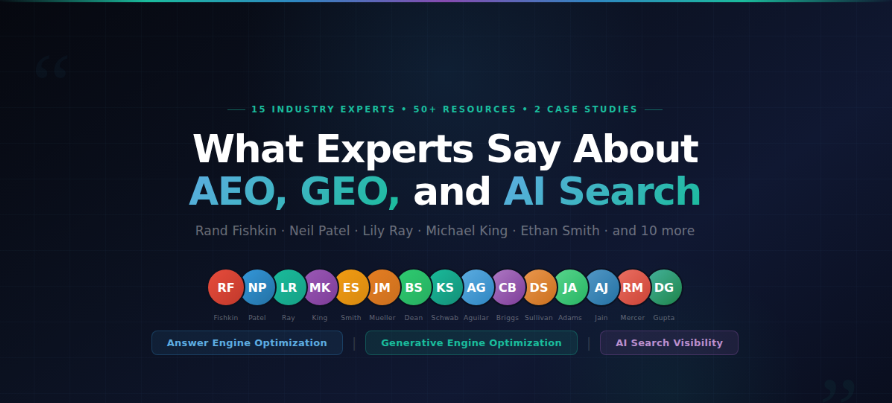
The Definitive Guide for B2B SaaS Marketing Leaders Navigating AI-Powered Search
Note on Expert Perspectives: Expert viewpoints in this article are sourced from their published works, conference talks, podcasts, and public statements—linked throughout for verification. Where perspectives are attributed, they represent the author’s synthesis of each expert’s publicly documented positions, not direct interview quotes unless explicitly noted. |
Your Prospects Are Getting Answers Without Clicking Your Website
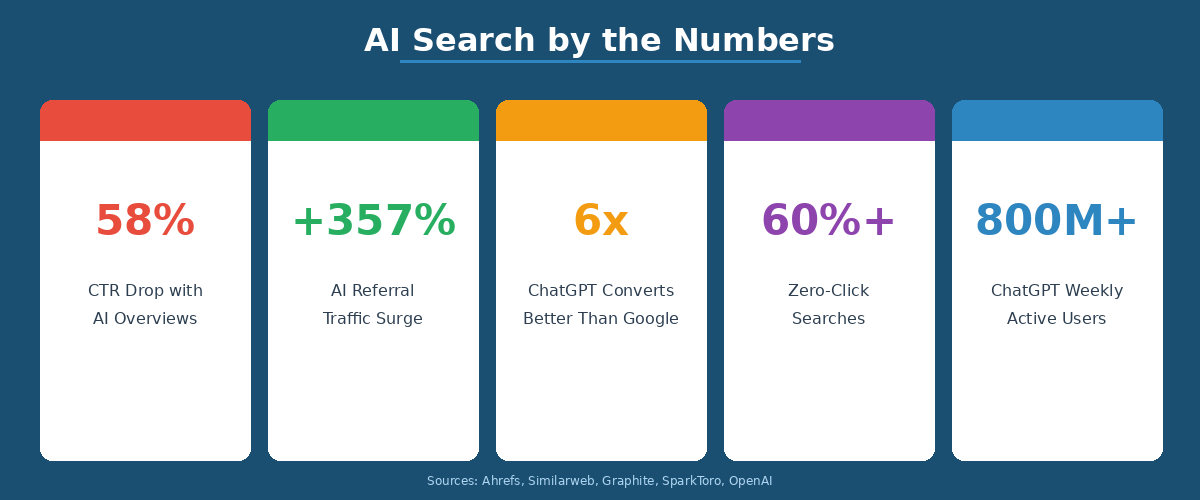
Here is a reality check for every B2B SaaS marketer: over 60% of Google searches now end without a single click (SparkToro/Datos, 2024). Your carefully crafted landing pages, your SEO-optimized blog posts, your conversion-tuned product pages—they are increasingly invisible to buyers who get their answers directly from AI.
Google’s AI-generated summaries now appear on roughly one in five Google searches, and when one does, searchers click through to a traditional result link about half as often — just 8% of visits, versus 15% when no summary appears (Pew Research Center, 68,879 Google searches from 900 U.S. adults, March 2025, retrieved 2026-09-16). Meanwhile, referral traffic from AI assistants keeps climbing: monthly sessions driven by LLMs like ChatGPT grew 9.9x across 166 tracked sites between November 2024 and May 2026, with ChatGPT alone sending 92.4% of that traffic (Search Engine Land, reporting on Previsible’s 2026 State of AI Discovery Report, retrieved 2026-09-16). The search landscape your marketing team optimized for three years ago no longer exists.
This is where two terms you are hearing everywhere come in: Answer Engine Optimization (AEO) and Generative Engine Optimization (GEO). Together, these strategies represent the new frontier of AI Search optimization—a fundamental shift in how your B2B buyers discover, evaluate, and shortlist software solutions.
For teams trying to operationalize that shift, The Practical Guide to AI Search Visibility offers a practical framework for improving how your brand appears across AI-generated answers and citation-based discovery.
We dug into the research—including the landmark GEO study from Princeton, Georgia Tech, Allen Institute for AI, and IIT Delhi published at KDD 2024—and compiled what 15 leading experts are actually saying. For each expert, we’ve included links to their most famous resources so you can go deeper. Here is what B2B SaaS marketers need to know, why it matters, and exactly what to do about it.
AEO vs. GEO: What Is the Actual Difference?
The terminology can be confusing, so let us cut through the noise. Here is how Neil Patel, one of the most recognized voices in digital marketing, frames it in his GEO vs AEO guide:
Neil Patel has argued that AEO and GEO are fundamentally different strategies that most marketers wrongly treat as interchangeable. AEO helps your content show up as a direct answer, while GEO is built for AI-powered results like Google’s AI Overviews and ChatGPT. Confusing them, he warns, is a strategic mistake. — Neil Patel, Co-Founder of NP Digital (neilpatel.com, Dec 2025) |
🔗 Dive Deeper with Neil Patel:
|
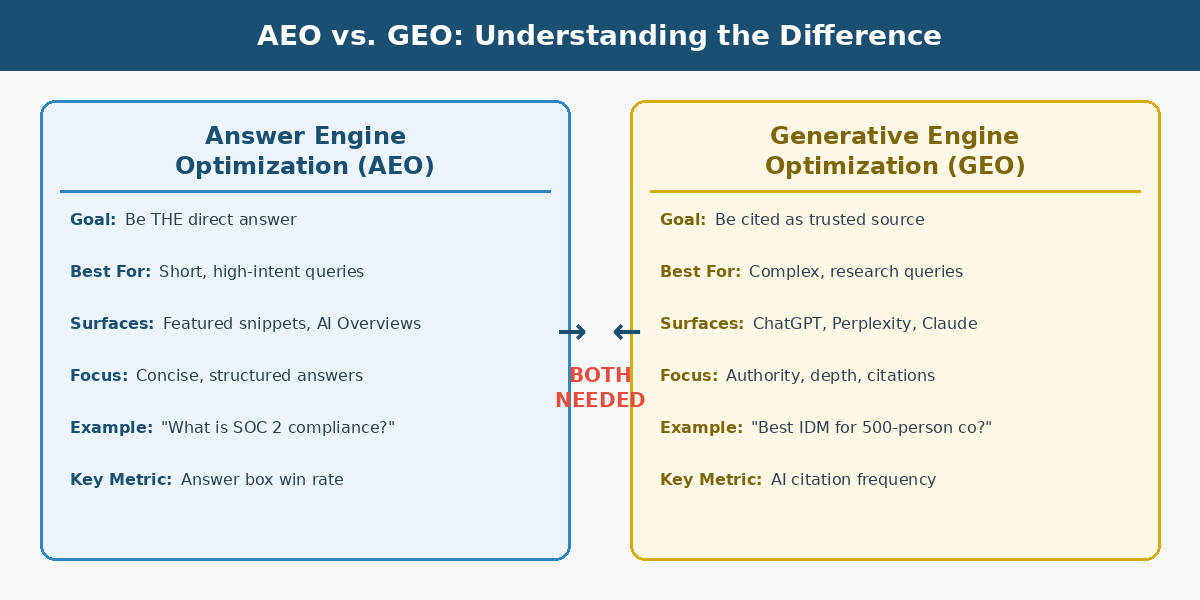
Answer Engine Optimization (AEO)
AEO is about structuring your content so AI systems can extract it as the direct answer to a specific question. Think of it as winning the equivalent of Google’s featured snippet, but across every AI surface—Google AI Overviews, AI Mode, voice assistants, and ChatGPT Search.
Best for: High-intent, short-answer queries like “How much does [your product] cost?” or “What is SOC 2 compliance?”
Generative Engine Optimization (GEO)
GEO goes deeper. It is about making your content authoritative and substantive enough that LLMs like ChatGPT, Claude, and Perplexity cite you as a trusted source when they synthesize comprehensive answers to complex questions.
Best for: Complex, research-oriented queries like “What should I consider when choosing an identity management platform for a 500-person company?”
Why You Need Both
Experts are unanimous on this point: AEO and GEO are complementary, not interchangeable. Ethan Smith, CEO of Graphite (the leading AEO agency working with Webflow, Upwork, and Notion), prefers the AEO umbrella term because it focuses narrowly on answer quality—but acknowledges that everything that works in SEO works in AEO, with additional strategies needed for LLM-specific citation optimization (Lenny’s Podcast, Sep 2025).
🔗 Dive Deeper with Ethan Smith:
|
What 15 Leading Experts Actually Say About AI Search
We compiled positions from the industry’s most influential voices—including leaders from Semrush, Ahrefs, NP Digital, SparkToro, Graphite, and more. Here is the landscape of expert opinion, distilled for B2B SaaS marketers:
Expert | Affiliation | Core Position | Key Recommendation |
Neil Patel | NP Digital | AEO and GEO are distinct but complementary; most marketers wrongly treat them as the same | Use AEO for short queries; GEO for complex topics; combine with SEO as triple-threat |
Lily Ray | Amsive (VP, SEO) | Good SEO IS good AEO; beware “GEO grifters”; AI search supplements, not replaces | Focus on E-E-A-T, information gain, off-site reputation |
Tim Soulo | Ahrefs (CMO) | AI search hype is overblown; core SEO still applies; don’t ignore YouTube | YouTube may drive more value than all LLMs combined |
Ethan Smith | Graphite (CEO) | AEO is the evolution of SEO; ChatGPT traffic converts 6x better | Target question clusters; build diversity of citations |
Rand Fishkin | SparkToro | Zero-click universe; traffic is a terrible goal; build influence | Zero-click marketing: create value where audiences already are |
Michael King | iPullRank | Answers over rankings; “Relevance Engineering” as new framework | Optimize across all AI platforms; focus on semantic richness |
Ross Simmonds | Foundation Mktg | Create Once, Distribute Forever; off-site presence essential | Seed brand on Reddit, Quora, LinkedIn, YouTube |
Andrea Volpini | WordLift | Knowledge Graphs and structured data are foundational to AI visibility | Build Schema.org markup, JSON-LD, semantic metadata |
Marie Haynes | MH Consulting | Extreme E-E-A-T now required for YMYL content in AI-first search | Prioritize credentials, trust signals, first-hand experience |
Kevin Indig | Growth Advisor | SEO entering new investment cycle; zero-click rising but volume up | Scale content depth; shift from ranked lists to definitive answers |
Danny Sullivan | Good SEO is good GEO; write for humans, not LLMs | Focus on helpful content; avoid AI tricks at expense of quality | |
Andrew Holland | JBH (SEO Dir.) | Future isn’t GEO—it’s Organic Revenue Growth; fame engineering | Increase relative fame; make brand search your priority |
Tushar Pol | Semrush | GEO fundamentals overlap with SEO; track AI share of voice | Track AI share of voice with a visibility platform; publish original research |
Patrick Stox | Ahrefs | AEO/GEO is evolution, not revolution; most SEO “works for free” | Keep technical foundations strong; create parsable content |
Deepak Gupta | GrackerAI (CEO) | AI Search visibility is #1 growth lever for B2B SaaS in 2026 | Monitor AI citations; build content intelligence systems |
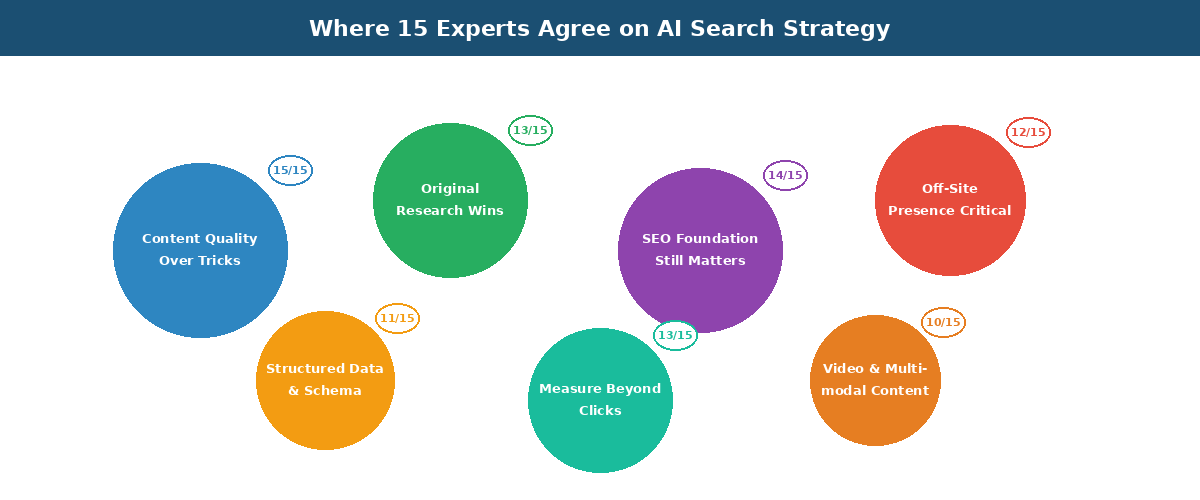
Five Themes Every B2B SaaS Marketer Must Internalize
1. Traditional SEO Tactics Are Failing in AI Search
The Princeton, Georgia Tech, Allen Institute for AI, and IIT Delhi research paper on GEO (published at KDD 2024), tested nine different content optimization strategies and found something alarming: keyword stuffing—the backbone of traditional SEO—actually hurt visibility in generative engine responses.
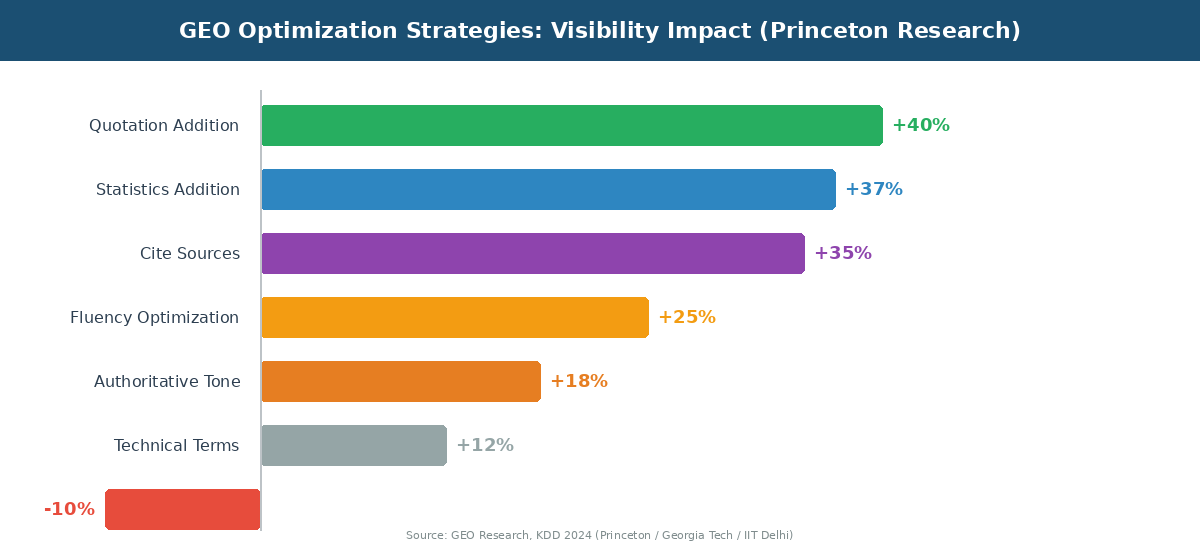
When tested on Perplexity.ai, keyword-stuffed content performed 10% worse than unoptimized content. The strategies that actually worked:
-
Quotation Addition (+40% visibility): Embedding credible quotes from recognized experts or studies
-
Statistics Addition (+37% on Perplexity): Replacing vague claims with concrete data points
-
Cite Sources (+30–40% visibility): Adding inline references to authoritative sources
-
Fluency Optimization (+15–30%): Making content structurally clear and readable for LLM parsing
The GEO research demonstrated that content optimized with citations, statistics, and expert quotations boosted visibility by up to 40% in generative engine responses—while keyword stuffing actually decreased it. These findings held across multiple generative engines and query types. — GEO Research Paper, KDD 2024 (Princeton / Georgia Tech / IIT Delhi) |
🔗 Dive Deeper with The Research:
|
2. Information Gain Is the New Competitive Moat
Multiple experts converge on one principle: AI systems want information gain—unique data, firsthand experience, original research, or perspectives that cannot be found elsewhere.
Lily Ray, VP of SEO Strategy and Research at Amsive, warns against what she calls “GEO grifters.” At her highly acclaimed MozCon 2025 keynote, she emphasized that 95% of ChatGPT users still use Google, and that strong SEO fundamentals remain the best path to AI visibility.
Lily Ray has consistently emphasized that the core work of SEO—building authoritative, well-structured content—already goes a long way toward earning AI search visibility. In her view, most brands don’t need an entirely new playbook; strong SEO fundamentals are sufficient to generate significant AI search presence. — Lily Ray, VP of SEO Strategy & Research, Amsive (Aug 2025) |
🔗 Dive Deeper with Lily Ray:
|
Tim Soulo, CMO of Ahrefs, brings a contrarian perspective: he argues that AI assistants still account for a small share of total site traffic next to established channels, and that YouTube remains the more consistently overlooked opportunity for B2B marketers. His advice: don’t over-invest in AI assistant optimization at the expense of proven channels like video.
🔗 Dive Deeper with Tim Soulo: • Podcast: SEO in the Age of AI (Empire Flippers) |
3. Off-Site Reputation Now Gates AI Inclusion
LLMs validate your claims against third-party sources. Ross Simmonds, founder of Foundation Marketing and Distribution.ai, has built an entire philosophy around this reality with his “Create Once, Distribute Forever” model.
As Michael King, founder of iPullRank, puts it:
Michael King has argued that LLMs fundamentally reward originality over repetition. As he sees it, too much SEO content is derivative—one site rewriting another’s article, creating “derivatives of derivatives.” AI models, by contrast, seek out diversity of opinion and the wisdom of the crowd, making original perspectives far more valuable than rehashed content. — Michael King, Founder of iPullRank |
🔗 Dive Deeper with Ross Simmonds:
|
AI engines frequently cite sources that never crack Google’s top rankings at all — citation and ranking follow different mechanics, not the same authority signals (see the Princeton/Georgia Tech/IIT Delhi GEO research above, and our guide to AI citation patterns for how each engine selects sources). This is a meaningful opportunity for mid-market SaaS companies that cannot out-rank enterprise incumbents in traditional search.
4. Machine Readability Is Non-Negotiable
Andrea Volpini, founder of WordLift, argues that the future of search is built on Knowledge Graphs and structured data. AI crawlers parse your content differently than human readers, and if your content is not structured for machine consumption, it will not be cited.
🔗 Dive Deeper with Andrea Volpini:
|
Patrick Stox of Ahrefs reinforces that keeping technical SEO foundations strong remains essential for AI crawlability — parsable markup, fast load times, and clean site architecture help both classic search rankings and AI citation eligibility. He’s cautious about leaning on any single vendor’s AI-conversion multiples as a universal benchmark, since methodology varies widely between studies.
🔗 Dive Deeper with Patrick Stox:
|
Here is what the technical implementation looks like for B2B SaaS:
-
Schema.org markup (JSON-LD): Implement FAQ, HowTo, SoftwareApplication, and Organization schemas
-
Modular content structure: Write in self-contained 200-word sections under clear question headings
-
llms.txt file: Create in your root directory for AI crawler instructions
-
Multimodal readiness: Add transcripts to videos, descriptive alt text, structured metadata
5. The Label Debate Matters Less Than Execution
There is an active debate. Ethan Smith prefers “AEO.” Michael King coined “Relevance Engineering.” Andrew Holland says “fame engineering” is the future. Google’s Danny Sullivan cuts through it all:
Danny Sullivan has been direct about this: good SEO is good GEO. His consistent advice to publishers is to write for people, not for algorithms or LLMs, and he has cautioned that chasing AI-specific tricks can backfire when they come at the expense of genuinely useful content. — Danny Sullivan, Director within Google Search (WordCamp US, Aug 2025) |
🔗 Dive Deeper with Danny Sullivan:
|
🔗 Dive Deeper with Michael King:
|
🔗 Dive Deeper with Andrew Holland:
|
As Deepak Gupta, CEO of GrackerAI, observes:
At GrackerAI, we’ve observed a clear pattern: the companies winning in AI Search are not the ones debating whether to call it AEO, GEO, or LLMO. They are the ones building content intelligence systems that monitor, optimize, and iterate on their presence across every AI platform simultaneously. The name is irrelevant. The execution is everything. — Deepak Gupta, CEO of GrackerAI |
What the Princeton/IIT Delhi Research Proves for B2B Content
The GEO research paper quantified which strategies increase visibility in AI-generated responses. The most important finding for B2B: GEO methods disproportionately benefit lower-ranked websites. Content ranked fifth saw visibility increases of up to 115% with proper optimization, while top-ranked content actually lost ground.
For mid-market SaaS companies competing against enterprise incumbents, AI Search platforms represent the best opportunity to get in front of buyers. The playing field is leveling because AI cares more about content substance than domain authority.
Domain-Specific Strategies Matter
-
For factual content (product comparisons): Adding citations performed best
-
For opinion/thought leadership: Statistics Addition was most effective
-
For explanatory content (how-to guides): Quotation Addition from authorities boosted visibility most
-
For business/commercial content: Fluency Optimization showed strongest gains
The combination effect: Fluency + Statistics outperformed any single strategy by over 5.5%. Do not pick one approach—layer them.
More Expert Resources Worth Exploring
Here are additional high-impact resources from the remaining experts featured in this guide:
Marie Haynes of MH Consulting argues that AI-first search raises the bar on E-E-A-T for anything resembling YMYL (Your Money or Your Life) content: credentials, first-hand experience, and demonstrable trust signals matter more, not less, when an LLM is deciding what to cite. For a deeper walkthrough of how E-E-A-T concretely affects AI-answer ranking, see how E-E-A-T impacts AEO ranking in AI answers.
🔗 Dive Deeper with Marie Haynes:
|
🔗 Dive Deeper with Kevin Indig:
|
The 90-Day AEO/GEO Playbook for B2B SaaS Teams
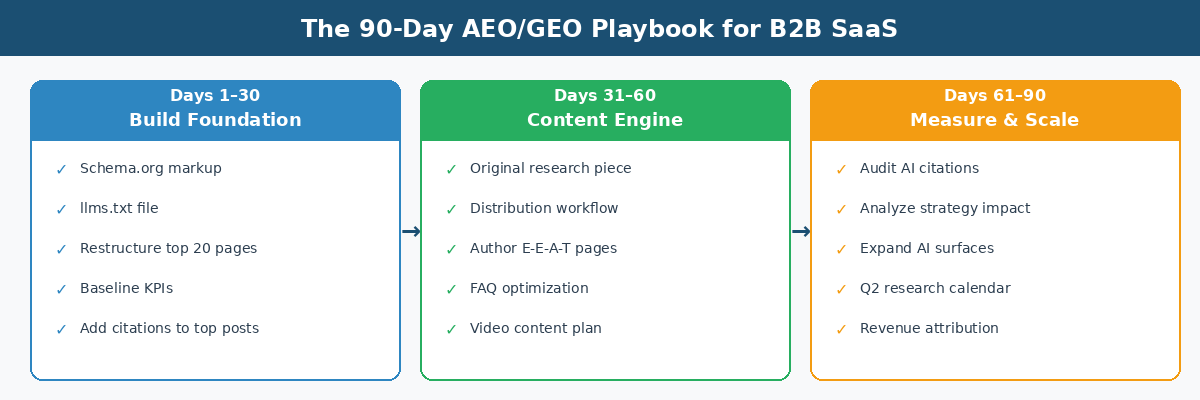
Days 1–30: Build the Technical Foundation
-
Audit your Schema.org markup. Implement JSON-LD for Organization, SoftwareApplication, FAQ, and HowTo schemas.
-
Create an llms.txt file in your root directory with explicit instructions for AI crawlers.
-
Restructure your top 20 pages into modular, 200-word sections under clear question-based headings.
-
Establish baseline KPIs for AI Search visibility — presence, prominence, sentiment, and citation rate per engine — using an AI visibility tracking platform such as GrackerAI’s AI Visibility Intelligence suite.
-
Add citations, statistics, and expert quotes to your five highest-traffic blog posts.
Days 31–60: Launch Your Content and Distribution Engine
-
Publish your first original research piece (customer survey, benchmark report, or product usage data analysis).
-
Build a systematic distribution workflow: every piece of content gets repurposed for LinkedIn, Reddit, Quora, and YouTube.
-
Create author pages with credentials for every content contributor. Demonstrate E-E-A-T.
-
Optimize product documentation and FAQs with concise 2–4 sentence answers to high-intent questions.
Days 61–90: Measure, Iterate, Expand
-
Audit AI citations: Query your top 50 terms across ChatGPT, Perplexity, Claude, and Google AI Overviews.
-
Analyze which content strategies are driving the most AI visibility in your specific domain.
-
Expand to additional AI surfaces beyond Google—optimize for Claude, ChatGPT, Perplexity, and Copilot.
-
Plan your Q2 original research calendar based on what AI systems are hungry for in your space.
How to Measure Success When Clicks Are Not the Goal
As Rand Fishkin argues in his zero-click marketing framework, traffic is a vanishing metric. New KPIs for B2B SaaS:
-
AI Citation Frequency: How often is your brand cited in AI responses for target queries?
-
LLM Share of Voice: What % of the time are you mentioned when AI recommends in your category?
-
Brand Mention Accuracy: When AI mentions your product, is it positioning you correctly?
-
AI Referral Conversion Rate: ChatGPT-referred visitors convert roughly 6x better than average organic traffic, per Graphite’s research cited above — are you tracking this segment?
-
AI Overview Citation Rate: How often does your content appear in AI Overviews?
GrackerAI’s Visibility dashboard tracks all five of these per-engine automatically. Build a routine of querying your top 50 terms across AI platforms weekly, whatever tooling you use to do it.
For a deeper dive on winning B2B buyers specifically through AI search channels, see our complete guide to winning B2B buyers in AI search, which covers the full buyer journey optimization strategy from awareness through purchase decision.
Essential Deep Research, Case Studies & Reports
For readers who want to go even deeper, here are the most important research papers, case studies, and data reports driving the AEO/GEO conversation:
Foundational Research Papers
Aggarwal, P., Murahari, V., et al. (2024). GEO: Generative Engine Optimization KDD ’24 Proceedings.
Pew Research Center. (2025). Google users are less likely to click on links when an AI summary appears in the results (68,879 searches, 900 U.S. adults, retrieved 2026-09-16).
Industry Reports & Benchmarks
Gartner. (2024). Predicts Search Engine Volume Will Drop 25% by 2026.
Previsible. (2026). 2026 State of AI Discovery Report, via Search Engine Land (6.77M AI-driven sessions across 166 sites; ChatGPT referral sessions up 9.9x since Nov 2024, retrieved 2026-09-16).
Previsible. (2026). 2025 State of AI Discovery Report — 527% AI traffic surge Jan–May 2025.
SparkToro/Datos. (2025). State of Search 2025 — 60%+ zero-click searches.
Expert Publications & Must-Read Guides
King, M. (2025). The AI Search Manual — Complete Guide to Relevance Engineering (iPullRank, Nov 2025).
Haynes, M. (2024). SEO in the Gemini Era — Book on how AI changed Google Search.
Simmonds, R. (2024). Create Once, Distribute Forever — Book on content distribution strategy.
Smith, E. (2025). The Ultimate Guide to AEO (Lenny’s Podcast) — 7-step playbook for ChatGPT ranking.
Tools for AI Search Monitoring
GrackerAI tracks presence, prominence, sentiment, and citation rate per AI engine in one dashboard, purpose-built for cybersecurity and B2B SaaS brands. See also our roundup of AEO tools for brands for a broader comparison beyond GrackerAI.
Industry Coverage & Press
The AEO/GEO space is attracting significant industry attention, GrackerAI included:
• AP News: GrackerAI Launches Industry’s First GEO Platform for Cybersecurity SaaS
• Markets Herald: $68B SEO Industry Faces First Real Threat: Why VCs Betting on GEO
• Belmont Star: Cybersecurity Buyers Asking AI for Vendor Recommendations
Frequently Asked Questions
What is the difference between AEO and GEO?
AEO structures content to be extracted as a direct answer on a single AI surface — the equivalent of winning a featured snippet, but for AI Overviews, AI Mode, and voice assistants. GEO is broader: it works to get a brand cited as a source when LLMs like ChatGPT, Claude, or Perplexity synthesize an answer to a more complex, research-oriented question. Most B2B SaaS teams need both.
Do I need to choose between AEO, GEO, and traditional SEO?
No. Every expert compiled in this guide, including Google’s own Danny Sullivan, converges on the same point: strong technical and content SEO remains the foundation, and AEO/GEO add citation- and answer-specific tactics on top of it. Treat them as complementary disciplines, not competing budgets.
How fast can a B2B SaaS company see results from AEO/GEO work?
The 90-day playbook above sequences the work: technical foundations (schema markup, an llms.txt file, modular content) in the first 30 days, distribution and original research in the next 30, and measurement and expansion in the last 30. Format changes like adding citations, statistics, and expert quotations can register in AI visibility within weeks, per the KDD 2024 GEO research cited above; authority-style gains take longer.
How should marketers measure success when AI answers reduce clicks?
Track citation frequency, share of voice, and mention accuracy per AI engine rather than pageviews alone — Pew Research found that a Google AI summary roughly halves the click-through rate to any single link (Pew Research Center, retrieved 2026-09-16). The conversion rate on whatever AI-referred traffic does arrive is a more meaningful proxy than raw sessions.
Can smaller or mid-market brands compete with larger, better-known competitors in AI search?
Yes — this is one of the more consistent findings across the sources in this guide. The KDD 2024 GEO research found that lower-ranked content gained the most from optimization, with content ranked fifth seeing visibility increases of up to 115%, because generative engines weigh content substance and citation-worthiness more heavily than domain authority. That levels the field for companies that cannot out-rank enterprise incumbents in traditional search.
The Bottom Line
The shift from search engines to answer engines is not coming—it is here. Gartner predicted a 25% drop in traditional search volume by 2026 (Gartner, February 2024). Pew Research found that a Google AI summary roughly halves the odds a searcher clicks through to any single link. AI referral traffic kept climbing through 2026, and ChatGPT-referred visitors convert markedly better than average organic traffic, per the research cited above.
The threat is real: invisible to AI means invisible to a growing segment of buyers. The opportunity is equally real: generative engines care more about content quality than domain authority, meaning mid-market SaaS companies can compete in ways impossible in traditional search.
As Deepak Gupta of GrackerAI emphasizes, the companies that dominate the next decade are those that treat AI Search visibility as a core revenue channel today. The experts are clear. The research is clear. The data is clear. The question is not whether to invest in AEO, GEO, and AI Search optimization—it is how fast you can start.
Related Articles
-
 cybersecurity content audit
 How to Audit Cybersecurity Content for Accuracy and Originality
Cybersecurity content with incorrect facts destroys confidence fast. Here's a practical audit framework for correctness and originality that preserves the credibility of your security publications.
-

10 Examples of SaaS Companies with Exceptional Marketing
Explore 10 SaaS marketing examples with actionable tactics. Learn innovative strategies from top companies to elevate your own campaigns.
-

How to Find the Right B2B Prospects for Your SaaS Product
Stop wasting sales outreach on leads that're not a good fit. Learn ways to find, check, and work with the right B2B prospects for your SaaS product.
-
 online reputation management
 The Importance of SEO in Online Reputation Management
Discover how SEO influences your digital brand. Learn actionable strategies to suppress negative search results and build a positive online reputation today.