Speed-to-Lead for Inbound: Simple Rules That Increase Conversions

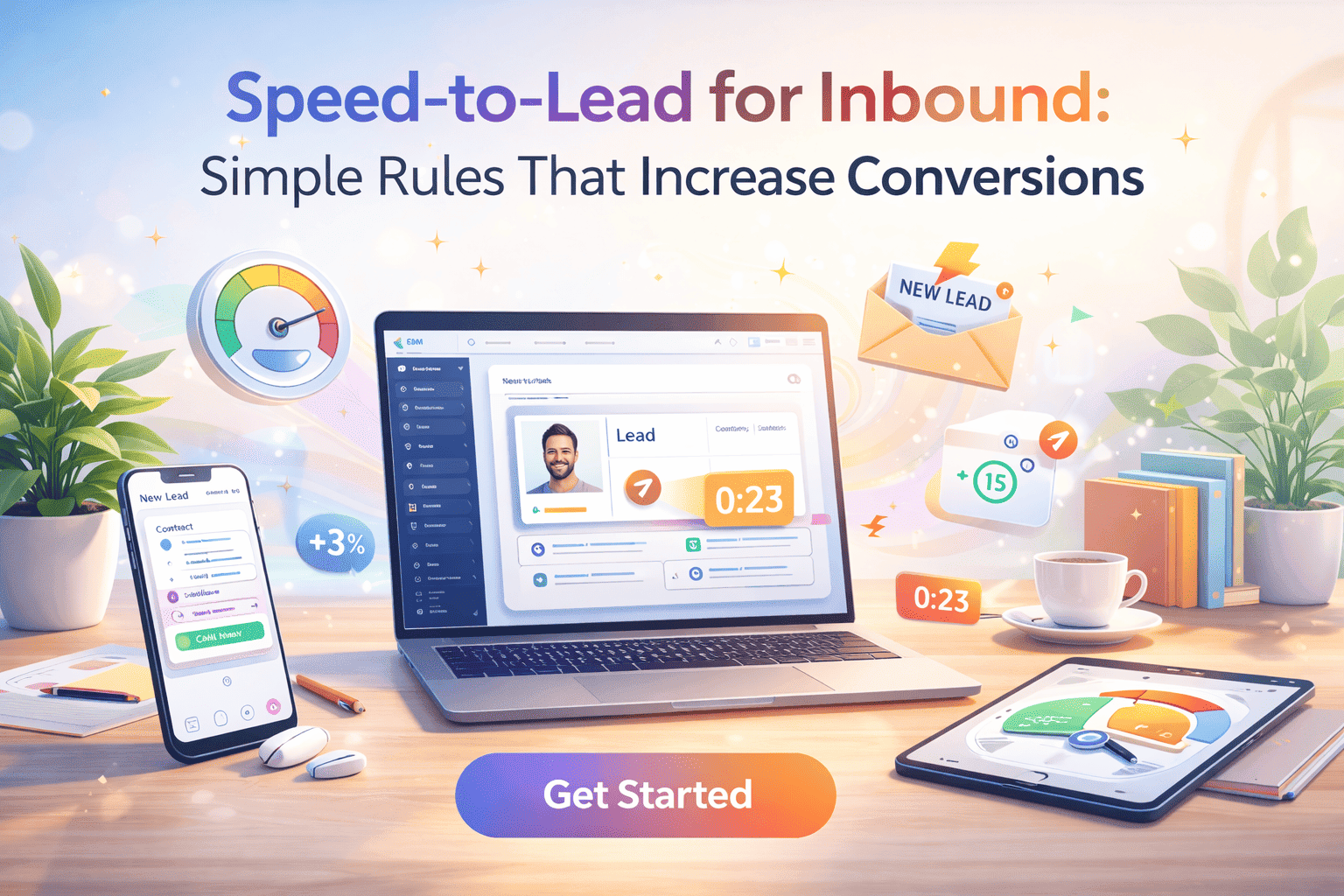
Speed to lead is the time between when a prospect submits a form, books a demo, or calls in, and when a business makes first contact. It is the single biggest lever most sales teams have on conversion rate, because the fastest responder — not necessarily the best product — usually wins the deal.
In many industries, including SaaS, B2B services, and high-demand e-commerce, the response window that actually moves conversion is as short as 5-10 minutes. According to HubSpot's 2024 State of Service research, 82% of customers expect an issue or inquiry to be handled immediately, where "immediate" is commonly defined as ten minutes or less (HubSpot, retrieved 2026-09-19). A Harvard Business Review-associated study is also widely cited for the finding that contacting a lead within an hour makes a company roughly 7 times more likely to convert it than a competitor that waits longer — treat that figure as a directional benchmark rather than a fresh statistic, since the underlying research is now over a decade old.
What Is Speed to Lead?
Speed to lead — also called lead response time — measures how quickly a business engages with an incoming prospect from a form, sign-up flow, or other inbound channel.
Traditional speed to lead runs through four operational steps, and each one adds latency:
- Lead capture through a form, sign-up flow, or inbound channel.
- Lead assignment to a sales agent.
- Notification of the assigned agent.
- First response — an email, a call, or a scheduled meeting.
Multiple studies show that the odds of successfully reaching a prospect drop sharply with every passing hour. Every minute of delay reduces the chance of even starting a conversation, let alone closing a deal.
Advanced lead distribution software automates the routing step so prospects reach the right person immediately: early-stage researchers get nurturing content, and high-intent leads get connected to an agent right away.
Why Response Time Directly Affects Conversion Rates
Response time affects conversion because a lead who just submitted a form is actively evaluating options, not passively browsing. They have already moved past the awareness stage and are comparing vendors in real time.
A slow response creates friction and uncertainty. If a lead does not hear back quickly, they typically do one of four things:
- Move forward with a faster competitor.
- Switch to other tasks and forget about the inquiry.
- Assume the company is slow or unresponsive as a vendor.
- Lose interest in the product or service entirely.
By the time a slow team responds, the opportunity is often already gone. Buyers read response time as a signal of what working with the company will actually be like after purchase — so speed is not just about winning the deal, it is a first impression of the product.
The Same Logic Applies to AI-Sourced Leads
Increasingly, the prospect who fills out that form did not find the company through a Google search — they asked ChatGPT or Perplexity for a recommendation and clicked through from the answer. Winning that citation is only half the job. Once the lead converts from an AI-driven recommendation into a form fill, the same 5-10 minute response window still decides whether it closes. Tracking which AI answer engines are sending inbound traffic — and how quickly that traffic gets a human response — is where AI visibility monitoring and speed-to-lead discipline intersect (see GrackerAI's AI citation tracking).
7 Rules That Increase Conversions
The most effective speed-to-lead fixes are usually the simplest to implement — they do not require hiring more agents or paying for overtime coverage.
The key is balancing automation with human judgment: a lead management system (LMS) that reads prospect behavior and engagement patterns, paired with reps who know when to pick up the phone.
Rule 1: Use Short Forms and Collect First-Party Data
Short forms reduce friction. Ask for name, email, and a small number of qualifying details — not everything you eventually want to know. The goal at this stage is to capture interest, not to complete a full intake.
Pair the short form with marketing automation and lead-tracking tools that assemble first-party data in the background:
- Website behavior (pages viewed, time on page)
- Form interactions and previous submissions
- Chat conversations
- Email engagement (opens and clicks)
- Campaign source data (UTM parameters, ad campaigns, referral channels)
That data lets a rep prioritize high-intent leads and tailor the first follow-up instead of sending a generic message.
Rule 2: Route Prospects Instantly With a Lead Management System
Manual routing breaks down once dozens or hundreds of leads arrive across channels in the same day. A lead management system assigns each incoming prospect to the right rep automatically, based on rules set in advance — territory, deal size, language, or specialization.
Once assigned, the rep gets an immediate notification and should respond while purchase intent is still high.
Rule 3: Send an Immediate Automated Acknowledgment
The first few seconds after a lead submits a request shape how they perceive the company. A strong automated acknowledgment message includes:
- The lead's name and confirmation that the request was received.
- A reference to the specific request, plus relevant information such as pricing or availability.
- Clear next steps — when and how a rep will follow up.
- Direct contact details for anyone who wants to reach out sooner.
While the prospect is reading that confirmation, the assigned rep is already notified and preparing to follow up.
Rule 4: Respond Within 5 Minutes
Inbound leads are usually comparing several vendors at once, submitting the same request to multiple companies in the same session. The first responder gains a real, measurable advantage.
An AI chatbot or call agent that handles the first response makes hitting a 5-minute window realistic without adding headcount. Modern conversational AI tools can parse informal phrasing, typos, and mixed-language input well enough that a prospect can describe their problem in plain language and get a useful answer immediately, with a clean handoff to a human rep for anything that needs judgment.
Rule 5: Prioritize High-Intent Leads
Top reps should spend their time on the prospects most likely to buy. A lead management system pairs high-intent leads with the best-suited rep automatically — for example, routing a Spanish-speaking enterprise buyer to a rep with the matching language and experience, rather than to whichever rep is next in a generic queue.
Once the highest-value leads are covered, the system routes the remaining inquiries to the rest of the team.
Rule 6: Follow Up Multiple Times, Strategically
Not every lead converts on the first conversation — especially in industries with long decision cycles, like B2B software, commercial real estate, or high-value financial services.
The traditional marketing "rule of 7" holds that a buyer typically needs somewhere between 5 and 13 touchpoints before they trust a brand enough to convert. Keep each follow-up short and tied to the prospect's stated need, and let automation handle timing so reps reach out when interest is highest — not on a fixed weekly schedule.
Rule 7: Track and Improve Response Metrics
You cannot improve what you do not measure. Eight metrics matter regardless of industry:
| Metric | What it tells you |
|---|---|
| Time to first response | Average time from form submission to first contact |
| First-contact resolution rate | Share of leads whose initial questions get fully answered in one interaction |
| Follow-up timing | How quickly the second and third contacts happen |
| Time to qualification | How long it takes to qualify a prospect after first contact |
| Response rate by channel | Which channel (email, phone, chat, SMS) delivers the fastest engagement |
| Engagement depth | Number of interactions per lead |
| Agent performance | Average response time and conversion rate per rep |
| Missed lead rate | Share of leads that never receive any response |
Use these metrics to find where speed-to-lead actually breaks down — a slow assignment step, a confusing campaign, or a rep who consistently responds slower than the rest of the team.
Build an Internal Culture Around Speed
Tools alone will not fix a broken response process if the team does not buy into it. Train new hires from day one on why fast, specific answers matter, and show experienced reps — who may be more attached to older workflows — how automation removes repetitive work rather than replacing their judgment.
Stanislav Khilobochenko, VP of Customer Services at MacKeeper, frames it this way: "Great customer service is about empathy delivered efficiently. The future of customer engagement is intelligent, automated, and deeply personal. Technology should remove friction, not add to it."
Frequently Asked Questions
What is a good speed-to-lead benchmark?
Five minutes or less is the target most B2B and high-intent e-commerce teams should aim for. HubSpot's research puts the threshold for what customers consider "immediate" at ten minutes, and conversion odds drop sharply for every hour a lead waits beyond that (HubSpot, retrieved 2026-09-19).
Does speed to lead matter more than lead quality?
No — the two are not substitutes. A fast response to a low-intent lead still will not close, and a slow response to a high-intent lead often loses the deal to whichever competitor answered first. Qualify and route leads intelligently (Rule 5), then respond to the qualified ones fast.
Can an AI chatbot replace a sales rep for the first response?
Not entirely, but it can close the response-time gap. A well-configured chatbot can acknowledge the lead, answer common questions, and qualify intent within seconds, then hand off to a human rep for anything that needs judgment or negotiation. The rep still owns the relationship; the bot owns the speed.
How does speed to lead apply to leads that come from ChatGPT or Perplexity?
The same way it applies to any inbound channel — once the prospect fills out a form, the clock starts. The only difference is the acquisition channel: a lead that discovered the company through an AI answer engine still expects the same fast, specific first response as one who found it through search or a referral.
What is the biggest cause of slow speed to lead?
Manual routing is the most common bottleneck. When assignment depends on a person checking a shared inbox or spreadsheet, response time stretches to hours or days. Automating routing and first acknowledgment (Rules 2 and 3) removes most of that delay without adding headcount.
Conclusion
Users in 2026 expect an instant response. A speed-to-lead of an hour or two, acceptable a decade ago, now reads as a company that is slow or indifferent. AI-powered chatbots and call agents have made sub-five-minute response realistic at any team size — not by replacing reps, but by handling the acknowledgment and qualification steps while reps focus on the conversations that need a human. The result is the same seamless coordination this guide describes: faster response, without a drop in service quality.
For related reading, see demand generation vs. lead generation for cybersecurity, what AI changes about cybersecurity lead generation, improving LinkedIn lead gen form quality, and multi-channel attribution and true cost per lead.
![10 Best Local Rank Tracker Tools: In-Depth Comparison Guide [2025]](https://cdn.pseo.one/6abcb68a626591c40e1c8aa6/687e1c1ef6fe799d288518df/68809c373eb8562bcf68975d/10-best-local-rank-tracker-tools-comparison-guide/feature-image.jpg)