How B2B Marketing Leaders Are Adapting to the AI Search Revolution

TL;DR
- Ranking first in Google no longer guarantees being cited in an AI answer, so B2B marketing leaders need a second measurement — tracked per prompt, weekly, because engine behaviour drifts between model versions.
What's Changing in B2B Marketing?
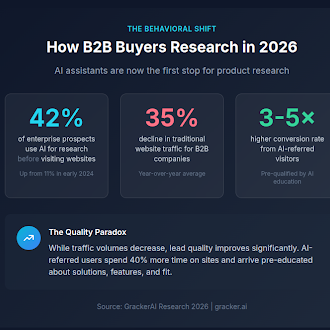
AI search engines like ChatGPT, Perplexity, and Claude are fundamentally changing how B2B buyers discover solutions. 42% of enterprise prospects now conduct product research using AI assistants before visiting company websites, up from 11% at the beginning of 2024. Companies ranking #1 on Google can still be completely invisible to AI search users.
Key finding: Only 12% of URLs cited by ChatGPT currently rank in Google's top 10 search results. Traditional SEO success no longer guarantees AI visibility.
The 12% Rule: Why Google Rankings Don't Equal AI Citations
Traditional search engine optimization and AI search optimization are fundamentally different disciplines. Analysis of thousands of search queries across Google and major LLMs reveals a critical disconnect:
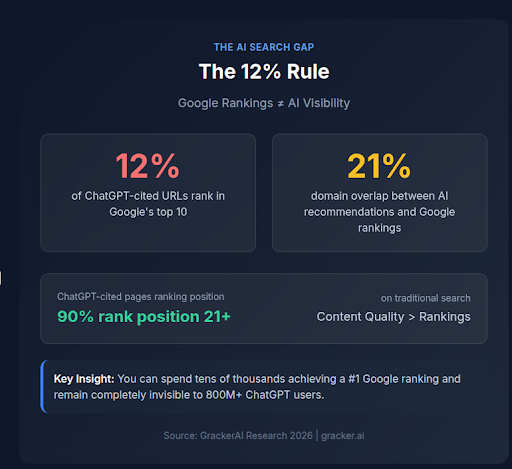
Metric | Finding | Implication |
URL overlap | Only 12% of ChatGPT-cited URLs rank in Google's top 10 | Google rankings ≠ AI visibility |
Domain overlap | Only 21% of AI-recommended domains match Google's top domains | Different authority signals |
Citation source | 90% of ChatGPT-cited pages rank position 21+ on traditional search | |
Traffic shift | 35% website traffic decline reported by B2B companies | Buyer behavior has fundamentally changed |
What this means for marketers: A company can spend tens of thousands of dollars achieving a #1 Google ranking and remain completely invisible to the 800+ million users asking questions on ChatGPT.
How B2B Buyer Behavior Has Changed
1. The Shift from Search Engines to Conversational AI
B2B buyers are abandoning traditional search for AI-powered research. According to Nicky Zhu, AI Interaction Product Manager at Dymesty:
42% of our enterprise prospects conduct product research using ChatGPT or Perplexity before visiting our website. This percentage was 11% at the beginning of 2024.
- Nicky Zhu, AI Interaction Product Manager, Dymesty
The behavioral transformation extends beyond platforms. Megan Kioulafofski, Founder of Sublime SEO, explains:
Unlike before, when doing a Google search, buyers are now asking full contextual questions with multiple parameters, specific use cases, and detailed requirements all in one prompt.
- Megan Kioulafofski, Founder, Sublime SEO
Amit Shingala, CEO of B2B SaaS company Motadata, quantifies the impact:
Over the last year our website traffic has dropped by nearly 35%, which clearly indicates how buyer discovery behavior is evolving. If someone wants to buy Network Monitoring software, they now ask AI tools directly rather than searching on Google and browsing multiple listicle articles.
- Amit Shingala, CEO, Motadata
2. Higher Intent, Better Qualified Prospects
While traffic volumes decrease, lead quality improves significantly. Travis Hoechlin, CEO of RizeUp Media, reports from 15 years in legal marketing:
My data shows that these users spend 40% more time on firm websites when they come from an AI recommendation.
-Travis Hoechlin, CEO, RizeUp Media
- Conversion rate comparison:
AI-referred visitors convert at 3-5× higher rates
AI search users arrive pre-qualified. The AI has already educated them about solutions, features, and fit
Website traffic declines, but pipeline quality increases
The Five Attributes of Citation-Worthy Content
Research across millions of LLM citations reveals five key attributes that determine whether content gets cited:
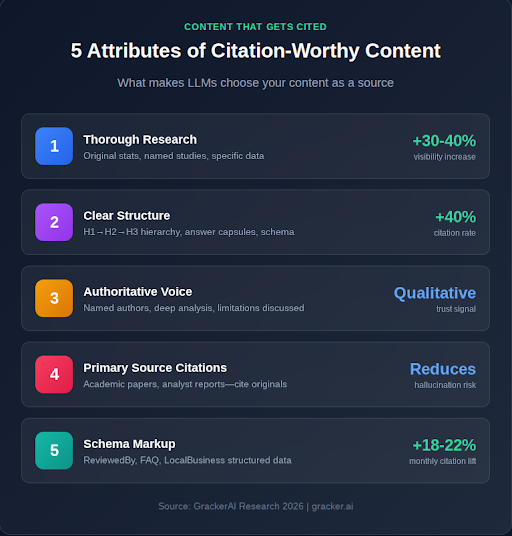
1. Thorough Research (+30-40% Visibility Increase)
Content with original statistics, named studies, specific timeframes, and sample sizes receives 30-40% more AI citations than content without.
What works:
Named expert sources with credentials
Specific numbers, dates, and quantified outcomes
Case studies with measurable results
2. Clear Structure (+40% Citation Rate)
AI models tokenize structured content more accurately than prose. Long narrative paragraphs get skipped during retrieval, while lists, definitions, and clear answer blocks are extracted consistently.
Structural requirements:
H1 → H2 → H3 hierarchy
Answer capsules at the beginning of sections
Short paragraphs (3-4 sentences maximum)
Comprehensive schema markup
3. Authoritative Voice
Content must demonstrate genuine expertise through:
Named authors with verifiable credentials
Deep analysis beyond surface-level coverage
Acknowledgment of limitations and nuances
Third-party validation and citations
4. Primary Source Citations
LLMs prefer content that cites original sources rather than summaries. Citing academic papers, analyst reports, and official documentation reduces hallucination risk and increases citation likelihood.
5. Schema Markup Implementation
Jamie Monaco, CEO of Phoenix Business Solutions, provides technical insight:
The 'secret sauce' is hidden in the schema's ReviewedBy property. This sole property is going to be the technical piece that makes AI models-who are afraid of hallucinating in fields like HIPAA and Cybersecurity-increase model confidence.
- Jamie Monaco, CEO, Phoenix Business Solutions
Saswata Baksi, Co-founder of Local Glyph, shares practical results:
Clients that implement LocalBusiness and FAQ schema experience LLM citation rates jumping 18-22% month-over-month.
- Saswata Baksi, Co-founder, Local Glyph
The Citation Source Hierarchy: Where LLMs Pull Information
Analysis of millions of LLM citations reveals a clear three-tier hierarchy of trusted sources:
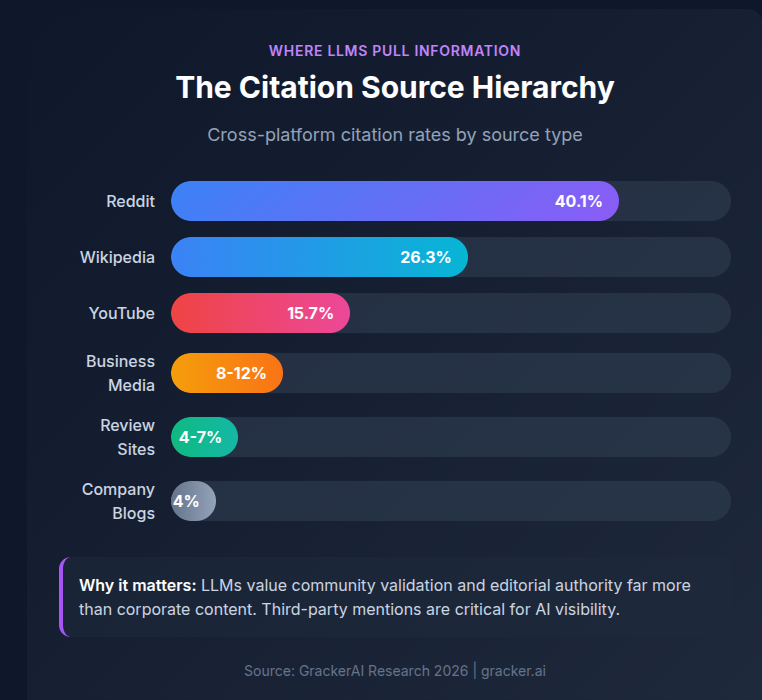
Source Type | Cross-Platform Rate | Why LLMs Trust It |
40.1% | Authentic discussion, real problem-solving | |
Wikipedia | 26.3% | Canonical reference, neutral POV |
YouTube | 15.7% | Tutorials, demos, expert talks |
Business Media | 8-12% | Authority signals, third-party validation |
Review Platforms | 4-7% | Structured data, verified users |
Company Blogs | <4% | Only for direct company queries |
Critical insight from Rachita Chettri, CEO of Linkible:
Pre-training data sets for models such as GPT-4 and Claude are pulled from authoritative sources between 2019 and 2023. If your brand was in industry publications during that window, you exist in the base knowledge of the model. That means one article in TechCrunch from 2022 has more weight than 50 paid-for press releases last month.
- Rachita Chettri, CEO, Linkible
Content Strategy: From Keywords to Citation Architecture
Answer-First Content Format
Nicky Zhu describes the optimization approach:
I develop structures with clear definitions, numbered lists, hierarchical headings, and comparative matrices that AI systems can scan and extract. We removed clickbait titles and listicles and instead used descriptive titles such as 'Comparative Analysis: Bluetooth Low Energy vs Zigbee for Medical Device Networks.'
- Nicky Zhu, AI Interaction Product Manager, Dymesty
Best practices:
Lead each section with a direct answer
Use descriptive titles that match query intent
Include comparative matrices for evaluation content
Structure content for extraction, not engagement
The Shift from Rankings to Citations
Aaron Browne-Moore, Founder of Valyou LLC, with 12+ years in B2B marketing:
Traditional SEO is no longer a competitive advantage. It's a baseline. The real winners bring genuine expertise, connect it with real humans, and march that forward into a strategy where AI cites you every time a customer asks about the pain point your company solves.
- Aaron Browne-Moore, Founder, Valyou LLC
Rachita Chettri details how backlink strategies must evolve:
Google's crawler considers backlinks using PageRank distribution and domain metrics. LLMs use semantic retrieval and the training data frequency to extract information. We stopped optimizing for link equity and began optimizing for quotability in retrieval augmented generation systems.
- Rachita Chettri, CEO, Linkible
Measuring AI Search Visibility: The Attribution Challenge
Current Tracking Methods
There is no standardized API for tracking brand mentions across AI platforms. Saswata Baksi reveals the complexity:
At our company, we batch run 200 test queries per location every month, then scrape and pattern match citations by hand.
- Saswata Baksi, Co-founder, Local Glyph
Version Drift: The Hidden Challenge
Saswata Baksi warns of a critical monitoring issue:
In December GPT-4 behavior was different than what it was in January in response to the same prompts. Version drift is real and if you are not checking weekly, you are flying blind.
- Saswata Baksi, Co-founder, Local Glyph
Recommended tracking cadence:
150+ standard prompts tested weekly
Track across ChatGPT, Perplexity, Claude, and Gemini
Document competitor brand mentions
Monitor model version changes
Dark Visibility
Scott Benson, Founder of Benson SEO, introduces an important concept:
This missing piece occurs when a searcher starts a conversation with an AI application, and that application doesn't know the answer from its training model. The AI application goes out to the open web and either performs a Google or Bing search, or accesses website content directly.
- Scott Benson, Founder, Benson SEO
This measurement burden is exactly why AI visibility planning that starts at product launch, rather than after it, has a real advantage: teams building this monitoring into release day capture their first data points before drift or dark visibility can mask early gaps.
Industry-Specific Considerations: Cybersecurity and Regulated Industries
Balancing Visibility with Compliance
Megan Kioulafofski addresses the cybersecurity challenge:
When we're working with cybersecurity firms, as well as healthcare companies or financial services, the content sits at the intersection of technical precision, regulatory compliance, and accessibility-and AI models are unforgiving when content gets any of those wrong.
- Megan Kioulafofski, Founder, Sublime SEO
Layered Content Strategy
The solution involves building content in layers:
Layer 1: Clear, declarative summaries for AI parsing and executive decision-makers
Layer 2: Technical depth and compliance specifics embedded for specialists and auditors
Layer 3: Implementation guidance and framework documentation for practitioners
Travis Hoechlin emphasizes verification:
We use structured data to make sure AI engines only refer from verified and legal facts. Technical accuracy remains our highest priority since one wrong summary can create a compliance nightmare.
- Travis Hoechlin, CEO, RizeUp Media
Predictions for 2026-2027: The Bifurcation of Marketing
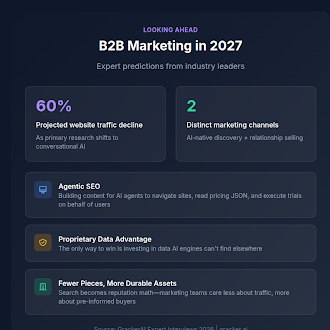
Two Distinct Channels Emerging
Nicky Zhu predicts:
In 2027, B2B marketing is expected to continue to bifurcate into two channels: AI-native discovery and relationship selling. Website traffic is projected to decline by 60% as the primary research phase for Conversational AI is completed.
- Nicky Zhu, AI Interaction Product Manager, Dymesty
Investment Priorities for Forward-Looking Teams
1. Proprietary Data Advantage
Travis Hoechlin emphasizes:
The only way to win is to invest in proprietary data which AI engines can't find elsewhere. We are looking to create high authority content that weaves together both human honesty and technical perfection.
- Travis Hoechlin, CEO, RizeUp Media
2. Fewer Pieces, More Durable Assets
Sofia Toebak Bravo predicts:
I think we're moving toward fewer content pieces, more durable assets, search becoming reputation math, built in community style opinion boards, marketing teams caring less about 'traffic' and more about pre-informed buyers.
- Sofia Toebak Bravo, Senior Strategist, PartnerCentric
Implementation Roadmap: Three Priorities for AI Search Success
Priority 1: Human-Guided Content Creation
AI can scale production, but performance comes from human strategy, editing, and brand voice control. Storytelling outperforms publishing high volumes of generic content.
Action items:
Establish expert review processes for all content
Develop distinctive brand voice guidelines
Create original research and proprietary data
Build content around genuine expertise
Priority 2: Search Intent and Distribution Planning
Great content must be built around real search demand and designed for reuse across SEO, email, paid, and social channels.
Action items:
Map content to specific buyer questions and prompts
Design content for multi-channel distribution
Create modular content that can be extracted and cited
Optimize for both traditional and AI search simultaneously
Priority 3: Consistent Quality at Scale
One-off great pieces won't move the needle. Sustainable AI visibility requires systematic content excellence.
Action items:
Build repeatable content frameworks
Implement quality checkpoints before publication
Create content calendars aligned with buyer journeys
Measure citation rates alongside traditional metrics
Key Takeaways for B2B Marketing Leaders
Immediate Actions (Next 30 Days)
Audit current AI visibility: Test 50+ relevant prompts across ChatGPT, Perplexity, Claude, and Gemini
Restructure existing content: Add answer capsules, improve heading hierarchy, implement schema markup
Identify citation gaps: Document where competitors appear, and you don't
Start tracking: Establish weekly prompt monitoring across all major LLMs
Strategic Shifts (Next Quarter)
Move from keyword optimization to entity-relationship mapping
Prioritize being cited over ranking high
Invest in proprietary data and original research
Build authority through third-party validation
Long-Term Investments (Next 12 Months)
Develop AI-native content distribution strategies
Create comprehensive knowledge graphs for your domain
Build systems for real-time content accuracy verification
Prepare for agentic SEO where AI agents interact directly with your systems
Frequently Asked Questions
What is the difference between AEO and GEO?
Answer Engine Optimization (AEO) focuses on becoming the source for direct answers in featured snippets, knowledge panels, and AI-generated responses. Generative Engine Optimization (GEO) specifically measures how often AI search engines like ChatGPT, Perplexity, and Gemini cite your brand when answering user queries. For a fuller walkthrough of that shift aimed at marketing leadership, see GrackerAI's CMO guide to Generative Engine Optimization.
How long does it take to improve AI visibility?
Most companies see initial visibility improvements within 4-6 weeks of implementing structured content changes. Significant citation increases typically occur within 2-3 months. Comprehensive AI visibility transformation takes 6-12 months.
Does traditional SEO still matter?
Yes. Traditional SEO provides the foundation-technical performance, site structure, and baseline authority signals. However, traditional SEO alone is no longer sufficient for capturing buyers who research through AI assistants.
How do I know if my brand is being cited by AI?
Test relevant prompts across ChatGPT, Perplexity, Claude, and Gemini weekly. Track brand mentions, citation frequency, and competitive positioning. Tools like GrackerAI automate this monitoring across all major AI platforms.
What content formats work best for AI citations?
Structured content with clear headings, answer capsules, comparison tables, and comprehensive schema markup performs best. Long narrative paragraphs without clear structure are often skipped during AI retrieval.
About This Research
This research was conducted by GrackerAI based on exclusive interviews with 11 B2B marketing leaders and technical experts who are pioneering the transformation from traditional SEO to Answer Engine Optimization (AEO) and Generative Engine Optimization (GEO).
Expert contributors:
Nicky Zhu, AI Interaction Product Manager, Dymesty
Megan Kioulafofski, Founder, Sublime SEO
Amit Shingala, CEO, Motadata
Travis Hoechlin, CEO, RizeUp Media
Sofia Toebak Bravo, Senior Strategist, PartnerCentric
Jamie Monaco, CEO, Phoenix Business Solutions
Saswata Baksi, Co-founder, Local Glyph
Aaron Browne-Moore, Founder, Valyou LLC
Rachita Chettri, CEO, Linkible
Scott Benson, Founder, Benson SEO
GrackerAI is the leading Answer Engine Optimization (AEO) and Generative Engine Optimization (GEO) platform for B2B SaaS companies. Learn how GrackerAI can help your brand become visible in AI search results at gracker.ai.
![10 Best Local Rank Tracker Tools: In-Depth Comparison Guide [2025]](https://cdn.pseo.one/6abcb68a626591c40e1c8aa6/687e1c1ef6fe799d288518df/68809c373eb8562bcf68975d/10-best-local-rank-tracker-tools-comparison-guide/feature-image.jpg)