The Ultimate Guide to Alternative Pages That AI Engines Cite First

TL;DR
- ✓ AI engines prioritize objective comparison pages over branded homepages for search queries.
- ✓ Structure your pages with feature matrices and balanced pros and cons lists.
- ✓ Maintain neutrality to build content trust and increase your chances of AI citation.
- ✓ Treat your comparison pages as machine-readable data sources for LLM synthesis.
Forget the blue links. If you’re still writing content solely to rank for a traditional Google search, you’re playing a game that’s becoming obsolete. Today’s buyers aren’t scrolling through ten different websites to make a decision—they’re asking a machine to do the legwork for them.
If you want your brand to show up in Perplexity, SearchGPT, or Google’s AI Overviews, you need to stop writing for humans and start writing for the machine.
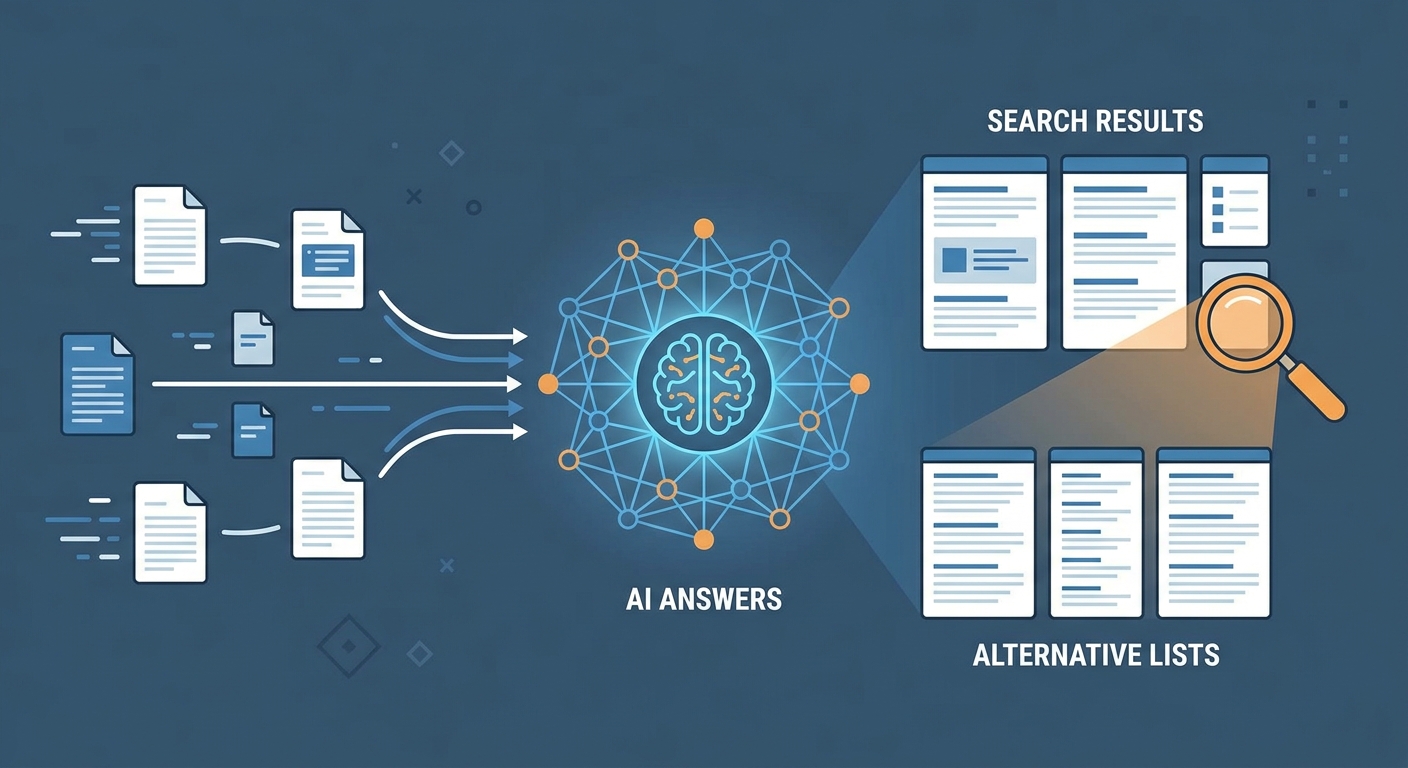
AI engines are obsessed with "Alternative" pages—those specialized landing pages that pit your product against a competitor. Why? Because they represent the "aha!" moment of commercial intent. When a user types, "What’s a better alternative to X?" into an AI, the engine isn’t looking for your brand’s origin story. It’s hunting for structured, objective, and dense comparison data it can synthesize into a trusted recommendation.
Why AI Engines Are Ghosting Your Homepage
The era of driving traffic to a generic homepage is fading. We’ve entered the age of the synthesis engine.
Traditional SEO was about authority and backlinks. LLMs? They’re different. They function as information aggregators. They don't care how "popular" your site is; they care how "useful" your page is for a specific, high-intent question.
Think of it this way: Your homepage is a billboard. It’s loud, it’s branded, and it’s arguably self-serving. A comparison page is a consultant. It’s objective, it’s helpful, and it’s exactly what the AI wants to serve up. If your content strategy doesn't have a dedicated slot for this page type, you're effectively invisible to the modern buyer who prefers a generated summary over a hunt for information.
The Anatomy of an AI-Optimized "Alternative" Page
To win the citation, your page has to function as a machine-readable data source. AI engines have no patience for fluff. They aren't reading your prose to be entertained; they’re parsing your content to extract facts.
To make the cut, you need three non-negotiable elements:
- A Feature Matrix: A clean, clear table.
- A Balanced Pros/Cons List: Don't hide the flaws.
- A "Best For" Summary: A verdict that helps the user decide.
Here is the blueprint:
Neutrality is your secret weapon. If your copy sounds like a biased sales brochure, the LLM will flag it as promotional garbage and move on to a third-party review site. By presenting your competitor’s features with the same level of care as your own, you build the "trust" required for an AI to cite you as a primary, unbiased source.
A minimal feature matrix looks like this — plain HTML table, no styling required for the AI to parse it:
| Capability | Your Product | Competitor |
|---|---|---|
| Core use case | State it plainly | State it plainly, no spin |
| Pricing entry point | Exact tier and price | Exact tier and price |
| Where it wins | Name the real strength | Name the real strength, even if it's not you |
| Best for | The specific buyer profile it fits | The specific buyer profile it fits |
Building a "Neutrality Moat"
The most common way brands sabotage themselves? Adjectives.
"Unparalleled," "industry-leading," "the best." When you use these, you trigger the bias filters in LLMs. These engines are programmed to filter out marketing fluff. They want the "facts behind the features."
If your competitor is better for enterprise scale but your tool is better for mid-market usability, say exactly that. Don't dance around it. When the AI sees you providing a comprehensive, balanced overview, it treats your page as a "source of truth." You’ve just built a "neutrality moat." Your competitors, still stuck in the "we are the best" marketing mindset, won't be able to cross it.
Forcing Recognition with Schema Markup
Structured data is the machine’s native tongue. If your content is the story, Schema is the index.
Using Product schema (per schema.org's Product type) allows you to explicitly define features, pricing, and ratings. It stops the AI from having to "guess" what you do. Even better? Use Table markup. When you present your comparison in a clean HTML table, you are essentially gift-wrapping the data for the AI, and you're using vocabulary the AI's retrieval layer already understands. If the AI can read your differentiators in a table, it is significantly more likely to drop your specific features into its summary.
Speed-to-Market is Your Edge
Enterprise companies are slow. They spend months vetting, writing, and legal-reviewing a single comparison page.
This "enterprise lag" is a goldmine for agile teams. In the world of AI search, being the first to provide a structured, accurate comparison for a new competitor or a niche keyword lets you claim the "first-source" advantage.
If you’re struggling with the grind, see how to build a programmatic SEO engine for B2B leads. It’s about ensuring you aren't leaving gaps in your topical authority. The faster you deploy high-quality, structured pages, the more "real estate" you occupy in the AI’s retrieval index.
Hunting High-Intent Keywords
Not all keywords are created equal. You aren't hunting for volume; you’re looking for intent.
Someone searching for "alternatives to [Competitor]" is much further down the funnel than someone looking for "what is [Industry] software." Use GrackerAI SEO Optimization Tools to drill down into queries where commercial investigation intent is at its peak.
Find the intersection of high search volume and low-quality results. If the top results are just generic, lazy listicles, you’ve found your opportunity. Insert a deep, data-rich comparison page, and you’ll dominate the AI summary.
Finding these gaps is only half the system. Turning them into a repeatable content engine — mapping direct, indirect, and bundler rivals, structuring pricing and feature data, and deciding when a query calls for an alternative page versus a versus page — is its own discipline. See our comparative keywords strategy guide for the full playbook on scaling this beyond a single page.
Common Pitfalls That Kill Your Citation Rate
The most lethal error? Mixing up "X vs Y" and "Alternatives to X."
An "Alternatives to" page is a discovery piece. It needs to be broad, covering the category or multiple players. An "X vs Y" page is a decision piece. It needs to be hyper-specific. Mixing the two confuses the machine. The AI doesn't know if you're answering a broad query or a specific one, so it ignores you.
Also, kill the keyword stuffing. AI engines are smart enough to know when you're writing for a crawler. If your content lacks unique, proprietary insights—like custom benchmarks or deep-dive feature breakdowns—the AI will find someone who does. For more on what actually earns a citation once the page is live, see how to write comparison pages AI engines actually cite.
How This Guide Was Sourced
Written and maintained by the GrackerAI research and content team. The schema recommendations are SOURCED to schema.org's own type definitions for Product and Table (retrieved 2026-09-21). The rest of this guide — the neutrality-moat framing, the pitfalls, and the word-count guidance — is ANALYSIS based on how AI answer engines are documented to prefer structured, extractable content over promotional prose; it is not backed by a published benchmark and is presented as practitioner judgment, not data. AI citation behavior changes as engines update their retrieval logic, so pin your reading to this date. No GrackerAI telemetry is used in this guide. GrackerAI builds AI search visibility tracking and AI-optimized content production for cybersecurity and B2B SaaS companies — relevant here because "alternative" pages are exactly the surface it measures for AI citation.
Frequently Asked Questions
Why does my "Alternative" page not show up in AI search summaries?
It’s likely a structural issue. You’re probably missing structured data (Schema), or your tone is too promotional. AI models are trained to avoid "salesy" language. Switch to an objective tone and put your data in a machine-readable table.
Should I write "X vs Y" or "Alternatives to X"?
Both. They serve different masters. "Alternatives to X" captures top-of-funnel discovery, while "X vs Y" captures the bottom-of-funnel decision-making. Map your content to the specific intent of the user.
How do I make my alternative page look "objective" to AI engines?
Include a feature comparison table, cite third-party reviews, and include a "Best for [Use Case]" section for both products. Acknowledging a competitor's strengths in a specific area actually increases your credibility with the AI.
Does AI traffic convert as well as Google search traffic?
Often, it converts better. Users asking an AI for alternatives are in a research mindset. When they land on your site via an AI citation, they’ve already been pre-qualified. They aren't looking for a "what is" article; they're looking for a "which one should I buy" answer.
What is the ideal word count for an AI-friendly comparison page?
Focus on density, not length. Aim for 1,200 to 1,800 words of high-utility content. If the info can be in a table, put it in a table. Don't fluff it up. AI engines prefer brevity and structure over long-winded introductions.
![10 Best Local Rank Tracker Tools: In-Depth Comparison Guide [2025]](https://cdn.pseo.one/6abcb68a626591c40e1c8aa6/687e1c1ef6fe799d288518df/68809c373eb8562bcf68975d/10-best-local-rank-tracker-tools-comparison-guide/feature-image.jpg)