How to Audit Your SaaS Brand's Current AI Search Visibility in 60 Minutes

TL;DR
- ✓ Learn why traditional SEO is failing to capture AI-driven buyer traffic.
- ✓ Master the 60-minute framework for auditing your brand's AI search presence.
- ✓ Build a Golden List of high-intent prompts to measure your Share of Prompt.
- ✓ Connect your brand to entity-rich content to improve AI model citations.
The era of obsessing over blue links is dead. If your SaaS brand is still treating traditional search as the only game in town, you’re invisible to a massive chunk of your audience. We're talking about the 45% of buyers—according to The State of B2B SaaS Search 2026—who now bypass Google entirely to let LLMs curate their software stack.
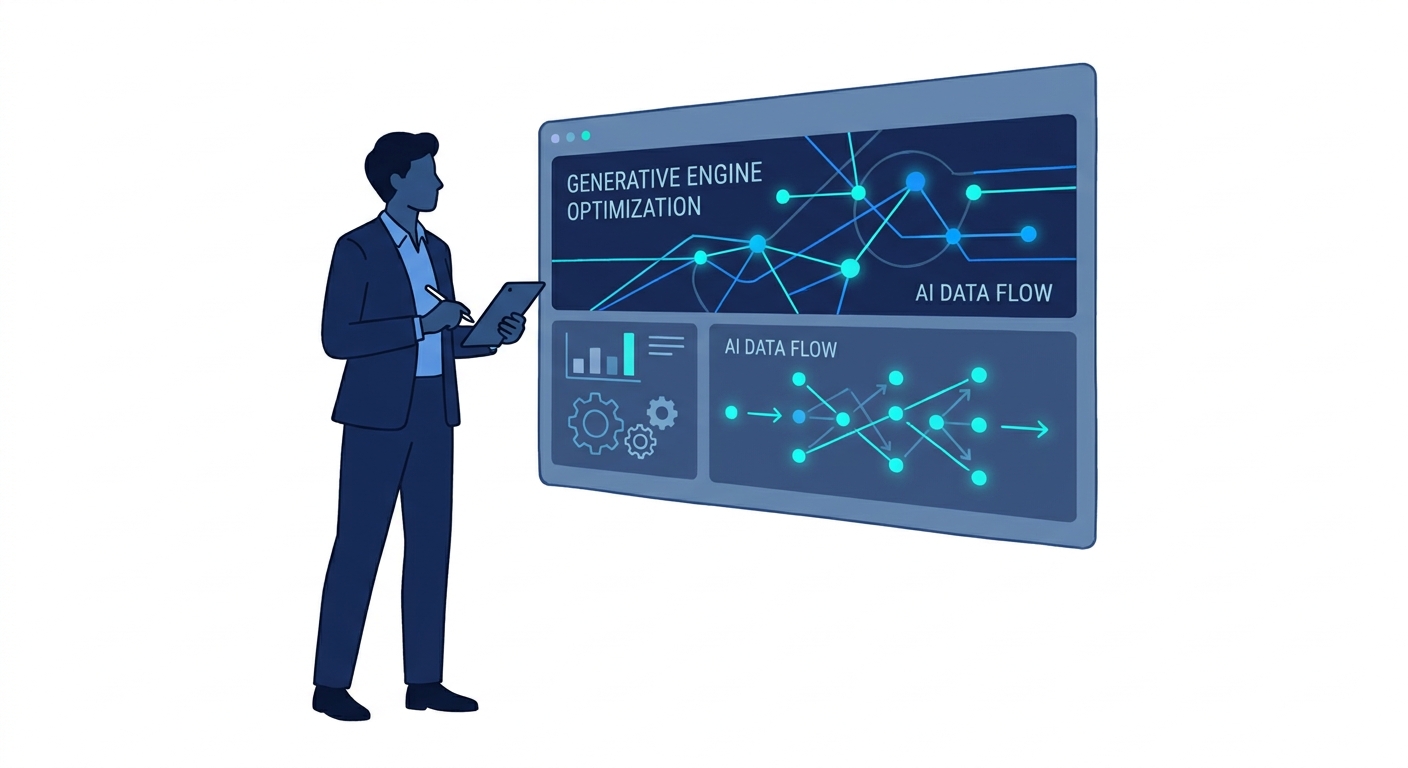
This pivot from search engines to "answer engines" is what the industry calls Generative Engine Optimization (GEO). If you aren't mastering it, you’re being left out of the most important conversations in your niche. Auditing your AI visibility isn't some vanity project; it’s about making sure your product actually shows up when a buyer asks an AI to solve their workflow headache. You can run a rock-solid baseline audit in exactly 60 minutes. Here is the framework.
How Does Your Brand Appear in AI Answers? (The 60-Minute Audit Framework)
Forget everything you know about Domain Authority. High DA doesn't guarantee you a seat at the table anymore. AI models run on "Entity Association"—a complex, semantic web of how your brand, product category, and use cases are connected in training data and live web indices.
To get a real sense of where you stand, you need a "Golden List" of 12 high-intent buyer prompts. We aren't talking about generic keywords here; these are the specific phrases a lead types into Perplexity, ChatGPT, or Gemini when they’re ready to open their wallet. By running these through a controlled test, you’ll calculate your "Share of Prompt"—the percentage of time your brand actually gets cited as a solution.
Step 1: Preparing Your "Golden List" of Prompts (10 Minutes)
Your audit is only as good as your inputs. You need to channel your inner buyer. Split your 12 prompts into three distinct buckets:
- Category Exploratory: "What are the best [Category] tools for [Industry]?"
- Problem-Specific: "How can I automate [Pain Point] for my [Role] team?"
- Comparative: "[Your Brand] vs. [Competitor] for [Use Case]."
Don't be vague. If you sell a CRM, don't just type "best CRM." Try: "best CRM for enterprise fintech companies that need SOC2 compliance." The more specific the prompt, the more likely the AI will pull from deep, entity-rich content rather than just high-DA aggregator sites that offer surface-level advice.
Step 2: Executing the Query and Scoring Visibility (20 Minutes)
Open three tabs: ChatGPT, Perplexity, and Gemini. For every prompt on your Golden List, hit enter. You’re looking for a binary: Are you mentioned as a solution, or are you a ghost?
But don't stop at "Yes" or "No." Look at official guidance from model developers on how LLMs rank sources. They lean on brands cited in authoritative, third-party contexts. If you’re mentioned, note the sentiment:
- Primary Solution: You’re in the top-tier list of recommendations.
- Footnote/Mention: You’re buried in a list of 10+ tools.
- Negative/Comparison: You’re only brought up because a competitor is "better" than you.
Keep a simple spreadsheet. If you’re absent across all three platforms for a "best-of" query, you’ve got a massive "Citation Gap."
Step 3: Why Does Your Brand Lack "Conversational Context"? (15 Minutes)
If your organic search traffic is humming but your AI visibility is flatlining, you’re suffering from a lack of conversational context. SEO used to be about keywords; AI visibility is about entities.
AI models are synthesis machines. If your website is filled with "marketing fluff"—pages screaming "We are the best!"—the AI ignores it. It wants "instructional truth." It needs to know exactly what your tool does, who it’s for, and how it stacks up against others. If your landing pages don't map your solution to the specific problems a user describes, you’ll never bridge that Citation Gap. Your site needs to be the definitive source of truth about your own product.
Step 4: Benchmarking Against Your Top 3 Competitors (15 Minutes)
Take your results and map them against your three biggest rivals. Who is winning the "Share of Prompt"? If a competitor shows up in 80% of your Golden List queries and you’re at 20%, you aren't just losing SEO traffic—you’re losing the entire discovery phase of the sales cycle.
Look for the "why." Are they mentioned in more G2 reviews? Are they cited in more "Alternative to" articles? Are they featured in deep-dive YouTube videos that the AI is using as a training source? Finding out where they get cited is your roadmap for where to put your next marketing dollar.
What Are the Quickest Wins to Improve Your AI Search Visibility?
You don't need a total brand overhaul to move the needle. Start by beefing up your landing pages with "Vs." and "Alternative" content. If you aren't writing the narrative on how you compare to your competitors, the AI will pull that info from third-party review sites that might be biased or hopelessly outdated.
Next, implement FAQ Schema that addresses specific product use-cases. By providing structured, clear, and concise answers to "How does [Brand] solve [X]?" directly on your site, you make it easy for LLMs to ingest and cite you as the authority. If you want to scale this, you can check out the 10 Best AI Visibility Tools for B2B SaaS to stop manual spot-checking and start automated monitoring.
Beyond the 60-Minute Audit: When Should You Scale Your Efforts?
The 60-minute audit is your baseline, not a long-term strategy. Once you know where you stand, shift to an "AI-Integrated Content Strategy." Stop cranking out keyword-stuffed blog posts and start creating "Entity-Dense" documentation that satisfies both humans and AI crawlers.
For many SaaS companies, the technical side of mapping these data points requires outside help. Whether you decide to build internal monitoring systems or partner with SaaS SEO services to handle the heavy lifting, the goal remains the same: ensure that when your potential customer asks an AI for a solution, your brand is the first one it recommends. This AI-visibility audit is deliberately narrow — it does not replace a traditional security or compliance audit. For cybersecurity and B2B SaaS teams running both, the blind spots in cybersecurity audits covers the gaps a standard technical audit tends to miss.
Frequently Asked Questions
How often should I run an AI visibility audit?
Quarterly is the minimum. However, if you’re in a crowded space where AI models update their preferred sources constantly, a monthly audit is smart to make sure your "Share of Prompt" isn't eroding.
My brand isn't showing up in any AI answers. What's the first thing I should fix?
Start by auditing your "Product" and "About" pages. Ensure they explicitly define the problem you solve and the specific category you belong to. AI models rely on clear, descriptive language to map your brand to relevant industry entities.
Should I worry about Google AI Overviews (AIO) differently than ChatGPT?
Yes. Google AIO is heavily tethered to your traditional search authority, backlink profile, and existing schema markup. ChatGPT, Perplexity, and Claude rely more on conversational context, third-party review mentions, and the "semantic weight" of your website's content. A comprehensive strategy must account for both.
Does high domain authority guarantee visibility in AI search results?
No. While high DA helps in traditional Google rankings, AI models often prioritize sites that offer the most direct, accurate, and contextually relevant answer to a prompt. A lower-DR site with highly specific, entity-rich content can easily outrank a high-DR site that is filled with generic, keyword-stuffed content.
What is the difference between "Share of Voice" and "Share of Prompt"?
Share of Voice (SOV) measures your brand's visibility in traditional search results (blue links). Share of Prompt measures how often your brand is included in the synthetic, conversational answers generated by an LLM in response to a high-intent user query.
![10 Best Local Rank Tracker Tools: In-Depth Comparison Guide [2025]](https://cdn.pseo.one/6abcb68a626591c40e1c8aa6/687e1c1ef6fe799d288518df/68809c373eb8562bcf68975d/10-best-local-rank-tracker-tools-comparison-guide/feature-image.jpg)