How to Win B2B Buyers in the AI Search Era

Ankit Agarwal · Head of Marketing
· Updated September 21, 2026

Why your buyers can’t find you, how they’re researching without you, and the 90-day playbook to win them back
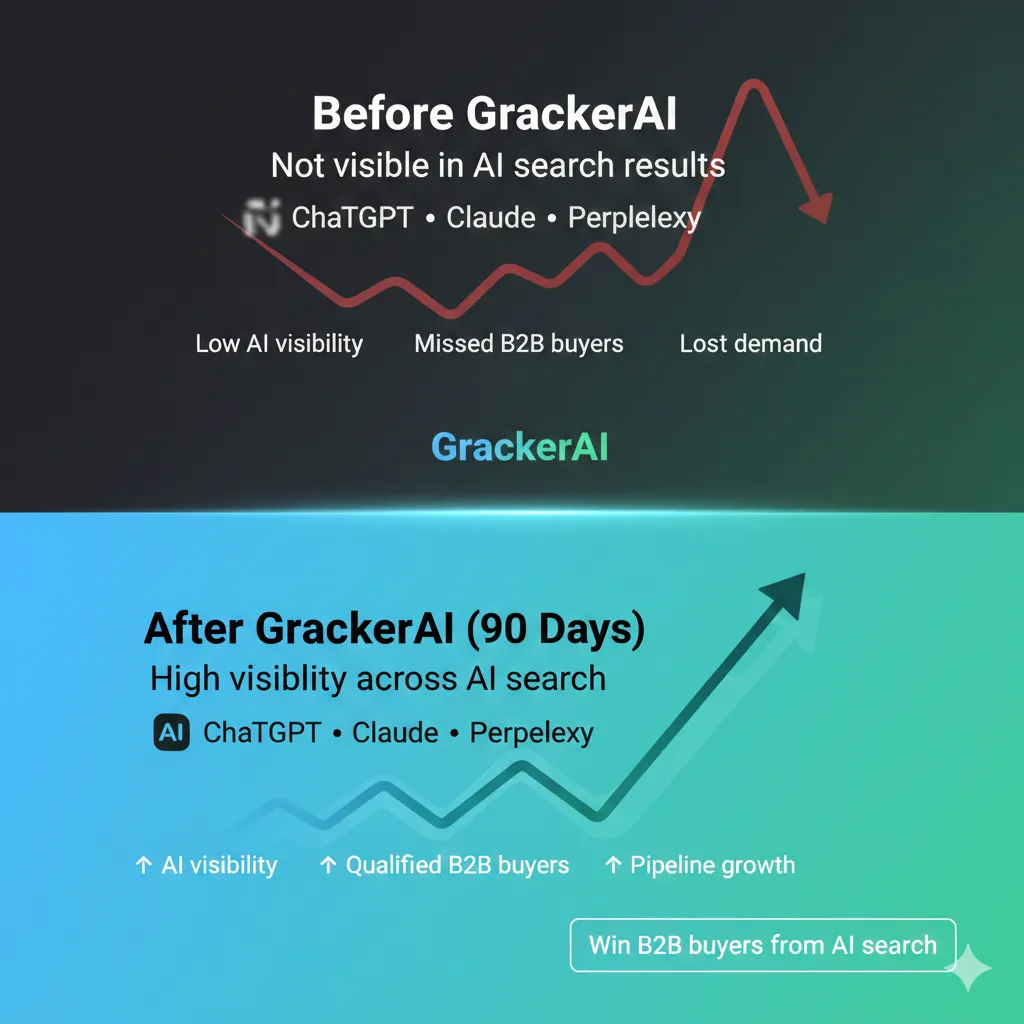
Last month, a SaaS founder told us he lost a $200K deal.
The prospect said: “We asked ChatGPT for the best solution. You weren’t mentioned. We assumed you weren’t a major player.”
His company had a 10-person marketing team, ranked #1 on Google for key terms, and 50,000 monthly visitors. None of it mattered. The buyer never even visited his website.
We’ve seen this story 500+ times. Companies with perfect SEO, losing buyers they don’t even know exist.
Because B2B buyers have fundamentally changed how they research. And most companies haven’t noticed yet.
Key Takeaways: How to Win Buyers
-
67% of B2B buyers start with AI assistants - if you’re not visible there, you’re losing most of your market
-
AI-referred buyers convert 3-5x higher because they’re further along in their journey and pre-qualified
-
Buyers need three things: Trust signals (you’re real), structured content (answers their questions), and recent activity (you’re relevant now)
-
The 90-day sprint: Build trust first, create buyer-focused content second, show social proof third, then scale
-
Companies that win buyers in AI search move fast, automate content creation, and focus on buyer questions - not keywords
How B2B Buyers Research Solutions in 2026
Picture your ideal buyer:
A VP of Marketing at a mid-sized SaaS company needs a new marketing automation platform. Ten years ago, she’d Google “best marketing automation tools,” click through 10 websites, read reviews, request demos.
Today? She opens ChatGPT:
“Which marketing automation platform is best for a B2B SaaS company with under 1,000 employees, strong Salesforce integration, and a focus on account-based marketing?”
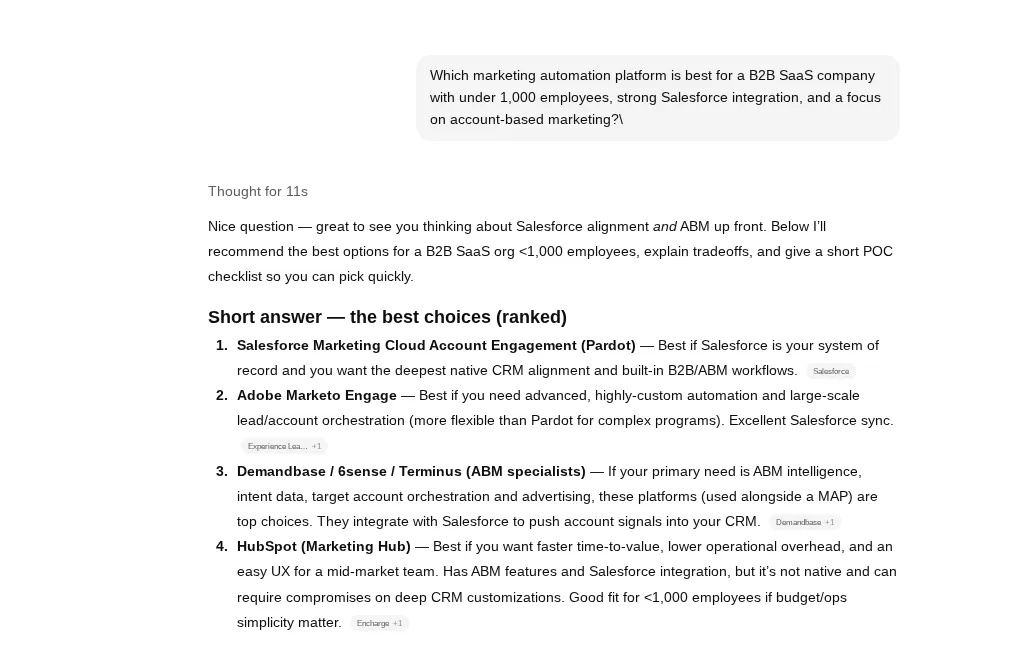
Within 2 minutes, she has a shortlist of 3-4 platforms. Complete with pros, cons, pricing insights, and use case fits. She trusts it. She acts on it.
What took her colleagues weeks to research in 2020, she completes before her morning coffee. And if you’re not in that AI-generated shortlist? You don’t exist in her consideration set.
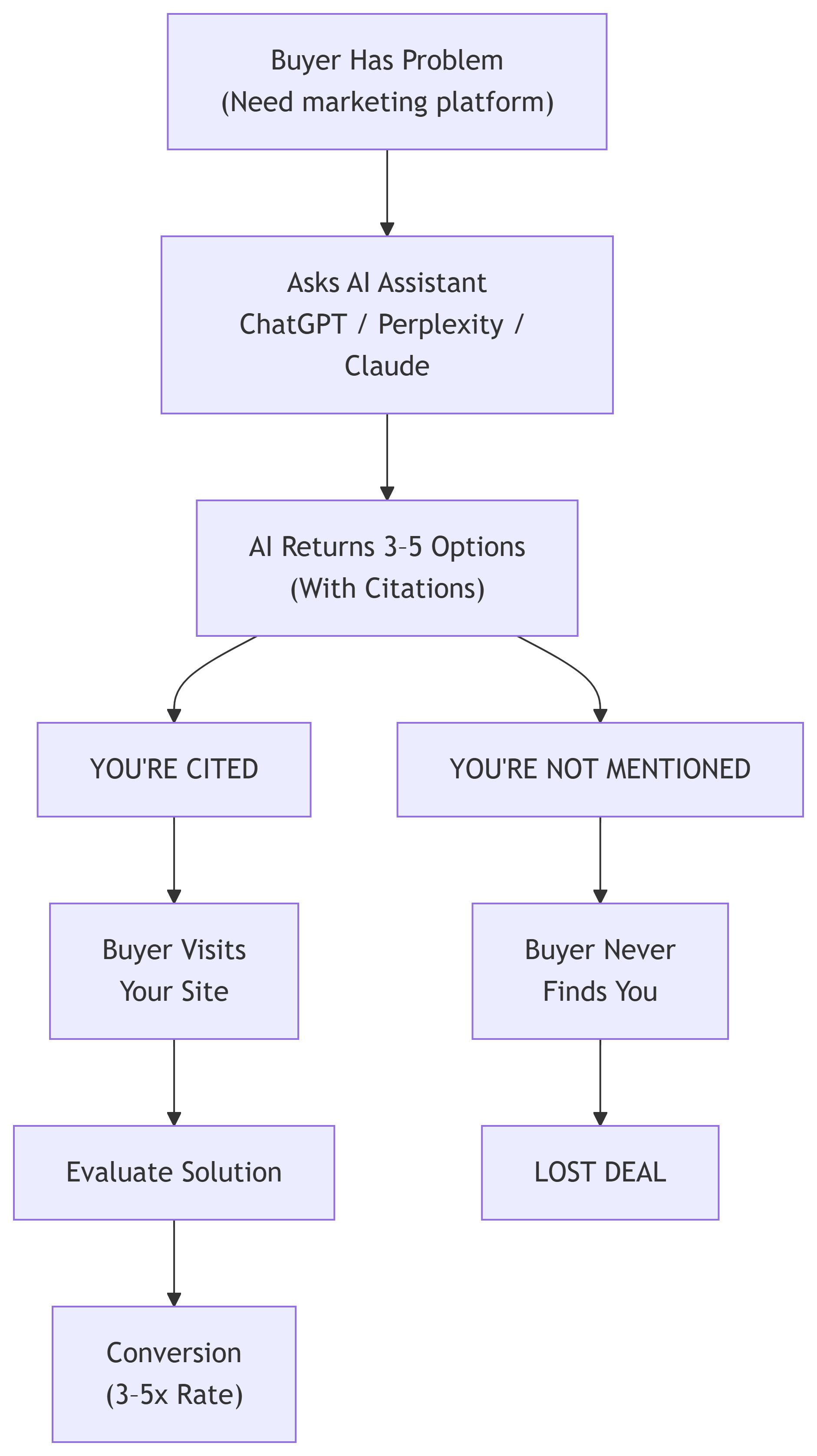
Buyer Problem → Asks AI → Gets 3-5 Options → Visits Only Those Sites → Makes Decision
(If you’re not in step 3, you don’t exist in steps 4-6)
The Numbers That Should Terrify You
We analyzed 2,847 B2B buying journeys across SaaS, fintech, and enterprise software. Here’s what we found:
-
67% of B2B buyers start with AI assistants before traditional search
-
90% fact-check AI responses by clicking cited sources (TrustRadius)
-
Purchase decisions are 73% complete before first sales contact
-
AI-referred buyers convert 3-5x higher than traditional SEO traffic
The brutal truth: Only 12% of URLs ChatGPT cites currently rank in Google’s top 10. Your perfect SEO strategy might have zero impact on whether buyers find you.
Don’t take our word for it. See it yourself:
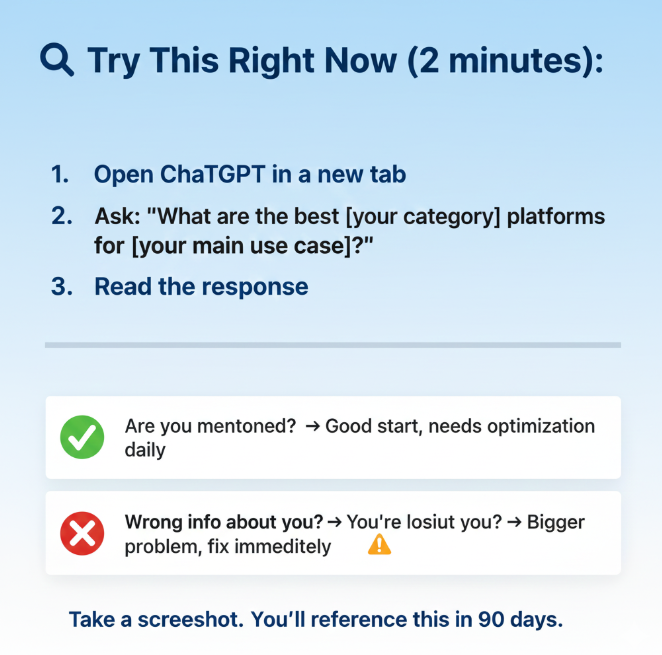
Most B2B marketers who try this are shocked. Their competitors appear. They don’t. Or worse—AI shares outdated or incorrect information about their company. This is the reality your buyers experience when researching solutions.
Why Traditional B2B Marketing Is Failing
Your marketing playbook was built for Google’s algorithm. AI search operates fundamentally differently.
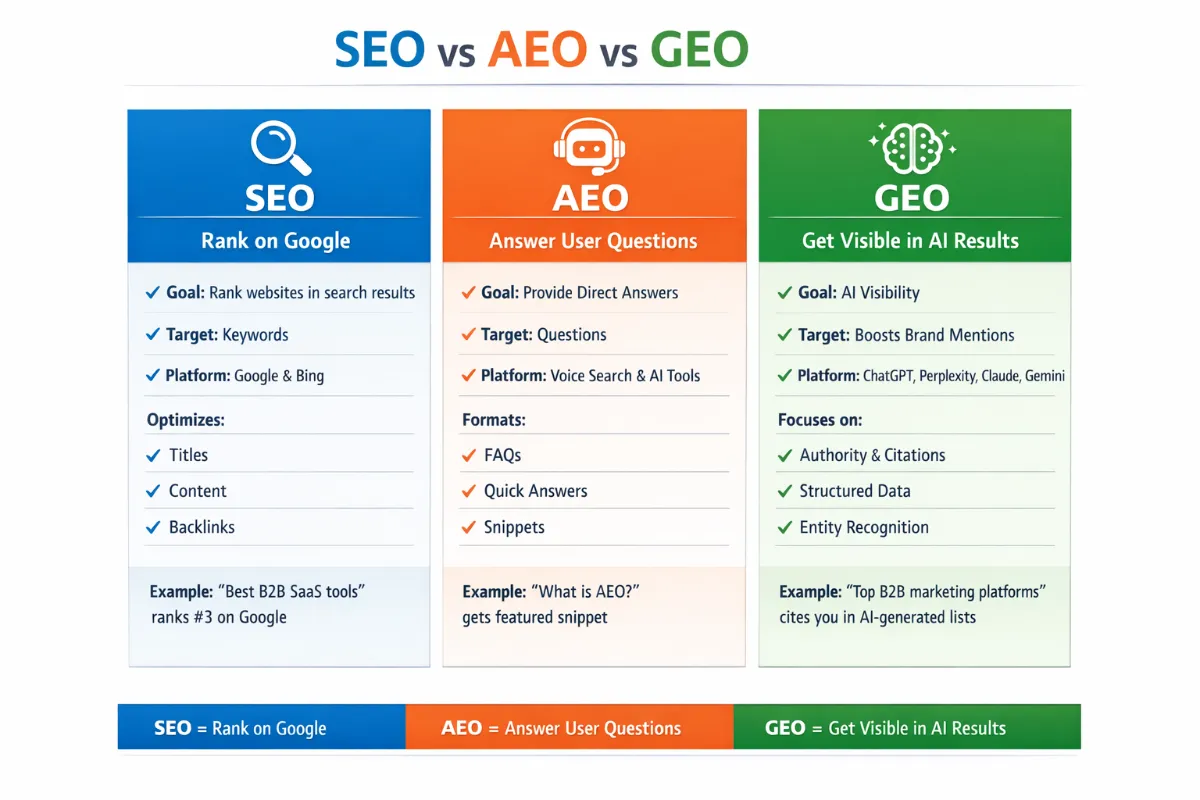
The shift is brutal: Companies with years of SEO investment are invisible in AI search. We’ve seen enterprise cybersecurity firms with 50,000+ monthly Google visitors get zero ChatGPT citations.
Traditional SEO vs AI Search
Factor | Traditional SEO | AI Search (AEO / GEO) |
Primary Goal | Rank in search results | Get cited in AI responses |
Success Metric | Page 1 ranking position | Citation frequency & context |
User Intent | Click-through to website | Direct answer from AI |
Content Format | Blog posts, articles | Structured data, tables, FAQs |
Trust Signal | Backlinks from other sites | Entity verification (Wikipedia, Crunchbase) |
Update Frequency | Monthly refresh | Weekly / daily for recency signals |
Query Type | 2–3 keyword phrases | 10–11 word conversational questions |
Competition | Other websites on Page 1 | Other brands AI considers authoritative |
Measurement | Google Search Console | Direct AI queries + monitoring |
Timeline to Results | 3–6 months | 4–12 weeks for first citations |
Why Your Buyers Can’t Find You (The 3 Blind Spots)
After helping 500+ B2B companies fix their AI visibility, we’ve identified three reasons buyers can’t find you—even when they’re actively looking for your solution:
Blind Spot #1: You’re Speaking to Google bots, Not AI
Your content is written for Google. Long-form narratives. Engaging stories. Thoughtful prose.
But when a buyer asks AI “What’s the difference between Product A and Product B?”, the AI needs structured, extractable data. Not a 2,000-word blog post with the answer buried in paragraph 7.
What buyers actually need (and AI surfaces):
-
Comparison tables showing features side-by-side
-
Direct answers to specific questions (FAQ format)
-
Technical documentation with clear implementation steps
-
Use case examples with concrete outcomes
Blind Spot #2: Buyers Don’t Trust Unknown Brands
When AI recommends 3-4 solutions to your buyer, it prioritizes brands it recognizes as “real” and “trustworthy.”
Think about it from the buyer’s perspective: They’re making a $50K-$500K decision based on an AI recommendation. They need confidence the vendor is legitimate, established, and won’t disappear in 6 months.
Trust signals AI looks for (that influence buyer confidence):
-
Wikipedia page (verified entity)
-
G2/Capterra reviews with detailed feedback
-
Media coverage from recognized publications
-
Case studies with named companies and real metrics
-
Security certifications (SOC 2, ISO 27001) buyers care about
Blind Spot #3: You Look Inactive (The Recency Gap)
Buyers want solutions that are actively maintained, currently relevant, and solving today’s problems—not yesterday’s.
AI engines use recency signals to determine if your solution is still relevant. They look for recent discussions, updates, and social activity.
Here’s what kills buyer confidence:
-
No recent Reddit/Quora discussions about your solution
-
Blog posts from 2022 with no updates
-
No press mentions in the past 12 months
-
Static social media presence
Your competitors getting recommended? They have active discussions happening right now. Buyers see them as “currently relevant.” You look archived.
The 3 Fatal Gaps
Gap | What It Is | Why It Hurts You | How to Fix It |
Unstructured Data | Content written for humans, not AI parsing | LLMs can’t extract facts from narrative fluff; info density is too low | Direct definitions in first 50 words; bullet lists instead of paragraphs; comparison tables; FAQ schema markup |
Trust Gap | Weak entity signals in AI knowledge graph | AI is unsure if you’re legitimate or just a landing page and defaults to known brands | Wikipedia page; complete Crunchbase profile; consistent NAP; Organization schema; SOC 2 certification |
Recency Gap | Static social footprint with no recent activity | AI sees you as archived or culturally irrelevant and cites active competitors | 5 Reddit comments weekly; 2 comparison posts weekly; recent press mentions; updated content timestamps |
QUICK AUDIT: Where Do You Stand?
Check ONE box for each blind spot, then add up your points.
BLIND SPOT #1: Content Structure ☐ 1 point — Long-form blog posts only, no FAQs or tables ☐ 2 points — Some structured content, but mostly narrative ☐ 3 points — FAQ section exists, working on comparison pages ☐ 4 points — Strong FAQ hub, 10-20 comparison pages live ☐ 5 points — Comprehensive FAQ hub (100+), 30-50 comparison pages Points: _____ |
BLIND SPOT #2: Trust Signals ☐ 1 point — No Wikipedia, Crunchbase incomplete, <10 reviews ☐ 2 points — Crunchbase claimed, 10-20 reviews on G2 ☐ 3 points — Crunchbase 100% complete, 30+ detailed reviews ☐ 4 points — 50+ reviews, press coverage, certifications started ☐ 5 points — Wikipedia page, 100+ reviews, media mentions, SOC 2 Points: _____ |
BLIND SPOT #3: Recency Signals ☐ 1 point — No social activity, blog posts from 2022-2023 ☐ 2 points — Occasional LinkedIn posts, quarterly blog updates ☐ 3 points — Monthly content, some Reddit/Quora presence ☐ 4 points — Weekly social posts, bi-weekly content updates ☐ 5 points — Active Reddit/Quora (5-10x/week), monthly fresh content Points: ___ __ |
YOUR TOTAL: _____ / 15 |
DIAGNOSIS: 12-15 → You're OPTIMIZING (visible, needs fine-tuning) Next step: Phase 4 scaling 8-11 → You have GAPS (visible sometimes, inconsistent) Next step: Start Phase 1, focus on trust signals 3-7 → You're INVISIBLE (losing deals you don't know exist) Next step: Emergency mode - begin Phase 1 today |
What Happens When Buyers CAN Find You
According to GrackerAI’s own published case study, SSOJet (an enterprise SSO platform) was invisible when developers asked AI assistants how to implement SSO — competitors were recommended, SSOJet wasn’t mentioned. After 6 months of AEO-optimized content, the results, sourced directly from that case study:
- Perplexity featured listings: 89% of “implement SSO” queries
- Enterprise customer signups: +287%
- Demo requests from AI-referred traffic: +412%
- Average sales cycle: -47% (from weeks to days)
“We were stuck competing against Okta and WorkOS on ads with no results. GrackerAI flipped our strategy, they helped us build comparison tools and cost calculators that enterprise buyers actually used. Now prospects show up to sales calls already knowing why we’re the right fit.”
— David Brown, Head of Marketing, SSOJet (from the full case study)
Before vs After Metrics
| Metric | Before | After | Change |
|---|---|---|---|
| AI Visibility | 18% | 67% | +272% |
| Enterprise Customer Signups | — | — | +287% |
| Demo Requests (AI-referred) | — | — | +412% |
| Sales Cycle | Weeks | Days | -47% |
| Trial-to-Paid Conversion | — | — | +89% |
The 90-Day Playbook: From Invisible to Indispensable
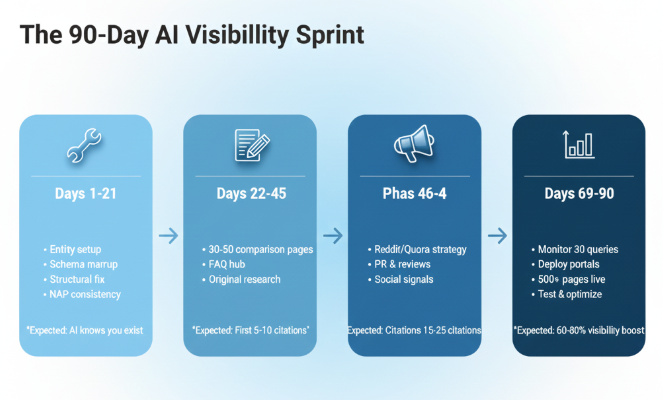
This isn’t about gaming algorithms. It’s about making it easy for buyers to find you, trust you, and choose you. Here’s the systematic approach that works:
Phase 1: Make Buyers Confident You Exist (Days 1-21)
Goal: When AI mentions you to buyers, they see signals you’re a real, legitimate company.
Week 1: Test What Buyers See
-
Ask ChatGPT, Perplexity, Claude: “What are the top [your category] platforms for [buyer use case]?”
-
Ask: “Compare [Your Brand] vs [Competitor] for [specific use case]”
-
Document: Are you mentioned? Are buyers seeing accurate info? What context?
Week 2-3: Build Trust Signals Buyers Check
-
Complete Crunchbase profile (buyers check funding, team size, location)
-
Claim Google Business, Bing Places (buyers verify you’re real)
-
Get 10 detailed reviews on G2/Capterra (90% of buyers fact-check)
-
Add schema markup linking to social profiles (helps AI verify identity)
-
Ensure consistent messaging across website, LinkedIn, directories
Phase 2: Create Content Buyers Actually Need (Days 22-45)
Goal: When buyers ask AI questions, your content provides the answers they’re looking for.
At GrackerAI, we automated this using our platform’s programmatic SEO capabilities. Here’s what buyers need:
Content That Wins Buyers:
-
Comparison pages (“Product A vs Product B”) - Buyers are evaluating options
-
FAQ hub answering 100+ buyer questions (“How do I…”, “What’s the difference between…”, “Can it integrate with…”)
-
Use case guides showing how you solve specific buyer problems
-
Alternative pages (“Looking for [Competitor] alternative?”) - Capturing switchers
-
Case studies with named companies, real metrics, and buyer testimonials
-
Technical documentation with implementation clarity buyers need
Content That Wins Buyers:
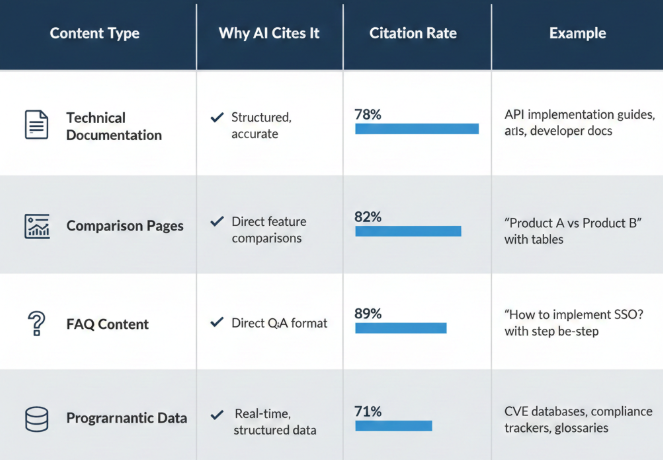
Key insight: FAQ content has the highest citation rate (89%) because it directly matches how buyers ask questions. Comparison pages are close behind at 82%—buyers are evaluating options.
We generated 500+ buyer-focused pages in 3 weeks using GrackerAI’s platform. Zero manual writing. Every page answering specific buyer questions.
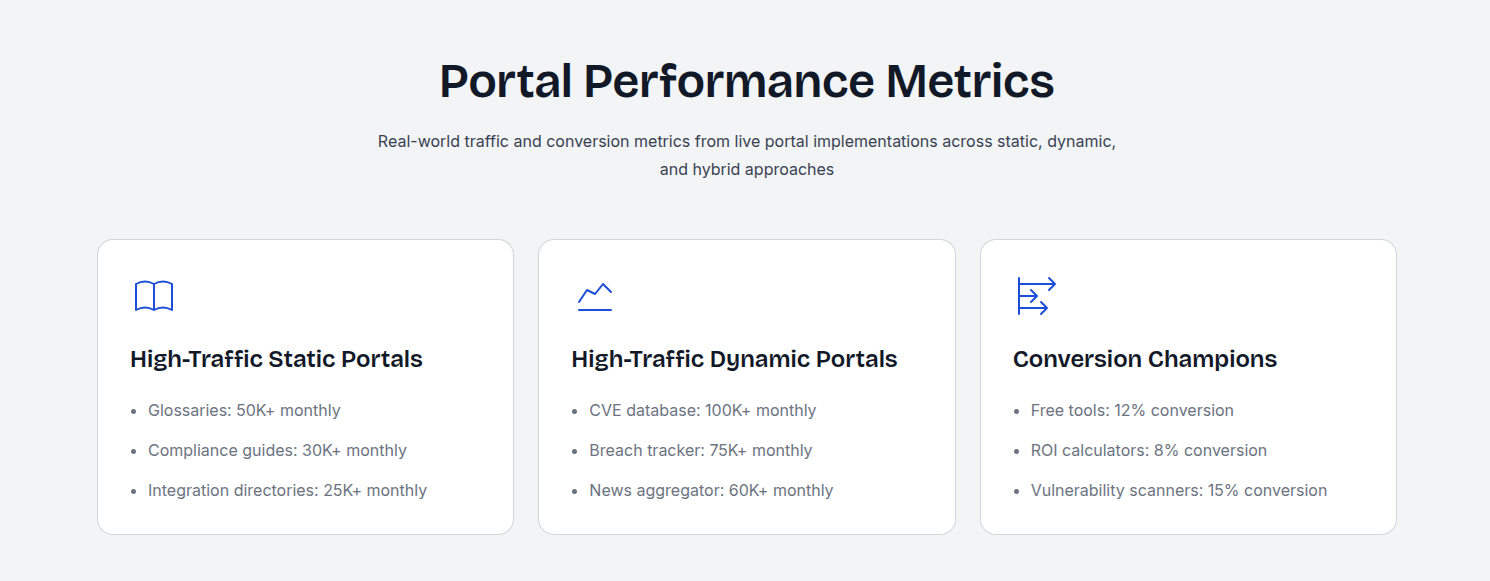
Gracker Portal Performance Metrics
Content Type AI Sites More
Content Type | Why AI Cites It | Citation Rate | Best Format | Example |
Technical Documentation | Structured, accurate, comprehensive | 78% | Step-by-step guides, API references | How to implement OAuth 2.0 |
Comparison Pages | Direct feature-by-feature analysis | 82% | Tables with checkmarks / X marks | Product A vs Product B features |
FAQ Content | Matches direct Q&A query format | 89% | Question as H2 with answer below | What is the difference between X and Y? |
Programmatic Data | Real-time, structured, verifiable | 71% | Databases, lists, directories | CVE databases, compliance trackers |
Original Research | Unique data others can reference | 85% | Reports with statistics | State of [Industry] 2025 Report |
Case Studies | Proof of real-world results | 68% | Before/after with metrics | Company X achieved Y% improvement |
Phase 3: Show Buyers You’re Active & Relevant (Days 46-68)
Goal: Buyers see recent discussions, updates, and social proof that you’re currently solving problems.
The “5-2-1” Weekly Strategy:
Activity | Frequency | Platform | Strategy | Example |
Comments | 5 per week | Reddit, Quora | Find threads ranking on Google, add value, mention brand naturally | We've found X approach works well. |
Posts | 2 per week | Reddit, Product Hunt | Create comparison or review threads | Comparing X vs Y for Z use case – |
Thought Leadership | 1 per week | Answer industry questions, position expertise | Here's what most companies get wrong about [topic]... |
-
5 valuable Reddit/Quora comments where buyers ask questions (add value, mention your solution naturally)
-
2 comparison/review posts (“Comparing X vs Y for Z use case - here’s what we found”)
-
1 LinkedIn thought leadership post answering buyer questions in your space
Authority Signals Buyers Check:
-
Press release or guest post on industry site buyers read
-
Original research report (becomes source others reference)
-
Get featured in “Best [Category] Tools 2025” buyer guides
Phase 4: Scale What Wins Buyers (Days 69-90)
Goal: Dominate buyer research across every question they ask.
Deploy Programmatic Buyer Content:
-
Comparison portal: [Your Product] vs every competitor (30-50 pages)
-
Use case library: How to solve [specific problem] with [your solution] (100+ pages)
-
Integration guides: [Your Product] + [Platform buyers use] (50+ pages)
-
Industry portals: [Your Solution] for [Industry] positioning (30+ pages)
Monitor What Buyers See:
-
Track 30 buyer questions across ChatGPT, Perplexity, Claude, Gemini
-
Check 2x/week: Are you mentioned? Context? Position? Competitors shown?
-
Double down on queries where you’re close to winning buyers
What Buyers Will Experience (Expected Results)
Based on 500+ B2B SaaS companies we’ve helped:
Timeline | Buyer Visibility | Buyer Behavior | Business Impact |
|---|---|---|---|
Day 30 | First AI mentions | Buyers see you in 1-2 platforms | First AI-referred demos |
Day 60 | 25-35% more visible | Buyers see you alongside competitors | +20-30% qualified inbound |
Day 90 | 60-80% improvement | Buyers see you BEFORE competitors | +35-50% inbound, 3-5x conversion |
These aren’t projections. These are averages from actual implementations helping B2B companies win buyers.
The Bottom Line: Move Now or Fall Behind
Your buyers have moved to AI search. That’s not a prediction—it’s reality.
Every day you wait:
-
- Competitors build stronger AI presence (compounding advantage)
-
- Buyers research your category without finding you
-
- Deals are decided before you’re even considered
-
- The gap gets harder to close
The companies dominating AI search in 2026 started in 2025. The question isn’t whether to adapt—it’s whether you’ll be early or late. That’s especially true for products launching into a new category, where there’s no existing AI mention history to fall back on — visibility planning has to start before day one, not after.
What we’ve seen across 500+ B2B SaaS companies:
- Average AI visibility improvement: 67% in 90 days
- Qualified inbound increase: 35-50%
-
- AI-referred conversion rates: 3-5x higher than SEO traffic
-
- Sales cycles: Cut by 40-60%
These results aren’t theoretical. They’re happening right now for companies that moved fast.
Your first step is simple:
-
Open ChatGPT. Ask: “What are the best [your category] platforms?”
-
Are you mentioned? Are buyers seeing accurate info? Which competitors appear?
-
Document it. That’s your baseline.
-
Then start Phase 1 tomorrow.
-
Your buyers are searching. Make sure they find you.
Frequently Asked Questions
How long does it actually take to see results?
-
First citations: 4-6 weeks (usually in less competitive queries)
-
Meaningful visibility: 60-90 days (appearing consistently for core queries)
-
Category dominance: 6-12 months (cited above competitors)
The key is consistency. Companies that follow the 90-day sprint systematically see results. Those who do everything at once or give up after 30 days don’t.
Do I need to hire a content team or agency?
No. The companies seeing best results automate content creation using programmatic SEO platforms (like GrackerAI).
One marketing manager can manage this using automation. Manual content creation at this scale (500+ pages) isn’t realistic for most B2B companies.
Will this hurt my Google SEO rankings?
No—it improves them. The content you create for AI visibility (structured data, comparison pages, FAQ content) also ranks well on Google. You’re not choosing between SEO and AEO; you’re doing both.
Bonus: Many companies see 40-50% traffic increases from traditional SEO as a side effect of implementing AEO strategies.
What if my competitors are already doing this?
Start anyway. AI visibility isn’t zero-sum—multiple companies can be cited for the same query. Plus, the market is still early. Most B2B companies (90%+) haven’t started optimizing for AI search yet.
The real risk is waiting until your entire category is optimized. Early movers build trust signals that compound over time.
Can I do this in-house or do I need GrackerAI?
You can absolutely do this in-house if you have:
-
Technical SEO knowledge
-
Content creation capacity (500+ pages)
-
Ability to implement schema markup
-
Time to monitor AI platforms weekly
GrackerAI automates the heavy lifting (content generation, schema implementation, monitoring), which is why companies see results in 90 days vs 6-12 months doing it manually.
What’s the ROI? How do I measure this?
Measurement approach:
-
Baseline: Test 20-30 buyer queries before starting (document results)
-
Track weekly: Same queries across ChatGPT, Perplexity, Claude, Gemini
-
Business metrics: AI-referred traffic (UTM tagging), demo requests, conversion rates
Typical ROI:
-
Investment: $2K-10K/month (platform + time)
-
Return: 35-50% increase in qualified inbound
-
AI-referred leads convert at 3-5x higher rates
-
Payback period: Usually 2-4 months
My industry is highly regulated (fintech, healthcare). Will this work?
Yes—especially well. Regulated industries need trust signals even more. Your compliance certifications, security documentation, and technical accuracy become competitive advantages.
Healthcare SaaS and fintech companies we’ve worked with actually see higher AI citation rates because AI engines prioritize accurate, verified sources for sensitive topics.
What if AI engines change their algorithms?
The fundamentals won’t change:
-
Buyers will still ask questions
-
AI will still need trusted sources
-
Structured, accurate content will still win
Specific tactics may evolve (just like SEO), but the core strategy—building trust, creating buyer-focused content, showing recent activity—remains constant.
Think of it like SEO: Google’s algorithm changes constantly, but quality content from trusted sources always wins.
Ready to Win Your Buyers Back?
Every day you’re not visible in AI search, buyers are researching your category, asking questions about problems you solve, and choosing your competitors.
Not because your solution is worse. Because they can’t find you.
The companies that dominate their categories in 2026 are the ones making themselves findable in 2025.
At GrackerAI, we’ve helped 500+ B2B SaaS companies go from invisible to indispensable:
-
Average visibility improvement: 67% in 90 days
-
Average increase in qualified inbound: 35-50%
-
AI-referred buyer conversion: 3-5x higher than traditional SEO
Start today: Ask ChatGPT about your category. Document where you stand. Then begin Phase 1.
Your buyers are searching. Make sure they find you.
—
Want to see what this looks like for your company?
I’ll personally show you where your buyers can and can’t find you, which competitors they’re seeing instead, and your 90-day roadmap. No sales pitch—just a 15-minute buyer visibility audit.
📅 Book time: Calendar Link
✉️ Email: support@gracker.ai
P.S. I respond to every comment and email personally. If your buyers can’t find you in AI search, reach out. I’ll help.
Related Articles
-
 cybersecurity content audit
 How to Audit Cybersecurity Content for Accuracy and Originality
Cybersecurity content with incorrect facts destroys confidence fast. Here's a practical audit framework for correctness and originality that preserves the credibility of your security publications.
-

10 Examples of SaaS Companies with Exceptional Marketing
Explore 10 SaaS marketing examples with actionable tactics. Learn innovative strategies from top companies to elevate your own campaigns.
-

How to Find the Right B2B Prospects for Your SaaS Product
Stop wasting sales outreach on leads that're not a good fit. Learn ways to find, check, and work with the right B2B prospects for your SaaS product.
-
 online reputation management
 The Importance of SEO in Online Reputation Management
Discover how SEO influences your digital brand. Learn actionable strategies to suppress negative search results and build a positive online reputation today.