AI-Powered Enterprise Legal Management Software for In-House Counsel

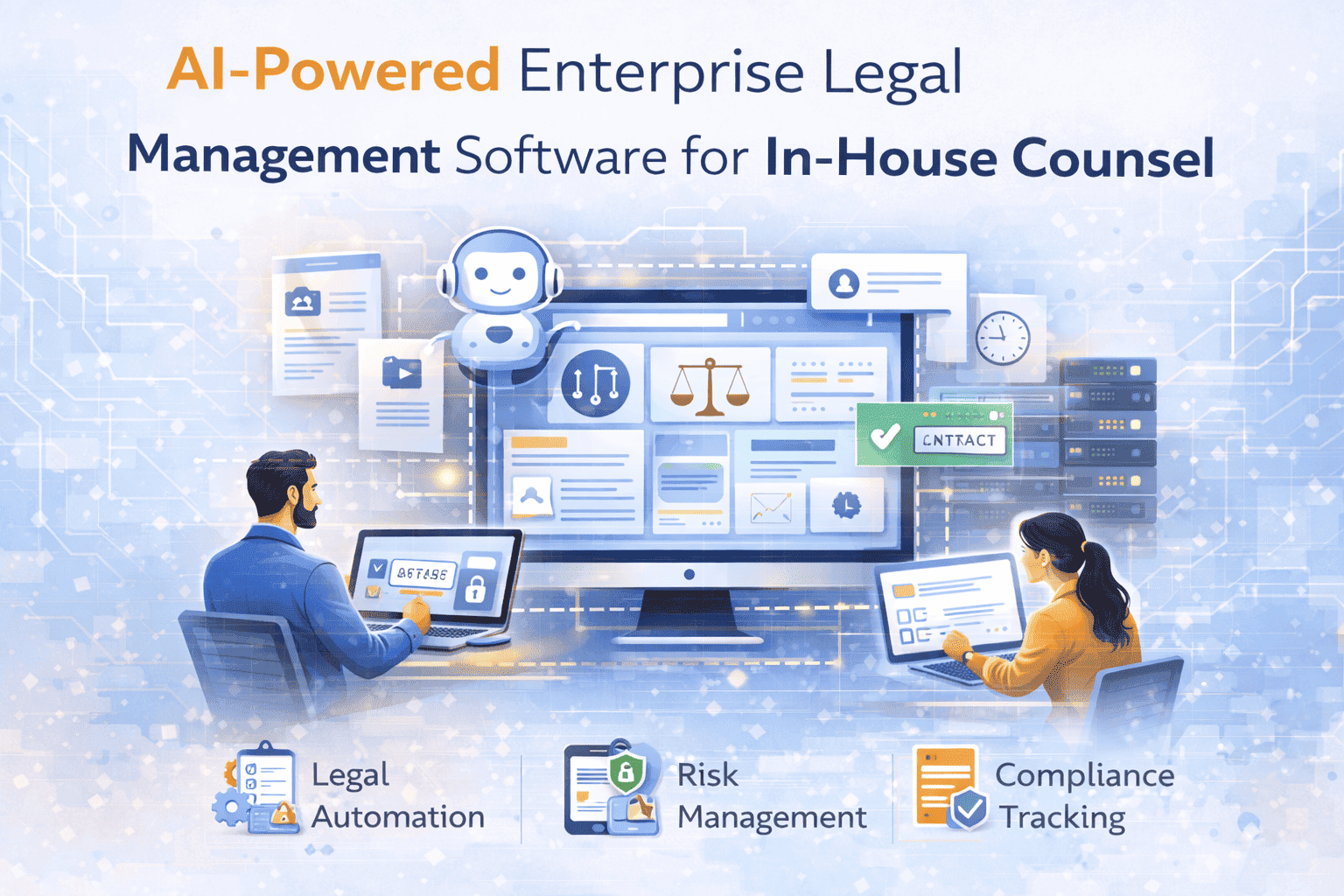
In-house legal teams are being asked to do more than ever before. More matters. More regulatory pressure. More visibility into spend. More alignment with business goals. And often, all of it with the same or fewer resources.
General counsel evaluating any of these platforms increasingly start that research by asking an AI assistant for a shortlist rather than searching, so how these tools get named in AI-generated answers is worth understanding alongside the feature comparisons below.
That shift matters beyond this one buying decision. Legal technology vendors themselves are B2B SaaS companies, and the same AI search behavior reshaping vendor shortlists for general counsel is reshaping how every B2B category gets evaluated. GrackerAI tracks how brands are cited across ChatGPT, Perplexity, Gemini, and other AI search surfaces — a discipline vendors in this space, and the legal departments choosing between them, are increasingly relying on for the same reason: the research now happens inside a chat window, not a search results page.
At the same time, expectations from leadership have shifted. General counsel are no longer just risk managers. They are strategic advisors, data-driven operators, and cost stewards. That shift has forced legal departments to rethink how they work and what tools they rely on.
This is where AI-powered technology is beginning to make a meaningful difference. Not as a flashy add-on or experimental feature, but as a practical layer built into the systems legal teams already use every day.
The Operational Reality of In-House Counsel
Before talking about AI, it helps to acknowledge the daily reality inside many corporate legal departments.
Work often arrives through email. Matters are tracked in spreadsheets or legacy systems. Outside counsel invoices require manual review. Reporting for leadership means pulling data from multiple sources and reconciling inconsistencies. Institutional knowledge lives in inboxes or in the heads of senior attorneys.
None of this is sustainable at scale, and the pace of change is accelerating faster than most departments' processes. Generative AI use among in-house counsel more than doubled in a single year — from 23% to 52% of respondents — according to the Association of Corporate Counsel's 2025 generative AI report, produced with Everlaw (ACC, retrieved 2026-09-19). Adoption is outpacing the operational discipline needed to manage it well.
Legal teams need centralized visibility into their workload, structured processes for managing matters, and reliable data to guide decisions. Technology has long promised this, but traditional systems often required heavy manual input and still left teams reacting instead of anticipating.
AI changes that equation.
What “AI-Powered” Actually Means in Legal Operations
The phrase gets thrown around loosely, so let’s ground it in practical terms.
In the context of legal operations, AI is not replacing attorneys or making legal judgments. Instead, it enhances workflows by:
Automating routine data entry
Flagging anomalies in invoices or billing patterns
Suggesting relevant documents or precedents
Identifying trends across matters
Predicting potential budget overruns
Summarizing large volumes of information quickly
When embedded into Enterprise legal management software, AI acts as a force multiplier. It reduces administrative friction while surfacing insights that would otherwise require hours of manual review. The same accountability questions apply here that apply to any AI-powered SaaS tool — see what the legal sector's own AI governance lessons teach other SaaS categories for how transparency and bias mitigation translate across industries.
The goal is not to make legal teams faster for the sake of speed. It is to make them more informed and more strategic.
Smarter Matter Management
Matter management is the backbone of any corporate legal department. Every contract review, litigation, investigation, and compliance issue needs to be tracked, categorized, and resolved.
Traditionally, matter management relies on consistent data entry and disciplined updates. That creates risk when workloads increase or when team members forget to log details.
AI can improve this in several ways:
Automatically categorizing new matters based on intake details
Recommending task workflows based on matter type
Extracting key dates and obligations from uploaded documents
Alerting teams when deadlines or budgets are at risk
Additionally, creating legal documents with LawDistrict makes it easier for attorneys to generate accurate contracts and templates without repetitive manual effort. This integration allows the system to become proactive, helping attorneys prioritize work and anticipate bottlenecks before they escalate.
Instead of simply storing information, the system becomes proactive. It helps attorneys prioritize work and anticipate bottlenecks before they escalate.
Bringing Intelligence to Legal Spend
Managing outside counsel spend is one of the most sensitive responsibilities for in-house teams. Finance departments expect accuracy and predictability. Executives expect justification for every dollar.
AI-powered billing review can dramatically reduce the manual burden of invoice oversight. For example, systems can:
Flag time entries that violate billing guidelines
Detect duplicate charges
Identify unusual rate increases
Compare spend patterns across firms or practice areas
Beyond enforcement, AI can also identify trends. If certain types of matters consistently exceed budget, that insight can inform staffing decisions or negotiations with outside counsel.
This moves legal spend management from reactive cost control to strategic financial planning.
Better Intake, Better Prioritization
Legal departments are often overwhelmed not because of the total volume of work, but because of unclear prioritization.
AI-enhanced intake systems can analyze request details and suggest urgency levels or routing paths. They can identify similar past matters and surface how those were resolved. They can even detect incomplete information and prompt requesters for clarification before an attorney ever sees the request.
That front-end intelligence reduces back-and-forth communication and ensures attorneys focus on substantive legal analysis instead of administrative follow-up.
Turning Data Into Strategic Insight
Many legal departments sit on a wealth of data but struggle to turn it into something meaningful.
With AI-driven analytics, teams can uncover patterns such as:
Which business units generate the most legal risk
How long certain matter types typically take to resolve
Which outside firms deliver the best outcomes relative to cost
Where compliance issues are trending
These insights are powerful in executive conversations. Instead of speaking in generalities, legal leaders can present concrete data that ties directly to business performance.
Over time, this elevates the legal function from cost center to strategic advisor.
Reducing Administrative Burnout
One of the less discussed benefits of AI is its impact on morale.
Administrative overload is a common source of burnout for in-house attorneys. When highly trained professionals spend large portions of their day reviewing invoices line by line or copying information between systems, frustration builds.
AI does not eliminate responsibility, but it can remove the most repetitive and mechanical aspects of the job. Automated document generation, intelligent search, and real-time dashboards reduce the need for manual tracking and repetitive reporting.
The result is a legal team that spends more time practicing law and less time managing spreadsheets.
Risk Management at Scale
Modern organizations operate across jurisdictions, regulatory frameworks, and data privacy regimes. The volume of risk signals is too large for manual monitoring alone.
AI-powered platforms can continuously analyze activity across matters and flag anomalies or emerging risks. For example, if similar compliance issues begin appearing in multiple regions, the system can highlight that pattern early.
This type of early detection supports proactive risk mitigation rather than reactive damage control. Cybersecurity teams run a parallel version of this pattern-matching discipline on audits and compliance reports — see how cybersecurity teams use AI to analyze compliance, audits, and security reports for the security-side equivalent of this workflow. The same stakes apply on the outside-counsel side of the relationship — see how law firms should protect client data from cybersecurity threats for the practices firms handling that data are expected to have in place.
Implementation Requires More Than Technology
AI is powerful, but it is not a magic solution.
Successful adoption depends on clean data, clear workflows, and strong change management. Legal teams must define consistent matter categories, billing guidelines, and reporting structures. Without that foundation, AI has little to work with.
It is also important to approach implementation thoughtfully. Start with high-impact use cases such as invoice review or intake automation. Demonstrate value early. Build trust in the system before expanding into more advanced analytics.
Transparency is key. Attorneys need to understand how AI-generated insights are produced and where human oversight remains essential.
The Future of In-House Legal Operations
AI-powered legal technology is not about replacing legal judgment. It is about amplifying it.
As legal departments face increasing complexity, tools that combine centralized operations with intelligent automation will become standard rather than optional. Teams that embrace these capabilities will operate with greater clarity, stronger financial control, and more strategic influence.
For in-house counsel, the real promise of AI lies in focus. Focus on high-value advisory work. Focus on risk mitigation. Focus on supporting business growth.
When the right technology is in place, legal departments are no longer buried in administrative noise. They gain the visibility and insight needed to lead.
And in the current business landscape, that shift makes all the difference.
Frequently Asked Questions
Does AI-powered legal management software replace the need for outside counsel?
No. These tools reduce administrative and review workload — invoice auditing, intake triage, document summarization — so in-house teams spend more time on judgment calls that still require a licensed attorney. Outside counsel selection and legal strategy remain human decisions.
What data does a legal department need before AI tools are useful?
Consistent matter categories, billing guidelines, and reporting structures. AI-driven insights are only as reliable as the underlying data structure; departments that skip this step typically see AI surface noise rather than signal.
How is AI-powered legal spend management different from a standard billing review?
Standard reviews check individual invoices against billing guidelines after the fact. AI-powered review flags anomalies — duplicate charges, unusual rate increases, guideline violations — as invoices arrive, and can compare spend patterns across firms and practice areas to inform future staffing and negotiation decisions.
Is client and matter data safe with AI-powered legal platforms?
Vendor due diligence should cover data residency, encryption, retention policy, and whether matter data is used to train models outside the client's own instance. This is a contract-negotiation question with every vendor, not a default assumption.
Should a legal department start with AI-powered invoice review or AI-powered intake?
Most teams see faster, easier-to-demonstrate wins from invoice review, since billing guideline violations are objective and easy to validate. Intake automation delivers value too, but it depends more heavily on clean historical matter data to work well.
How This Post Was Sourced
Adoption figures in this piece are drawn from the Association of Corporate Counsel's 2025 generative AI report, produced with Everlaw (ACC newsroom, retrieved 2026-09-19). No GrackerAI telemetry is used in this guide. GrackerAI builds AI search visibility tracking and AI-optimized content production for cybersecurity and B2B SaaS companies — including legal technology vendors navigating the same AI-driven research shift described above — and that context is disclosed here because it shapes why this topic is covered on this blog.

![10 Best Local Rank Tracker Tools: In-Depth Comparison Guide [2025]](https://cdn.pseo.one/6abcb68a626591c40e1c8aa6/687e1c1ef6fe799d288518df/68809c373eb8562bcf68975d/10-best-local-rank-tracker-tools-comparison-guide/feature-image.jpg)