Why Credible Businesses Win in AI-Driven Discovery

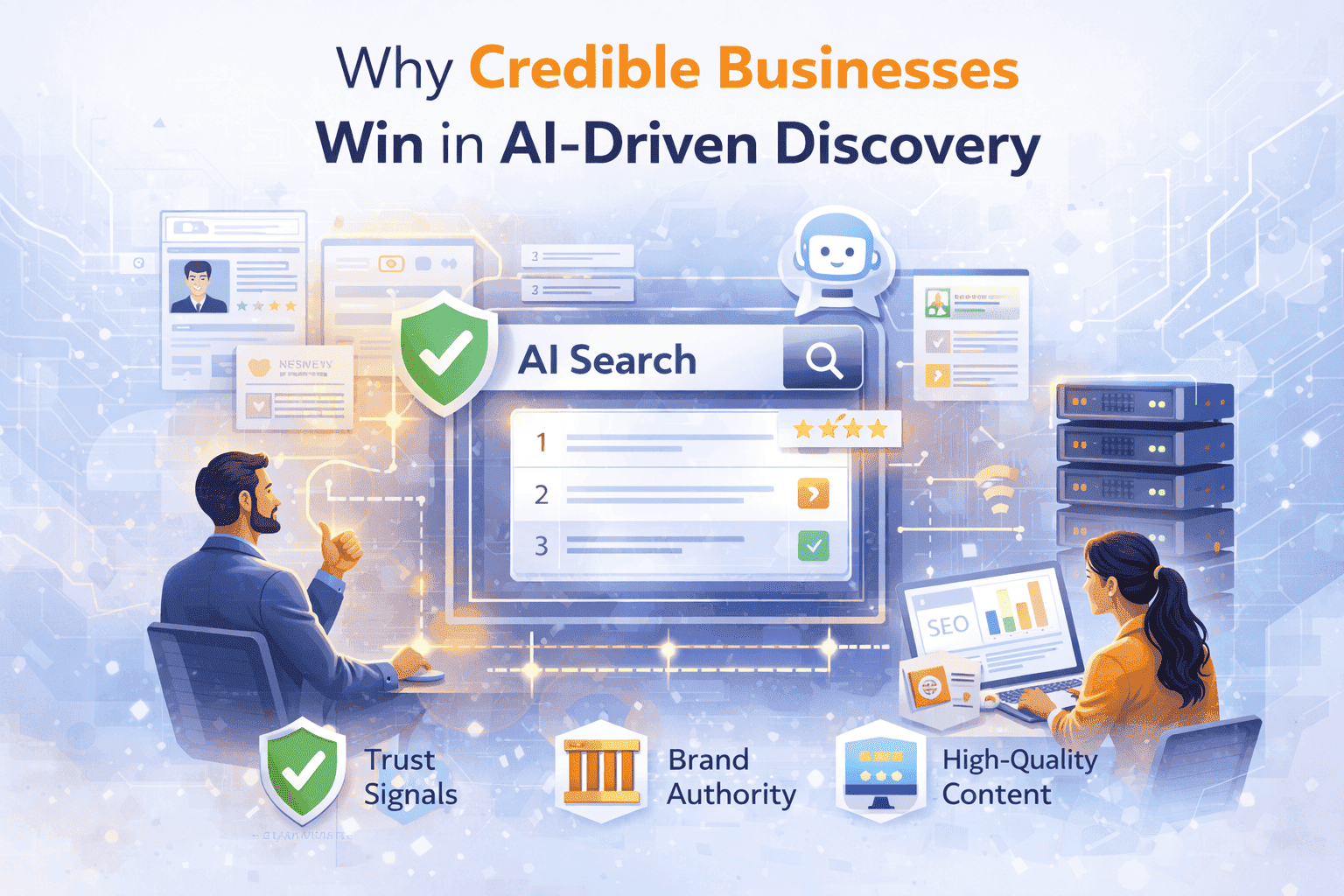
Credible businesses win in AI-driven discovery because AI answer engines are built to reduce uncertainty, and a verifiable, consistent, well-documented business is a lower-risk citation than an anonymous one. That is the entire mechanism: credibility is not a branding preference the model has, it is the filter it uses to decide what to trust.
AI-driven discovery is transforming how customers find and evaluate businesses. Instead of scrolling through links, users receive a single synthesized response generated from sources the model considers trustworthy. Gartner projects that traditional search engine volume will drop 25% by 2026 as buyers shift queries to AI chatbots and other virtual agents (Gartner, retrieved 2026-09-19). That means visibility is no longer determined solely by keywords or advertising. It depends on credibility.
As such, businesses are judged by signals machines analyze behind the scenes. These include consistency of company information, verified records, authoritative mentions, and overall digital reliability. Organizations that demonstrate these traits are more likely to be surfaced, cited, or recommended. Those that don’t may be overlooked entirely.
Credibility has become a measurable advantage, not just a branding concept.
Ultimately, as AI increasingly shapes decision-making, the companies that stand out will be those that understand how trust is evaluated and intentionally build the signals that prove they are legitimate, reliable, and worthy of attention.
What “AI-Driven Discovery” Really Means
AI-driven discovery relates to the way artificial intelligence systems locate, evaluate, and present information to users. Instead of simply retrieving links like traditional search engines, these systems analyze large volumes of data and deliver summarized answers, recommendations, or rankings. The goal is efficiency. Users get what they need faster, often without visiting multiple websites.
This shift changes how visibility works online. Traditional digital strategy focused heavily on search engine optimization tactics such as keyword placement, backlinks, and page traffic. While those factors still matter, AI systems now evaluate deeper indicators of reliability and authority. They are designed to prioritize accuracy and reduce the risk of presenting misleading or low-quality information.
To do this, AI tools assess patterns across multiple signals. They look for consistency in business details across platforms, confirmation of legitimacy through public records, and evidence that a company is recognized by other credible sources. They also analyze how often a brand is referenced, how current its information is, and whether its content demonstrates expertise.
This means that AI does not “seek out” information. It filters for trustworthiness. Businesses that understand this distinction are better positioned to appear in AI-generated results and recommendations. How AI Agents Are Changing Search and Brand Discovery covers the mechanics of that filtering in more depth — what an AI agent actually does with the information it finds.
Why Credibility Is the New Ranking Factor
Credibility isn’t a vague concept in AI-driven discovery; rather, it’s a signal that can be measured. Algorithms are designed to reduce uncertainty, which means they naturally prioritize sources that appear reliable, verified, and consistent across multiple data points.
Compared with traditional search, which has always heavily relied on keywords, AI models assess trust indicators. They analyze whether a business looks legitimate, established, and authoritative before deciding to surface it in results.
Key credibility signals AI systems often assess include:
Consistency: Matching business name, address, and contact details across platforms
Authority: Mentions from reputable websites or recognized publications
Accuracy: Up-to-date information and verifiable claims
Reputation: Reviews, ratings, and public feedback trends
History: Evidence of sustained activity over time
What’s more is that you must realize that credibility compounds. The more reliable signals your business produces, the stronger your digital trust profile becomes. Over time, this increases the likelihood that AI systems will reference, recommend, or summarize your content. How E-E-A-T Impacts AEO Ranking in AI Answers breaks down how Google's own Experience-Expertise-Authoritativeness-Trust framework maps onto this same compounding effect.
Structural Legitimacy Signals Matter More Than Ever
When a company operates as a formally registered entity, such as a Limited Liability Company (LLC), it demonstrates that the business exists as a recognized legal enterprise rather than a side hustle or hobby. And that really matters to algorithms designed to prioritize trustworthy sources.
Entrepreneurs in the Lone Star State, for instance, exploring topics like forming an LLC in Texas tend to focus on liability protection or tax flexibility. However, formal registration also boosts digital credibility because it creates public records and consistent identifiers that AI systems can cross-reference.
Some structural trust signals include:
Registered entity status (such as an LLC) showing official state recognition
Employer Identification Number (EIN) confirming tax registration and operational legitimacy
Public filings that verify business existence and standing
Consistent registration data across government and commercial databases
These markers act as proof points. They tell AI systems your business is real, established, and accountable. And that’s a visibility advantage to your business.
Reputation Data: The Fuel Behind AI Recommendations
AI systems rely heavily on reputation data to decide which businesses deserve attention. They are designed to minimize risk for users, so they favor organizations that appear consistently credible across multiple independent sources. The stronger and more consistent your reputation signals, the more likely AI tools are to reference or recommend your business.
But you must know that these systems don’t rely on a single metric. Instead, they analyze patterns across a wide network of public information; this helps form a trust profile.
AI evaluates the following reputation signals:
Customer reviews: Volume, quality, and consistency of feedback
Third-party mentions: Citations from reputable websites or media outlets
Backlinks: Links from authoritative domains pointing to your site
Listings: Verified profiles in directories and professional databases
Engagement trends: Evidence that real users interact with your content
Quality matters more than quantity. A handful of strong, credible signals can outweigh dozens of weak ones.
Content Authority in an AI World
Content is not judged only by relevance in AI-driven discovery; rather, it’s evaluated for authority. Algorithms are designed to prioritize information that appears accurate, well-supported, and created by knowledgeable sources. This means surface-level content is less likely to be selected, summarized, or recommended.
AI systems analyze both what you publish and how you present it. A well-built author page is one of the cleanest ways to put those signals in one place — see author pages & E-E-A-T: the complete playbook for the specifics. They look for signals that indicate expertise, credibility, and originality rather than repetition of widely available information.
Here are some strong authority signals you should be aware of:
Original insights: Unique perspectives or proprietary data
Evidence-based claims: Statistics, research, or cited sources
Clear structure: Logical formatting that improves readability and comprehension
Author credibility: Identifiable writers with relevant experience or credentials
Freshness: Updated content that reflects current information
Thin or generic material tends to be filtered out because it adds little value to a reader. AI tools aim to deliver the most useful answer, not the most common one.
Businesses that invest in high-quality, expert-driven content position themselves as reliable sources. Over time, this increases the likelihood that AI systems will treat their material as trustworthy enough to surface in results. Named, verifiable authorship is one of the highest-leverage versions of this signal — Author Pages & E-E-A-T: The Complete Playbook covers how to build that out. GrackerAI's AI visibility tracking (disclosure: GrackerAI publishes this blog) measures whether that investment is actually converting into citations, rather than assuming it is.
Transparency as a Competitive Advantage
Transparency is also a recognized credibility signal.
Opaque or anonymous websites often rank lower in AI trust evaluations because there is little evidence to confirm legitimacy. Transparent businesses, on the other hand, provide data points that systems can validate across multiple sources.
Signals that strengthen transparency include:
Clear ownership information: Named leadership or company details
Accurate contact data: Verified address, email, and phone number
Published policies: Privacy, terms, and compliance disclosures
Consistent branding: Matching details across platforms and listings
Verified domains and profiles: Confirmation through trusted services
Transparency builds confidence at scale. It reassures customers that a company is ethical while simultaneously giving AI systems the verification signals they need to treat your business as reliable.
Common Credibility Mistakes That Reduce Visibility
Many businesses struggle with AI visibility, not because they lack high-quality products or services, but because they send weak or conflicting credibility signals. Ultimately, algorithms are designed to detect inconsistencies and uncertainty, and when they do, they are less likely to surface that business in results.
Often, the issue isn’t what a company is doing right—it’s what it’s overlooking.
Frequent credibility gaps include:
Inconsistent business details across directories, websites, and listings
Outdated information that signals neglect or inactivity
Anonymous web presence with no clear ownership or contact data
Lack of authoritative references from reputable third parties
Missing structural indicators, such as verified registrations or identifiers
Even small discrepancies can weaken trust scores because AI systems rely on pattern recognition. If data points don’t align, the algorithm may interpret that as unreliability.
The key insight is simple. Credibility is cumulative, but so is doubt. Businesses that regularly audit their digital presence and correct inconsistencies are more likely to be recognized as trustworthy sources. In cybersecurity specifically, where technical accuracy is table stakes, From Threats to Trust: Building Cybersecurity Content That Users Actually Search For covers what that audit looks like in practice.
How Businesses Can Strengthen AI Trust Signals
Improving credibility in AI-driven discovery is not about trying to trick or game an algorithm. It’s about demonstrating legitimacy, consistency, and expertise in ways machines can verify. Businesses that intentionally strengthen their trust signals make it easier for AI systems to recognize them as reliable sources.
Small improvements, applied consistently, can produce measurable gains in visibility over time.
Effective strategies include:
Maintain formal business status: Keep registrations, licenses, and filings current
Use consistent business data: Ensure your name, address, and contact details match everywhere
Publish authoritative content: Share original insights, research, and expert analysis
Earn reputable mentions: Seek citations from credible sites and industry sources
Monitor your presence: Regularly audit listings, profiles, and public information
These actions create a clear pattern of reliability. AI systems reward that pattern because it reduces uncertainty and increases confidence in the information associated with your brand.
Remember, credibility is not a single achievement. Instead, it should be approached as an ongoing work in progress.
Credibility is the New Visibility Strategy
AI-driven discovery is reshaping how businesses are found, evaluated, and trusted. Algorithms now favor organizations that demonstrate legitimacy, consistency, and authority across verifiable signals.
Companies that invest in strong structures, accurate data, and credible content position themselves to be surfaced and recommended. Those that don’t risk digital invisibility. In our brand-new AI-centric world, credibility is a discoverability strategy that determines who gets seen, trusted, and chosen.
Frequently Asked Questions
What is AI-driven discovery?
AI-driven discovery is the process by which AI answer engines like ChatGPT, Perplexity, and Google AI Overviews locate, evaluate, and synthesize information into a direct response instead of returning a list of links for the user to evaluate themselves.
How is credibility different from traditional SEO ranking factors?
Traditional SEO rewards keyword matching, backlinks, and page traffic. AI-driven discovery instead evaluates verifiable signals — consistent business information, third-party validation, structural legitimacy, and content that demonstrates genuine expertise — because the model is trying to minimize the risk of citing something inaccurate.
Can a new business with no brand recognition build AI credibility quickly?
Not quickly, but predictably. Credibility compounds from consistent, verifiable signals over time rather than from a single campaign. Building Authority Without Brand Recognition covers the specific playbook for a startup doing this from zero.
Does formal business registration actually affect AI visibility?
It is one input among several. Public records and consistent registration data give AI systems a verifiable identifier to cross-reference against other mentions of your business, which supports the consistency signal — but it does not substitute for authoritative content or third-party validation.
What is the fastest way to audit current credibility signals?
Check whether your business name, address, and contact details match exactly across your site, directories, and listings; confirm your content has identifiable, credentialed authors; and ask an AI tool directly what it knows about your business to see what it currently gets wrong or omits.

![10 Best Local Rank Tracker Tools: In-Depth Comparison Guide [2025]](https://cdn.pseo.one/6abcb68a626591c40e1c8aa6/687e1c1ef6fe799d288518df/68809c373eb8562bcf68975d/10-best-local-rank-tracker-tools-comparison-guide/feature-image.jpg)