Tips for Growth Hacking Customer Validation

TL;DR
- Validation ensures customers will pay before you invest in scaling.
- Move beyond discovery to prove your solution works as a business.
- Modern validation requires data-driven facts over gut feelings and politeness.
- Leverage AI-enhanced insights to analyze market sentiment and behavior efficiently.
- Prioritize traction and profitability to attract investors and ensure growth.
It’s 2026. Building software is cheap. AI has slashed development costs by 80%, meaning anyone with a laptop and a pulse can build an app.
But here’s the brutal economic inversion no one talks about: while building got cheaper, getting attention got expensive. Customer acquisition costs have tripled. This flips the script on how you start a business. You can’t afford to build the wrong thing anymore. Growth hacking without customer validation is just lighting money on fire to see if the ash looks like a dollar sign.
The "build it and they will come" era? Dead. Buried. Gone.
Today, smart founders and growth hackers have a new mantra: Traction before checks. Investors don't care about your shiny pitch deck; they care about your data. As Eric Ries hammered home in The Lean Startup Methodology, "The number one reason startups fail is trying to sell a product that no one is waiting for."
If you aren't validating your hypothesis with the same rigor you apply to your code, you aren't a founder. You're a gambler.
What Is Customer Validation in Growth Hacking?
Let’s clear up the jargon. Customer validation isn't about asking people if they like your idea. It’s the process of proving a specific group of humans will exchange money, time, or reputation for your solution.
It’s different from customer discovery. Discovery is finding the problem. Validation is proving the solution actually works as a business.
When you apply a growth hacking mindset here, you aren't just looking for a "yes." You’re hunting for efficiency. You’re using the principles of the Customer Development Model to optimize your funnel before you turn on the traffic tap.
Sean Ellis, the father of the movement, defined a growth hacker as "a person whose true north is growth." But you can't grow a zero. Growth hacking customer validation means using data to verify you have a seed worth watering. It requires a hard pivot from gut feelings—"I think this is cool"—to cold, hard facts—"30 people prepaid for this."
Memorize this distinction:
- Customer Discovery: "Do people hurt?"
- Customer Validation: "Will people PAY to stop the hurting?"
- Growth Hacking: "Can we SCALE the cure profitably?"
In this modern landscape, this also involves leveraging AI-enhanced customer insights to analyze sentiment and behavior faster than a human team ever could.
Why Traditional Validation Fails in 2026
The old playbook was cute: ask your friends, post on Reddit, launch on Product Hunt.
That doesn't work anymore.
The biggest enemy of validation is the "Politeness Problem." In a remote-first world, validation calls often happen over Zoom. People are nice. They want to be encouraging. You show them a mockup, they say, "That looks great!" You leave the call thinking you’re the next Steve Jobs. You aren't. You have a false positive.
As Rob Fitzpatrick writes in The Mom Test, "If they haven't tried to solve it themselves, it's not a real problem. It's a complaint." Traditional validation fails because it relies on hypothetical questions ("Would you buy this?") rather than past behaviors ("When was the last time you paid for a solution like this?").
Plus, B2B buyers have evolved. They’re skeptical. They don’t just Google solutions; they interrogate AI. Forrester’s 2026 Buyers’ Journey Survey found that 94 percent of B2B buyers now use AI somewhere in their purchase process, up from 89 percent the year before (Forrester, retrieved 2026-09). If your validation strategy ignores how buyers research via ChatGPT or Perplexity, and whether AI engines already cite anyone in your category, you’re validating for a market that doesn’t exist anymore.
The 4-Phase Growth Hacking Validation Framework
You need a system. Random acts of marketing won't give you the data to make a go/no-go decision. This four-phase framework is built for velocity. Sequence is everything. You can't validate willingness to pay (Phase 4) if you haven't validated the problem (Phase 1).
Expect this to take 4-6 weeks. Sounds long? It’s a hell of a lot shorter than spending six months building a product nobody wants.
Phase 1 - Problem Validation: Is This a "Hair-on-Fire" Problem?
A "hair-on-fire" problem is urgent, painful, and obvious. If your head is on fire, you aren't looking for "organic artisan water." You’re looking for wet.
Your goal: 30 interviews. Why 30? Because fewer than that lets outliers skew your data. According to ProductPlan, you need 30-45 minutes per interview to get past the surface-level pleasantries and dig into the root cause.
The "Mom Test" Question Bank:
- "Tell me about the last time this problem cost you money or time."
- "What have you already tried to solve this?"
- "How much did that solution cost?"
- "If I could solve this, what specifically changes for your business tomorrow?"
Kill Criteria: If fewer than 70% of your interviewees have actively tried to solve the problem (spreadsheets, interns, duct-taping tools together), you don't have a business. You have a nice-to-have. PIVOT.
Phase 2 - Solution Verification: Will They Use What You Build?
You know the fire exists. Now, verify they want your water. Do not build the product yet. Build a smoke test.
A smoke test is a landing page that treats the product as if it exists. Your metric here is the Click-Through Rate (CTR) on the "Get Access" or "Buy Now" button. A CTR greater than 15% from cold traffic is a strong signal.
For deeper validation, use a Concierge MVP. Do the work manually. Building an AI scheduler? You be the scheduler behind the curtain for the first 10 customers.
The "Politeness is a Lie" Test: Force a commitment. If they say they love it, ask for a phone number. Ask for an intro to their boss. Ask for a pilot contract. If they hesitate, their interest was fake.
- B2B: Validate with BUYERS (the budget holder), not just users.
- B2C: Test the viral coefficient. If users won't refer a friend (viral coefficient < 0.1), your growth depends entirely on paid ads. That kills margins.
You can use AI customer journey analytics to track exactly where potential users drop off during this smoke test phase.
Phase 3 - Market Viability: Is This Big Enough?
You have a problem and a solution. Does the math work?
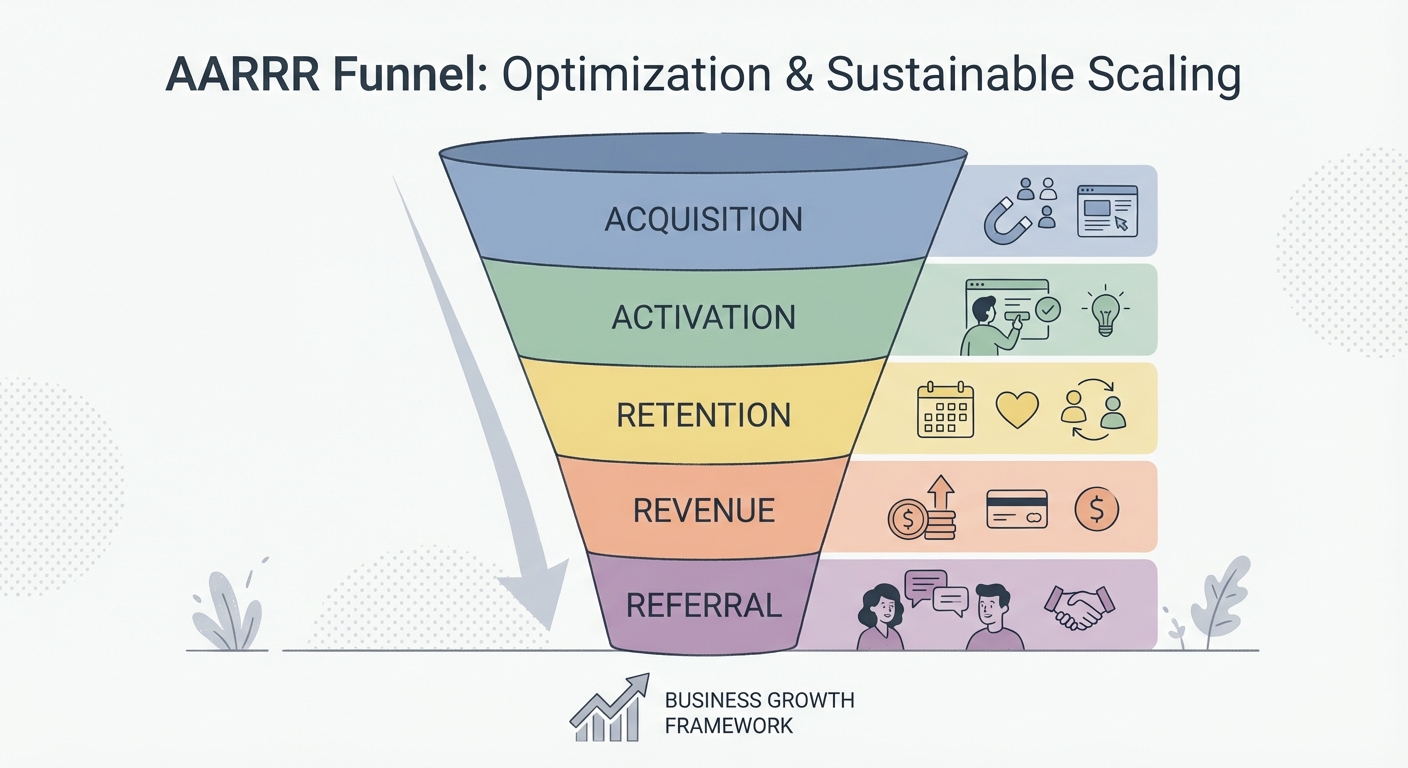
Apply the AARRR framework (Acquisition, Activation, Retention, Revenue, Referral) before you have a full product.
- Acquisition: Run ads on two channels. Which one has a lower CAC?
- Activation: What is the "aha moment"?
- Revenue: Can you charge enough to cover that CAC?
Kill Criteria: If your addressable market is under $10M, you have a lifestyle business, not a venture-scale startup. If your estimated CAC is higher than your projected LTV in these early tests, your unit economics are broken. Stop. Fix the model.
Phase 4 - Willingness to Pay: The Ultimate Validation
The only vote that counts is the one cast with a credit card.
Use the Van Westendorp pricing method to find your price point. Ask four questions:
- At what price is this too expensive?
- At what price is this a bargain?
- At what price does this become expensive but worth considering?
- At what price is this too cheap (making you doubt the quality)?
Then, run a pre-sale. Spin up a Stripe payment link. Offer a 30-50% "Founder's Club" discount.
Benchmarks:
- 0 Sales: Invalidated. Pivot.
- 1-10 Sales: Signal is there, but you might have the wrong audience or messaging.
- 50+ Sales: Product-Market Fit potential.
If you can't get 10 people to pay you $50 for a solution to a "hair-on-fire" problem, you do not have a business.
Growth Hacking Validation Tactics That Work in 2026
Tactic 1: The AI-Enhanced Interview Analysis
Don't rely on your memory. Record every interview (get permission). Use AI-powered customer journey mapping tools to transcribe and analyze sentiment. Look for patterns in the exact words customers use. These words aren't just data; they are your future copywriting gold.
Tactic 2: The Micro-Commitment Ladder
Asking for $1,000 on the first date is awkward. Build a ladder.
- Email signup (Low friction)
- Phone number (Medium friction)
- 15-minute feedback call (Time investment)
- Introduction to a peer (Reputation investment)
- Pre-order deposit (Financial investment)
Track the drop-off. If 100 people give emails but 0 give phone numbers, your value prop isn't strong enough to warrant a conversation.
Tactic 3: The Red Team Kill Committee
Confirmation bias is the silent killer. You hear what you want to hear. Appoint a "Red Team"—a co-founder or advisor whose specific job is to disprove your hypothesis. Set your kill criteria before you start. "If we don't get 10 pre-orders by Friday, we kill the project." Stick to it. As Tom Peters said, "Test fast, fail fast, adjust fast."
Tactic 4: The B2B Buyer Validation Hack
In B2B, the user is rarely the buyer. You might build a tool engineers love, but if the CTO won't sign the check, you're dead. Validate with decision-makers. Look for "Intent Data"—comments on LinkedIn posts about the problem, questions in industry forums. Request a Letter of Intent (LOI). "If we build X feature, will you sign a contract for $Y/month?"
Tactic 5: The Email Pre-Sale Campaign
Build a list before you build a product. Use a lead magnet to capture emails. Then send a 5-email sequence: Agitation -> Solution Tease -> Social Proof -> Offer -> Scarcity. According to OptinMonster, email marketing generates $44 for every $1 spent. It is still the heavyweight champion of validation ROI.
Common Customer Validation Mistakes
Mistake 1: Accepting Compliments as Validation When someone says, "That's a great idea," translate it to: "I don't want to hurt your feelings." It means nothing. Only commitments matter.
Mistake 2: Validating with Friends and Family Your mom will lie to you. Your friends will lie to you. They love you, not your product. Interview strangers who fit your Ideal Customer Profile (ICP).
Mistake 3: Asking Leading Questions "Would you use a tool that automatically writes your emails?" Everyone says yes to this. It's a hypothetical future. Instead, ask: "How many emails did you write yesterday? How long did it take? Did you look for a tool to help?"
Mistake 4: Building Before Validating Willingness to Pay Writing code feels like progress. It isn't. It's a cost. Do not write a line of code until you have verified the market has a budget for this problem.
Mistake 5: Ignoring the Buyer vs. User Gap The classic B2B trap. You validate with the end-user, build the product, and then realize the procurement department has a 9-month sales cycle you can't survive.
Essential Tools for Growth Hacking Customer Validation
- Interviews: Calendly (scheduling), Zoom + Otter.ai (transcription), Dovetail (analysis).
- Smoke Tests: Framer or Webflow (landing pages), Stripe (payments), Hotjar (heatmaps).
- Analytics: PostHog (product data), Google Analytics 4, Mixpanel.
- Surveys: Typeform (Van Westendorp surveys), UserTesting.
- AI & Insights: ChatGPT (script generation), Perplexity (research), and GrackerAI (for tracking search visibility and intent).
Measuring Validation Success: Metrics That Matter
Forget vanity metrics like "likes" or "pageviews." Focus on things that prove value.
- Pre-sales Conversion: Target >5%.
- Interview-to-Commitment: Target >30%.
- Referral Willingness: Target >10%.
- Landing Page CTR: Target >15%.
You are looking for the Sean Ellis Product-Market Fit signal: Ask users, "How disappointed would you be if this product disappeared?" If more than 40% say "Very Disappointed," you have fit. Validation is the starting line, not the finish — customer-centric innovations in cybersecurity covers the feedback loops and retention practices that keep that fit from eroding after launch.
Your 4-Week Customer Validation Action Plan
Week 1: Problem Validation Conduct 10 interviews. Identify the top 3 pain points. If you can't find 10 people to talk to, you don't have a market.
Week 2: Solution Verification Build a smoke test landing page. Drive 100 qualified visitors via cold outreach or ads. Target a >15% conversion rate on the "Get Access" button.
Week 3: Market Viability Map your AARRR funnel. Test two acquisition channels. Calculate your preliminary CAC.
Week 4: Willingness to Pay Launch a pre-sale campaign. Send it to your email list. Your goal is 10+ pre-orders.
Success Criteria: ✅ 30+ interviews. ✅ >15% landing page conversion. ✅ 10+ pre-sales/LOIs.
If you hit these, you build. If you don't, you kill it and move on. That is the essence of growth hacking: speed to truth.
Clearing this validation gate is the start, not the finish line. Once you've hit these numbers, the four-stage growth hacking roadmap picks up with the Learn, Develop, Optimize, and Scale process for turning validated demand into a repeatable growth engine.
FAQ
How many customer validation interviews should I conduct before building my product?
You need a minimum of 10 interviews just to understand the problem, but 30 is the gold standard. Research from ProductPlan shows that 30 interviews allow you to see recurring patterns and filter out the crazies. Each session should be 30-45 minutes. If fewer than 70% of these people have actively tried to fix the problem themselves, you likely don't have a business case.
What's the difference between customer discovery and customer validation?
Discovery is about the problem; validation is about the solution. Discovery asks, "Does this pain exist?" Validation asks, "Will you pay for this specific cure?" In the Steve Blank Customer Development framework, discovery is Step 1 and validation is Step 2. Growth hacking techniques usually kick in during validation and scaling (Step 3). Skipping validation to jump to growth is the fastest way to scale a failure.
How do I know if someone is really interested in my product or just being polite?
Apply the "Commitment Test." Compliments are free; commitments cost something. If a prospect says "Great idea," ask for currency: their phone number, a verified introduction to a colleague, or a deposit. If they hesitate, they were just being polite. Rob Fitzpatrick's The Mom Test teaches that true interest is demonstrated through action. A rating of "5/5" on a survey means a 50% chance of buying, while a "4/5" drops to nearly zero. Demand skin in the game.
What metrics prove I've achieved product-market fit?
Product-market fit isn't a vibe; it's data. Look for: (1) 50+ pre-sales or signed Letters of Intent (LOIs), (2) a landing page conversion rate above 15%, and (3) a viral coefficient where more than 10% of users refer others organically. The ultimate litmus test is the Sean Ellis question: if >40% of users would be "very disappointed" if your product disappeared, you have fit. Tracking these via the AARRR framework ensures you aren't fooled by vanity metrics.
Should I validate with end-users or buyers in B2B markets?
Both. But the buyer (the budget holder) is the priority for business viability. A common B2B failure mode is building a tool users love but buyers won't fund. Start by validating the business case and ROI with the buyer—get a Letter of Intent if possible. Simultaneously, validate usability with end-users. If the buyer signs but the team refuses to use it, you'll churn in 12 months. Success requires alignment between the user's workflow and the buyer's wallet.
![10 Best Local Rank Tracker Tools: In-Depth Comparison Guide [2025]](https://cdn.pseo.one/6abcb68a626591c40e1c8aa6/687e1c1ef6fe799d288518df/68809c373eb8562bcf68975d/10-best-local-rank-tracker-tools-comparison-guide/feature-image.jpg)