Top AI Visibility Tools for Automated Content Creation


TL;DR
- The AI visibility tool worth buying for content automation is the one that closes the loop — tracking citations, identifying the sources engines trust, and generating extractable content in a single workflow.
If you are a VP of Marketing or Head of Growth reading this, you have already encountered the problem: your team tracks AI visibility, discovers you are invisible on thirty high-intent prompts, and then stares at the gap with no clear path to closing it. Monitoring without execution is an expensive way to feel bad about your pipeline.
This guide is about the tools that do both. They track where AI engines cite competitors instead of you, identify which sources those engines trust, and then generate citation-ready content to fill the gap. For marketing leaders who need ROI and scale, that closed loop is the only model worth investing in.
Introduction
The most effective AI visibility platforms for marketing leaders combine real-time citation tracking across multiple LLMs with automated content creation that is structured for extraction. Topical authority over keyword density. Factual precision over marketing language. Schema-marked, entity-clear pages over generic blog posts. The platforms that do this end-to-end are rare. This guide identifies which ones actually deliver
Key takeaway
AI visibility tools must prioritize topical authority over keyword density. LLMs cite sources they trust as knowledge authorities, not sources that have stuffed the most keywords.
Automated content creation for AI search requires factual accuracy and structured data. An LLM will not cite a claim it cannot verify or attribute.
Tracking AI-driven traffic requires moving beyond clicks and rankings to monitor brand sentiment, citation source attribution, and entity mentions inside LLM outputs.
The most effective platforms integrate real-time prompt analysis with automated content workflows, so the gap between "invisible on this prompt" and "article published" closes in days, not months.
AI-referred shoppers converted 31% better than other traffic sources during the 2025 holiday season, with that gap roughly doubling year-over-year (Adobe Analytics, via Digital Commerce 360, retrieved 2026-09-18). The ROI case for this investment is already concrete.
Why traditional SEO tools fail in the age of AI search
Traditional SEO was a content quantity game layered on top of a link authority game. Publish more, earn more links, rank higher. AI search breaks both assumptions.
LLMs do not rank pages. They evaluate which sources to treat as authorities when synthesizing an answer to a specific question. That evaluation happens at the entity level (is this brand a known expert in this domain?), the content level (does this page directly answer the question in a structured, extractable way?), and the source level (do authoritative third parties cite this brand as a knowledge source?).
A page optimized for keyword density can rank first on Google and never appear in a single AI citation. A page that opens with a 40-60 word direct answer to a specific question, backed by original data, and marked up with FAQ and Organization schema, can become a top citation source even for a brand with a fraction of the link profile
The practical implication: the content strategy that earns AI citations is structurally different from the content strategy that earns traditional rankings, and the tools for measuring and executing it are different too.
How AI visibility tools actually work
Understanding the mechanics separates tools that genuinely improve citations from ones that create impressive-looking dashboards.
Step one: prompt simulation. The platform runs a defined set of buyer-intent queries through the AI engines it covers, capturing the full response including which brands were named, in what order, with what sentiment, and which source URLs the engine cited.
Step two: multi-sampling. Because LLMs are non-deterministic (the same prompt can produce different responses on consecutive runs), accurate platforms run each prompt multiple times and report an appearance rate rather than a single data point. Tools that run each prompt once are reporting noise.
Step three: citation attribution. This is where tools diverge most significantly. Basic tools tell you whether your brand appeared. Advanced tools tell you which URL the engine cited, which domain it came from, and whether it was a direct source citation (the engine linked to a specific page) or a parametric mention (the brand name appeared from training data with no source link). These require different optimization strategies.
Step four: gap analysis. The output that matters is not your own score. It is the list of prompts where competitors appear and you do not, with the source URLs the engine cited instead of you. That list is your content roadmap.
Step five: content generation (only in end-to-end platforms). The platforms that close the loop take the gap analysis and produce structured, citation-ready content designed to match what each engine wants to cite.
Key criteria for evaluating AI visibility platforms
Evaluate any platform against these six factors before committing.
Citation attribution depth: Does the platform distinguish between a brand mention (your name appeared) and a source citation (the engine linked a specific URL from your domain or a third-party source as the basis for a claim)? Without that distinction, you are measuring the wrong thing.
Multi-engine, non-blended tracking: Each engine (ChatGPT, Perplexity, Gemini, Copilot, Grok, Google AI Mode) sources from different places and rewards different content structures. A blended score hides which engine is failing and why. Require per-engine breakdowns.
Content generation capability: For marketing leaders who need scale without proportional headcount growth, the platform must generate content, not just recommendations. A PDF brief that someone has to execute manually is not automation.
Content quality and citation-readiness: Automated content that is generic or inaccurate does not earn citations. Evaluate the quality of generated output. Does it include original data points? Does it structure answers for extraction? Does it implement schema correctly?
Prompt grounding in real buyer intent: Platforms that pull tracked prompts from Google Search Console or Bing data show you gaps in real buyer behavior. Platforms that rely only on curated prompt libraries show you gaps in hypothetical behavior. Real data produces more actionable output.
Attribution and ROI reporting: The final requirement for a marketing leader: can you connect AI citations to business outcomes? At minimum, the platform should surface which specific prompts and content pieces are driving AI-referred traffic, even if full-funnel attribution still requires GA4 and CRM integration.
Top AI visibility and content automation tools compared
GrackerAI
Best for: B2B and cybersecurity marketing leaders who need monitoring plus automated content execution in one platform.
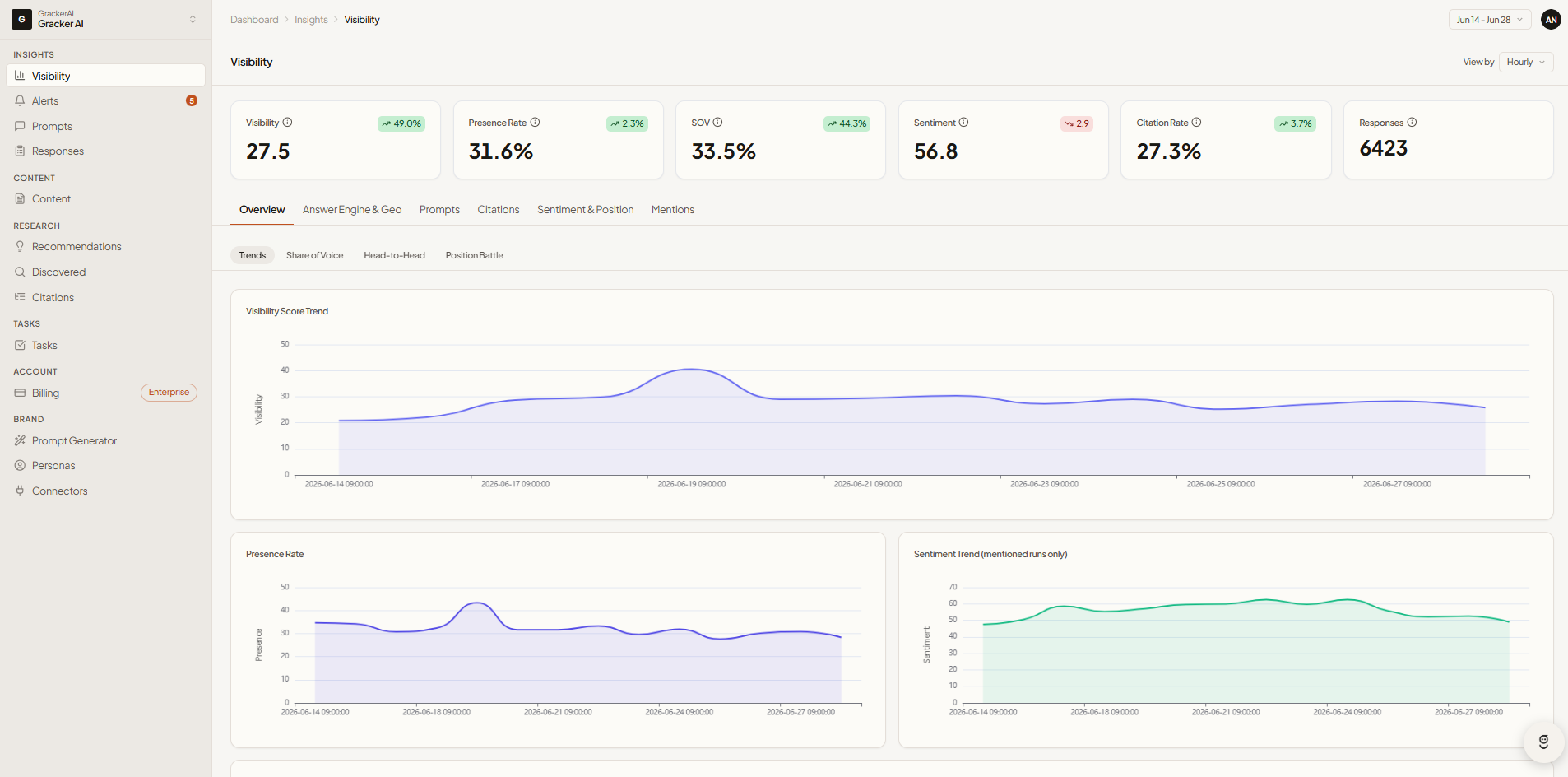
GrackerAI is the clearest example of the closed-loop model. It tracks citation gaps at the per-engine, per-prompt level, starting with 3 engines on Starter, adding Microsoft Copilot for 4 total on Scale, and scaling to all 10 tracked engines on Enterprise, where Gemini, Google AI Overviews, Claude, Grok, DeepSeek, and Brave Leo join the lineup.
It grounds those prompts in real Search Console and Bing data so the gaps it surfaces are actual buyer queries. And it closes the loop with an article engine that generates citation-optimized content: structured with direct answers, FAQ schema, Organization schema, and entity-clear language, designed to match what each engine retrieves.
For a VP of Growth, the operational value is in removing the handoff. The gap analysis and the content production happen inside the same platform, eliminating the workflow friction that causes most monitoring programs to stall at the insight stage.
On content quality: GrackerAI's output for B2B and cybersecurity is calibrated to the technical accuracy those categories require. Factual claims, structured comparisons, and compliance-aware language are baked into the generation model.
The limit: built exclusively for B2B and cybersecurity. Consumer brands, retail, and general-market companies are outside its scope.
Starting price: $99/month ($79/month billed annually). Content generation included on standard plans. Start with a free AI visibility score.
How GrackerAI Content Automation Works?
1. Prompt Diagnosis
For any prompt you're tracking to improve your AI visibility, you can run a Prompt Diagnosis to determine whether you already have content targeting that prompt.
GrackerAI's Prompt Diagnoser analyzes your existing content and tells you whether:
You already have content targeting the prompt.
You need to create new content if no relevant content exists.
If relevant content already exists, GrackerAI provides actionable recommendations on what needs to be improved so that AI search engines are more likely to cite it. It compares your content with competitor content that is most frequently cited by AI search engines and identifies content gaps, optimization opportunities, and areas for improvement.
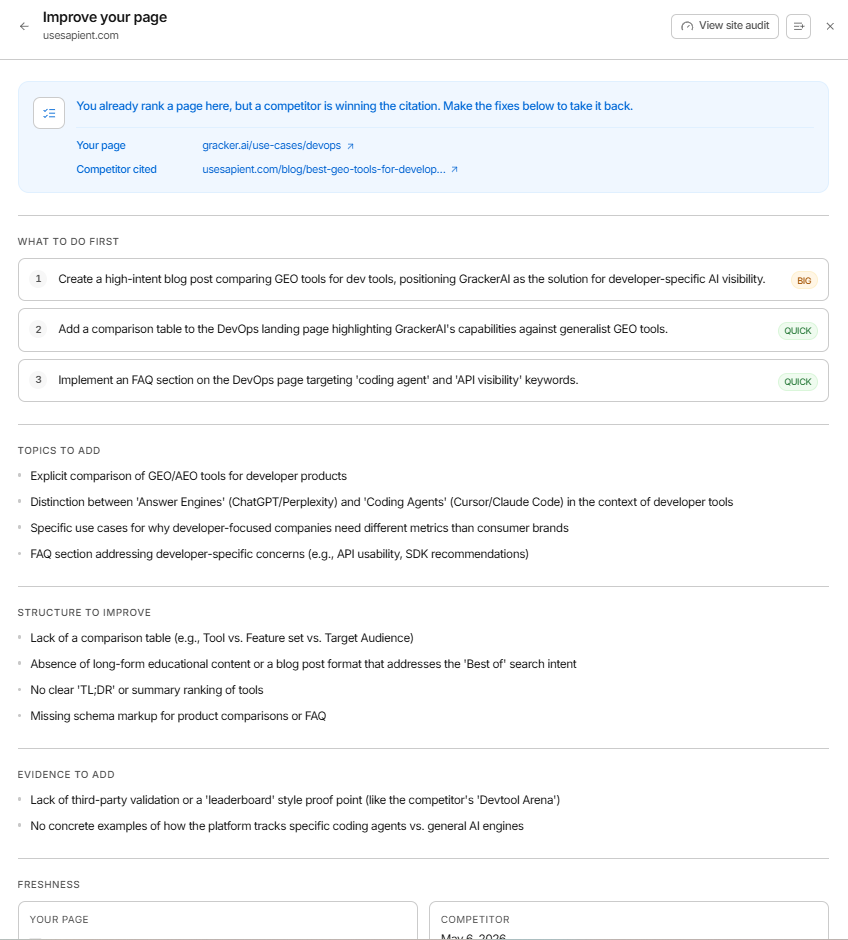
If you need to create new content, GrackerAI will generate a complete content brief, including:
Topic
Headline
Summary
FAQs
Recommended article type
Primary and secondary keywords to focus on
Additional content recommendations to maximize AI visibility
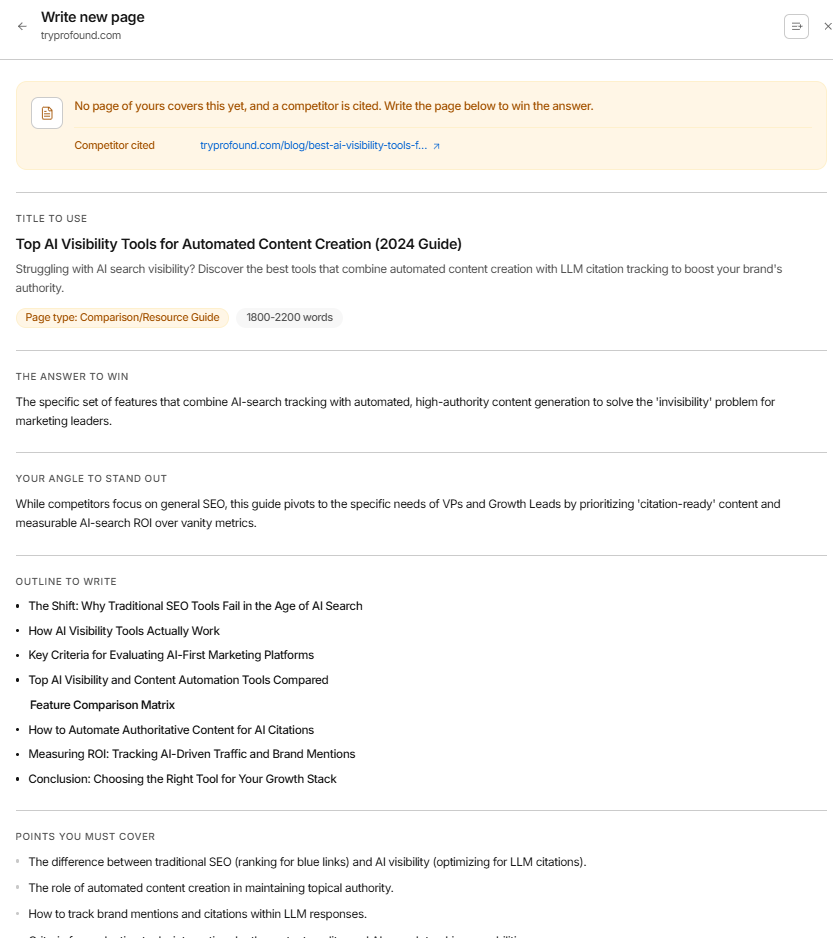
2. Improve Visibility
Improve Visibility is the core feature of GrackerAI Content Automation.
When you're tracking prompts, GrackerAI identifies the prompts where your AI visibility is low and helps you increase your chances of being cited by AI search engines.
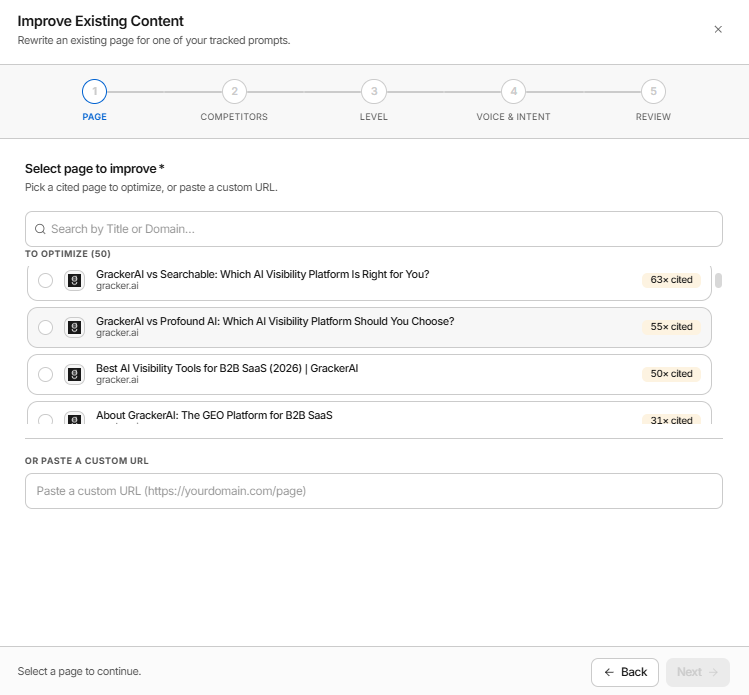
There are two ways to improve your visibility:
Optimize Existing Cited Content:
If AI search engines are already citing one of your pages for a prompt, GrackerAI analyzes that content and suggests improvements to make it more comprehensive, relevant, and citation-worthy.Optimize Another Target Page:
If you have another page that targets the same prompt but isn't being cited by LLMs, simply provide its URL. GrackerAI will analyze and optimize the content of that page with actionable improvements to increase its likelihood of being cited by AI search engines.
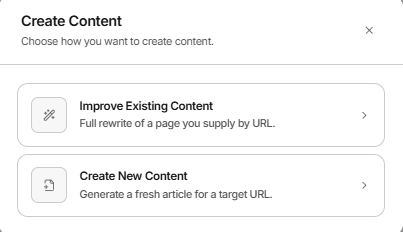
If you need to create new content, GrackerAI will generate a complete content brief, including:
Topic
Headline
Summary
FAQs
Recommended article type
Primary and secondary keywords to focus on
Additional content recommendations to maximize AI visibility
3. Competitor Content Being Cited
GrackerAI lets you discover which competitor content is being cited by AI search engines and the specific prompts for which it is being cited.
If you're targeting the same prompt, you can select it directly from the list. GrackerAI will then determine whether you already have content targeting that prompt.
- If you already have relevant content, GrackerAI will analyze it and provide recommendations to optimize it for better AI visibility and increase its chances of being cited.
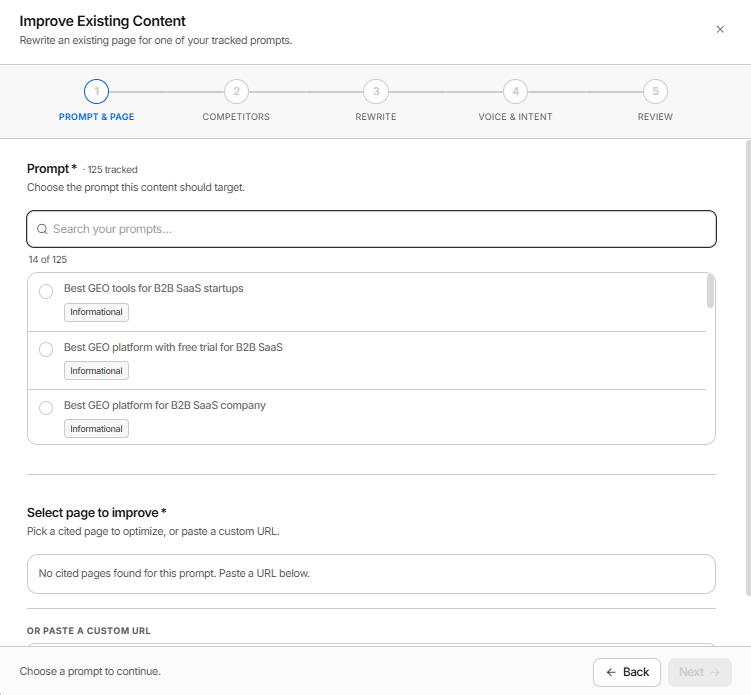
- If you don't have content targeting that prompt, GrackerAI will generate a new, AI-optimized content brief to help you create content that competes with the cited pages.
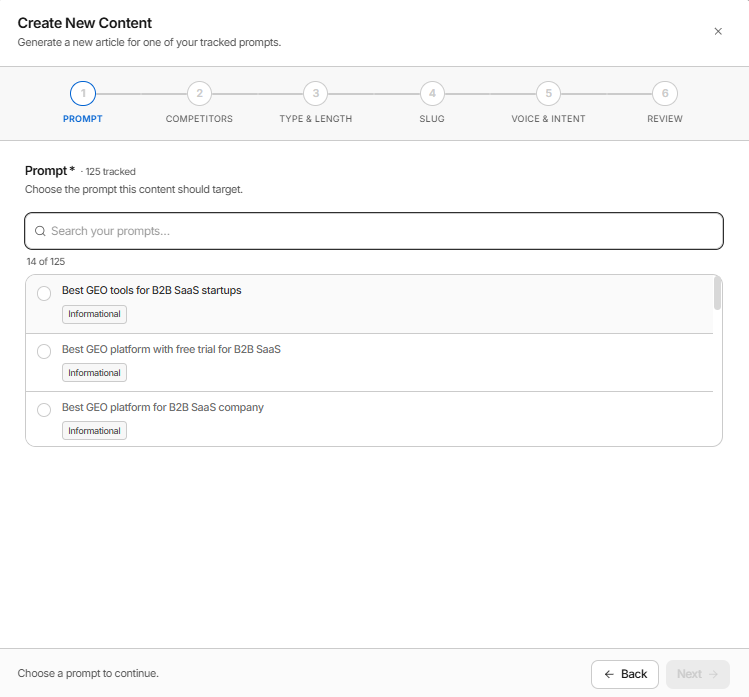
This feature makes it easy to identify competitor opportunities and create or optimize content based on what's already being cited by AI search engines.
AirOps
Best for: Growth teams whose primary bottleneck is content production volume rather than visibility measurement.
AirOps is a content operations platform with AI visibility analysis layered on top. It is built around workflows: automating the research, drafting, and updating of content at scale. The AEO tracking features are newer than the dedicated monitors, but the strength is execution capacity. If your team has identified the gaps and needs to produce citation-ready content at volume, AirOps handles the production workflow efficiently. Their own citation analysis across LLMs is one of the most-cited resources on the topic in ChatGPT, which is a credibility signal worth noting.
The limit: tracking depth is shallower than platforms built from the monitoring side. Better for teams whose content production is the constraint, not teams still trying to understand where they are invisible.
Starting price: Custom; contact for pricing.
Profound
Best for: Enterprise marketing leaders who need the deepest analytics layer and can build a separate content workflow.
Profound is the most data-rich platform in the category: 27M+ citations analyzed, 10+ engines tracked, 400M+ real user prompts for demand analysis, and the most sophisticated sentiment and source attribution tracking available. For a VP who needs boardroom-ready data and can staff content execution separately, it is the strongest monitoring platform.
Profound Workflows, launched in 2026, adds an automation layer that turns monitoring insights into structured content briefs and processes. Profound Agents take that further, handling research-to-optimization as an autonomous workflow. The platform is moving toward the closed loop but is not there fully yet for most teams.
The limit: starts at $99/month for ChatGPT-only. Meaningful multi-engine tracking requires the $399/month Growth tier. Content execution still requires separate investment.
Starting price: $99/month (Starter, single engine); $399/month (Growth, multi-engine).
Writesonic GEO
Best for: Content-led teams that need monitoring plus content production at the lowest combined price.
Writesonic combines GEO citation tracking with its core AI writing tools, giving teams citation gap analysis and drafting tools in one subscription. Engine coverage is broad and the entry price ($49/month) is the most accessible of any platform that includes both tracking and content generation. The content generation is general-purpose AI writing rather than specifically citation-structured output, which matters if your goal is precision AEO optimization rather than volume production.
The limit: tracking depth is lighter than dedicated GEO platforms. Content output requires more editorial oversight for citation-readiness than more specialized tools. Better for teams that need to start cheaply than teams optimizing at scale.
Starting price: $49/month.
Feature comparison matrix
Platform | Engines tracked | Citation attribution | Content generation | Prompt grounding | Entry price |
|---|---|---|---|---|---|
GrackerAI | 3-10, tiered (per-engine depth) | Mention + source URL + entity | Yes, built-in, B2B-optimized | Search Console + Bing | $99/mo ($79/mo annual) |
Profound | 10+ | Deep, 27M+ citations analyzed | Workflows + Agents (Growth+) | 400M+ real prompts | $99/month |
AirOps | Major engines | Citation + source tracking | Yes, workflow-based | Real buyer data | Custom |
Writesonic GEO | Wide coverage | Mention + citation gap | Yes, general AI writing | Custom prompts | $49/month |
How to automate authoritative content for AI citations
Automation only works if the content it produces earns citations. Here is what citation-ready content requires, and what platforms need to automate correctly.
**Structure for extraction, not for reading:**LLMs retrieve in chunks of 50–150 words. Every important page needs to open with a 40–60 word direct answer to its core question. Self-contained sections with clear headings allow the retrieval layer to lift and cite specific paragraphs without needing the full page.
Factual claims that can be attributed: LLMs prefer statements they can verify or attribute: statistics from named studies, findings from named reports, specifications from named sources. Vague claims ("our solution helps you grow") get passed over. Precise claims with attribution ("a 2026 study by X found Y") get extracted and cited.
Schema that tells AI crawlers who you are: Implementing Article schema with Organization schema as publisher, FAQPage schema for question-and-answer sections, and Author schema with verifiable credentials gives AI crawlers a machine-readable signal that this content has a source. Automated content generation platforms need to produce this schema correctly or the content underperforms.
Original data at the domain level: Citation probability is statistically correlated with topical authority and the presence of data that can only be attributed to your brand. A platform that only generates content from publicly available information is producing output that competes directly with every other source on the topic. Content that includes your own survey data, your own benchmark analysis, or your own product performance metrics creates a citation anchor that cannot be replicated.
Measuring ROI: AI-driven traffic and brand citation impact
AI-referred traffic grew 527% year-over-year between January and May 2025, across a sample of 19 GA4 properties tracking sessions from ChatGPT, Perplexity, and Gemini (Previsible AI Traffic Report, via Search Engine Land, retrieved 2026-09-18). The challenge is attribution: most AI referrals arrive as direct or dark traffic because the session did not originate from a clicked link.
Three measurement approaches that work for marketing leaders:
**GA4 source filtering:**Sessions from chatgpt.com, perplexity.ai, gemini.google.com, and copilot.microsoft.com are measurable. Track these as an AI referral segment. Compare this segment against total sessions month over month; a rising share of AI-referral traffic even without full click-level attribution is a directionally reliable signal that citations are converting into visits.
Branded search lift correlation: Compare branded search volume trends against citation rate trends by market. If branded search in a market rises as citation rate in that market rises, the connection is visible even without direct attribution. This is the most reliable proxy for the parametric citation impact that never generates a click.
Answer Share as the pipeline proxy: Calculate your Answer Share (the percentage of tracked high-intent prompts where your brand appears) monthly. Tie quarterly Answer Share improvements to quarterly pipeline volume. Over two to three quarters, the correlation becomes defensible to leadership even without a clean click-path.
ROI formula for leadership reporting: GEO ROI = ((AI-attributed revenue - total GEO investment) / GEO investment) x 100. With AI-referred visitors converting meaningfully better than organic (31% higher during the 2025 holiday season, per Adobe Analytics data above) and a measurable Answer Share trend, the formula becomes presentable within two quarters of consistent tracking.
Frequently asked questions
What is the difference between AI visibility tracking and automated content creation for AI search?
AI visibility tracking tells you where your brand appears (or does not) in AI-generated responses. Automated content creation for AI search uses that data to produce structured, citation-ready content that fills the gaps. Platforms that do only the first leave execution to your team. Platforms that do both create a system where finding and closing gaps happens in the same workflow.
Does automated content get cited by AI engines?
Yes, if it is structured correctly. AI engines cite based on content structure, topical authority, and source credibility, not on whether a human or a tool wrote the content. Factual accuracy, clear entity attribution, proper schema, and self-contained answer sections are the signals that matter. Automated content that meets those standards earns citations at the same rate as manually written content with the same characteristics.
How many pieces of content does it take to move AI visibility?
Industry practitioners estimate roughly 250 pieces of content or mentions to meaningfully shift how an AI model perceives a brand at the category level. For a specific prompt or topic cluster, meaningful improvement in citation rate typically requires a focused cluster of five to fifteen well-structured pieces covering the topic from multiple angles, rather than a single comprehensive guide.
How do I know if a platform's content generation is good enough for AI citations?
Test it. Give the platform one of your existing citation gaps (a prompt where competitors appear and you do not), generate an article, and manually check: Does it open with a direct answer? Does it include specific, attributable data? Is schema implemented? Does it cover the topic with genuine depth rather than surface-level summarizing? Run the prompt after publishing and measure whether your appearance rate improves over the following four weeks.
What is the ROI timeline for AI visibility investment?
Typical timelines based on 2026 industry benchmarks: 5–15% mention rate increase within 30 days (schema fixes, FAQ content), 15–30% citation rate increase within 60 days (new structured content gains traction), 25–50% share-of-voice increase within 90 days (topical authority compounds). Full revenue attribution in B2B categories typically becomes visible within two quarters, given deal cycle length.
Start with a free AI visibility score or book a demo to see the per-engine, per-prompt gap report.
![10 Best Local Rank Tracker Tools: In-Depth Comparison Guide [2025]](https://cdn.pseo.one/6abcb68a626591c40e1c8aa6/687e1c1ef6fe799d288518df/68809c373eb8562bcf68975d/10-best-local-rank-tracker-tools-comparison-guide/feature-image.jpg)