Best AI Search Optimization Platforms for Small Marketing Teams

TL;DR
- A lean marketing team should pick the AI search platform that produces a ranked citation-gap list and helps close it in the same place, because a blended visibility score reports movement without naming an action.
Most AI search guides are written for enterprise teams with dedicated SEO departments, six-figure tool budgets, and analysts to interpret dashboards. This one is not. If your marketing team is two people, or five people wearing twelve hats each, the platform decision looks completely different.
Introduction
Small marketing teams get the highest ROI from AI search by targeting the citation gap, the specific prompts where AI engines already recommend competitors and not you, and using a platform that finds those gaps and helps close them without requiring a separate analyst, a separate content team, and a separate reporting workflow. Monitoring alone is not enough. Automation is the differentiator.
Key takeaways
Small teams achieve more by optimizing for Answer Engine Optimization (AEO) than chasing high-volume keyword competition where they cannot outspend larger rivals.
The most efficient platforms combine citation tracking with automated content creation. Monitoring-only tools create a second job: someone still has to build the fix.
AI search traffic is widely reported to convert meaningfully higher than standard organic traffic (ANALYSIS — the specific multiple varies by study and the most-cited figures trace back to SEO-vendor research rather than an independently reproducible primary source, so treat it directionally). A small team owning a niche in AI answers beats a large team dominating blue-link rankings for that niche.
Look for one platform that does the loop: finds where competitors are cited, shows you what sources AI trusts, and generates the content to fill the gap.
Why small marketing teams need AI-specific SEO now
Traditional SEO rewards resources. More backlinks, more content, more technical infrastructure. That dynamic has always favored companies with bigger teams. AI search is different. It rewards authority and structure, and a 1,500-word guide that directly answers a specific question with original data can beat a 10,000-word resource from a company ten times your size if it is structured for extraction.
The underlying shift is real and fast. Gartner forecasts traditional search engine volume will drop 25% by 2026 as users migrate to AI chatbots and other virtual agents (Gartner press release, "Search Engine Volume Will Drop 25% by 2026," retrieved 2026-09-18). AI Overviews and chat-style answers now appear across a large and growing share of informational queries, though the exact figure varies by query category and isn't consistently reported by a single primary source — treat any specific percentage you see quoted for that as ANALYSIS, not a verified constant. Buyers who arrive via AI citations are also widely reported to convert at a meaningfully higher rate than standard organic visitors (ANALYSIS — see the takeaway above on why that specific multiple is directional, not a hard number), because they have already received a pre-qualified answer: an engine named your brand as the solution to their problem before they ever clicked.
For a small team, that changes the math. You do not need to rank for everything. You need to be cited for the prompts your buyers actually ask. That is a focused, winnable problem, and it is exactly the kind of problem a purpose-built AEO platform is designed to solve.
The specific constraints small teams face (and why most tools ignore them)
Enterprise AEO platforms are built for teams that can dedicate someone to the data, someone to the content, and someone to the reporting. Small teams cannot do that. The constraints that matter are:
Budget. Most small teams cannot justify $400–500 per month for monitoring alone, especially before they have proven the ROI. The entry-level tier needs to be meaningful, not just a loss-leader with 15 prompts that fill up in the first week.
No spare headcount. A monitoring dashboard that surfaces gaps but offers no help closing them creates a second job. If the platform finds that you are invisible on twelve high-intent prompts, someone still has to write twelve pieces of content optimized for AI citation. A small team without a content resource cannot act on that data.
Need for automation. The platforms that work for lean teams do not just tell you what is wrong. They produce the fix, or at minimum a structured brief that removes the expertise gap between "we are invisible" and "here is what to publish."
Integration with existing workflow. Adding a seventh tool that requires a weekly ritual to check is a tool that will be ignored by week three. The best platforms for small teams surface alerts, not dashboards: they tell you when something changes, rather than making you check.
Key features to prioritize
Before comparing specific platforms, align on the features that actually move the needle for a lean team. These are non-negotiable.
Citation gap identification over vanity scores. A blended visibility score looks good in a report and tells you almost nothing actionable. What you need is a list of specific prompts where competitors appear and you do not, ranked by how often real buyers ask those questions. That list is your entire content strategy.
Per-engine depth, not averages. ChatGPT, Perplexity, and Gemini each pull from different sources and reward different content structures. A platform that blends them into one number hides the engine where you are collapsing. You need separate scores so you know where to invest first.
Automated or assisted content creation. For a small team, this is the difference between a platform that is worth paying for and one that creates work. The best platforms in this space now generate citation-optimized articles, FAQ sections, and comparison pages directly from the gap data. GrackerAI tracks your prompt and citation sources and can automate content for you
Prompt grounding in real buyer questions. Platforms that let you import from Google Search Console or Bing show you the prompts your actual buyers are typing. Platforms that rely only on hypothetical prompt libraries show you what the platform thinks your buyers ask. The first produces far more useful gap data.
Affordable entry with room to scale. A lean team needs a tier that is meaningful at $79–189 per month, with the ability to grow prompt volume, engine coverage, and content output as AI visibility becomes a proven channel.
Top AI search optimization platforms for lean teams
GrackerAI
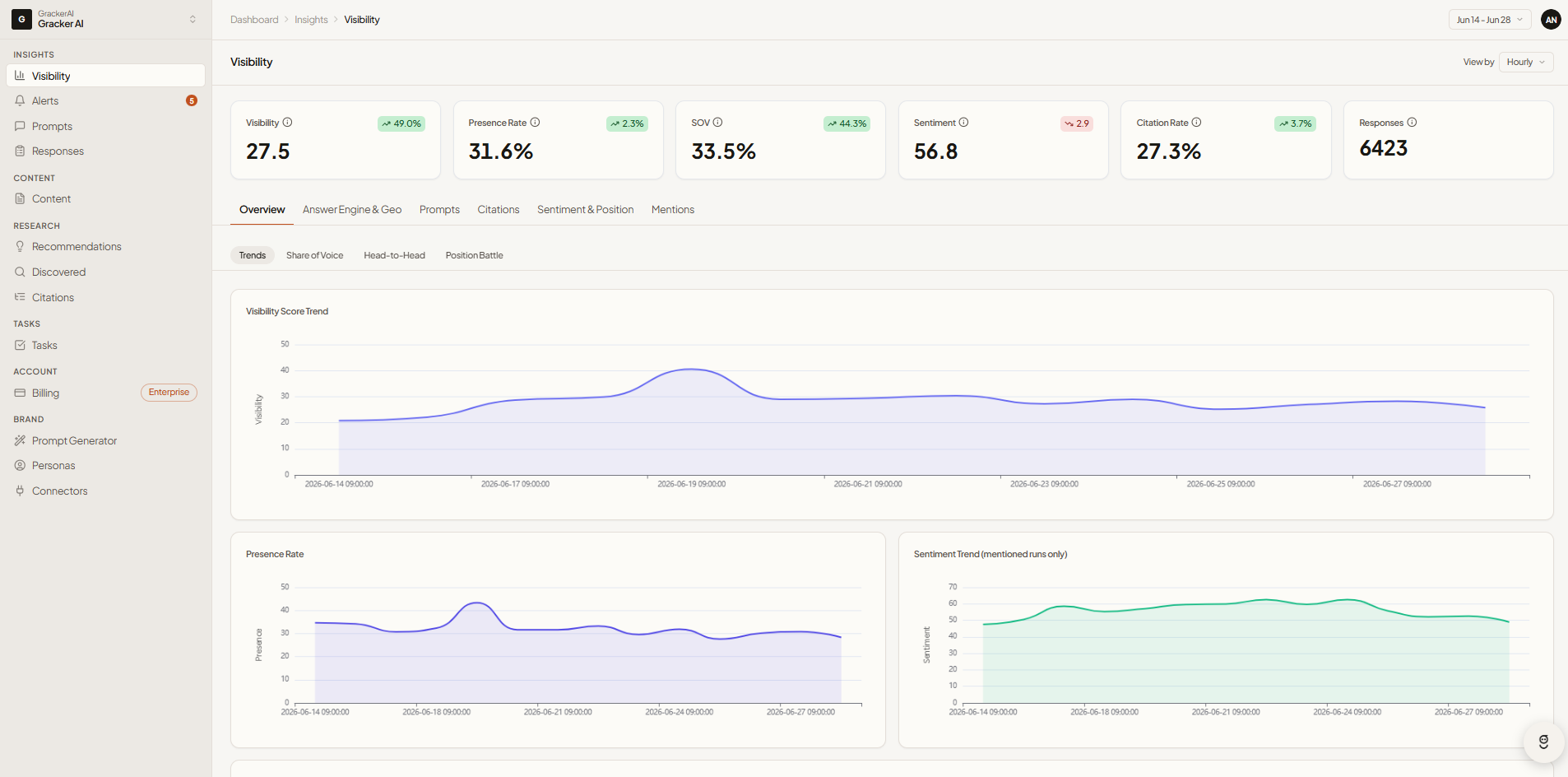
Best for: B2B and cybersecurity teams that need the full loop from monitoring to content, without a dedicated SEO department.
GrackerAI is purpose-built for exactly the lean-team problem. It tracks citation gaps across ChatGPT, Perplexity, Gemini, Copilot, Grok, Google AI Mode, and Google AI Overviews, segments them by engine, country, city, and buyer language, and then generates the content to close those gaps inside the same platform. There is no handoff between "here is where you are invisible" and "here is the article that fixes it."
For small B2B teams, the prompt grounding matters: GrackerAI pulls tracked prompts from real Search Console and Bing data, so the gaps it surfaces are grounded in actual buyer queries, not hypotheticals. The built-in article engine produces citation-optimized content designed to match what each engine wants to cite, including proper schema, structured answers, and entity-clear language.
The limit: GrackerAI is vertically focused on cybersecurity and B2B SaaS. If you sell consumer products or run a local services business, the industry-specific prompt models are not built for your category.
Starting price: Free AI visibility score. Paid from $79/month. Content generation included on standard plans.
Otterly AI
Best for: Solo marketers or small teams that need daily monitoring at the lowest possible entry cost.
Otterly AI is the fastest way to get from zero to a daily visibility reading. Setup takes under ten minutes, daily tracking is included even on the cheapest tier, and the interface is clean enough that non-technical marketers can interpret it without training. It tracks ChatGPT, Perplexity, Google AI Overviews, and Copilot on the base plan, shows cited source URLs, and provides competitor share-of-voice comparisons.
The limit: 15 prompts on the Lite tier fills up within days for an active team. Gemini and Google AI Mode are paid add-ons. There is no content generation built in, so Otterly surfaces what is missing and leaves the fixing to you. It is a strong starting point, not a complete system.
Starting price: $29/month (Lite, 15 prompts). $189/month for Standard (100 prompts).
Peec AI
Best for: Small teams in competitive markets tracking competitor share of voice by country and language.
Peec AI is unusually strong on competitive benchmarking and multi-language support, which matters if your buyers are in markets outside English-speaking regions or if your competitive set is dense. It tracks major engines per-platform rather than blended, visualizes share-of-voice trends over time, and flags shifts in competitor citations before they show up in your pipeline. At €89/month for a meaningful feature set, it is one of the better-priced options for teams in Europe and LATAM.
The limit: no content generation and limited data integrations. Pricing is not published in USD, which adds friction for US-based teams comparing options.
Starting price: €89/month.
HubSpot AEO
Best for: Teams already on HubSpot that want AI visibility in the same system as their CRM and content tools.
HubSpot AEO's primary advantage is not its AEO depth, it is the integration. Prompt data, citation analysis, and competitor insights sit in the same platform as your content calendar, your CRM, and your campaign analytics. For a lean team managing everything in HubSpot, removing one more tool switch has genuine operational value. The free AEO Grader gives a quick baseline before committing to a paid plan.
The limit: as a standalone AEO product, the monitoring depth is shallower than dedicated tools. No automated content generation for gap filling. Best evaluated as a consolidation play rather than a best-in-class AEO tool.
Starting price: Available within HubSpot plans; free AEO Grader for baseline.
Comparison table
Platform | Best for lean teams | Citation gap tracking | Content generation | Entry price |
|---|---|---|---|---|
GrackerAI | B2B and cybersecurity, full loop | Yes, per-engine and per-prompt | Yes, built-in | $79/month |
Otterly AI | Solo marketers, daily monitoring | Yes, cited URL level | No | $29/month |
Peec AI | Competitive markets, multi-language | Yes, SOV by country | No | €89/month |
HubSpot AEO | HubSpot-native teams | Basic | No | Included in HubSpot |
How to measure ROI from AI assistant citations
The ROI calculation for AI search is different from traditional SEO because the click is often missing. AI referrals frequently arrive as direct or dark traffic, so you cannot rely on a clean referral line in GA4. Track these proxies instead.
Branded search lift. As your AI visibility improves, branded search volume in your target markets should rise. Users who hear your name in an AI answer often search your brand directly before visiting. A rising branded search trend in markets where your citation rate is also rising is the clearest signal that AI visibility is converting.
AI-attributed traffic in GA4. Filter for sessions where utm_source or referrer contains chatgpt.com, perplexity.ai, gemini.google.com, or copilot.microsoft.com. This captures the portion of AI referrals that do pass a link — and that portion has grown since May 2026, when ChatGPT began rendering more brand names as clickable links directly inside its answers rather than footnote-style citations alone, so a larger share of what used to be invisible "dark" AI traffic is now attributable through this filter.
Answer Share as your north star. Calculate the percentage of your tracked high-intent prompts where your brand appears. Track it weekly. A ten-point improvement in Answer Share for your core category queries is a measurable outcome you can tie to pipeline growth with a reasonable lag assumption.
GEO ROI formula: ((AI-attributed revenue - total GEO investment) / total GEO investment) x 100. For a lean team spending $79/month on a platform and four hours per month on content, even two AI-attributed closed deals per quarter in a typical B2B deal size makes the math work considerably.
The future of search: what lean teams should do now
AI search visibility is roughly where local SEO was a decade ago: forming fast, with early movers compounding an advantage that will be expensive to close later. The brands that build a citation presence in their category now will find it self-reinforcing. Engines cite authoritative sources, authoritative sources earn more citations, and that pattern hardens.
For a lean team, the practical playbook is narrow: pick the fifteen to twenty prompts that represent your buyers' highest-intent questions, track your appearance rate weekly across the engines they use, find the gaps, and publish content designed to close them. A platform that does all of that in one place is not a luxury. For a team without spare headcount, it is the only approach that actually scales.
Frequently asked questions
What is AEO and why does it matter more than traditional SEO for small teams?
Answer Engine Optimization is the practice of structuring content so AI engines cite it directly in their responses. It matters more for small teams because it is a focused, authority-based competition rather than a volume-based one. A small team that owns the AI citations for its specific niche outperforms a larger team that ranks broadly in traditional search but is absent from the answers AI gives to high-intent buyers.
How many prompts do I need to track to get useful data?
Ten to twenty prompts representing your category's highest-intent buyer questions is enough to start. The key is grounding them in real queries from Search Console rather than hypotheticals, and running each prompt multiple times per engine to get a reliable appearance rate rather than a single snapshot.
Can a small team realistically compete with enterprises in AI search?
Yes, in specific niches. AI engines reward content clarity, topical depth, and consistent third-party authority, not domain size. A 1,500-word guide that directly answers a specific buyer question, backed by a few strong third-party mentions, can consistently outrank enterprise content that is broader and less structured.
How long before I see results from AEO investment?
Typical improvement timelines: 5–15% mention rate increase within 30 days for quick wins like schema fixes and FAQ content. 15–30% citation rate increase within 60 days as new content builds traction. 25–50% share-of-voice increase within 90 days as topical authority compounds. These are industry benchmarks, actual results vary by competitive category.
Is it worth paying for a platform or should I start manually?
Manual tracking works for a quick baseline: run twenty prompts across ChatGPT and Perplexity, record whether you appear, and note which competitors do. That takes about two hours. The problem is that one-time data is not a trend. Consistent weekly measurement, multi-engine sampling, and automated alerts require a platform. Most teams find the value clear within sixty days of having reliable data.
If your team is evaluating beyond the four platforms above, our roundup of free-trial AI visibility platforms and our AI visibility tools comparison for B2B SaaS go deeper on the enterprise and mid-market end of the same market — useful context for knowing what you'd be trading up to later.
Run a free AI visibility score to see where you stand today, or book a demo to see the per-engine citation gap report.
Sources: Gartner, "Search Engine Volume Will Drop 25% by 2026, Due to AI Chatbots and Other Virtual Agents" (press release, retrieved 2026-09-18). Figures marked ANALYSIS above are directional estimates without a verifiable primary source and should not be quoted as exact.
![10 Best Local Rank Tracker Tools: In-Depth Comparison Guide [2025]](https://cdn.pseo.one/6abcb68a626591c40e1c8aa6/687e1c1ef6fe799d288518df/68809c373eb8562bcf68975d/10-best-local-rank-tracker-tools-comparison-guide/feature-image.jpg)