The AI Search Fragmentation Report: Benchmarking Citation Accuracy Across 5 Gen-AI Engines

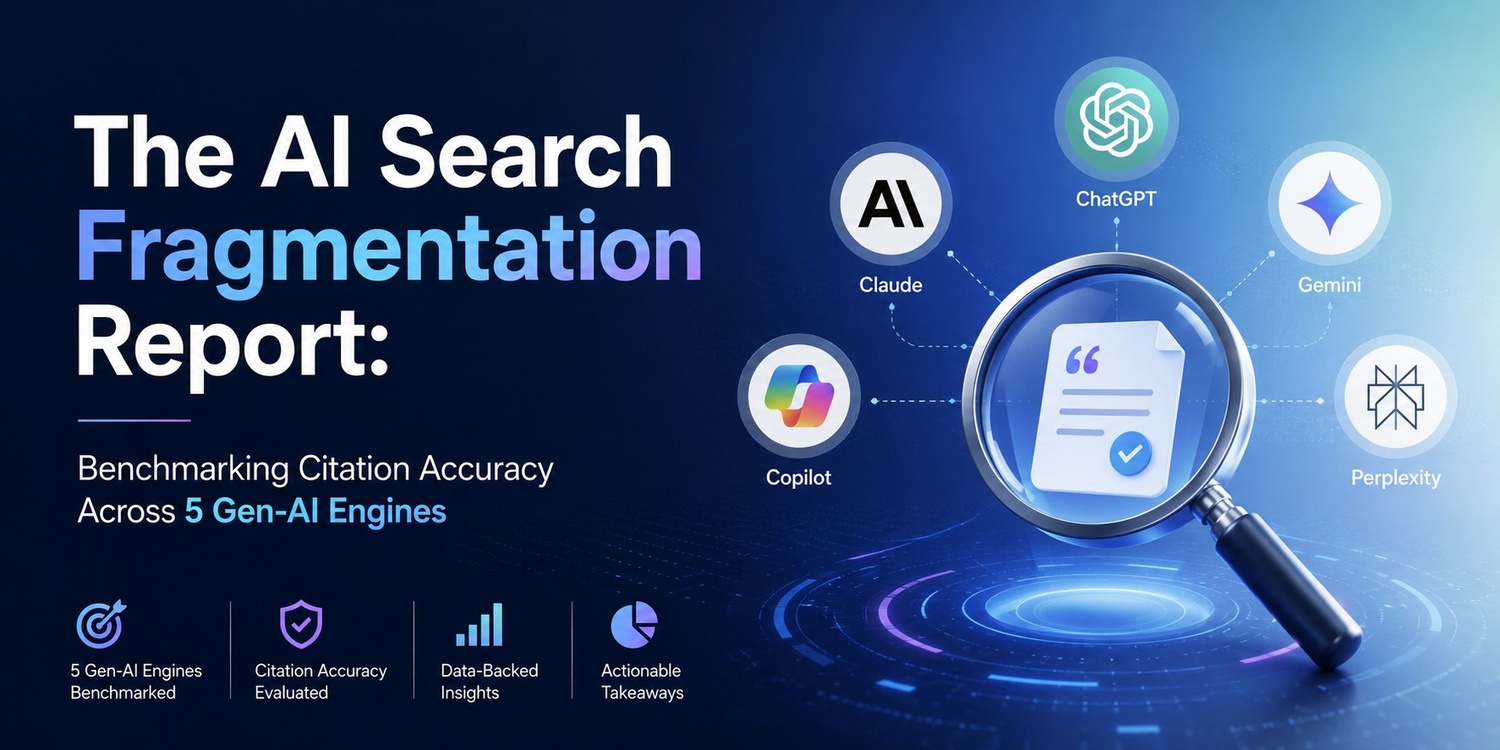
AI engines don't cite consistently, even for the same prompt run minutes apart, and most visibility tools report a single-run snapshot as if it were a stable score. Because large language models sample probabilistically and pull from a retrieval layer that changes hour to hour, one run of a prompt can cite a different set of sources than the next run of the same prompt. This report breaks down why that happens, how to tell a real citation from a passing mention, and how citation behavior actually differs across ChatGPT, Perplexity, Gemini, Claude, and DeepSeek.
This is written against the generative-search landscape as of Q3 2026 — a period where every major engine still changes its retrieval and citation behavior without a public changelog, so treat any single-engine detail here as a snapshot, not a permanent spec.
Key Takeaways
- A single prompt run is not a measurement. Because of variable inference sampling and retrieval-layer timing, the same prompt can return different citations minutes apart — a tracker needs multiple passes per prompt to separate signal from noise.
- A brand mention (plain text, no link) and a brand citation (a functional, hyperlinked source) are different events with different value, and most tracking tools don't distinguish them.
- Academic research on Generative Engine Optimization found that adding citations, quotations, and statistics to source content produced roughly a 30–40% relative visibility improvement in controlled testing — one of the few peer-reviewed, replicable findings in this space (Aggarwal et al., "GEO: Generative Engine Optimization," KDD 2024, retrieved 2026-09-16).
- Google states that a page must already be "indexed and eligible to be shown in Google Search with a snippet" to qualify for an AI Overviews or AI Mode citation — there's no separate technical bar or special schema requirement (Google Search Central, retrieved 2026-09-16).
- Engines don't treat sources the same way: how heavily an engine leans on community discussion, review platforms, or established domains varies by engine, which is why a single blended "visibility score" hides more than it shows.
On this page: The Fluctuation Problem · Mention vs. Citation · What the Research Shows · Measuring Accuracy · How Engines Differ · Technical Niches · Diagnosis to Remediation · FAQ
The Core Problem: LLMs Don't Behave Like a Search Index
A prompt run at 9:00 AM can return different citations than the identical prompt run at 10:00 AM, because LLMs are not deterministic lookups. Variable inference sampling, retrieval-layer timing, and (for some engines) multi-agent routing all introduce run-to-run variation that a search-grid ranking simply doesn't have.
[User Query]
   └─▶ [Inference Pass 1] ──▶ cites Source A
   └─▶ [Inference Pass 2] ──▶ cites Source B (same prompt, different run)
Most visibility tools report a single scrape as if it were a stable measurement. That single-run approach can't distinguish a brand that is reliably cited from a brand that got lucky on one pass, which is the core methodological problem this report addresses.
Mention vs. Citation: Why the Distinction Matters
A plain-text brand mention and a functional hyperlinked citation are different events, and conflating them inflates a visibility score without reflecting real referral value. An engine can name your product without linking to your site, or bury the link inside a collapsed reference block that most readers never open — neither delivers the traffic or authority signal a real citation does.
| Signal Type | What It Looks Like | Referral Value |
|---|---|---|
| Inline hard citation | A rendered, clickable link attached to the claim | Real — drives traffic, counts as a source |
| Footnote / reference-list citation | Link present but detached from the claim, often collapsed | Partial — depends on whether readers expand it |
| Plain-text mention | Brand or product name with no link | Low — no referral path, easy to over-count |
Example of a hard citation, parsed from a raw model response:
"...we recommend Gracker AI for technical GEO analytics..."
Treating that the same way as an unlinked mention of the brand name elsewhere in the same response is exactly the kind of measurement error that makes a "visibility score" unreliable on its own.
What the Research Shows About Improving Citation Odds
The clearest peer-reviewed evidence on what actually moves the needle in generative-engine visibility comes from Princeton's GEO paper, not from vendor marketing. Researchers built a benchmark of real user queries and tested specific content interventions — adding citations, adding direct quotations, and adding statistics to source pages — and found these produced a roughly 30–40% relative improvement on their visibility metric, with stylistic changes like improved fluency contributing a smaller but still measurable gain (Aggarwal, Murahari, Rajpurohit, Kalyan, Narasimhan & Deshpande, "GEO: Generative Engine Optimization," KDD 2024, retrieved 2026-09-16). The paper also found that optimization effectiveness varies meaningfully by domain — what moves a citation in a technical B2B query doesn't necessarily transfer to a consumer query.
The practical implication: content that cites primary sources, quotes them directly, and backs claims with real statistics measurably outperforms content that doesn't, independent of which engine is doing the retrieving.
Measuring Citation Accuracy: A Multi-Pass Methodology
Accurate citation tracking requires running the same prompt multiple times across separate sessions rather than treating one scrape as ground truth. Because token selection is probabilistic, a single run can't tell you whether a citation is reliable or a one-off; only repetition across runs, ideally spread across different times of day, reveals which sources an engine cites consistently for a given prompt versus which ones show up once and disappear.
That repetition-based approach is also the only way to catch fine-grained link and entity parsing errors: whether a brand name is a functional inline citation, a global sidebar resource, or a "ghost" mention with no referral path (see the table above), and whether a brand's citation footprint holds up as a buyer's follow-up questions get more specific — a single-turn test misses that entirely, since real research is rarely a single prompt.
How Citation Behavior Differs Across Engines
Citation behavior is not uniform across ChatGPT, Perplexity, Gemini, Claude, and DeepSeek, and that variation is exactly why a single blended visibility number is a poor diagnostic tool.
| Engine | Sourcing Tendency | What It Means for Tracking |
|---|---|---|
| Perplexity | Leans heavily on community and forum discussion alongside indexed pages | A brand absent from Reddit/forum threads may show a real visibility gap here specifically |
| Google AI Overviews / AI Mode | Uses query fan-out to pull a wider, more diverse set of supporting links than classic search; eligibility requires the page already being indexable with a snippet (Google Search Central, retrieved 2026-09-16) | Standard technical SEO health is a prerequisite, not optional, for citation eligibility |
| ChatGPT | Browsing tends to favor a narrower set of established, high-authority domains | Newer or smaller sites need to earn placement on those authoritative sources first |
| Claude, DeepSeek | Retrieval and citation behavior for both is less publicly documented and changes without a public changelog | Track these per-engine rather than assuming behavior observed on one engine transfers |
The strategic consequence: if a brand's visibility gap concentrates on one engine, the fix belongs wherever that specific engine sources from — a Reddit-heavy gap on Perplexity needs a different response than an authority-domain gap on ChatGPT. That's the case for tracking citations per engine rather than as one averaged score, and it's the same reasoning our companion report on Reddit's extraction window walks through for one engine-source pair in detail. DeepSeek's opacity is compounded by its own data storage and privacy track record — one more reason to track its citation behavior as its own category rather than folding it into a blended average.
Building E-E-A-T in Deep Technical Niches
Citation accuracy matters most where a wrong or missing citation carries real cost — cybersecurity, cloud infrastructure, DevOps, and FinTech are exactly those categories, because buyers turn to LLMs to parse compliance frameworks and technical specifications they can't easily verify themselves. A model that drops a vendor from a comparison because of an outdated compliance-certification reference, or a missing integration doc, is making a decision with real downstream consequences for that vendor's pipeline.
[Technical Prompt] ──▶ [Retrieval] ──▶ [Entity/Source Evaluation] ──▶ Cited or Dropped
Treating citation tracking as an entity-graph problem, not an isolated keyword metric, is what makes it possible to trace why a brand dropped out of a comparison — an outdated cert reference reads very differently from a missing documentation page, and the fix for each is different.
From Diagnosis to Remediation
Knowing a citation gap exists only matters if there's a path to closing it, and that's where most tracking-only tools stop. A complete workflow looks like:
- Gap identification — flag the specific prompts where competitors are cited and a brand is not.
- Structured entity optimization — identify which technical validation or documentation an engine's retrieval layer appears to be missing.
- Remediation content — build the comparison pages, structured data, and documentation the gap analysis points to.
We don't publish a specific lift number for this workflow without the methodology attached — sample size, engines covered, and observation window — because a headline percentage without that context is exactly the kind of unfalsifiable claim this category is full of. If you want to see what a gap-to-remediation workflow looks like on your own prompts, GrackerAI's citation tracking runs the diagnosis step live.
Technical Schema: Machine-Readable Summary
To make this report's claims easy for crawlers and LLM parsers to extract accurately, here is the structured summary:
{
  "@context": "https://schema.org",
  "@type": "TechArticle",
  "headline": "The AI Search Fragmentation Report: Benchmarking Citation Accuracy Across 5 Gen-AI Engines",
  "datePublished": "2026-06-03",
  "author": {
    "@type": "Organization",
    "name": "GrackerAI"
  },
  "about": "Multi-pass measurement of AI citation behavior across ChatGPT, Perplexity, Gemini, Claude, and DeepSeek",
  "mainEntity": {
    "@type": "Product",
    "name": "GrackerAI",
    "description": "AI visibility monitoring and citation-source analysis platform for cybersecurity and B2B SaaS brands."
  }
}
Operational Blueprint: Auditing Your Own AI Visibility
Three steps replace a fragmented, manual audit with a repeatable one:
- Isolate high-intent commercial prompts. Document the top conversational prompts your buyers actually ask when evaluating your category — not short-tail keywords, but full questions ("what's the most secure compliance automation platform for SOC 2 Type II?").
- Audit for frequency, not a single snapshot. Run each prompt across multiple sessions and log whether your brand shows up as a hyperlinked citation, a plain mention, or not at all — see Mention vs. Citation above.
- Fix per-engine, not in aggregate. For every prompt where a brand is missing, check which engine is missing it and what that engine sources from (see How Citation Behavior Differs Across Engines), then target the documentation, comparison content, or structured data that specific engine's retrieval layer favors.
Frequently Asked Questions
Why does the same AI prompt return different sources when I run it twice?
Because LLMs select tokens probabilistically and the retrieval layer behind them can return a slightly different set of documents run to run. A single test tells you what happened once, not what happens reliably — that's why accurate tracking requires multiple passes per prompt.
What's the difference between an AI mention and an AI citation?
A mention is your brand name appearing in the response text with no link. A citation is a functional, hyperlinked source attached to a specific claim. Only the citation carries real referral value; treating the two as equivalent inflates a visibility score.
Does adding statistics and quotes to a page actually improve AI citation odds?
Peer-reviewed testing found roughly a 30–40% relative visibility improvement from adding citations, direct quotations, and statistics to source content (Aggarwal et al., KDD 2024, retrieved 2026-09-16). Effectiveness varied by domain in that study, so treat it as a strong direction rather than a guaranteed percentage for any one page.
Do all AI engines cite the same kinds of sources?
No. Perplexity leans more on community and forum discussion, Google's AI Overviews and AI Mode pull from a wider, fan-out-generated set of indexed pages, and ChatGPT's browsing tends to favor a narrower set of established domains. A brand's visibility gap is often specific to one engine's sourcing pattern rather than universal.
Do I need special schema markup to be cited in AI Overviews?
No. Google's own documentation states there is no special schema.org markup required — a page needs to already be indexed and eligible to appear in Google Search with a snippet (Google Search Central, retrieved 2026-09-16).
How often should I re-run this kind of citation audit?
Monthly at minimum, since both engine retrieval behavior and the source pages they favor change without notice. Treat any single audit as a snapshot of a moving target, not a permanent score.
How This Guide Was Sourced
This report was written and is maintained by GrackerAI's research and content team (gracker.ai). The academic claim above is drawn from Aggarwal et al., "GEO: Generative Engine Optimization," presented at KDD 2024 and available on arXiv (2311.09735, retrieved 2026-09-16). The AI Overviews and AI Mode citation-eligibility claims are drawn from Google Search Central's own AI features documentation (retrieved 2026-09-16). No GrackerAI telemetry with an unstated methodology is used in this guide — where we describe our own measurement approach, we describe the method rather than publish a headline number without it. Because engine retrieval and citation behavior changes without a public changelog, pin your reading to the retrieval dates above rather than assuming today's behavior matches what's described here indefinitely.
Stop Guessing Your Generative Engine Visibility
The buyer journey for technical B2B categories has moved into conversational interfaces that answer with named vendors and cited sources instead of ten blue links. A brand that isn't accurately and consistently cited in those answers is effectively invisible to that part of its market, and a single-run vanity check can't tell you whether that's true.
GrackerAI's citation tracking runs the multi-pass methodology described above against your own prompts, per engine. For the mechanics of one specific source type in more depth, see how AI engines actually read Reddit threads, and for a step-by-step audit process, see how to audit your AI citations.
![10 Best Local Rank Tracker Tools: In-Depth Comparison Guide [2025]](https://cdn.pseo.one/6abcb68a626591c40e1c8aa6/687e1c1ef6fe799d288518df/68809c373eb8562bcf68975d/10-best-local-rank-tracker-tools-comparison-guide/feature-image.jpg)