
Embeddings are vectors (lists of numbers) that represent the meaning of text, letting systems find passages similar in meaning to a query without shared words.
What are Embeddings?
Embeddings are numeric representations of meaning. A machine learning model converts a word, sentence, passage or image into a vector, a list of numbers, so that items with similar meaning sit close together in that space. Systems compare vectors to find content semantically related to a query, even when the two share no exact keywords.
Google’s machine learning course describes embeddings as lower-dimensional representations of sparse data, which fixes the lack of meaningful relations between items in one-hot encodings. OpenAI’s API docs describe embeddings as measuring the relatedness of text strings, used for search, clustering, recommendations and classification. The idea goes back to word vectors such as word2vec; modern embedding models represent whole passages.
How it works
- Encode content. An embedding model turns each passage (often a chunk of a page) into a vector, typically hundreds or thousands of numbers long.
- Store vectors. Vectors go into an index or vector database.
- Encode the query. The user’s question is embedded with the same model.
- Compare. The system finds vectors nearest to the query vector, usually by cosine similarity or a related distance measure.
- Use results. Nearest passages are ranked, shown, or passed to a language model as context for an answer.
An illustrative example: a page section titled “How to detect lateral movement” and a query “spotting attackers moving between hosts” share few words, but a good embedding model places them close together.
From SEO to AEO and GEO
Classic SEO grew up on lexical matching: keywords in titles, headings and anchor text. Google moved beyond that years ago with RankBrain, neural matching and BERT, which interpret meaning rather than strings. AI answer engines push further. Retrieval for an AI answer often happens at the passage level, and semantic similarity is a common part of how passages are chosen.
| Classic SEO habit | AEO/GEO reality |
|---|---|
| Repeat the exact keyword | Make the passage’s meaning unambiguous |
| One page targets many variants | One section answers one question well |
| Page-level relevance | Passage-level relevance |
What carries over: matching search intent, topical depth and clear structure. What fades: keyword density and exact-match tactics, which do little for meaning-based retrieval.
Embeddings also explain why AI answers sometimes cite a page that never mentions the query’s exact phrasing. The page was close enough in meaning to be retrieved, and its passage happened to answer the question clearly.
What to do about it
- One idea per section. Mixed sections produce blended vectors that match no query strongly.
- Answer first. Put the direct answer in the first sentence under each heading.
- Use buyer vocabulary alongside your product terms, especially in technical categories where vendors invent names.
- Name entities explicitly. “Our platform” carries less meaning than the product and category name.
- Test semantically. If you have engineering help, embed your key pages and buyer questions with an open model and check which sections are nearest. Treat it as a proxy, not a replica of any engine.
Common mistakes
- Assuming embeddings replaced all ranking signals. They are one component; authority, freshness and other signals still matter.
- Synonym stuffing. Lists of variants dilute meaning.
- Ignoring chunk boundaries. A key fact split across two sections may be retrieved without its context.
Related terms
- Vector Search
- Semantic Search
- Chunking
- Retrieval-Augmented Generation
- Neural Matching
- How AI engines cite sources
Sources
- Embeddings, Google Machine Learning Crash Course
- Vector embeddings guide, OpenAI developer docs
- Understanding searches better than ever before (BERT), Google
Frequently asked questions
What is an embedding in simple terms?
It is a list of numbers that stands for the meaning of a word, sentence or passage. A model converts text into these numbers so that texts with similar meaning get similar numbers. A computer can then measure how close two pieces of text are in meaning by comparing their vectors.
Do ChatGPT and Google use embeddings to pick sources?
Embeddings are a standard building block of modern search and retrieval, and Google has written publicly about neural matching and BERT in Search. AI vendors do not publish exactly how their answer engines retrieve and rank sources, so the precise role of embeddings in any one engine is not public.
Can I optimize content for embeddings?
Not by tricks. You can make a passage's meaning clear: one topic per section, a direct answer near the heading, specific named entities and the terms buyers actually use. Vague, multi-topic passages produce vague vectors that match nothing strongly.
Guides that cover Embeddings
-
 RAG optimization
Is Your Content RAG-Ready? Optimizing Your Infosec Documentation for Retrieval-Augmented Generation
Stop building hallucination engines. Learn how to optimize your cybersecurity documentation for Retrieval-Augmented Generation (RAG) with metadata and chunking.
-
 Generative Engine Optimization
How to Improve Brand Visibility in AI Search Engines (2026 Guide)
Master Generative Engine Optimization (GEO). Learn how to increase your 'Share of Model' and brand citations in AI-powered answer engines like ChatGPT and Claude.
-
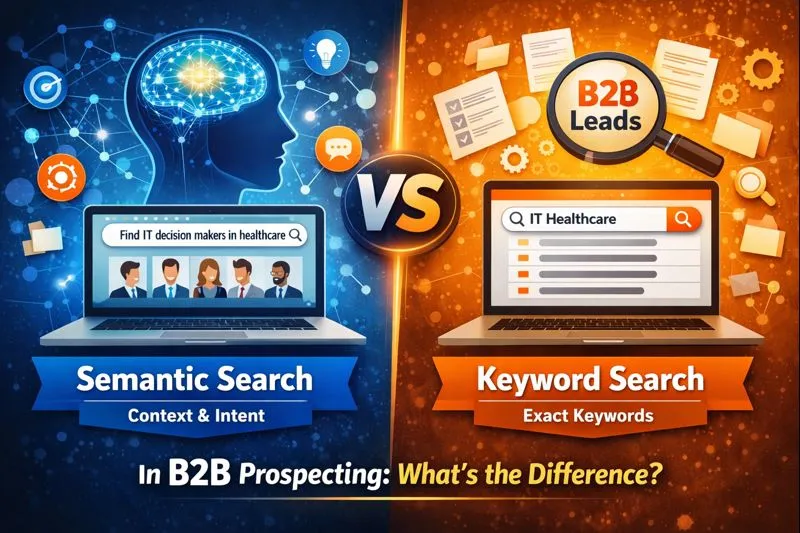 Semantic search
Semantic Search vs Keyword Search in B2B Prospecting: What's the Difference?
Learn how semantic search differs from keyword search in B2B prospecting and helps sales teams find more relevant, high-fit leads accurately.
-
 Cybersecurity
Why Cybersecurity Marketers Need Reliable Devices to Run Advanced AI SEO Workflows
Learn why cybersecurity marketers need reliable devices to run AI SEO workflows, protect sensitive data, avoid downtime, and maintain search visibility.