

Vector search retrieves content by comparing embeddings, returning passages whose meaning is closest to the query rather than those sharing its exact keywords.
What is Vector Search?
Vector search is a retrieval method that finds content by meaning. It converts the query and every stored item into embeddings (numeric vectors), then returns the items whose vectors are nearest to the query vector. Because similarity is measured in meaning, a question can retrieve a relevant passage even when the two share few or no words.
The term is also called semantic vector search, dense retrieval or nearest-neighbor search. It became mainstream as embedding models improved and as retrieval-augmented generation (RAG) made “find the right passage for the model” a core engineering task.
How it works
flowchart LR
  A[Content split into chunks] --> B[Embedding model]
  B --> C[(Vector index)]
  Q[User query] --> D[Same embedding model]
  D --> E[Nearest neighbor search]
  C --> E
  E --> F[Top passages ranked]
  F --> G[Shown to user or sent to LLM]
- Chunk and embed. Documents are split into passages and each is turned into a vector.
- Index. Vectors are stored in an index built for approximate nearest-neighbor (ANN) search, which trades a little accuracy for large speed gains.
- Query. The query is embedded with the same model.
- Retrieve. The index returns the closest vectors by a similarity measure such as cosine similarity.
- Re-rank and use. Results are often re-ranked, filtered by metadata, merged with keyword results, then shown or passed to a language model.
From SEO to AEO and GEO
Classic search was built on an inverted index: a map from words to the documents containing them. SEO tactics followed, from keyword placement to exact-match anchors. Google layered meaning on top through neural matching and BERT, but the mental model stayed “rank pages for keywords.”
| Classic SEO | AEO/GEO with vector retrieval |
|---|---|
| Inverted keyword index | Vector index of passages |
| Rank whole pages | Retrieve individual chunks |
| Exact-match terms help | Clear meaning helps |
In AI answers, retrieval often happens at the passage level before a model writes the response. What carries over: relevance to intent, topical depth and authority signals that influence ranking after retrieval. What changed: a page can rank well overall yet have no single passage close enough to a specific question to be retrieved.
This is one reason long, all-in-one guides sometimes lose AI citations to shorter, more focused pages. The focused page has a passage that sits very close to the question; the long guide spreads related ideas across many loosely connected paragraphs.
What to do about it
- Write retrievable sections. Each H2 or H3 should answer one question in its first sentence or two.
- Mirror real questions. Collect buyer phrasing from sales calls, support tickets and community threads, and use it in headings and opening lines.
- Keep exact terms too. Hybrid systems still reward exact product names, CVE IDs, standards and acronyms.
- Make chunks self-contained. Avoid “as mentioned above”; restate the subject.
- If you run your own docs search or chatbot, use hybrid search and evaluate retrieval with a set of real questions.
Common mistakes
- Assuming vector search ignores keywords. Many systems are hybrid.
- Long, wandering sections that blend several topics into one vector.
- Treating similarity as authority. Being retrieved is a first step; engines still choose which sources to cite.
Related terms
- Embeddings
- Semantic Search
- Chunking
- Retrieval-Augmented Generation
- Passage Ranking
- How AI engines cite sources
Sources
- What is vector search?, Elastic
- Retrieval, OpenAI developer docs
- Retrieval-Augmented Generation for Knowledge-Intensive NLP Tasks, Lewis et al., 2020
Frequently asked questions
What is the difference between vector search and keyword search?
Keyword search, such as BM25, ranks documents by matching query terms. Vector search ranks by similarity of meaning between embeddings. Keyword search is precise for exact names, codes and IDs; vector search handles paraphrases and natural-language questions. Many production systems run both and merge results, which is called hybrid search.
What is a vector database?
A database built to store embeddings and run fast nearest-neighbor queries over them. Examples include Pinecone, Qdrant, Milvus and Weaviate, and many general databases and search engines, such as Postgres with pgvector and Elasticsearch, also support vector search.
Do AI answer engines use vector search?
Vector retrieval is a standard technique in RAG systems and modern search. Vendors such as OpenAI, Google and Perplexity do not publish the full retrieval stack behind their consumer answer engines, so the exact mix of vector, keyword and other signals in any one engine is not public.
Guides that cover Vector Search
-
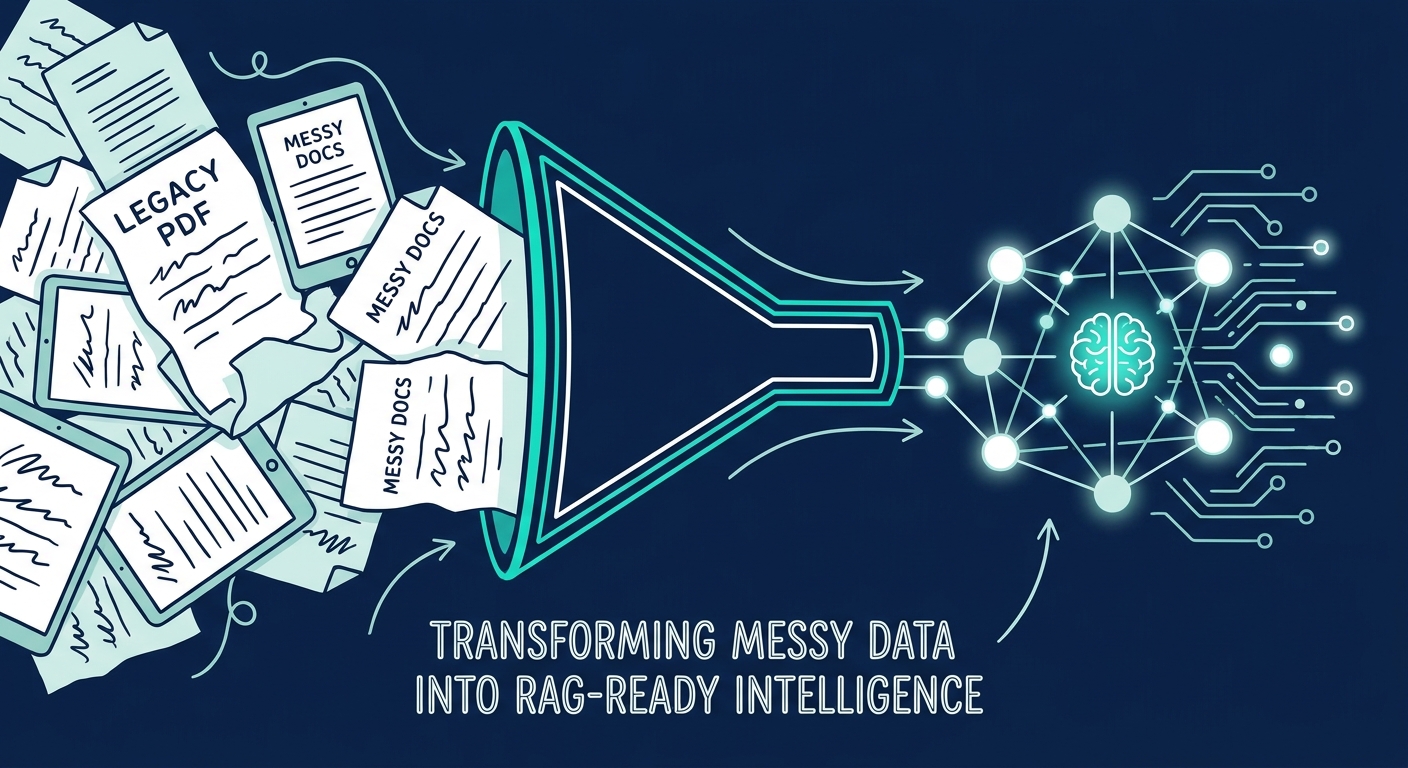 RAG optimization
Is Your Content RAG-Ready? Optimizing Your Infosec Documentation for Retrieval-Augmented Generation
Stop building hallucination engines. Learn how to optimize your cybersecurity documentation for Retrieval-Augmented Generation (RAG) with metadata and chunking.
-
Automated LLM-Friendly Content Structuring
LLM-friendly structure means answer-first sections, clear headings, short self-contained passages, tables and schema, applied automatically through templates.







