Is Your Content RAG-Ready? Optimizing Your Infosec Documentation for Retrieval-Augmented Generation

TL;DR
- Standard PDF dumps cause AI hallucinations and compliance failures.
- Transform static documents into machine-readable, metadata-rich data assets.
- Use structured metadata to ensure LLMs retrieve only authorized, current info.
- Implement semantic chunking to preserve context rather than arbitrary character limits.
- Shift from document-based storage to granular, atomic information units.
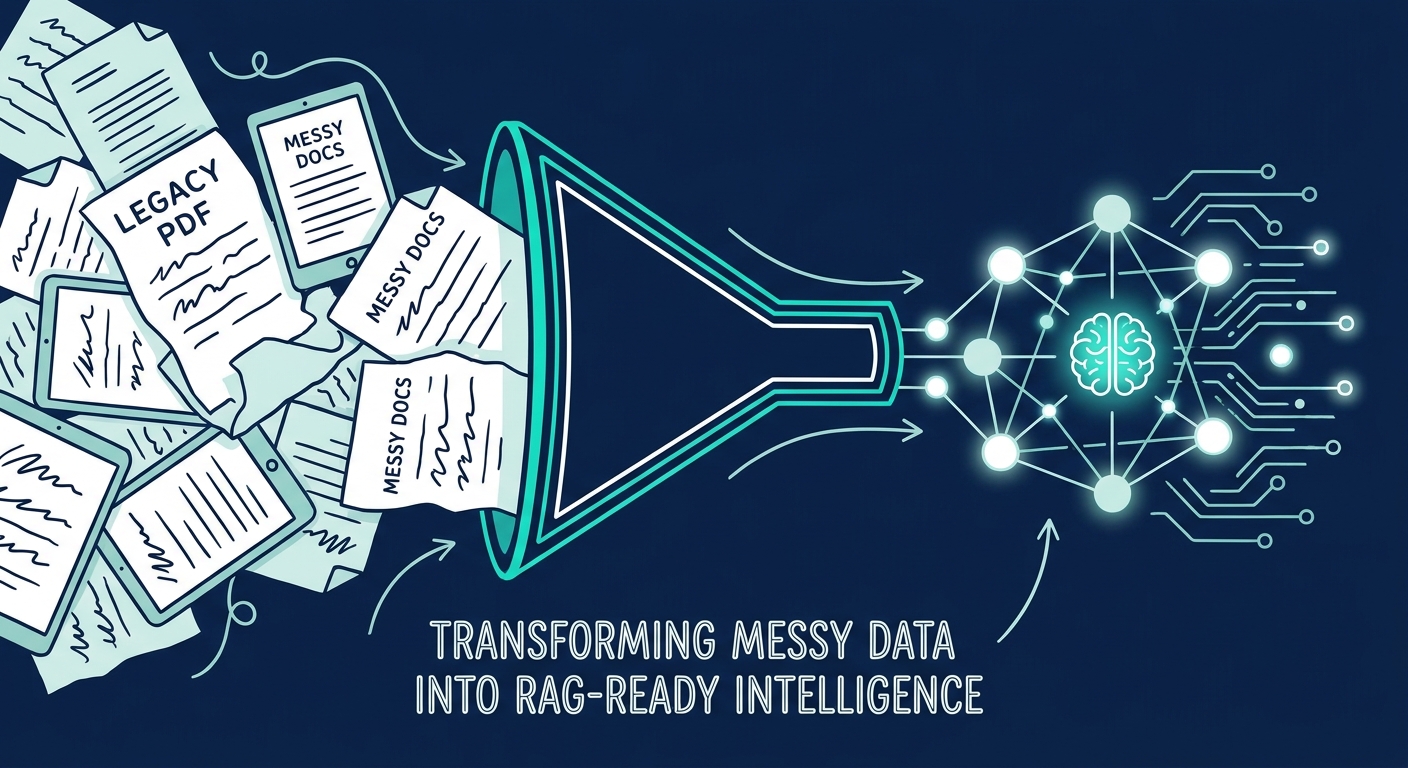
If you’re currently dumping your aging, dusty PDF library into a vector database and praying for an intelligent cybersecurity assistant to emerge, stop. You aren’t building a RAG system. You’re building a hallucination engine.
In enterprise infosec, accuracy isn’t just a nice-to-have—it’s the entire job. The problem? Your documentation was written for human eyes, not for the cold, logical precision of an AI agent. If you want to move beyond naive retrieval, you have to stop treating your docs like static files and start treating them like structured, machine-readable assets. This is the bedrock of a modern AI-driven content strategy for GRC and compliance teams. Every paragraph, policy, and playbook needs to be optimized for "grounding"—the ability for an LLM to cite its sources and prove it isn't making things up.
What is the "RAG-Readiness" Gap in Enterprise Infosec?
The chasm between a standard file share and a production-grade RAG pipeline is vast. Legacy docs are often monolithic, bloated, and trapped in formats like PDF or Word that make automated parsing a nightmare. When an AI tries to pull data from this "data swamp," it loses its mind. It can’t tell the difference between a firewall policy from 2019 and your current, NIST-aligned compliance framework.
This leads to "hallucinated compliance." Imagine your LLM confidently citing a dead ISO control or misinterpreting a critical security error code because it pulled a snippet from a deprecated document. In a regulated environment, that isn't just a "glitch." It’s an audit failure and a massive liability. RAG-readiness means moving away from unstructured data dumps. You need a system where every single piece of information is tagged, categorized, and contextually aware.
How Do You Architect Content for Agentic Retrieval?
To turn static archives into an active, agentic knowledge base, you have to shift your perspective. Stop thinking in terms of "pages" or "documents." Start thinking in atoms of information. Every chunk of your documentation should be a self-contained, machine-readable unit with its own metadata baggage.
The hierarchy of metadata is your best friend here. At a minimum, every chunk needs to carry doc_type, security_level, last_reviewed, and regulatory_mapping. When you embed these tags, your retrieval engine stops guessing. It doesn't just find keywords; it finds the correct version of the document that the user is actually allowed to see.
Technical Optimization: How Do You Execute Semantic Chunking?
Most teams make a fatal error: they rely on fixed-size character limits. If you slice your documentation every 500 characters, you will inevitably decapitate your context. You’ll leave the AI with half a sentence and zero meaning.
Instead, use thematic chunking. Split your policies and playbooks at logical boundaries—headers, sub-sections, or specific control statements. For a deeper dive into the mechanics of this, check out this Advanced RAG Cheat Sheet; it’s a goldmine for building systems that actually hold up under scrutiny.
Also, don't put all your eggs in the vector search basket. Implement a hybrid strategy that mixes semantic embeddings with good old-fashioned keyword-based BM25 retrieval. Why? Because when a user searches for a specific error code like "ERR-403-X," they need an exact match. They don't need a "semantically similar" interpretation that leads the system to guess.
How Can You Sanitize Sensitive Playbooks for AI Indexing?
The "Security-First" RAG paradox is simple: you want your AI to be helpful, but you can't afford to burn your house down. If your incident response playbooks contain hardcoded credentials or internal network topologies, you’re one malicious prompt injection away from a total breach -- the same class of operational risk CISOs already have to manage when disseminating threat intelligence more broadly; see how CISOs can leverage threat intelligence to stay proactive. As highlighted in recent research on Privacy Risks in RAG, the retrieval phase is a major vulnerability where unauthorized data can bleed into the context window.
The fix? Bake access control metadata directly into the indexing process. Your RAG engine should perform an authorization check against the user’s role before it synthesizes an answer.
How Do You Audit Your Existing Documentation?
If you don't know where your content stands, you can't fix it. Start with a simple question: "If I query this document, can the system reliably surface the specific control I need?"
Most teams realize their documentation is a mess of redundancies and outdated advice. Use tools like Ragas or TruLens to get hard numbers on your retrieval performance. Look at Faithfulness, Context Precision, and Answer Relevance. Move past "gut feel" and into data-driven improvement. If you need a starting point for bridging the gap between your current mess and an AI-ready architecture, see the four verifiable causes of an AI search visibility drop for a diagnostic framework you can run against your own content first.
Learning from Success: A Case Study in Reduced Hallucinations
Teams that overhaul incident response documentation -- shifting from monolithic, sprawling PDFs to a modular, Markdown-based library with strict metadata tagging -- consistently report fewer hallucinations from their RAG-powered assistants. The mechanism is straightforward: the retrieval engine stops fighting against five different versions of the same policy, so it grounds each answer in the current, correctly-scoped chunk instead of guessing between conflicting versions.
If you want to mirror this success, look at the AWS Documentation Best Practices for RAG. It’s a great roadmap for minimizing ambiguity. Consistent headers, clear definitions, and a "single source of truth" philosophy are the bedrock of reliable retrieval.
The Future: Moving Toward a "RAG-Native" Culture
The final step is adopting a "Docs-as-Code" mindset. In a RAG-native organization, documentation isn't an afterthought. It’s a version-controlled, testable, and iterative product. Every time an incident response manual is updated, that change should flow through a pipeline that re-indexes the content, validates the metadata, and runs automated tests. This isn't just about keeping your docs tidy; it’s about building a living, breathing knowledge base that grows alongside your security infrastructure -- and that same discipline compounds when the audience is an AI engine deciding whether to cite you at all. See our roundup of GEO tools for SIEM and SOC platforms for how citation tracking and RAG-readiness fit together.
Frequently Asked Questions
Does my documentation need to be in a specific format for RAG?
Yes. While LLMs can ingest almost anything, machine parsing thrives on structure. Markdown and JSON-like schemas are vastly superior to legacy PDF or Word formats. These structured formats allow for clearer delineation of content, better metadata injection, and higher-quality semantic chunking, which directly results in higher retrieval accuracy.
How do I prevent my RAG system from revealing sensitive infosec data to unauthorized users?
You must implement metadata-based access control at the vector index level. By tagging each document chunk with a security classification and validating that tag against the user’s identity during the retrieval query, you ensure that the model never even sees (or synthesizes) data the user isn't permitted to view. Security must be baked into the retrieval logic, not just the front-end application.
What is the biggest mistake companies make when preparing docs for AI?
The "data dumping" fallacy. Many organizations assume that simply feeding a massive, disorganized repository of files into a vector database will result in intelligence. In reality, this creates high levels of noise, leading to poor grounding and significantly higher hallucination rates. Quality, deduplicated, and logically structured content is always better than quantity.
How do I know if my RAG system is actually performing well?
Move beyond "gut feel" by using quantitative evaluation frameworks like Ragas or TruLens. You need to track metrics such as Faithfulness (is the answer grounded in the retrieved context?), Context Precision (is the retrieved information actually relevant to the query?), and Answer Relevance (does the system actually answer the user's question?). If you aren't measuring these, you are just guessing.
![10 Best Local Rank Tracker Tools: In-Depth Comparison Guide [2025]](https://cdn.pseo.one/6abcb68a626591c40e1c8aa6/687e1c1ef6fe799d288518df/68809c373eb8562bcf68975d/10-best-local-rank-tracker-tools-comparison-guide/feature-image.jpg)