7 Best AI Visibility Platforms with Competitor Analysis (2026)


TL;DR
- Competitor tracking in an AI visibility tool is three measurements at once — share of voice, sentiment and average citation position — across every engine your buyers use, not a presence check on one.
GrackerAI is the best AI visibility platform with competitor analysis for B2B SaaS and cybersecurity companies. It combines SOV tracking, sentiment scoring, and citation position data in one dashboard. Profound is the best enterprise alternative. Peec AI is strongest for regional competitor benchmarking. Otterly AI is the most affordable entry point at $29/month. |
Why Competitor Analysis Is the Most Important GEO Feature in 2026
Knowing your own AI visibility score is useful. Knowing exactly where your competitors are being cited and you are not is what actually drives growth. This is the gap that separates AI visibility monitoring from AI visibility strategy.
When a B2B buyer asks ChatGPT to recommend the best SIEM platform, or a CISO uses Perplexity to compare zero trust vendors, the AI engine selects which brands to cite based on its training data and real-time source evaluation. Your competitor appearing in that answer and you not appearing is a lost pipeline opportunity. Competitor analysis in a GEO platform tells you specifically which prompts, which AI engines, and which content formats are driving those citations for your competitors so you can close those gaps.
This guide reviews 7 platforms on the depth and usefulness of their competitor analysis features, using real benchmark data from May 2026 where available. If you'd rather run this analysis by hand before evaluating a platform, algorithmic competitor analysis: how to reverse-engineer competitors' AI visibility walks through the manual methodology first.
The 4 Competitor Analysis Metrics That Matter Share of Voice (SOV): what percentage of AI-generated answers in your category mention your brand versus competitors. Visibility %: how often your brand appears when tracked prompts are run across AI engines. Sentiment Score: whether AI engines describe your brand positively, neutrally, or negatively relative to competitors. Avg Position: where in an AI-generated answer your brand is mentioned. #1 is the first-cited brand, which drives the highest buyer recall. |
Quick Comparison: AI Visibility Platforms with Competitor Analysis
Platform | Starting Price | Competitor Intel | SOV Tracking | Sentiment Analysis | Best For |
|---|---|---|---|---|---|
GrackerAI | $99/mo (Starter), $499/mo (Scale) | Full competitor analysis | Yes, with avg position | Yes, scored 0-100 | B2B SaaS and cybersecurity |
Profound | $99/mo (1 engine) | Competitive benchmarking | Yes | Limited | Enterprise compliance teams |
Peec AI | ~$95/mo | Competitor visibility scores | Yes | No | Regional multi-market teams |
Semrush | $99/mo per domain | AI brand mention tracking | Yes | Yes | Teams combining SEO and AI visibility |
Ahrefs | $129/mo+ | Brand mention monitoring | No dedicated SOV | No | Backlink and content teams |
Otterly AI | $29/mo | Basic competitor comparison | No | No | Startups on tight budgets |
BrightEdge | Custom (enterprise) | Enterprise share of voice | Yes | Limited | Large enterprise content teams |
Platform Reviews: Competitor Analysis Depth
1 Gracker.ai
Best overall competitor analysis for B2B SaaS and cybersecurity companies |
GrackerAI provides the most complete competitor analysis suite of any GEO platform available in 2026. Where most tools show you a simple visibility percentage for your brand and competitors, GrackerAI tracks four distinct competitor intelligence dimensions simultaneously: Share of Voice, absolute visibility percentage, sentiment scoring, and average citation position, across 3 to 10 AI engines depending on plan tier (GrackerAI pricing, retrieved 2026-09-16). Sentiment analysis is included on every paid plan; full Share of Voice and position tracking require Scale or above, and head-to-head competitor comparison and geographic breakdowns are Enterprise-tier features.
SOURCED (methodology, partial): the figures below are pulled from GrackerAI's own competitor-monitoring dashboard, dated May 2026. GrackerAI has not published the underlying prompt count, sampling window, or per-engine breakdown behind this specific benchmark, so treat the relative rankings as directional rather than independently audited. No third-party telemetry is used elsewhere in this guide.
The comparison below covers GrackerAI's competitive set, including Profound, Frase, SurferSEO, MarketMuse, and BrightEdge.
Visibility and Share of Voice are different metrics worth understanding separately. Visibility measures how often your brand appears when a specific tracked prompt is run. SOV measures your brand's share of all citations across the competitive landscape — a brand can appear less often than a competitor but still capture more of the total citation share if it appears more prominently and earlier in AI-generated answers.
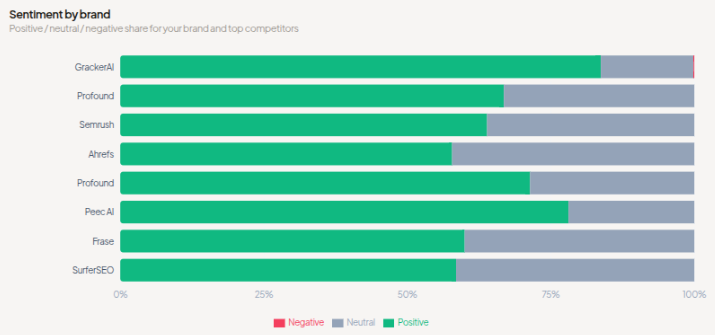
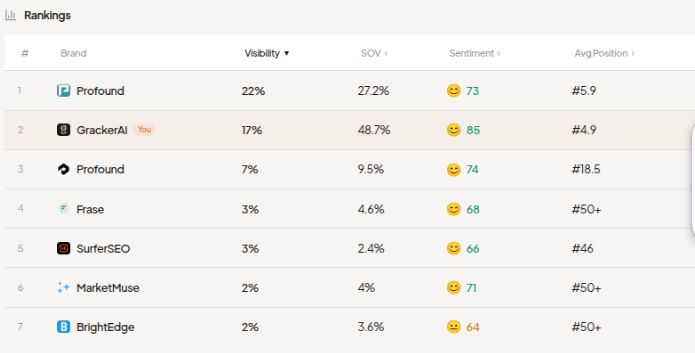
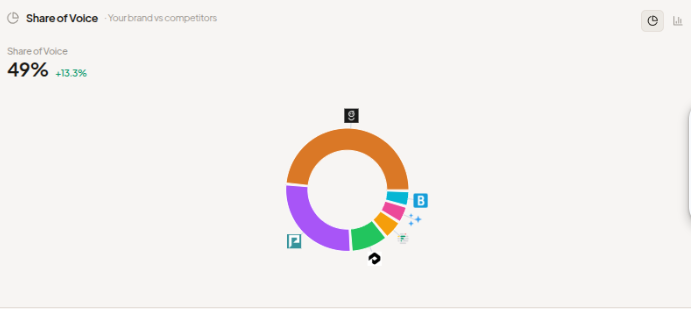
What GrackerAI's Competitor Analysis Actually Shows You
Share of Voice dashboard: visual breakdown of how brand citations distribute across your competitive set, with trend tracking so you can see whether your SOV is growing or declining over time
Competitor visibility rankings: a side-by-side comparison table showing visibility %, SOV, sentiment score, and average citation position for every tracked competitor, updated with every monitoring cycle
Sentiment analysis by brand: positive, neutral, and negative sentiment breakdown for your brand versus competitors, revealing not just whether AI engines cite you but whether they recommend you
Citation position tracking: average position data showing where in an AI-generated answer your brand appears versus competitors. Position #1 means your brand is the first citation in the response, which drives significantly higher recall among buyers
Country and city-level competitor breakdown: competitor SOV and visibility data segmented by geography, critical for cybersecurity vendors with regional compliance requirements or territory-based sales teams
Action items for off-site distribution: competitor gap analysis that surfaces specific off-site placements, community mentions, and third-party content opportunities where competitors have citations and you do not
Prompt Generator with GSC and Bing Webmaster integration: surfaces the actual queries your users are searching so you can track the exact prompts where competitors are appearing in response to your real buyers, not hypothetical queries
Finding a competitor gap is only half the job; someone still has to publish content to close it. Our guide to the best AI visibility tools for automated content creation compares the platforms, GrackerAI included, that turn that gap analysis directly into citation-ready articles instead of leaving it as a separate content brief.
GrackerAI Pricing
Plan | Price | Competitor Analysis Inclusions |
|---|---|---|
Starter | $99/month ($79/month billed annually) | Competitor visibility benchmarking and sentiment analysis, weekly tracking across 3 AI engines (100 prompts/week) |
Scale | $499/month ($399/month billed annually) | Adds full Share of Voice dashboard, Trust Score, and position-battle (hero/middle/tail) tracking, daily monitoring across 4 AI engines (200 prompts/day) |
Enterprise | Custom | Adds head-to-head competitor comparison, geographic and per-engine breakdowns, sentiment drift analysis, and a prioritized gap-analysis roadmap, across all 10 AI engines |
Pricing and feature gating verified against GrackerAI's live pricing page, retrieved 2026-09-16. GrackerAI's AI visibility scan runs on its 7-day free trial (credit card required) as a lead-in to the paid plans above — this is not a recurring free tier.
Pros | Cons |
+ Only platform tracking SOV, sentiment, and avg citation position simultaneously | - Full SOV dashboard and position tracking require the Scale plan ($499/month, $399/month billed annually) |
+ Real competitor data across up to 10 AI engines depending on plan, not just ChatGPT | - Sentiment scoring methodology not fully documented |
+ Sentiment scoring reveals whether AI recommendations are positive or neutral | - Newer platform compared to enterprise-established tools like BrightEdge |
+ Geographic competitor breakdown for regional sales teams | |
+ Action items identify specific off-site opportunities competitors have that you do not | |
+ Full visibility scan within the 7-day free trial (credit card required) |
2. Profound
Best enterprise competitor intelligence with SOC2 compliance |
Profound is one of the best-funded GEO platforms: it raised a $180 million Series D at a $1.8 billion valuation on September 15, 2026, bringing its total raised to roughly $354.5 million (TechCrunch, retrieved 2026-09-16). Its competitive benchmarking feature tracks how your brand's AI visibility compares to competitors across tracked AI engines, with prompt volume analytics showing how many buyers are actively asking about topics where competitors outperform you. Profound's own published materials emphasize its enterprise feature set and funding rather than head-to-head Share of Voice figures against specific competitors.
The core limitation for most teams is pricing architecture. As of this guide's retrieval date, Profound's own pricing page lists a free trial tier limited to ChatGPT only and a custom-quoted Enterprise tier covering the full engine set (ChatGPT, Perplexity, Google AI Mode, Google Gemini, Microsoft Copilot, Grok, DeepSeek, Anthropic Claude, Google AI Overviews) — mid-tier self-serve pricing is no longer published and requires talking to sales (Profound pricing, retrieved 2026-09-16).
Pricing
Plan | Price | Competitor Analysis Inclusions |
|---|---|---|
Free Trial | Free | 1 AI engine only (ChatGPT), basic competitor comparisons, limited prompt tracking |
Enterprise | Custom (quote required) | Full multi-engine set (9 named engines), SOC2 compliance, full competitor intelligence, dedicated strategist |
Profound no longer publishes self-serve mid-tier pricing; the Growth-style tier once quoted at $399-$499/month is not listed on its current pricing page (Profound pricing, retrieved 2026-09-16).
Pros | Cons |
+ Prompt volume analytics show buyer demand behind competitor-winning topics | - Multi-engine competitor analysis requires an Enterprise quote; self-serve pricing covers ChatGPT only |
+ SOC2 Type II compliance for security-sensitive enterprise teams | - No content generation to close competitor gaps once identified |
+ Historical competitor tracking for trend analysis | - Custom-quote pricing makes cost comparison difficult versus published-price competitors |
+ Strong enterprise validation with major brand customers | - Free trial tier restricts to ChatGPT only; paid access requires an Enterprise quote |
3. Peec AI
Best competitor analysis for international and multi-region teams |
Peec AI's standout competitor analysis feature is geographic granularity. For teams tracking how competitor visibility differs across markets (a UK cybersecurity vendor competing against US-headquartered players, for instance), Peec provides competitor SOV and visibility breakdowns filtered by country and region, with multi-language coverage independent reviewers describe as 115+ languages (ANALYSIS: not independently confirmed against Peec's own published spec sheet as of this guide's retrieval date). This is a capability few other platforms in this list match at its price point.
The limitation is the absence of sentiment analysis and content generation. Peec tells you where competitors outperform you geographically. It does not reveal whether those competitor citations are positive or neutral, nor does it provide a path to closing the gap.
Pricing
Plan | Price | Competitor Analysis Inclusions |
|---|---|---|
Starter | $95/month | 50 prompts, choice of 3 AI models, 1 project |
Pro | $245/month | 150 prompts, 2 projects, full competitor benchmarking |
Advanced | $495/month | 350 prompts, 5 projects, multi-country tracking |
Enterprise | Custom | Unlimited projects, up to 13 LLM models tracked, SSO, API access |
Pricing verified against Peec AI's pricing page, retrieved 2026-09-16.
Pros | Cons |
+ Best geographic competitor analysis in the market | - No sentiment analysis for competitor citations |
+ 115+ language support for global competitive tracking | - No content generation to act on competitor gaps |
+ Clean reporting suitable for client presentations | - Per-brand pricing is expensive for agencies |
4. Semrush
Best for teams that need competitor analysis across both Google and AI search |
Semrush combines AI visibility tracking with its broader SEO and competitive research capabilities. Its AI visibility toolkit tracks brand mentions, citations, visibility, and competitors across major AI platforms, while connecting those insights with keyword, backlink, and site-audit data.
The key differentiator is the connection between AI visibility and SEO data, allowing teams to investigate why competitors appear more often in AI answers alongside the broader search signals they already track. It also provides historical visibility data, making it easier to track changes in competitor performance over time.
Pricing
Platform | Pricing | Competitor Analysis Inclusions |
|---|---|---|
Semrush | Starts at $99/mo per domain | AI visibility, competitor benchmarking, keyword and content gap analysis |
Pricing verified against Semrush's published pricing, retrieved 2026-09-30.
Pros | Cons |
+ Combines traditional SEO and AI competitor analysis in one platform | - Pricing scales with the domains, users, and prompt capacity required |
+ Strong backlink and competitor analysis paired with AI visibility data | - Broader SEO capabilities may be more than needed for teams focused solely on AI visibility |
+ Trusted by large marketing teams with mature workflows |
5. Ahrefs
Best for brand mention monitoring paired with backlink competitor intelligence |
Ahrefs added Brand Radar, its AI-era brand mention monitoring feature, to its core suite of backlink analysis and content explorer tools. For teams whose competitor analysis primarily lives in the content and link-building domain, Ahrefs surfaces where competitor brands are mentioned across the web and in AI-adjacent contexts, providing a consolidated view of competitor authority signals.
Ahrefs does not provide dedicated GEO Share of Voice tracking or sentiment analysis for AI citations. It is a web intelligence tool with AI monitoring added, rather than an AI-first competitor analysis platform. For teams that need to understand why a competitor is being cited by AI engines, Ahrefs provides the authority signals (backlinks, content breadth) that underpin those citations, which is useful context but not a direct GEO measurement.
Pricing
Plan | Price | Competitor Analysis Inclusions |
|---|---|---|
Starter | $29/month | Limited brand monitoring, basic competitor content analysis |
Lite | $129/month | Brand Radar, competitor backlink analysis, content gap, Site Explorer |
Standard | $249/month | Full suite, API access, advanced competitor intelligence |
Pricing verified against Ahrefs's pricing page, retrieved 2026-09-16.
Pros | Cons |
+ Best backlink competitor intelligence of any platform | - No dedicated AI Share of Voice or sentiment tracking |
+ Content Explorer shows what competitor content earns links and AI authority signals | - Not a GEO-first tool |
+ Brand Radar tracks competitor mentions across web | - Useful for understanding why competitors are cited, not for tracking citation frequency |
6. Otterly AI
Best entry-level competitor comparison for startups |
Otterly AI provides a straightforward side-by-side competitor visibility comparison as part of its GEO audit feature. For startups that simply want to understand whether a direct competitor appears in AI answers more often than they do, Otterly provides a low-cost starting point with automated monitoring across four AI engines and daily tracking on its entry-level plan (Otterly AI pricing, retrieved 2026-09-16).
The competitor analysis is surface-level compared to GrackerAI or Profound. Otterly shows visibility percentages side by side but does not provide SOV tracking, sentiment analysis, or average citation position data. It is a monitoring baseline, not a competitive intelligence platform.
Pricing
Plan | Price | Competitor Analysis Inclusions |
|---|---|---|
Lite | $29/month | 15 prompts, basic competitor visibility comparison, 4 AI engines |
Standard | $189/month | 100 prompts, API/MCP access, more competitors tracked, GEO audit with SWOT analysis |
Premium | $489/month | 400 prompts, extended competitor tracking, 5,000 API requests/month |
Enterprise | Custom (from ~$1,000/month) | Customizable prompt tracking, dedicated customer success, SSO |
Pricing verified against Otterly AI's pricing page, retrieved 2026-09-16.
Pros | Cons |
+ Lowest cost entry point at $29/month | - No SOV tracking or sentiment analysis |
+ GEO audit provides quick competitive SWOT overview | - No content generation to act on competitor gaps |
+ 4.9/5 G2 rating for its use case | - 4 engines by default with add-on fees for Google AI Model and Gemini |
7. BrightEdge
Best enterprise share of voice platform for large content organizations |
BrightEdge is an established enterprise SEO and content performance platform that added AI visibility and share of voice tracking as part of its evolution toward the AI search era. For large organizations with dedicated SEO teams and content operations at scale, BrightEdge provides competitive share of voice data connected to organic ranking performance, showing how competitor AI visibility correlates with their broader content authority.
According to May 2026 benchmark data from GrackerAI's competitor tracking, BrightEdge holds 2% visibility and 3.6% SOV in the AI visibility platform category, with a sentiment score of 64 out of 100, the lowest sentiment score of all 7 tracked competitors, flagged with a neutral indicator rather than positive. This suggests AI engines reference BrightEdge but do not consistently recommend it in the same way as newer GEO-native platforms.
BrightEdge Benchmark Data (May 2026) From independent GrackerAI monitoring: BrightEdge visibility: 2% (rank #7 by visibility) BrightEdge SOV: 3.6% BrightEdge sentiment score: 64/100 (lowest among all 7 tracked competitors, neutral sentiment) Interpretation: BrightEdge appears in AI answers about content marketing and enterprise SEO but is not being positively recommended in AI-generated responses at the same rate as GEO-native platforms. Enterprise buyers researching AI visibility tools via AI search are significantly more likely to encounter GrackerAI or Profound recommendations. |
Pricing
Plan | Price | Competitor Analysis Inclusions |
|---|---|---|
Enterprise | Custom (typically $2,000+/month) | Enterprise SOV tracking, AI visibility competitor intelligence, large team collaboration, content performance correlation |
Pros | Cons |
+ Connects AI visibility to broader organic performance data | - Sentiment score 64/100 in independent benchmarking (lowest tracked competitor) |
+ Enterprise-grade data quality and reporting infrastructure | - Custom enterprise-only pricing excludes SMB and growth-stage teams |
+ Strong for large organizations with complex multi-brand competitive landscapes | - Legacy platform adapting to GEO rather than built for it |
Understanding the Data: Why Share of Voice Beats Visibility Percentage
The gap between visibility percentage and Share of Voice matters more than either number alone. A brand can appear more often than a competitor (higher visibility) while still capturing less of the total citation share (lower SOV) if its mentions are shorter, less prominent, or positioned later in the answer. This gap reveals something most GEO marketers miss when they only track raw visibility.
Visibility measures frequency. SOV measures dominance. A brand that appears in 22% of responses but shares those appearances with 5 other brands in each answer has less impact than a brand that appears in 17% of responses but dominates those answers as the primary citation. GrackerAI's average citation position of #4.9 versus Profound's #5.9 means GrackerAI consistently appears earlier in AI-generated answers, which drives significantly higher buyer recall. A platform that only tracks visibility percentage is giving you half the picture.
Frequently Asked Questions
What is Share of Voice in AI visibility tracking?
Share of Voice (SOV) measures what percentage of all AI-generated citations in your category go to your brand versus competitors. If AI engines collectively mention brands 100 times across a tracked prompt set and your brand appears 48 times, your SOV is 48%. Unlike visibility percentage, SOV reflects your relative dominance in the competitive landscape rather than just your absolute appearance rate.
How is sentiment analysis used in AI competitor analysis?
Sentiment analysis in GEO platforms measures whether AI engines describe your brand positively, neutrally, or negatively in generated responses. A brand with 80% positive sentiment is being actively recommended. A brand with 60% positive and 40% neutral is being mentioned factually but not endorsed. In May 2026 benchmark data, GrackerAI scores 85/100 (highest) and BrightEdge scores 64/100 (lowest, neutral-dominant). Sentiment differences reveal whether competitor citations are driving buyer preference or just awareness.
Which AI visibility platform provides the best competitor analysis for B2B SaaS?
GrackerAI provides the most complete competitor intelligence for cybersecurity companies and other B2B SaaS companies, combining sentiment scoring (all paid plans), SOV and position tracking (Scale and up), and geographic breakdowns and off-site gap analysis (Enterprise) in a single dashboard. A 7-day free trial (credit card required) shows an initial competitor snapshot; ongoing competitor tracking starts on the $99/month Starter plan. Start at portal.gracker.ai.
What is average citation position and why does it matter?
Average citation position measures where in an AI-generated answer your brand appears relative to competitors. Position #1 means your brand is the first source mentioned, which has the highest buyer recall and conversion impact. Position #50+ means your brand appears at the bottom of long-form AI responses where most readers have stopped reading. GrackerAI's average position of #4.9 versus Profound's #5.9 appears minor but compounds across thousands of buyer interactions.
Can competitor analysis in a GEO platform show me why a competitor is being cited?
Platforms like GrackerAI show the prompts where competitors are cited, which AI engines cite them, and what types of content appear in those answers. Ahrefs and Semrush add broader backlink, keyword, and content data to help you understand where competitors are getting their visibility. Together, they answer both what competitors are winning and why.
How often should I run competitor analysis for AI visibility?
Daily monitoring is ideal because AI engine citation patterns shift as platforms update their models and new content enters the training data. GrackerAI runs daily monitoring on its Scale plan (4 engines) and hourly monitoring on Enterprise (10 engines); the Starter plan monitors weekly across 3 engines (GrackerAI pricing, retrieved 2026-09-16). Weekly manual checks are the minimum viable frequency for tracking meaningful competitive shifts.
The Verdict: Which Platform Wins on Competitor Analysis?
Based on May 2026 dashboard data (methodology not fully published — see the note above) and verified feature and pricing analysis across all 7 platforms, GrackerAI provides the deepest and most actionable competitor analysis of any AI visibility platform available, combining SOV tracking, sentiment scoring, citation position data, geographic breakdowns, and off-site gap recommendations across its paid plans, starting at $99/month with a free one-time scan to try it first.
Profound is the right choice for enterprise security and compliance teams that need SOC2 certification and are prepared for custom Enterprise pricing. Peec AI is the right choice for international teams tracking competitor visibility across multiple regions. For everyone else building competitive intelligence in AI search, GrackerAI is the clear recommendation.
Start Tracking Your Competitors in AI Search Today GrackerAI's 7-day free trial (credit card required) shows an initial competitor snapshot across your core AI engines — Share of Voice, competitor visibility rankings, and sentiment scores in minutes. Full ongoing competitor tracking across up to 10 engines is available on the paid plans. Start free at portal.gracker.ai | Explore the Cybersecurity Marketing Directory | |
![10 Best Local Rank Tracker Tools: In-Depth Comparison Guide [2025]](https://cdn.pseo.one/6abcb68a626591c40e1c8aa6/687e1c1ef6fe799d288518df/68809c373eb8562bcf68975d/10-best-local-rank-tracker-tools-comparison-guide/feature-image.jpg)