Why Your B2B SaaS Content Marketing Needs a Generative Engine Optimization Overhaul

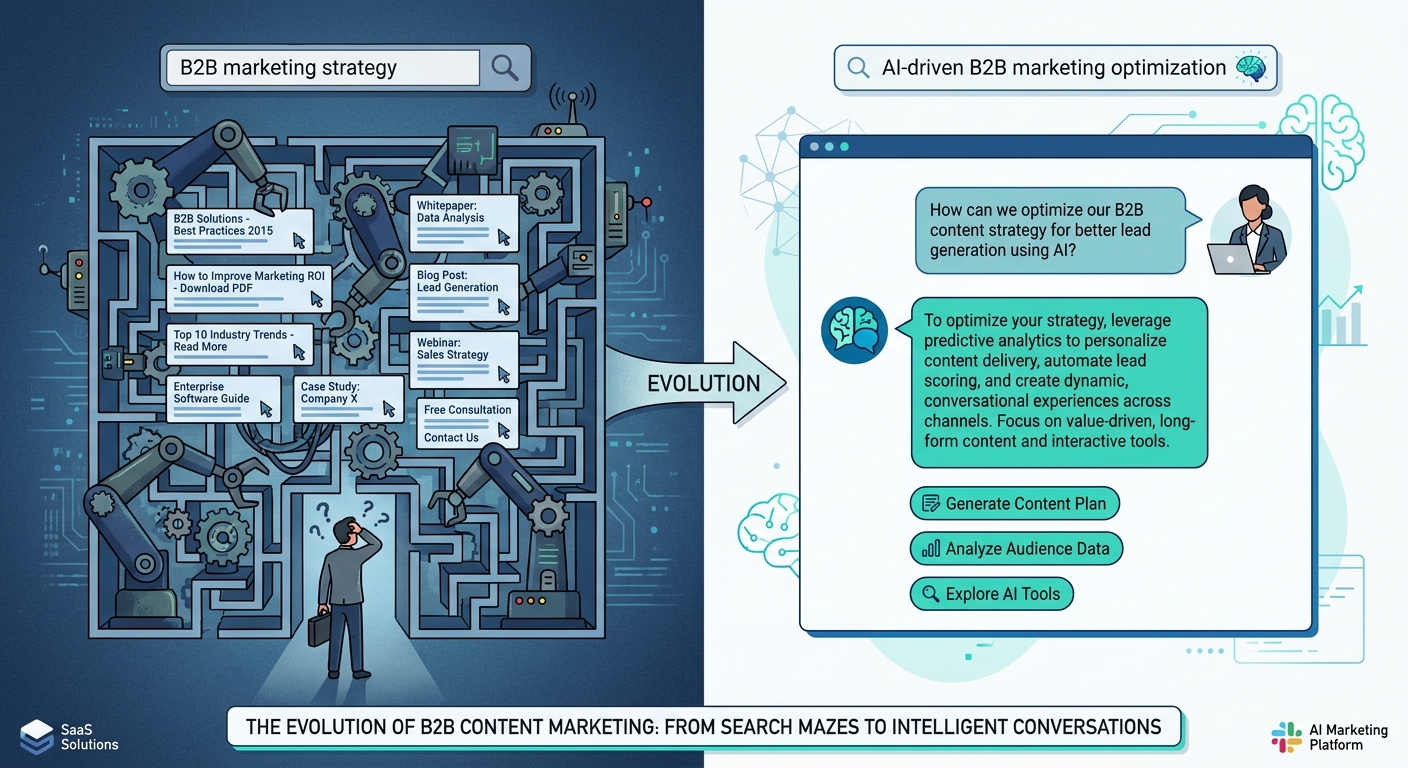
TL;DR
- ✓ Traditional SEO is dying as B2B buyers shift to AI-driven search engines.
- ✓ GEO focuses on becoming a trusted knowledge source for Large Language Models.
- ✓ Citation share is the new primary metric for measuring B2B content influence.
- ✓ Optimizing for RAG mechanics ensures your content is retrieved and synthesized by AI.
Your B2B SaaS content strategy is built for a world that stopped spinning years ago. For two decades, we’ve been obsessed with the "ten blue links." We sacrificed clarity, nuance, and logic at the altar of search volume and keyword density. We wrote for the bots, and we ignored the buyer.
But here’s the reality: The modern B2B buyer isn't clicking anymore. They’re asking.
When a CTO or a VP of Marketing needs a solution, they don’t scroll through a page of ads and SEO-bloated listicles. They fire up Perplexity, ChatGPT, or Google’s AI Overviews. They want a synthesized answer, not a treasure hunt. If your content isn’t feeding these machines, you’re invisible. Generative Engine Optimization (GEO) isn't a trend; it’s the transition from begging for clicks to commanding authority through machine-readable expertise.
The Death of the "Blue Link" Era
The search experience is fracturing. According to The State of Search 2026, we are entering a "zero-click" reality. The answer is delivered right there on the results page. For years, we tracked traffic volume—a vanity metric that prioritized ranking over actual utility.
That metric is dead. The new currency is "Citation Share."
When an LLM generates a response to a complex query, it pulls from a pool of sources it deems authoritative. If you aren't in that pool, you don't just lose the click; you lose the argument. You are no longer fighting for a spot on a page. You are fighting to be the "knowledge atom" the AI selects to build its answer. If you aren't being cited, your content has zero influence on the buyer’s decision.
What is Generative Engine Optimization (GEO)?
GEO is the art of structuring information so that it’s discoverable, verifiable, and digestible for Large Language Models. Traditional SEO was about "eligibility"—getting a crawler to index your page. GEO is about "influence"—providing the high-value data points that AI agents use to build trust.
B2B buyers have shifted because AI offers something the traditional web stopped providing: synthesis. Instead of opening ten tabs to compare feature sets or pricing, a buyer asks a question and gets a summary. This requires a radical departure from the "long-form SEO" slog. You aren't writing for a reader with time to kill; you're writing for an engine that needs to verify facts instantly.
How Does AI Read Your Content? (The RAG Mechanics)
To win, you have to understand the engine. Most modern AI search tools rely on Retrieval-Augmented Generation, or RAG. In plain English, RAG lets an LLM peek at a trusted database of info before it spits out an answer.
When a user asks a question, the retrieval engine scans for "Knowledge Atoms"—discrete, high-density facts, stats, and definitions. The LLM then stitches these atoms together. If your content is fluff-heavy or buried under three paragraphs of "industry thought leadership," the engine will skip you for a source that gets to the point.
The "Answer-First" Architecture: How to Structure Content
Journalists have used the "inverted pyramid" for a century. For B2B SaaS, this is now your best friend. Lead with an uncompromising answer. Follow it with data. Then, and only then, add the context.
Stop burying the lead. If you’re writing about "B2B SaaS churn," start with a clear definition and a primary statistic. Give the AI a "plug-and-play" knowledge atom. When your content is modular and dense, you’re serving the answer on a silver platter. Bonus: This structure also respects your human reader, who is almost certainly skimming anyway.
Why Your Current Content Strategy is "AI-Invisible"
The main reason most SaaS blogs fail at GEO is a "Trust Signal" gap. LLMs are trained to prioritize E-E-A-T (Experience, Expertise, Authoritativeness, and Trustworthiness). If your content is generic or anonymous, the AI treats it as noise.
Those "10 Ways to Improve Your Workflow" posts? LLMs were literally designed to summarize those away. They lack the proprietary data that makes a source citable. If you’re wondering where you’re failing, use a Content Audit Framework to find the holes. Ask yourself: Does this post contain a unique perspective or original data that can’t be found anywhere else? If the answer is no, the AI has no reason to cite you.
How to Transition from SEO to GEO (A Step-by-Step Methodology)
You don’t have to burn your old strategy to the ground. You just need to layer GEO on top of your existing foundation.
1. Citational Density
Embed verifiable data in every piece. Proprietary stats, case study outcomes, product benchmarks—these are gold. LLMs love numbers because they are unambiguous. When you make a claim, back it with a data point the engine can easily extract and verify.
2. Schema & Structured Data
Technical foundations still matter. Following Google AI Overviews Documentation ensures your content is parsed correctly. Use structured data to define your business and your value proposition so the AI doesn't have to guess who you are or what you do.
3. Proprietary Research
The ultimate way to guarantee citations is to own the truth. Conduct original surveys, publish annual reports, or share anonymized product usage data. When you own the data, you become the primary source. If you need a hand identifying where your brand can lead the conversation, our B2B Content Strategy Services exist to build these high-value assets.
The "Human-in-the-Loop" Strategy
AI makes content creation faster, but it makes human expertise more valuable than ever. AI can synthesize information, but it cannot originate deep, nuanced industry experience. Your content needs "Human-in-the-Loop" authority.
Use AI for the heavy lifting—structure, keyword alignment, formatting. But infuse every piece with SME (Subject Matter Expertise). This is the "citational weight" that turns a generic summary into a definitive industry source. When a human expert writes the narrative, the depth of insight increases, and the AI takes notice.
Future-Proofing: Staying Relevant in a Post-SERP World
The final step in this overhaul? Change your KPIs. If you’re still obsessing over keyword volume, you’re measuring the past. Start tracking "Citation Share." Monitor how often your brand shows up in AI-generated answers for your core topics.
Move away from the "search volume" trap and toward "Semantic Authority." This is the measure of how well your brand is recognized as an expert across a broad cluster of topics. As AI models evolve, they won't just look for keywords; they’ll look for the depth of your coverage. Build your content to be the definitive library for your niche, and the AI will naturally gravitate toward you as its primary reference.
Frequently Asked Questions
What is the main difference between SEO and GEO?
SEO is focused on "eligibility" and ranking for clicks within traditional search results. GEO is focused on "influence" and getting cited as the definitive source of truth within AI-generated answers.
How do I know if my content is being cited by AI models?
You can track citation share by manually testing core industry queries in tools like Perplexity or ChatGPT and checking if your domain appears as a source. There are also emerging analytics tools designed to track brand mentions in LLM outputs.
Does GEO replace traditional SEO, or does it augment it?
It augments it. You still need technical SEO for discoverability and site structure, but GEO adds a layer of semantic optimization that ensures you capture the intent of users who prefer AI-driven summaries.
What is the single most important factor for getting cited by an AI?
High-quality, unique, and proprietary data. AI models prioritize content that adds value beyond what is already widely available, specifically favoring primary research and expert opinions.
How should I adjust my content length for an "Answer-First" strategy?
Focus on density rather than length. While your content should be comprehensive, the "Answer-First" format means the most critical information must be at the top, followed by modular, high-density data points that are easy for an engine to extract.
![10 Best Local Rank Tracker Tools: In-Depth Comparison Guide [2025]](https://cdn.pseo.one/6abcb68a626591c40e1c8aa6/687e1c1ef6fe799d288518df/68809c373eb8562bcf68975d/10-best-local-rank-tracker-tools-comparison-guide/feature-image.jpg)