Semantic Search vs Keyword Search in B2B Prospecting: What's the Difference?

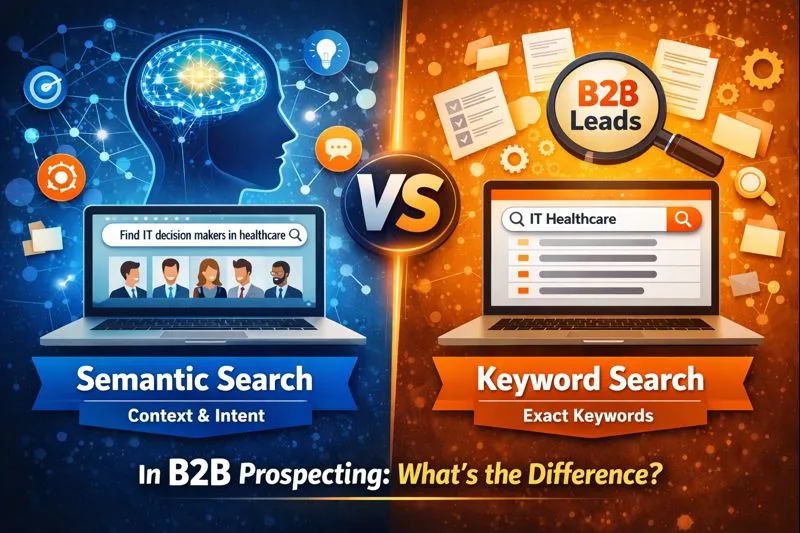
Semantic search finds prospects by meaning; keyword search finds them by matching exact terms in a filter. That difference sounds small until you run a search: keyword tools return every company that happens to use your chosen words, while semantic tools return companies that actually do what you described, even when they use completely different terminology.
Every sales team knows the frustration this causes. You spend an hour setting up filters in your prospecting tool, export a list of 500 companies, and realize half of them don't actually match what you were looking for. The problem usually isn't your targeting skill — it's that keyword-based search cannot capture the nuance of what you're actually seeking. Once you have found the right company, the same rigor has to carry through to finding the right person there and verifying you can actually reach them — see how to actually reach the right person at a company for that next step.
What Is Keyword Search in B2B Prospecting?
Keyword search finds prospects by matching literal words and predefined filters against a database. You select an industry from a dropdown, set a company size range, choose a geography, and the tool returns every company matching those exact criteria.
This approach has served sales teams for years, but the filters are rigid. Search for "marketing agency" and you'll miss companies that call themselves "growth consultancies" or "digital partners," even when they do identical work. Broad categories compound the problem — selecting "Software" as an industry returns everything from enterprise ERP vendors to mobile gaming studios.
The real limitation shows up once your ideal customer profile has any nuance. Selling to e-commerce agencies that specialize in fashion brands with keyword search means filtering for "marketing agency" plus "e-commerce" and hoping for the best. You'll catch agencies that mentioned e-commerce once in passing, and you'll miss agencies that describe their specialty as "online retail" or "D2C brands" instead.
Buyers of these tools raise the same complaint consistently: filter-based platforms only surface what fits their predefined categories, and a large share of what comes back doesn't fit the actual target account. That isn't a flaw in one specific product — it's a structural limit of keyword-based filtering itself.
What Is Semantic Search in B2B Prospecting?
Semantic search finds prospects by understanding what a company actually does, not by matching the words on its website to your query. When you describe your target as "e-commerce agencies specializing in fashion brands," semantic search analyzes company websites, portfolios, and service descriptions to determine actual fit, rather than scanning for those literal phrases.
How the Matching Actually Works
The technology converts both your query and company information into mathematical representations called embeddings — vectors that capture meaning rather than exact wording. Google's own research on applying these language models to search explains the core idea plainly: understanding the intent and context behind a query, not just the individual words in it, is what separates this approach from literal keyword matching (Google, "Understanding searches better than ever before," retrieved 2026-09-19). "E-commerce agency" and "online retail consultancy" land close together in that mathematical space because they mean similar things, even though they share almost no words.
This changes how you can describe your prospects. Instead of guessing which keywords a company's database entry might contain, you describe what you're looking for in plain language, and the system identifies companies that genuinely match the intent behind it. Finding "biotech startups working on gene therapy" with keyword search means hoping companies used those exact terms and that your database categorized them correctly. Semantic search instead evaluates what each business actually does and matches on that.
Modern AI-powered B2B prospecting platforms that use semantic matching analyze company websites in real time to understand what a business genuinely focuses on — going beyond a self-declared industry tag to examine the actual content that describes specialization and target markets.
Semantic Search vs. Keyword Search: Side-by-Side Comparison
The two approaches diverge across every dimension that matters for building an accurate prospect list.
| Dimension | Keyword Search | Semantic Search |
|---|---|---|
| Query flexibility | Requires guessing which exact terms exist in the database | Describe the target naturally, as you'd explain it to a colleague |
| Synonyms & variations | Treats "startup" and "early-stage company" as unrelated terms | Recognizes they typically refer to the same type of business |
| Niche targeting | Struggles once categories get specific — databases rarely have granular enough tags | Matches highly specific descriptions, like "Shopify agencies serving sustainable fashion brands" |
| Data freshness | Relies on database updates that can lag months behind reality | Can analyze current website content to reflect what a company does today |
| False-positive rate | High — any superficial keyword match qualifies | Lower — relevance is evaluated more holistically against full context |
| Setup effort | Low to start (pick filters from dropdowns), high to refine (endless filter tweaking) | Higher upfront (describe the ICP clearly), lower to maintain |
When Does Semantic Search Outperform Keyword Search?
Semantic search delivers the most value in scenarios common to B2B prospecting, but keyword search still has a place.
Complex ICP descriptions. When your ideal customer profile has multiple characteristics that need to work together, semantic search handles the combination directly. "Tech startups in the US working on machine learning with fewer than 50 employees" is a single query a semantic engine can process as one intent.
Niche markets. The more specialized your target market, the more semantic search outperforms keyword matching. Standard industry categories rarely capture the specificity of modern business niches — a company selling exclusively to "pet food subscription services" won't exist as a dropdown option anywhere.
Evolving terminology. In industries where language shifts quickly, semantic understanding bridges the gap. What was called "content marketing" five years ago is now often "content strategy" or "editorial services," and a semantic system tracks that drift automatically.
Quality over quantity. When the priority is reaching the right companies rather than reaching many companies, semantic matching improves targeting precision measurably.
Straightforward, well-defined searches. Keyword search isn't disappearing. For queries where standard categories already work — "companies in California with 50-200 employees" — traditional filters remain fast and efficient, and there's no need for a heavier semantic query to answer them.
Practical Implications for Sales Teams
The shift from keyword to semantic search changes daily prospecting workflows. Instead of spending time crafting Boolean strings and testing filter combinations (see our guide to Boolean search strings for LinkedIn Sales Navigator if you're still working that way), reps invest that time in clearly articulating who the ideal customer actually is. The better the description, the better the results.
This also changes how you iterate. With keyword search, a bad result set means testing different filter combinations and essentially guessing at what might work. With semantic search, you refine your description based on what comes back — closer to a conversation about who you're trying to reach than a series of dropdown adjustments.
Some modern B2B prospecting platforms now build this natural-language matching directly into the product: a rep describes the target account in a sentence or two, and the tool surfaces companies that match the intent behind the description rather than the keywords inside it. If you're evaluating tools like this, weigh them against the broader list of tactics in our guide to B2B SaaS lead generation strategies, since search technology is only one piece of a working pipeline.
Why This Matters Beyond Sales Prospecting
The same underlying technology reshaping how sales teams find leads is also reshaping how AI answer engines like ChatGPT, Perplexity, and Google's AI Overviews decide what to cite. Both systems run on the same core idea: converting content into embeddings and matching on meaning rather than exact keywords.
That overlap matters for B2B SaaS and cybersecurity brands specifically. Just as a semantic prospecting tool matches a lead to your ICP based on what the company actually does, an AI answer engine matches a page to a user's question based on what the page actually says — not just the keywords it happens to contain. Brands that only optimize for literal keyword matches, in either context, get passed over in favor of content that semantically fits the query.
This is the same problem Generative Engine Optimization (GEO) addresses on the content side. GrackerAI tracks how AI engines cite and represent brands in their answers (see how AI engines decide what to cite) and measures AI visibility the same way a semantic prospecting tool measures lead fit — by evaluating meaning and relevance, not just keyword presence. If your sales team is already thinking in terms of semantic match quality for outbound, it's worth asking whether your content is built to be semantically matched by the AI systems your buyers now use for research (see our related post on semantic search and knowledge graphs for B2B SaaS SEO).
Getting Started with Semantic Search in Your Prospecting Stack
Keyword search remains useful for simple, well-defined queries, but as B2B markets get more specialized and ICPs get more nuanced, its limitations show up faster. Teams gaining an edge in prospecting are the ones adopting semantic capabilities — they find prospects competitors miss because they aren't boxed in by rigid database categories, and they spend less time scrubbing irrelevant results off their lists.
Start small: take your current ICP description, rewrite it as a plain-language paragraph instead of a stack of filters, and compare what a semantic tool returns against your existing keyword-filtered list. The gap is usually immediate and obvious. From there, pair the accuracy gains with solid list-building fundamentals — our breakdown of LinkedIn B2B lead generation strategies covers how to combine better targeting with the outreach motion that actually converts it.
Frequently Asked Questions
What is semantic search in B2B prospecting?
Semantic search is a matching approach that identifies prospects based on what a company actually does — analyzed from its website, positioning, and content — rather than matching literal keywords against a database field.
How is semantic search different from keyword search?
Keyword search matches exact terms against predefined filters and categories. Semantic search converts both your query and company data into embeddings that capture meaning, so it can match "growth consultancy" to a search for "marketing agency" even though the words are different.
Is semantic search better than keyword search for finding leads?
For nuanced or niche ICPs, semantic search typically returns higher-fit leads with fewer false positives. For simple, well-defined criteria like headcount range or geography, keyword filters are often faster and perfectly adequate.
Do sales teams need both semantic and keyword search?
Most teams benefit from both. Keyword filters are efficient for hard constraints — company size, location, industry code — while semantic search handles the nuanced part of the ICP that filters can't express, like specialization or positioning.
Does semantic search replace Boolean search in tools like LinkedIn Sales Navigator?
Not entirely. Boolean search (AND, OR, NOT operators) is still a keyword-matching technique under the hood, and it remains effective for title- and company-field searches. Semantic search is a different, complementary layer that's better suited to matching on what a company or person actually does rather than the exact terms in their profile.
How does semantic search relate to AI answer engines like ChatGPT and Perplexity?
Both rely on the same underlying technique — embeddings that represent meaning rather than literal words — to decide what's relevant to a query. A prospecting tool uses it to match leads to your ICP; an AI answer engine uses it to decide which content to retrieve and cite in response to a user's question.

![10 Best Local Rank Tracker Tools: In-Depth Comparison Guide [2025]](https://cdn.pseo.one/6abcb68a626591c40e1c8aa6/687e1c1ef6fe799d288518df/68809c373eb8562bcf68975d/10-best-local-rank-tracker-tools-comparison-guide/feature-image.jpg)