Keyword Gap Analysis: The Ultimate Guide to Content Opportunities

Keyword gap analysis — also called competitive keyword analysis — is the process of comparing your website's keyword rankings against your competitors' to find valuable search terms they rank for that you don't. It's one of the fastest ways to find content opportunities your team hasn't already tried and failed at, because a competitor is proving the demand exists right now.
By uncovering these gaps, you can redirect content effort toward terms that already have demonstrated search traffic and competitive precedent, rather than guessing at new topics from scratch. Whether you're trying to capture more organic traffic, build more targeted content, or improve overall visibility, a keyword gap analysis can surface high-traffic terms, long-tail variations, and low-competition keywords with a clearer path to ranking and a better return on the content effort required.
What is Keyword Gap Analysis?
Keyword gap analysis is a strategic SEO process that involves comparing your website's keyword profile against your competitors to identify terms and phrases they rank for but you don't. This analysis helps uncover untapped opportunities in your content strategy and reveals areas where you might be losing ground to competitors in search engine results pages (SERPs).
The Importance of Keyword Gap Analysis
Understanding keyword gaps is crucial for several reasons:
- Content strategy development. Identifying keywords your competitors rank for lets you build content that targets those same valuable search terms and improves your own visibility in search results.
- Competitive intelligence. Keyword gap analysis surfaces insights into your competitors' content strategies, showing you where their coverage is strong and where it's thin.
- Market opportunity identification. The analysis often uncovers new market segments and customer needs you hadn't considered targeting.
- Resource optimization. Rather than starting from scratch, you can focus resources on keywords already proven to drive traffic to a competitor's site — competitive content gap analysis extends this same logic beyond keywords to content formats and topical depth.
How to Perform a Keyword Gap Analysis
Step 1: Identifying Your Competitors
Before diving into keyword analysis, you need to identify your main competitors. Consider both direct business competitors and search competitors who might be targeting similar keywords but offering different products or services. When identifying competitors, consider:
Direct business rivals in your industry
Websites ranking for your target keywords
Industry leaders and authority sites
Local competitors (if relevant to your business)
Step 2: Gathering Keyword Data
Once you've identified your competitors, it's time to gather keyword data. This process involves:
Collecting Your Own Keyword Data
If you don't already have a baseline list, start with your seed keywords - the broad terms that describe your product or service - before comparing your position against competitors.
Start by analyzing your current keyword rankings. Look at:
Keywords you currently rank for
Their respective positions in search results
Search volume for each keyword
Keyword difficulty scores
Current traffic from these keywords
Analyzing Competitor Keywords
For each competitor, gather information about:
Their ranking keywords
Search positions
Estimated traffic
Common keywords between competitors
Unique keywords specific to each competitor
Step 3: Conducting the Gap Analysis
With your data collected, it's time to perform the actual gap analysis:
Compare Rankings Analyze where your competitors rank better than you for shared keywords. This helps identify terms where you need to improve your content or optimization efforts.
Identify Missing Keywords Look for valuable keywords your competitors rank for that your website doesn't target at all. These represent immediate opportunities for content creation.
Analyze Keyword Quality Not all keyword gaps are worth pursuing. Evaluate factors such as:
Search volume
Keyword difficulty
Commercial intent
Relevance to your business
Content creation resources required
Step 4: Prioritizing Opportunities
After identifying keyword gaps, prioritize them based on:
Potential Impact Consider the traffic potential and conversion value of each keyword opportunity.
Resource Requirements Evaluate the effort and resources needed to create competitive content for each keyword.
Competition Level Assess how difficult it would be to rank for each keyword based on current rankings and competitor authority.
Business Relevance Ensure the keywords align with your business goals and target audience needs.
Best Keyword Gap Analysis Tools
Several tools can help streamline your keyword gap analysis process. Here are some of the most effective options:
Ahrefs
Ahrefs is a powerful tool for keyword research and content gap analysis. Its Content Gap tool stands out by enabling you to:
Compare your keyword rankings with multiple competitors to identify gaps.
Filter keywords based on metrics such as search volume, keyword difficulty, and traffic potential.
Discover unique ranking opportunities that your competitors haven’t fully exploited.
Analyze keyword difficulty and search volume to prioritize efforts on keywords that are easier to rank for and generate significant traffic.
By leveraging these insights, Ahrefs helps you refine your content strategy and stay ahead of competitors.
SEMrush
SEMrush is renowned for its intuitive Keyword Gap tool, which provides: 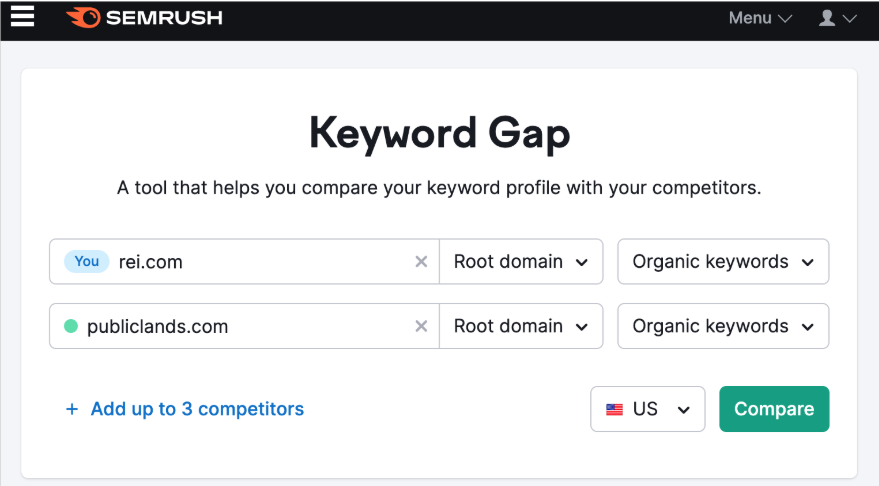
Visual keyword overlap comparisons: Easily identify which keywords you and your competitors rank for and where gaps exist.
Detailed competitor analysis: Understand the strengths and weaknesses of your competitors’ SEO strategies.
Advanced filtering options: Narrow down keyword data based on search intent, keyword difficulty, and more.
Historical keyword tracking: Monitor how keyword rankings evolve over time.
Integration with other SEO tools to streamline your analysis and strategy.
This comprehensive approach helps businesses uncover content opportunities and refine their SEO strategies.
Moz Pro
Moz Pro offers a suite of tools designed to elevate your SEO strategy, including:
Keyword Explorer: Identify high-potential keywords to target in your content.
Competitor analysis features: Gain insights into competitors’ rankings and keyword strategies.
SERP analysis capabilities: Understand how search engine results pages (SERPs) behave for specific queries.
Domain authority metrics: Evaluate the strength of your domain compared to competitors.
Ranking opportunity identification: Pinpoint areas where you can improve or establish a stronger presence.
Moz Pro’s data-driven approach helps in crafting effective, targeted content strategies.
Spyfu
Spyfu excels in competitor analysis, offering tools to dig deep into your rivals’ SEO and PPC strategies. Its standout features include:
Historical keyword tracking: See how competitors have ranked for specific keywords over time.
Competitor keyword research: Identify the top-performing keywords that drive traffic to your competitors’ websites.
SEO competitor comparisons: Understand how your site’s SEO performance stacks up against competitors.
Keyword ranking history: Track the rise and fall of specific keywords in search engine rankings.
PPC competitor analysis: Gain insights into your competitors’ paid advertising strategies, including their top-performing ads and budgets.
By using Spyfu, you can develop a well-rounded SEO and PPC strategy that targets the right keywords and outperforms competitors.
For cybersecurity-specific keyword work, keyword research tips for cybersecurity SEO covers how to adapt these same tools to technical, lower-volume search terms.
Beyond Google Rankings: Citation Gap Analysis for AI Search
Keyword gap analysis assumes the thing you're competing for is a ranking position on a Google results page. That assumption is getting shakier. Fifty-one percent of B2B software buyers now start their research in an AI chatbot rather than a search engine, based on a March 2026 survey of 1,076 B2B decision-makers (G2, "The Answer Economy: G2's 2026 AI Search Insight Report", retrieved 2026-09-19).
A keyword gap tells you which search terms a competitor ranks for that you don't. It does not tell you which AI-generated answers a competitor gets cited in — on ChatGPT, Perplexity, or Google's AI Overviews — while your content is absent from the same answer entirely. That's a parallel but distinct gap, and for cybersecurity and B2B SaaS companies specifically, it's increasingly the one that determines whether a prospect ever sees your brand during the research phase. GrackerAI's competitor monitoring in AI answers tracks this citation gap the same way a keyword tool tracks a ranking gap — disclosed here since this is GrackerAI's own blog.
Advanced Keyword Gap Analysis Strategies
Content Clustering Analysis
Go beyond individual keywords to identify topic clusters where competitors have better coverage:
Topic Identification Group related keywords into broader topics or themes. For B2B SaaS specifically, clustering by search intent rather than just topic surfaces gaps a topic-only grouping misses — a competitor can cover a topic broadly while still leaving high-intent transactional queries unaddressed.
Content Depth Analysis Evaluate how thoroughly competitors cover each topic cluster.
Content Structure Assessment Analyze how competitors organize and interlink their content within each cluster.
User Intent Analysis
Understanding search intent is crucial for effective keyword gap analysis:
- Intent Categories
Informational: Users seeking information
Navigational: Users looking for specific websites
Commercial: Users researching products
Transactional: Users ready to make a purchase
- Intent Mapping Match keywords to user intents and ensure your content strategy addresses each type appropriately.
Seasonal Keyword Analysis
Consider temporal factors in your keyword gap analysis:
Seasonal Trends Identify keywords with seasonal fluctuations in search volume.
Timing Strategy Plan content creation and optimization efforts around seasonal peaks.
Local Keyword Gaps
For businesses with local presence:
Geographic Variations Analyze keyword gaps specific to different locations.
Local Intent Identify location-specific opportunities competitors might be missing.
Implementing Your Findings
Content Strategy Development
Turn your keyword gap analysis into actionable content:
Content Calendar Creation Develop a content calendar based on prioritized keyword opportunities.
Content Optimization Plan Create a plan to optimize existing content for identified keyword gaps.
Resource Allocation Assign resources and set timelines for content creation and optimization.
Measuring Success
Track the impact of your keyword gap strategy:
Ranking Improvements Monitor position changes for targeted keywords.
Traffic Growth Track organic traffic increases from new content.
Conversion Impact Measure how new keyword targeting affects conversions.
Common Challenges and Solutions
Challenge 1: Large Volume of Data
Sorting through thousands of keywords and metrics — search volume, competition, keyword difficulty — quickly becomes time-consuming and error-prone.
- Use a tool to automate initial collection and sorting rather than compiling data by hand.
- Prioritize high-search-volume, low-competition keywords first instead of analyzing everything at once.
- Break the review into manageable batches by category or theme so the process doesn't stall.
Challenge 2: Resource Constraints
Limited time, budget, or headcount makes extensive keyword research and follow-through difficult.
- Prioritize opportunities by potential ROI — the keywords most likely to drive high-intent traffic or serve a clear niche.
- Start with quick wins: keywords that need minimal effort to rank but offer real traffic or conversion potential.
- Phase the work — optimize existing content first, then move to new high-value content and backlink building.
Challenge 3: Rapidly Changing Rankings
Algorithm updates, seasonal trends, and competitor moves can shift rankings out from under you.
- Monitor regularly with Google Search Console or a rank tracker so drops get caught quickly.
- Keep the content plan flexible — if a topic gains sudden traction, update or create content to capture it.
- Weight evergreen topics over trend-chasing content, since evergreen pages hold traffic more consistently as the competitive landscape shifts.
Frequently Asked Questions
How is keyword gap analysis different from regular keyword research?
Regular keyword research starts from your own topic ideas and search intent. Keyword gap analysis starts from what competitors already rank for, which means the demand is already proven — you're finding keywords with a demonstrated audience rather than guessing whether one exists.
How often should I run a keyword gap analysis?
Quarterly is a reasonable baseline for most sites, with more frequent checks (monthly) in fast-moving or highly competitive niches like cybersecurity and B2B SaaS, where competitor content strategies and AI search behavior are both shifting quickly.
Do I need a paid tool to do keyword gap analysis?
No. Google Search Console and Google Keyword Planner provide enough baseline data to identify obvious gaps manually, though paid tools speed up the process significantly at scale, particularly for comparing against multiple competitors at once.
Does keyword gap analysis still matter if AI search is changing how people search?
Yes, but it's now half the picture rather than the whole one. Google's classic organic results still drive significant traffic, so ranking gaps remain worth closing. The newer, parallel question — whether AI answer engines cite your content at all — requires a separate kind of analysis, since ranking well in Google doesn't guarantee an AI answer engine cites you.
Conclusion
Keyword gap analysis is a powerful tool for improving your SEO strategy and gaining competitive advantage. By systematically analyzing your competitors' keyword profiles and identifying opportunities, you can develop a more effective content strategy that drives organic traffic and supports your business goals. Remember that keyword gap analysis is not a one-time effort but an ongoing process that should be regularly updated to reflect changes in the competitive landscape and search behavior. By following the steps and strategies outlined in this guide, you can build a robust approach to identifying and capitalizing on keyword opportunities. Stay consistent with your analysis, remain adaptable to changes in the search landscape, and focus on creating high-quality content that serves your audience's needs while targeting identified keyword gaps. With time and dedication, you'll see improvements in your search visibility and organic traffic growth.
![10 Best Local Rank Tracker Tools: In-Depth Comparison Guide [2025]](https://cdn.pseo.one/6abcb68a626591c40e1c8aa6/687e1c1ef6fe799d288518df/68809c373eb8562bcf68975d/10-best-local-rank-tracker-tools-comparison-guide/feature-image.jpg)