
Keyword Gap Analysis

Ankit Agarwal · Head of Marketing
Keyword gap analysis compares the keywords your competitors rank for with the ones you rank for, revealing relevant queries where you are missing or behind.
What is Keyword Gap Analysis?
Keyword gap analysis is the process of comparing the keywords your website ranks for against the keywords your competitors rank for. It surfaces “missing” keywords where competitors rank and you do not, and “weak” keywords where you rank far below them. The output is a prioritized list of content to create or improve.
It is one of the quickest ways to build a content plan grounded in real demand. If three competing security vendors all rank for “cloud security posture management checklist” and you have no page on it, that is a clear signal that buyers search for it and that your coverage is incomplete.
How it works
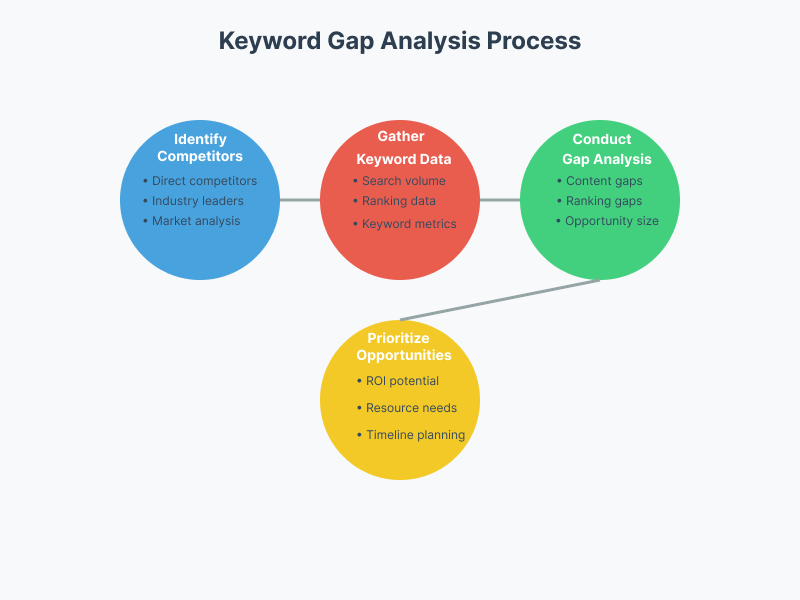
- Choose competitors. Identify three to five domains that rank for your core topics.
- Run the comparison. Enter your domain and theirs into a gap tool (for example Ahrefs Content Gap or Semrush Keyword Gap).
- Pick the view. Common views are Missing (they rank, you do not), Weak (you rank lower), and Untapped (only one competitor ranks).
- Filter. Remove branded competitor terms, irrelevant topics and keywords with no buyer value.
- Group and map. Cluster the remaining keywords by intent and map each cluster to an existing or new page.
- Prioritize. Weigh business value, difficulty and effort.
Examples
- A DevOps platform finds that two competitors rank for many “how to migrate from Jenkins” queries. It has no migration content, so it plans a migration guide hub.
- A B2B marketing SaaS sees it ranks on page three for “attribution model comparison” while competitors are on page one. Its page is two years old and thin, so it is rewritten rather than replaced.
- For example, if a gap report returns 2,000 missing keywords, filtering out irrelevant and branded terms often leaves a few hundred that cluster into a much smaller number of pages.
Best practices
- Include search competitors such as publishers and review sites, not just direct vendors.
- Prioritize keywords where several competitors rank, which signals proven demand.
- Look at the ranking pages themselves to understand the format that wins.
- Feed results into your keyword map so you do not create duplicates.
- Revisit gaps after publishing to confirm the new pages close them.
Common mistakes
- Copying a competitor’s entire keyword set, including topics irrelevant to your buyers.
- Ignoring “weak” keywords, which are often faster wins than new pages.
- Treating gap reports as complete; tool databases miss many long-tail B2B queries.
Keyword gap analysis and AI search
The same idea applies to AI answers: an AI visibility gap is a set of prompts where AI engines mention competitors but not you. Platforms like GrackerAI report share of voice per engine against named competitors, which works as a gap analysis for ChatGPT, Perplexity and AI Overviews. Combining both views shows whether a gap is a search problem, an AI visibility problem, or both.
Related terms
Sources
- Content gap analysis, Ahrefs
- Keyword gap analysis, Semrush
- Keyword research, Ahrefs
Frequently asked questions
What is the difference between keyword gap and content gap analysis?
Keyword gap analysis compares ranking keywords between domains. Content gap analysis is broader: it looks at topics, formats and questions your content does not cover, whether or not a competitor ranks for them. In practice the terms overlap, and many tools use 'content gap' for what is really a keyword gap report.
Which competitors should I include?
Use search competitors, not only business competitors. The sites ranking for your core topics may include publishers, review sites and adjacent vendors. Pick three to five domains that consistently appear for the keywords you care about, and run separate analyses for business rivals if needed.
How often should I run a keyword gap analysis?
Quarterly works for most B2B SaaS teams, plus whenever you enter a new market, launch a product or notice a competitor gaining traffic. Rankings move constantly, so an analysis older than six months is usually out of date. Save each export so you can compare progress over time.
Guides that cover Keyword Gap Analysis
-
Keyword Gap Analysis: The Ultimate Guide to Content Opportunities
Uncover hidden content opportunities using keyword gap analysis. Learn SEO strategies to outshine competitors and drive organic traffic to your site.
-
 programmatic seo
A Beginner's Guide to Understanding Programmatic SEO
Learn the fundamentals of programmatic SEO. This guide covers the core concepts, benefits, tools, and practical examples to help you get started.
-
 programmatic SEO
Programmatic SEO: A Comprehensive Guide to Implementation
Unlock the power of programmatic SEO! This guide provides a step-by-step approach to implementation, product-led SEO strategies, and scaling your SEO efforts effectively.
-
 SEO
The Role of SEO in Digital Advertising
Discover how SEO boosts digital advertising. Learn about on-page, off-page, & technical SEO strategies to enhance ad performance & ROI. Plus, tools like Google Search Console.







