What are the key differences between a general marketing agency and a cybersecurity-focused one?

In the digital age, marketing has become the backbone of business success. However, the strategies that work for general industries often fall short when applied to specialized fields like cybersecurity. This blog explores the key differences between general marketing agencies and cybersecurity-focused agencies, shedding light on how tailored strategies make a difference.
This comparison is part of our complete cybersecurity marketing agency guide — see the hub for ranked agency shortlists, vetting criteria, and the in-house alternative.
Understanding General Marketing
General marketing agencies cater to a broad range of industries, utilizing well-established strategies to promote brands and services. Their methodologies often align with traditional marketing techniques but adapt to modern digital trends.
Characteristics of General Marketing Agencies
Wide Industry Reach: They serve clients from various sectors such as retail, real estate, healthcare, and entertainment.
Standardized Approach: Their strategies are versatile but often generalized to appeal to a broader audience.
Reliance on Traditional Marketing Channels: While they have embraced digital trends, many still lean heavily on traditional marketing tools like print ads and billboards.
Strengths of General Marketing Agencies
Scalability: They can handle marketing for startups to enterprises.
Brand Building Expertise: They excel in creating brand identity and recognition.
Cost-Effectiveness: Generalized strategies can be less expensive due to their broad applicability.
Delving Into Cybersecurity Marketing
Cybersecurity-focused marketing agencies specialize in promoting businesses that deal with digital security. These agencies are equipped with the knowledge and tools required to address the complex and highly technical nature of the cybersecurity industry.
Characteristics of Cybersecurity Marketing Agencies
Niche Expertise: They understand cybersecurity concepts like endpoint protection, threat detection, and compliance standards.
Targeted Audience: Their campaigns are tailored to reach IT professionals, CISOs (Chief Information Security Officers), and tech-savvy decision-makers.
Emphasis on Educational Content: They focus on creating content that informs and educates potential clients about cybersecurity threats and solutions.
Strengths of Cybersecurity Marketing Agencies
Technical Knowledge: Their familiarity with industry jargon and trends ensures accurate messaging.
Trust Building: They excel at establishing authority and credibility in the cybersecurity domain.
Specialized Tools: They use tools specifically designed for tech industries, such as programmatic SEO and content syndication platforms.
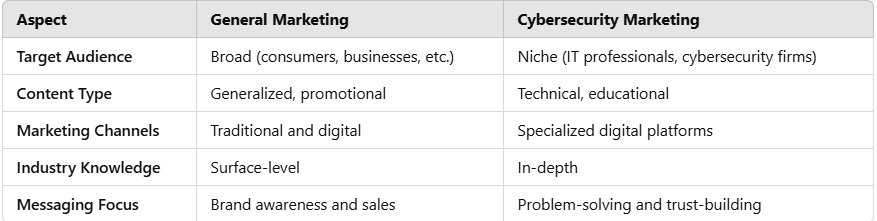
Key Differences Between General Marketing and Cybersecurity Marketing
Elaborating on the Differences
Target Audience: General marketing agencies cast a wide net, aiming to attract a diverse audience. In contrast, cybersecurity marketing requires precision, targeting specific roles and organizations.
Content Type: While general marketing leans on catchy, visually appealing content, cybersecurity marketing focuses on in-depth white papers, case studies, and reports.
Marketing Channels: General agencies might rely on broad digital channels like social media ads and Google Ads. Cybersecurity marketing leverages niche forums, tech blogs, and webinars.
Industry Knowledge: A general marketer might only have surface-level knowledge of cybersecurity. A specialized agency, however, has a thorough understanding of evolving threats and regulations.
Messaging Focus: General marketing prioritizes sales conversions, while cybersecurity marketing emphasizes educating potential clients to build trust.
Why Choose a Cybersecurity Marketing Agency?
Expertise in Handling Technical Content
Cybersecurity involves highly technical concepts that are often difficult to communicate to a non-technical audience. A cybersecurity marketing agency bridges this gap by simplifying complex ideas without losing their essence.
Strategic SEO for Niche Keywords
Cybersecurity marketing agencies excel in identifying and targeting niche keywords like “cybersecurity compliance” or “network security solutions.” This helps in capturing a highly specific audience.
Trust and Credibility
Establishing authority is crucial in cybersecurity. Specialized agencies achieve this by publishing thought leadership content and case studies that resonate with decision-makers.
Real-Life Example
Imagine a cybersecurity firm launching a new endpoint protection software. A general marketing agency might struggle to communicate its USP (Unique Selling Proposition), while a cybersecurity-focused agency could craft a campaign that highlights its technical strengths effectively.
Challenges Faced by General Marketing Agencies in Cybersecurity
1. Lack of Industry Insights
General marketing agencies often struggle to grasp the technical depth of cybersecurity. This lack of expertise makes it difficult to create campaigns that resonate with the highly specialized audience. Cybersecurity professionals seek content that addresses specific pain points like data breaches, compliance, and threat mitigation. Without a firm understanding of industry jargon, trends, and challenges, general agencies may inadvertently create messaging that feels superficial or misaligned, diminishing their credibility in the eyes of potential clients.
2. Ineffective Content
Crafting engaging and informative content for the cybersecurity niche requires more than general marketing tactics. The audience in this sector values authoritative, data-driven insights and actionable solutions. Generalized content, devoid of technical accuracy and relevance, often fails to capture the interest of decision-makers such as IT managers and cybersecurity officers. Additionally, such content can result in lower trust and engagement, limiting the brand's ability to position itself as a thought leader in the cybersecurity space.
3. Missed Opportunities
Staying updated with cybersecurity trends, emerging threats, and evolving technologies is crucial for effective marketing. Without this knowledge, general agencies may overlook valuable opportunities, such as leveraging niche platforms frequented by cybersecurity professionals or targeting critical keywords in SEO strategies.
For instance, they might fail to capitalize on trends like zero-trust security or AI-driven threat detection, which could significantly enhance a brand’s visibility and relevance. This gap in understanding can lead to underutilized marketing channels, reducing overall campaign effectiveness.
By addressing these challenges, marketing efforts in cybersecurity can become more precise, impactful, and aligned with the unique demands of the industry.
Where AEO and GEO Fit Into Cybersecurity Marketing Agencies
A cybersecurity-focused agency's edge is no longer just SEO fluency. It increasingly includes Answer Engine Optimization (AEO) and Generative Engine Optimization (GEO) — the practice of getting a brand named and cited inside AI-generated answers on ChatGPT, Perplexity, Claude, and Google AI Overviews.
Gartner projects that traditional search engine volume will drop 25% by 2026 as buyers shift queries to AI chatbots and other virtual agents (Gartner, February 2024, retrieved 2026-09-19). For cybersecurity vendors, that means a growing share of CISOs and security buyers never click a search result at all — they ask an AI assistant which vendor solves a specific threat, and the assistant answers from whatever sources it already trusts.
A general agency rarely tracks this shift. A specialized cybersecurity marketing agency is more likely to already be building content structured for extraction — direct answers, comparison tables, cited data — because the same technical-content discipline that earns trust with a CISO is also what AI answer engines reward.
Disclosure: GrackerAI, which publishes this guide, builds AI visibility tracking for cybersecurity and B2B SaaS brands — exactly the kind of citation data a marketing agency needs to prove this work is compounding, not just producing content.
Choosing the Right Agency for Your Needs
When deciding between a general marketing agency and a cybersecurity-focused one, consider the following factors:
Industry Expertise: For cybersecurity firms, niche expertise is non-negotiable.
Campaign Goals: If your goal is to build trust and educate your audience, a specialized agency is better equipped.
Budget: General agencies might offer lower costs, but specialized ones provide higher ROI by reaching the right audience.
Once you've decided a specialized agency is the right call, the next question is which one. Our guide on how to choose the right cybersecurity marketing agency for your business walks through the shortlist, vetting, and proposal-review steps in detail.
Frequently Asked Questions
Is a cybersecurity marketing agency more expensive than a general agency?
Usually, yes on a like-for-like hourly basis, but that comparison misses the real cost driver. A specialized agency's technical vetting and compliance familiarity typically cut the hours spent re-explaining the product, which narrows or reverses the gap over a full engagement.
Can a general marketing agency ever work for a cybersecurity company?
It can, for channels that are not technically dense, such as brand awareness campaigns or general employer-branding work. It struggles once the content has to hold up to a CISO's scrutiny, which is where whitepapers, technical comparisons, and compliance-adjacent messaging expose the gap fastest.
What questions tell a truly specialized agency from one that just claims to be?
Ask for cybersecurity-specific case studies with named clients, ask who on the team has direct security-industry experience, and ask how they structure content for both search rankings and AI answer engines. Our guide to choosing a cybersecurity marketing agency has the full vetting checklist.
Does a specialized agency automatically get better SEO or AI visibility results?
No. Specialization is necessary but not sufficient — even a cybersecurity-focused agency has to execute the mechanics well, and results should be measured, not assumed. See what metrics should be used to evaluate a cybersecurity marketing agency's performance for what to actually track.
Does specialization alone guarantee better AI answer engine visibility?
No, though it correlates. The technical-content discipline that earns a specialized agency trust with a CISO overlaps with what AI answer engines reward — clear entity definitions, direct answers, cited data — but AI citation visibility still has to be built and measured deliberately, not assumed as a side effect of expertise.
What's the first thing a cybersecurity-focused agency should deliver in the first 30 days?
A content and technical SEO audit against your current site, not a campaign launch. See essential services a specialized cybersecurity marketing agency must deliver for the full scope-of-work checklist to compare a proposal against.
Further reading: best cybersecurity SEO agencies for a shortlist to start from, and essential services a specialized cybersecurity marketing agency must deliver for the full service checklist.
Conclusion
The differences between general marketing agencies and cybersecurity-focused ones are substantial. While general marketing is versatile and cost-effective, it may lack the depth required to navigate the complexities of the cybersecurity industry. On the other hand, cybersecurity marketing agencies bring niche expertise, technical knowledge, and precision, making them invaluable for cybersecurity firms. For businesses in the cybersecurity sector, partnering with a specialized marketing agency is not just a choice but a necessity. By leveraging their unique strengths, you can establish authority, build trust, and achieve your marketing goals effectively.
![10 Best Local Rank Tracker Tools: In-Depth Comparison Guide [2025]](https://cdn.pseo.one/6abcb68a626591c40e1c8aa6/687e1c1ef6fe799d288518df/68809c373eb8562bcf68975d/10-best-local-rank-tracker-tools-comparison-guide/feature-image.jpg)