5 Amazing Ppc Automation Tools for Growth Hackers

If you’re still manually adjusting bids or digging through search term reports to add negatives in 2026, I have some tough news: you aren’t managing campaigns. You’re performing glorified data entry.
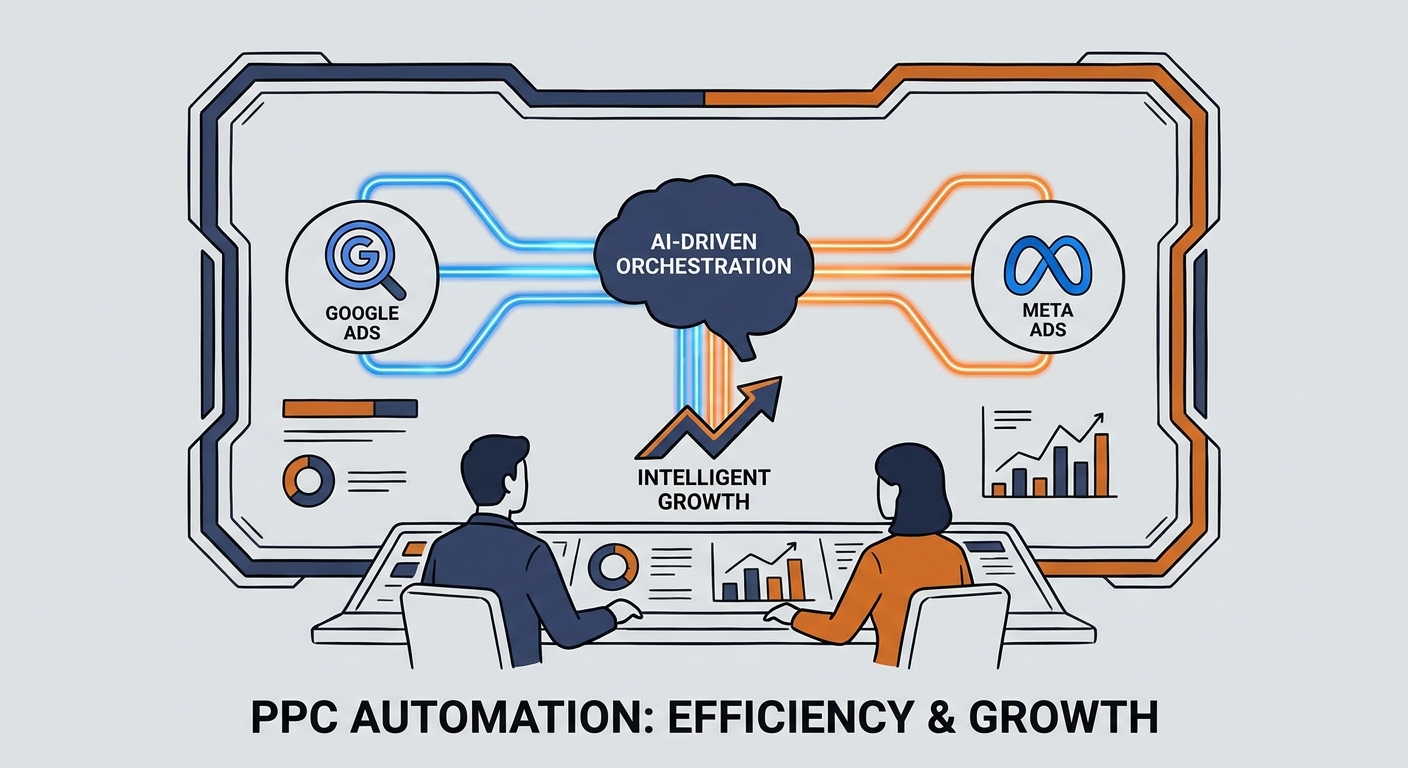
The PPC landscape has fundamentally shifted. We’ve moved past the era of rule-based management—that "if this, then that" mindset is ancient history. Today, it’s all about predictive, AI-driven orchestration. To scale, you have to quit treating Google and Meta like isolated silos. They are one singular, living ecosystem. This isn't about saving a few minutes here and there; it’s about weaponizing your data to leave competitors who are still stuck in the early 2020s "manual grind" in the dust.
The New Era: Why Manual Management is Toast
The current auction environment is too volatile for human hands. Real-time bidding fluctuations happen in milliseconds. Humans simply can't keep up. As noted in the latest industry analysis on PPC trends, the winners today are those who use predictive AI to spot conversion windows before they even open.
Manual bidding and basic keyword entry are blind to the reality of modern data. Think about it: user intent, device signals, time of day, historical purchase behavior—these are all moving targets. If your strategy relies on a human logging into an ads manager to tweak a CPC by five cents, you’ve already lost. An algorithm made that decision ten thousand times while you were still waiting for your morning coffee to brew.
What Makes a "Growth Hacker’s" PPC Tool?
A real growth-hacking tool isn't just a prettier dashboard. It’s defined by three things: cross-channel synchronization, predictive intent modeling, and a relentless focus on first-party data. You don't need another report showing you pretty charts; you need an engine that actually executes decisions.
The 5 Amazing PPC Automation Tools for 2026
1. Predictive Bidding Engines
- Best For: Scaling ROAS through high-precision bidding.
- The Growth Hack: These tools use predictive windows to bid aggressively only when the AI smells a high-intent conversion surge. Everything else? Ignored. By aligning with official bidding strategy guidelines, you let the machine master the auction while you keep your eyes on the macro-strategy.
- Pros: Massive efficiency; stops you from lighting money on fire for "window shoppers."
- Cons: You need a decent volume of historical conversion data for the AI to actually learn.
2. Cross-Channel Orchestrators
- Best For: Unifying Meta, Google, and TikTok into one stream.
- The Growth Hack: Use automated budget reallocation. If Meta is crushing it today but Google is lagging, the tool moves funds instantly. It creates a "fluid" budget that chases revenue rather than sticking to a rigid, outdated calendar.
- Pros: Kills channel silos; ensures your total ad spend is always working at maximum capacity.
- Cons: Can create "budget whiplash" if you don’t set firm guardrails.
3. Creative & Feed Automation Suites
- Best For: Infinite ad variation generation.
- The Growth Hack: Feed your product catalog into these tools, and let them spit out thousands of variations. Then, use automated testing to find the specific psychological triggers—urgency, social proof, scarcity—that actually make your audience click. It’s A/B testing on steroids.
- Pros: Keeps creative feeling fresh; kills ad fatigue before it happens.
- Cons: Garbage in, garbage out. If your source assets are weak, scaling them just makes your bad creative more visible.
4. Privacy-First Tracking Infrastructure
- Best For: Navigating the post-cookie world with server-side accuracy.
- The Growth Hack: Use server-side API integrations to feed first-party data directly back to the platforms. As explored in advanced PPC concepts from Optmyzr, this is how you keep your retargeting razor-sharp even when privacy restrictions make the standard pixel look like a blunt instrument.
- Pros: Future-proofs your data; infinitely more accurate than standard tracking.
- Cons: The technical setup is a bit of a hurdle.
5. AI-Driven "Single Source of Truth" Dashboards
- Best For: Holistic performance monitoring and automated "kill switches."
- The Growth Hack: Set these up to trigger alerts—or shut things down—the moment your CPA crosses the line into unprofitability. It turns your dashboard from a passive reporting tool into an active security guard for your margins.
- Pros: Peace of mind; prevents runaway spend on sinking campaigns.
- Cons: Can be overwhelming if you try to track too many KPIs at once.
How Do I Choose?
If you're a startup, don't overcomplicate it. Focus on efficiency. You don't need an enterprise-grade suite managing fifty channels yet. Start with the "low-hanging fruit"—automate your bid adjustments and prune your negative keywords.
As you scale, shift your focus to orchestration. Link your CRM to your ad platforms so that your bidding is optimized for actual profit, not just vanity metrics like clicks or impressions.
Remember, "set it and forget it" is a trap. The human role in 2026 is that of a "Creative Director" and "Strategy Architect." If you find yourself spending more time managing the tool than the strategy, you’re doing it wrong. We often integrate advanced automation to handle the math, which frees our teams up to obsess over the psychology of the ad creative.
Why Automation is Only 50% of the Battle
Automation is the engine, but you’re the pilot. AI handles the math—it identifies trends, shifts budgets, and optimizes bids. But it doesn't get brand sentiment. It doesn't understand cultural shifts. It doesn't know why a customer buys.
A hybrid growth strategy—where you feed the AI high-quality insights and let it handle the heavy lifting—will beat a purely automated setup every single time. See Improve Your Pay-Per-Click (PPC) Strategy for how to rebuild bidding, creative testing, and budget allocation around that same human-plus-AI hybrid approach. When we apply automated bidding to scale client performance, the biggest jumps in ROAS don't come from the tech alone; they come from the human-led creative testing the tech allows us to run.
Frequently Asked Questions
Can these tools replace a PPC manager entirely?
No. Tools handle execution. They don't handle the strategic vision, creative intuition, or the high-level business decisions required to build a brand.
Are these tools suitable for small budgets?
Automation costs money. The rule of thumb? Implement them once your ad spend reaches a point where the time you save—and the performance gains from better bidding—outweigh the monthly subscription cost.
Which automation tool is best for cross-channel scaling?
Look for platforms that offer native API connections to all major networks (Google, Meta, TikTok) and allow for cross-platform budget rules.
How does privacy regulation affect PPC automation?
Privacy regulations have made traditional third-party cookies unreliable. Modern tools prioritize server-side API integrations, which use your own first-party data to maintain tracking accuracy without being creepy.
Conclusion: Automate to Accelerate
The goal of using these tools isn't just to buy back an hour of your Tuesday. It’s to win the auction in a fragmented, AI-driven market. In 2026, the gap between those who automate their growth and those who don't is going to become a chasm.
Start small. Identify the most tedious, manual part of your workflow and automate that first. Stop managing the math. Start architecting the growth.
![10 Best Local Rank Tracker Tools: In-Depth Comparison Guide [2025]](https://cdn.pseo.one/6abcb68a626591c40e1c8aa6/687e1c1ef6fe799d288518df/68809c373eb8562bcf68975d/10-best-local-rank-tracker-tools-comparison-guide/feature-image.jpg)