Content-Led Growth vs. Product-Led Growth: The Hybrid Model Nobody's Talking About

TL;DR
- This article explores the nuances of content-led and product-led growth strategies, highlighting their strengths and weaknesses. It introduces a hybrid model that combines the best of both worlds, particularly relevant for B2B SaaS companies in the cybersecurity space. Furthermore, It offers actionable insights on how to implement this hybrid approach to accelerate growth and improve customer acquisition.
Introduction: The Growth Dilemma - Content vs. Product
Okay, so, ever feel like you're stuck choosing between two awesome things? Like, pizza or tacos? Growth kinda feels like that sometimes. It's a choice between attracting people with what you say or with what you do.
We got two main contenders in the growth game: content-led growth and product-led growth.
Content-led is like, "Hey, check out this super helpful blog post (or video, or whatever) and maybe you'll wanna try our product." Think how a healthcare company might publish articles about wellness to attract potential patients to their services, or a financial firm creates blog posts about investment strategies. It is all about attracting users through valuable content, demonstrating expertise and building trust by solving problems before a sale is even considered.
Product-led? That's more like, "Here's a taste of our amazing product –the product is the marketing– and you'll be hooked!" Like a retail platform offering a free trial so users can experience the ease of managing their inventory before committing. Which trial or freemium tier you offer isn't a small detail either — it's tied to the pricing model underneath it, and the evolution of SaaS pricing models covers how freemium and usage-based tiers became the default on-ramp for PLG.
The thing is, a lot of companies treat it like an either/or thing. Pick a side, plant your flag, and go to war! But, honestly, what if there's a better way? What if, gasp, we combine them?
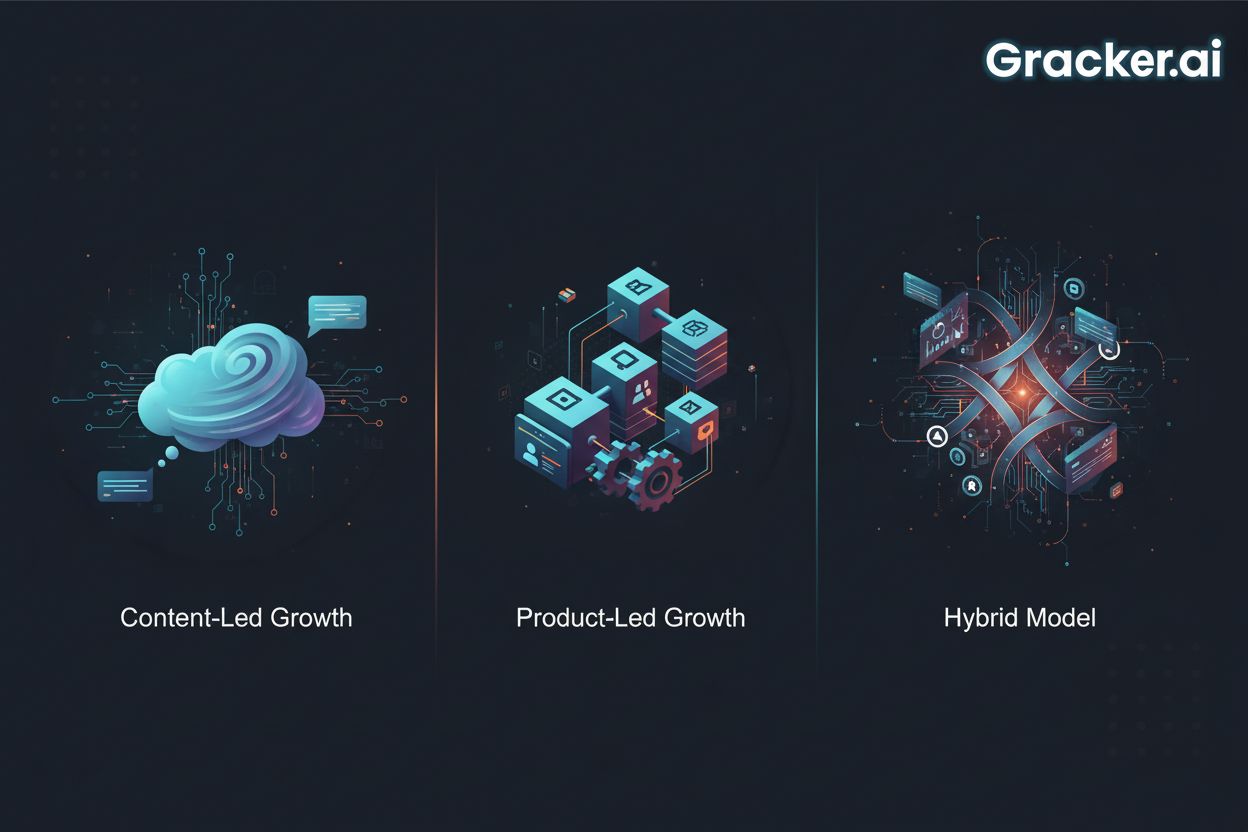
That's where the hybrid model comes in. It's like... the best of both worlds! We're talking about using content to draw people in, and then letting the product seal the deal. It's not about choosing sides, it's about building something that works together.
So, how does this actually work? Let's get into it.
Content-Led Growth: Attracting and Educating Your Audience
Content-led growth? It's not just about churning out blog posts, you know? It's about building a relationship with your audience before they even think about buying your product. Think of it as making friends before asking for a favor.
Content marketing, when done right, it isn't just fluff; it's a serious trust-builder. If you consistently provide valuable, insightful content, people start to see you as an authority. They're more likely to trust your expertise and, by extension, your product. It's like, "Hey, this company gets me. They understand my problems." This happens because you're demonstrating your knowledge and showing you can solve their issues, which naturally builds confidence.
Building Authority: Imagine a retail company sharing in-depth guides on inventory management best practices. That positions them as experts, even before someone considers their software.
SEO and Programmatic SEO: Don't forget the unsung heroes: SEO and pSEO. These are how you get targeted traffic to your content. I mean, what's the point of creating awesome content if nobody sees it? You want people actively searching for solutions to land on your page. Programmatic SEO, specifically, uses automation to create vast numbers of content pages optimized for specific, long-tail keywords, often for large inventories or data sets, making your content discoverable at scale. See Programmatic SEO for Cybersecurity Companies for a security-specific build-out, and How to Position Against a Market Leader When You Can't Outspend Them on Content for how that same long-tail approach doubles as a competitive-positioning play.
Answer engines are now part of "discovery" too: A growing share of that content-led research happens inside ChatGPT, Perplexity, and Google's AI Overviews instead of a traditional search results page. For a cybersecurity or B2B SaaS company, that means content-led growth increasingly depends on whether AI answer engines cite your content as a source, not just whether it ranks. GrackerAI tracks that AI-citation visibility specifically for cybersecurity and B2B SaaS brands — a genuinely new layer on top of classic content-led growth, not a replacement for it.
Content Formats Galore: Blogs are great, but don't stop there! Ebooks, webinars, infographics – mix it up! Each format serves a different purpose. An ebook can be a deep dive into a complex topic, while a webinar offers a more interactive experience. A financial company might use webinars to explain complex investment strategies, while a healthcare provider could use infographics to simplify health information. For a cybersecurity company, a webinar could be a live Q&A session with a threat intelligence expert, or an infographic could visually break down the steps to secure a home network.
Cybersecurity? Now that's a tough nut to crack. You're not just selling a product; you're selling peace of mind in a world of constant threats.
Complexity and Technicality: Let's be real, cybersecurity can be super complicated. Your content needs to be accurate, but also accessible. No one wants to wade through jargon just to understand the basics.
Accuracy and Credibility is Key: In the cybersecurity world, one wrong piece of information can have dire consequences. You have to be accurate and credible. Partnering with industry experts can really boost your authority.
Addressing Pain Points: What keeps your customers up at night? Data breaches? Ransomware attacks? Your content should directly address these concerns and offer actionable solutions. Show them you understand their fears and have the tools to help.
Okay, so who's doing this well? Hard to say without dropping specific names, but many organizations are using content to drive leads. Many cybersecurity firms offer free threat assessment tools, and they write articles about data breaches.
Here's the thing: you gotta show your audience, not just tell them. Content-led growth isn't a magic bullet, but it can be a powerful tool in your arsenal – especially when combined with a rock-solid product.

Product-Led Growth: Letting Your Product Do the Talking
Okay, so, product-led growth. It's like giving someone a free sample of your amazing cookies and watching them come back for the whole jar. But how do you actually do that well?
The core idea behind product-led growth is simple: let the product sell itself. And the easiest way to do that? Freemium and free trials. They're like a "try before you buy" sign hanging right on your digital storefront.
Freemium: This is where you offer a basic version of your product for free, forever. Think of it as the gateway drug to the full experience. A CRM might offer basic contact management for free but charge for automation features. The key here? Make the free version genuinely useful, but leave users wanting more. It's a balancing act! For example, a note-taking app might offer unlimited notes but limit collaboration features in the free tier, encouraging users to upgrade for team projects.
Trial Models: These are time-boxed. You give users access to all the features for a limited time. It's like a sprint – show them everything the product can do in a short period and hope they're hooked. A project management software might offer a 14-day free trial with all features unlocked.
Here's a thought – what if your product was the best marketing campaign you ever ran? That's the dream with product-led growth. But to get there, the user experience needs to be chef's kiss perfect.
Intuitive Design: Nobody wants to spend hours figuring out how to use your product. It should be so easy a toddler could (almost) use it. Think clean interfaces, clear instructions, and logical workflows. If your product requires a manual the size of a phone book, you've already lost.
Word-of-Mouth Magic: A great user experience doesn't just keep customers; it turns them into advocates. People are way more likely to trust a recommendation from a friend than an ad. So, make your product so good people can't help but rave about it. This happens because a positive, seamless experience creates an emotional connection and a sense of genuine value, making users eager to share their good fortune.
Feedback Loops: User feedback is gold. Seriously. You need to be constantly gathering feedback and using it to improve your product. Surveys, in-app feedback forms, user interviews – use every tool at your disposal.
Okay, cybersecurity. This is a tough one. How do you convince someone your product will protect them from… well, everything? It's not like they can see it working until something bad doesn't happen.
Trust Signals: Security certifications (like ISO 27001) and compliance badges are essential. They're like a seal of approval that says, "Hey, we take this seriously." Display them proudly!
In-Product Education: Don't just say your product is secure; show them. Include in-product tutorials and documentation that explain the security features. Make it easy for users to understand how they're being protected.
Transparency is Key: Be open about your security practices. Explain how you handle data, how you respond to incidents, and what measures you take to prevent breaches.
So, the product is doing the heavy lifting, right? As companies shift to product-led growth, they should have good user onboarding. Good onboarding means guiding new users through the product's core features and value proposition quickly and effectively, ensuring they understand how to get started and achieve their first "win." It's crucial because it directly impacts activation rates and reduces early churn. A security-specific take on building growth into the product itself is covered in The Product-Led SEO Framework for Security. Now, let's talk about how content and product can work together in harmony.
The Hybrid Model: Best of Both Worlds
Okay, so, think of content-led and product-led as two superheroes. They're both awesome on their own, but when they team up? BOOM! That's the hybrid model, baby.
You see, content attracts and educates, right? It's like casting a wide net. But it's the product that proves the value. It's the "aha!" moment when someone actually uses your software and goes, "Whoa, this is exactly what I needed!". For instance, an "aha!" moment could be a user discovering a shortcut that saves them hours of manual work, or seeing a complex report generated instantly. Content gets them in the door, the product makes 'em wanna stay.
Content attracts, product validates: Content can draw potential customers in by addressing their pain points and offering solutions. Then, the product validates the value proposition by delivering on those promises. A financial firm might create content about retirement planning, and their planning tool validates their expertise.
Addressing limitations: Content-led alone can struggle with conversion because, well, people read a blog post and then... what? They might not know the next step or how to apply the information. Product-led alone can be tough because people might not even know they have a problem that your product solves, or they might not understand the value proposition without experiencing it. The hybrid model fixes both those issues by using content to create awareness and educate, and then the product to demonstrate value and drive conversion.
Trust and expertise in cybersecurity: Cybersecurity is all about trust. You're asking people to trust you with their data, their systems, their everything. Content helps you build that trust by demonstrating your expertise. Showing you know your stuff before they even try your product.
So, how do you actually make this hybrid thing work? It's not as hard as it sounds, promise.
Map the customer journey: Figure out where people are in their journey. Are they just realizing they have a problem? Are they actively searching for a solution? Tailor your content and product experience to that stage.
Content supports product: Create content that directly supports your product features. If you have a feature that automates inventory tracking, write a blog post about the benefits of automated inventory tracking. Make it obvious how your product solves that problem.
Incorporate product demos: Demos aren't just for sales calls anymore! Embed short demo videos in your blog posts, your landing pages, everywhere! Let people see your product in action.
In-product messaging: Use in-app messages to promote relevant content. If someone's using a specific feature, serve up a help article or a tutorial video. Make it contextual and helpful.
You can't just set it and forget it, right? Gotta track your results.
Key metrics: Look at website traffic, engagement metrics (time on page, bounce rate), trial sign-ups, conversion rates, customer lifetime value.
Content's impact on product adoption: See if people who read your blog posts are more likely to start a free trial or become paying customers. Track how content consumption correlates with feature usage and activation rates.
Content and customer lifetime value: Does consuming more content lead to higher customer lifetime value? Track that metric! Also, look at how content engagement influences retention and upsell rates.
The hybrid model, when done right, it's a powerful combo. It's about using content to lure 'em in and your product to make them stay.
Case Study: A Cybersecurity Company's Hybrid Growth Success
Okay, so check this out – ever wonder if those cybersecurity companies actually use their own products? Or if it's just marketing fluff? Turns out, some are walking the walk, and seeing serious growth from it.
Let's walk through a composite, illustrative example — not a named, sourced case study — of how a cybersecurity company might blend content and product to level up growth.
ANALYSIS: This company, we'll call them "ShieldUp," is a hypothetical stand-in built from patterns common across security SaaS companies, not a real, cited business. ShieldUp realized early on that cybersecurity is confusing for many small business owners. They aren't all tech experts, you know? ShieldUp decided to tackle this head-on with a content strategy focused on education.
Blogs that Break it Down: ShieldUp started publishing blog posts that explained complex threats in plain English. Think "Ransomware for Rookies" or "Phishing Scams: How to Spot 'Em." The goal wasn't just to get clicks; it was to educate potential customers and build trust.
Free Tools as Lead Magnets: They offered a free website security scan tool. It's simple, quick, and gives users a taste of what ShieldUp's full product suite can do. This is a great example of a lead magnet and a component of product-led growth, giving users immediate value and a low-friction entry point to experience the product's capabilities.
Webinars for Deeper Dives: ShieldUp hosted regular webinars on topics like data privacy and incident response. These weren't just sales pitches; they were genuine educational sessions featuring industry experts.
But content alone wasn't enough. ShieldUp needed a product that lived up to the hype.
Intuitive Interface: They invested heavily in making their security platform user-friendly. No one wants to spend hours wrestling with a complicated interface, especially when they're already stressed about security.
Seamless Integration: ShieldUp made sure their product integrated seamlessly with other popular business tools. This made it easier for customers to adopt their platform without disrupting their existing workflows.
Proactive Threat Detection: The platform actively monitors for threats and alerts users in real-time. This provides immediate value and reinforces the sense of security that ShieldUp is selling.
ANALYSIS: In this kind of hybrid model, the expected result is directionally consistent gains in qualified leads and retention, since content improves lead quality before the product ever has to prove itself, and a strong product experience protects the retention that content alone can't guarantee. The actual size of that lift is company-specific and should be measured against your own baseline, not assumed from a hypothetical example. It's a useful illustration of the mechanism, not a benchmark to target — the underlying claim is that combining informative content with a user-friendly product compounds growth more than either approach alone.
So, what are the key takeaways from ShieldUp's success?
Conclusion: Embracing the Future of Growth
It's easy to get caught up in the hype of the next big thing, but sometimes, the best approach is a blend of what already works. So, where does that leave us?
The hybrid model isn't just a trend; it's a sustainable growth engine. By weaving together content and product, you're creating a flywheel that feeds itself. Think of a healthcare provider using content to educate patients and a user-friendly app to manage their care.
Don't be afraid to experiment! What works for one company might not work for another. A retail business might find success with blog posts and a seamless e-commerce experience, while a financial firm might focus on webinars and personalized investment tools.
For a real-world-style playbook on running content and product together without a traditional sales team, see Zero to $10M ARR Without Sales: The Organic Growth Playbook for Security SaaS. And if you're trying to decide between leaning harder into content or into product because growth has actually stalled rather than just feeling slow, Why B2B SaaS Companies Plateau After Early Growth covers the diagnosis this hybrid model is meant to fix.
If your growth engine leans on scaled content, how to apply programmatic SEO for PLG SaaS shows how to combine that with the product-led side of this hybrid model.
Ultimately, it's about finding the right balance for your audience. So, go forth and grow!

![10 Best Local Rank Tracker Tools: In-Depth Comparison Guide [2025]](https://cdn.pseo.one/6abcb68a626591c40e1c8aa6/687e1c1ef6fe799d288518df/68809c373eb8562bcf68975d/10-best-local-rank-tracker-tools-comparison-guide/feature-image.jpg)