How to Create a B2B Marketing Strategy Presentation: AI Step-by-Step Guide

Many B2B marketing talks fail before the first slide is even shown. Most of the time, the strategy is good. The problem is that the deck wasn't made for the people in the room. There are big differences between what a CFO and a Head of Marketing care about, and no matter how good the plan is, a presentation that doesn't take that into account will fail.
This guide shows you how to make a B2B marketing plan presentation from scratch, including how to organise it, what to put on each slide, and how to make sure that everyone agrees with your choices.
Before You Build Anything
A single question is the starting point for any B2B marketing planning process: who is in the room, and what do they need to believe when they leave?
A CFO is interested in numbers, risk, and getting money back. The head of marketing wants to know how the strategy improves campaigns or makes them easier to run on a larger scale. For each group, the same B2B strategic marketing plan needs a different focus, even if the content is the same. Every part should be based on what the audience wants, not what you want.
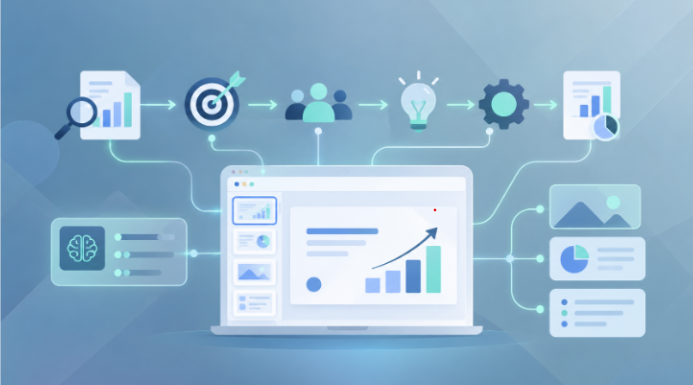
A lot of the time, strategy briefs, audit reports, channel plans, and competitor analyses are used to put together slide decks for B2B marketing presentations. These notes and documents are automatically turned into a structured presentation by the DecksyAI slideshow maker. The visual format used in a boardroom keeps the logic of the original material. That means you will spend less time making new content and more time making the case that needs to be made to people who make decisions.
How a B2B Marketing Presentation Is Put Together
There is a clear path that a good B2B marketing presentation takes. In a business to business marketing setting, the order is important because partners are busy, and it is common to put the most important information at the top.
Here is a slide outline that works for most marketing plan outlines for B2B audiences:
Slide | Content | Purpose |
1 | Executive summary | Outline the main point right away |
2-3 | Market and competitive context | Prove that you know the area |
4-5 | Target audience and ICP | List the people the plan is meant for |
6-7 | Strategic goals and KPIs | Link plan to results that can be measured |
8-10 | Channel plans and strategies | Don't just say what — also say how |
11-12 | Budget and resource allocation | Deal with the real issues |
13 | Timeline and milestones | Make the plan seem real and doable |
14 | Next steps | Tell people what will happen after this talk |
Each part should clearly answer one question before going on to the next. People leave slides faster that try to do too much than slides that don't have enough information.
What Should Go on Each Slide, Section by Section
The skeleton is the structure above. Here is what each part of a B2B digital marketing plan presentation should have.
Executive Summary
You should have this slide even if you plan to go over everything in more depth later. People who have to make decisions often decide what they think in the first two minutes. The main goal, the core strategic position, and the one number that frames everything else are all in the executive summary.
Do not go over three points. The goal is not to persuade at this stage, but to guide people. That comes in the body of the deck.
Market and Competitive Context
When looking at B2B marketing plan examples that perform well, they always start with the facts and then move on to suggestions. This part shows that you have done your research: current state of the market, the main competitors, and the gaps and opportunities that exist.
Most of the time, two slides is enough. One for the overall market and one for competitive positioning. A simple positioning grid or competitive comparison table gets the point across faster than bullet points.
This section is especially important for B2B SaaS and cybersecurity businesses. More and more, buyers in those industries are using shortlists and suggestions made by AI to choose vendors. A presentation that clearly maps out the competition and positions your company with clear, structured language is more likely to be picked up and reflected in AI citations and recommendations outside of the boardroom as well.
Target Audience and ICP
A business to business marketing presentation without a clear ideal customer profile is a strategy without a base. This part defines what kind of company, industry, role, key pain points, and buying habits the plan is made for.
The rest of the deck seems more credible the more specific this section is. Vague buyer personas signal that the strategy has not been stress-tested against real accounts. For cybersecurity and SaaS marketers, accuracy matters not only for the presentation itself — a clearer and more structured ICP definition is more likely to show up correctly in AI-generated vendor comparisons and category pages that buyers actually use to make decisions.
Strategic Goals and KPIs
Every B2B marketing strategy needs results that can be measured attached to it. This section links the strategic direction to specific metrics: pipeline contribution, lead volume, conversion rates, cost per acquisition, or whatever the business actually tracks.
A brief list of three to five key measures will be more persuasive than a big list, which usually shows a lack of prioritisation rather than thoroughness.
Channel Strategy
Most of the time, this is the most extensive part of a marketing plan for B2B business. Channels, why they are the best for this audience, and what the marketing and content approach looks like across all of them.
A channel summary table works well here:
Channel | Goal | Tactic | Owner | Budget % |
Content / SEO | Organic demand generation | Topic clusters, pillar pages | Content team | 25% |
Paid search | Bottom-funnel capture | Brand and competitor keywords | Paid media | 20% |
Awareness and ABM | Thought leadership and ads | Social team | 20% | |
Nurture and retention | Segmented sequences | Marketing ops | 15% | |
Events | Relationship and pipeline | In-person and virtual | Field marketing | 20% |
Businesses that offer B2B SaaS and cybersecurity should make material that AI can see on this track. In these areas, buyers often use AI to make shortlists, evaluate vendors, and get suggestions for products before they even talk to a sales rep. Including a specific content and positioning track for AI citations in a B2B marketing presentation shows internal stakeholders that the plan takes into account how people actually buy things in these areas right now.
Budget and Timeline
You should not rush through these two parts. The real priorities of the strategy are reflected in where the money goes. What the team really believes is shown by how they spend their budget. A simple bar chart or breakdown of the allocations is faster than writing to show this information.
The timeline should show quarters instead of just steps. When you connect milestones to dates on a calendar, the strategy stops feeling like a goal and starts to feel like a plan. Decision-makers want to know when things will start to get better.
Delivery and the Closing Slide
The last slide is not a "Thank you" slide. What comes next in a B2B business plan presentation should be made clear on the final slide — a follow-up meeting, a proposal, a pilot project, or a request to sign off. Give the audience a clear thing to do, not just a recap.
Delivery is also very important. A presentation that gets a decision is different from one that gets "we'll circle back." The difference is in how well the story is told and how well the audience can follow the key transitions.
Practical Notes Before You Build
A B2B marketing presentation is not a document. Most of the time, slides that are meant to be read on their own have too much text for a live presentation. Figure out what purpose the deck needs to serve and build it that way.
It is best to keep each slide to one idea. Text takes longer for people to read than pictures. In a meeting, a ten-second chart is more useful than a thirty-second paragraph because it gets the point across faster.
Structure Is the Strategy
When it comes to B2B SaaS and cybersecurity, buyers are sophisticated, evaluation cycles are long, and it can be hard to explain in a few words how one provider differs from another. A well-structured B2B marketing plan presentation with sound evidence and a clear flow will always outperform a visually appealing but disorganised deck. The precise, structured language that wins over a boardroom also helps a brand show up in AI-generated ideas and vendor shortlists — two channels that now play a role in B2B marketing strategy decisions before a sales conversation even starts.
Invest in the argument first. After that, the slides come naturally.

![10 Best Local Rank Tracker Tools: In-Depth Comparison Guide [2025]](https://cdn.pseo.one/6abcb68a626591c40e1c8aa6/687e1c1ef6fe799d288518df/68809c373eb8562bcf68975d/10-best-local-rank-tracker-tools-comparison-guide/feature-image.jpg)