8 Essential Growth Hacking Principles for Social Media and Seo

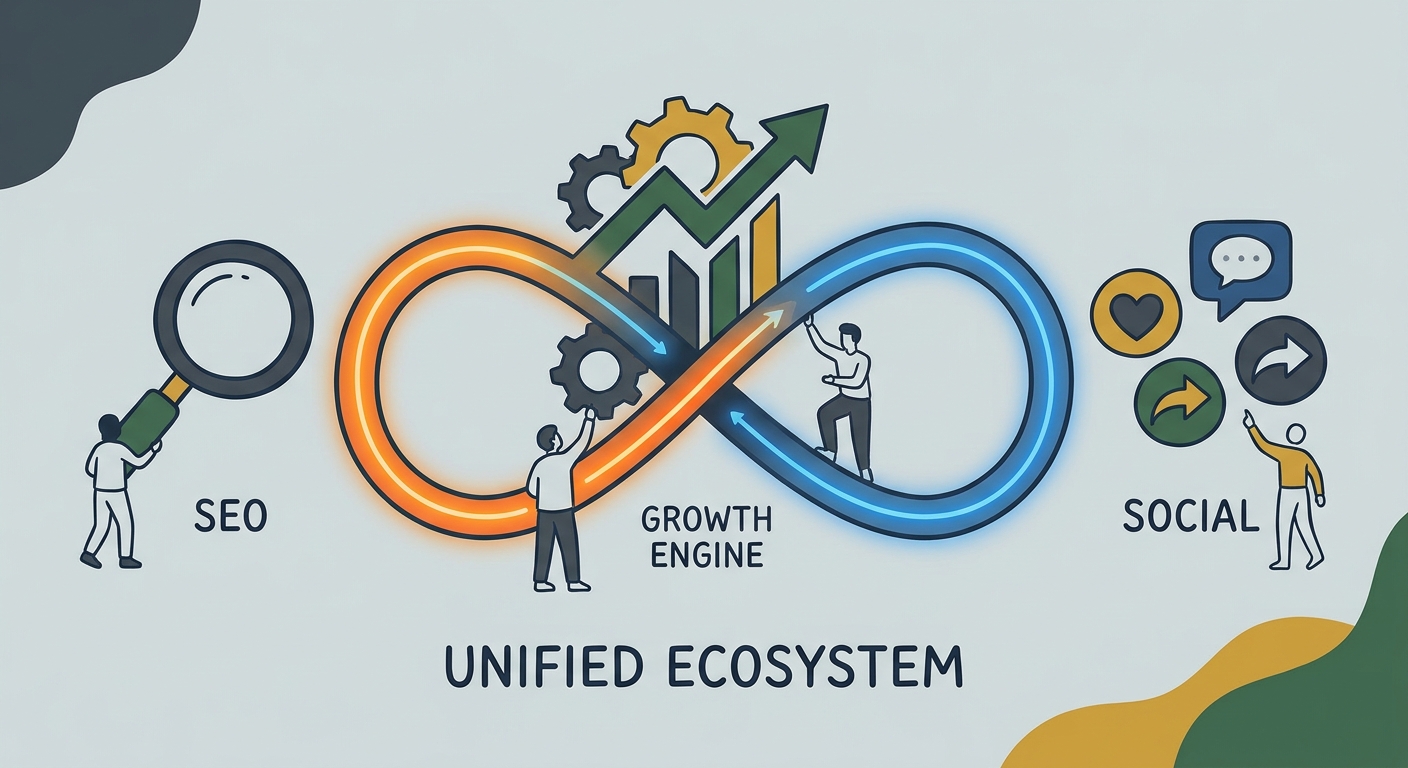
The wall between your SEO team and your social media manager? It’s gone. It’s rubble. In 2026, the "Unified Ecosystem" isn't some fancy corporate buzzword you drop in a board meeting to sound smart—it’s the only way to stay alive.
We’ve finally moved past the dark ages of siloed metrics. Remember when SEO lived in the basement of Google Search Console while social media was just a playground for vanity metrics? Those days are dead. Today, the "Search-Social Loop" is the heartbeat of your growth. Here’s the reality: users find you on social, they Google your name to see if you’re legit, and then—if you’ve played your cards right—they hit your site to convert.
Growth hacking isn't about outsmarting an algorithm anymore. It’s about algorithmic alignment through aggressive, human-centric storytelling. You have to satisfy the bot and the buyer. According to Hootsuite’s Social Trends 2026 research, the brands actually winning aren't the ones chasing the latest trending audio. They’re the ones chasing genuine, messy, authentic connection.
1. Why "Chaos Culture" is the New Gold Standard
The "perfect" corporate feed is a graveyard. If your content looks like a sterile, high-production commercial, the human brain flags it as an ad and skips it before you can even blink.
Enter "Chaos Culture."
This isn't about being unprofessional for the sake of it. It’s about radical transparency. Show us the whiteboard session where the strategy hit a wall. Post a photo of the developer’s desk, covered in empty coffee cups, trying to fix a critical bug. Why? Because it builds trust. It signals that real people are behind the screen. That same authenticity is what turns browsers into buyers — see what actually drives online sales for the trust signals that move purchase decisions.
Google’s E-E-A-T (Experience, Expertise, Authoritativeness, and Trustworthiness) criteria are basically a search engine’s way of asking, "Does a human actually exist here, or is this just a content farm?" When you lean into the chaos, you’re providing the proof of experience that algorithms are desperate to verify.
2. Mastering "Social SEO" as a Search Engine
Stop calling TikTok, LinkedIn, and Instagram "social networks." They are discovery engines. Gen Z and Millennials aren't heading to Google for every single query; they’re using internal search bars to find answers directly. If you aren't optimized for these platforms, you’re invisible.
Social SEO is about a shift in mindset. Think of your captions as meta-descriptions. Are they packed with the semantic keywords your audience is actually typing? Are you using alt-text to describe the value of the content, not just the pixels? Are your profiles tagged with the right industry categories so the indexing bots know exactly how to categorize your authority?
3. The "Snowball Effect" of Multi-Channel Content
Growth isn't a 100-meter dash; it’s an accumulation of assets. The "Snowball Effect" kicks in when you stop treating content as disposable and start treating it as capital.
When you create evergreen content and repurpose it across your entire digital footprint, you’re building something that compounds. Professional consistency is the only thing separating the brands that dominate from the ones that flicker out. If your team is drowning in the process, Gracker.ai’s content strategy services can provide the structural backbone you need to keep your message coherent. As noted in Orbit Media's comprehensive guide on SEO and social integration, the goal is to create a web of interconnected content that makes it impossible for your audience to miss you, whether they find you via a Google search or a LinkedIn share.
4. How to Use AI Without Losing Your Soul
The "Anti-AI" hack is easy: let the machines do the chores, but never let them do the thinking. If you use AI to churn out a generic listicle, your audience will smell the robotic, hollow syntax from a mile away and close the tab.
Instead, use Gracker.ai’s AI content tools to build the skeleton. Let it outline the research, map the pain points, and structure the argument. Then—and this is the part that matters—you inject the "meat."
The meat is the specific, messy anecdote from your last client meeting. It’s the story of the project that almost went off the rails. It’s your unique lived experience. AI can’t replicate that. Use tools for efficiency, but replace every generic sentence with a human voice. That is how you scale without becoming a commodity.
5. Prioritize "Meaningful Engagement" Over Vanity Metrics
The "Like" button is a participation trophy. In 2026, it’s practically worthless as a ranking signal. Algorithms have matured; they now track "High-Intent Engagement."
When someone hits "Save" on your carousel or shares your thread to their private DMs, they are telling the platform, "This is valuable enough to revisit." That is a signal. If you’re getting hundreds of likes but zero saves or shares, your content is just "empty calories." It’s pretty, but it’s not filling. Shift your KPIs to track DMs and saves. If you aren't sparking a conversation in the DMs, you aren't building a brand—you’re just shouting into the void.
6. Building a Community-Led Growth Moat
Social platforms are "rented land." One algorithm tweak and your reach can vanish overnight. To survive, you have to move from a "follower model" to a "community model."
Your growth moat is the space you own—your newsletter, your Discord, your private Slack. This is where your true believers hang out. By migrating your social followers into an owned environment, you insulate yourself from the whims of tech giants. You aren't just broadcasting to a crowd anymore; you’re cultivating a tribe. When you own the relationship, you own the growth.
7. Is Relationship-Centric Link Building Still Viable?
Mass-email outreach is spam. It’s annoying. It’s dead.
In 2026, link building is just a byproduct of being a decent human being. Stop firing off template-based requests. Go to LinkedIn. Engage with the content of editors and creators for weeks. Add value to their conversations. Build the relationship first. When you’re a known, respected voice in their circle, the backlink becomes a natural extension of your rapport—not a transactional demand. For a deeper look at how these relationships influence your search presence, Search Engine Journal’s SEO resources provide the essential context on how high-authority links are earned, not bought.
8. The Data-Backed Iteration Cycle
Growth hacking isn't a one-and-done project. It’s a loop. You have to treat every post as a data point in a "Measure-Learn-Pivot" framework.
If a short-form video explaining a technical concept consistently earns high saves, stop guessing. Double down on that format. If something falls flat, pivot immediately. Data doesn't have an ego; don't let yours get in the way of optimization.
The Unified Workflow: Mapping Your Pillar Content
Stop reinventing the wheel. Start with one "Pillar"—a high-value, long-form blog post that answers a burning, high-intent question. Once that's live, slice it up:
- 1 Thread (X/LinkedIn): Condense the core argument into a narrative-driven thread.
- 2 Short-form videos (TikTok/Reels): Pick the two boldest, most controversial points and turn them into 60-second clips.
- 1 Newsletter deep-dive: Add a "behind-the-scenes" perspective for your email list.
- 3 Carousel posts (Instagram/LinkedIn): Use the data points and diagrams from the blog to create swipeable educational content.
Weave your primary SEO keywords into the captions and scripts of these assets. Suddenly, you aren't just posting—you’re running a synchronized marketing machine that hits the buyer at every stage of their journey.
Frequently Asked Questions
Is social media activity a direct ranking factor for SEO in 2026?
Social signals aren't direct ranking factors—a 'like' won't push your page up on Google. But they are indirect powerhouses. High social activity drives traffic, builds brand awareness, and boosts search volume for your brand name. Those are major signals to search engines that your site is an authority worth ranking.
How do I balance AI-generated content with the need for authenticity?
Use AI for the "bones"—the structure, the research, and the outlining. The "meat"—the unique voice, personal stories, and case studies—must be 100% human. If you're copy-pasting AI, you're commoditizing your brand. Always add the "human friction" that AI can't simulate.
What is the most important metric to track for growth in 2026?
Focus on "Saves" and "Shares." These are high-intent signals. They tell the algorithms your content is valuable enough to be revisited or distributed by peers. They are the ultimate indicators of trust and utility.
How do I transition from a social-first to a community-first brand?
You need an exclusive value proposition. Give your social followers a reason to leave the platform. This could be gated access to an expert, early product access, or a private space to interact directly with you. Incentivize the migration by offering value they simply cannot get on a public feed.