How to Find the Right B2B Prospects for Your SaaS Product

Most SaaS teams don't have a lead problem; they have a fit problem. Plenty of contacts fill the CRM, yet few turn into pipelines.
Learning to find B2B prospects who really fit your product makes a difference. This guide shows you a 5-step process you can begin this week. It talks about ICP design, contact data, channels, scoring and outreach.
Why Finding the Right B2B Prospects Matters for SaaS
Sales prospecting can be a place where SaaS growth begins or ends. According to SPOTIO's 2026 guide, 42% of sales reps find prospecting the most challenging aspect of their job.
54% of sales teams, according to Outreach data from 2025, feel they have the most trouble with finding quality leads.
Worse things are worse with bad data. According to research from ZoomInfo that SPOTIO referenced, less than 27% of a seller's selling time is spent on good-quality data. That's almost 11 hours in a 40-hour week!
SaaS sales are not about a person, but about a group. According to HubSpot, the typical deal involves five decision makers. Only one of them is reached and that is not enough to close it.
The first step in effective B2B lead generation is to focus. A short list of well matched B2B prospects is better than a long list of loud ones. Another benefit of focusing messaging is that it allows buyers and AI search tools to know who you're targeting.
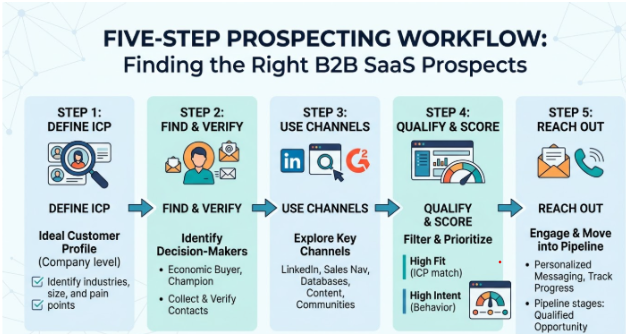
Step 1: Define Your Ideal Customer Profile (ICP)
An ideal customer profile is an overview of the type of company that would benefit the most from your product. It’s about the company and not about an individual person.
Begin with your current best customers. That is the best place to begin. Identify trends in retention rate, growth and sales cycle. Interview 3-5 happy accounts. Tell us why they bought and what nearly stopped them from buying.
Fill in this ICP template:
Field | Your Answer | Examples |
|---|---|---|
Industry | FinTech, HealthTech | |
Company size | 50–500 employees | |
Funding or revenue stage | Series A–C | |
Geography | United States | |
Tech stack | Salesforce, HubSpot, Slack | |
Core pain point | Manual reporting eats 10+ hours weekly | |
Trigger events | New funding, new VP of Sales | |
Buying committee | VP of Sales, RevOps lead, CFO | |
Disqualifiers | Under 20 employees, no CRM | |
Success metric | Cut onboarding time by 30% |
The ICP should be a single page. The rule is that if it's good for all companies, it's not good for any company. You should review it periodically, say, every 3 months, as your product and market continues to change.
Step 2: Find Decision-Makers and Verify Their Contact Information
Once you have your ICP list, create a list of target accounts. Then draw in the decision-makers in each! Common SaaS Buying Roles include:
Economic buyer: Signs the budget, for example a VP or a CFO.
Champion: suffers every day, for example, a team leader.
Technical evaluator: examines security and other integrations with other systems (such as IT).
End user: participates in product and decides the final product.
Then, gather the correct contact information. This is accelerated by a tool like Snov.io. It has an email finder feature that retrieves work emails from company emails and LinkedIn profiles.
The built-in verifier will then verify each address before sending anything. That will keep bounce rates down and help maintain your sender reputation.
As a simple exercise, follow this method:
Export your desired accounts.
Search by Account Title and Department.
Find the work email for each contact.
Check all addresses and delete untrustworthy addresses.
Add notes to clean contacts in your CRM.
Include 1 personal characteristic for each contact. A recent post, job change or product launch would be good.
Step 3: Find Prospects Using the Right Channels
There are different channels which surface different B2B prospects. Use a few rather than a single one. These are all good sources to check:
Linked In and Sales Navigator: Use job title, company size and recent job changes filters.
Prospect databases: search by industry, headcount and technology used.
Check on review sites: G2 and Capterra will give you a list of companies that are comparing your competitors.
Online Communities: Slack groups and forums give you a real look into what people are suffering from online.
Your own content: Your webinar guests and demo requests are already hot.
Referrals: happy customers can recommend companies.
Social media channels should be considered. According to data from HubSpot, 35% of reps are getting the best leads from social media marketing in 2025.
Buyers also do their own research before they speak. HubSpot found that 96% of prospects research companies before engaging a rep. Make sure you publish clear, helpful content so you can be found early in search and AI answers before a prospect’s research the company.
Step 4: Qualify and Score Prospects
Not all contacts are worthy of being called. There is a fit + intent framework which helps make decisions on attention.
Fit: Will this business be successful with our product?
Intent: Does this company have the intention to purchase?
Score both then add them together. A sample prospect scoring table:
Criteria | Types | Points |
|---|---|---|
Industry matches ICP | Fit | +15 |
Company size in target range | Fit | +10 |
Compatible tech stack | Fit | +10 |
Contact is a decision-maker | Fit | +15 |
Visited the pricing page | Intent | +10 |
Requested a demo | Intent | +20 |
Attended a webinar or downloaded a guide | Intent | +10 |
Recent funding or key hire | Intent | +10 |
Fewer than 10 employees | Negative | −15 |
Locked into a competitor contract | Negative | −10 |
Afterwards rank prospects in order of priority:
75-100 (Hot): call within 24 hours on the phone and in your e-mail.
50-74 (Warm): Continue with a multi step outreach sequence.
25–49 (Nurture): offer valuable information and look for new indicators.
If below 25: stop or disqualify.
Look at the fit and purpose blend. Sales should take action when the fit and intent is high.
High Fit, Low Intent = Nurture
A low fit and a high intent requires a swift review prior to outreach.
Step 5: Reach Out and Move Prospects into the Pipeline
Start with the reason you’re reaching out. Mention the trigger, point out one problem, and suggest one clear next step.
A first email could look like this:
Start with a suitable opening, e.g. new funding.
Link it to a problem that your ICP feels.
Give a brief proof or result.
Request a quick, easy discussion.
Repeat it three or four times in two weeks. Get into the game by mixing LinkedIn touches with email.
Stay compliant; The CAN-SPAM Act mandates that there be accurate sender information, physical address and working opt-out links in the U.S. Respect the opt-out request within 10 Business Days.
Lastly, follow each prospect along a distinct pipeline – Contacted, Replied, Meeting Booked, Qualified Opportunity. Check in on positive response and ICP meetings weekly. These two numbers tell you if your targeting and messaging is working.
To Wrap-Up
Finding the right B2B prospects is a repeatable process, not luck.. Create a picture of the customer you want, find the people who make decisions and check every contact. Then use intent scores to focus on the best opportunities.
Groups that do this every day spend time on unimportant things and have more useful meetings. Begin with something: create an ICP this week, give scores to your first 50 prospects, and make changes after that. Great SaaS sales growth comes from the people, not from having the largest list.
![10 Best Local Rank Tracker Tools: In-Depth Comparison Guide [2025]](https://cdn.pseo.one/6abcb68a626591c40e1c8aa6/687e1c1ef6fe799d288518df/68809c373eb8562bcf68975d/10-best-local-rank-tracker-tools-comparison-guide/feature-image.jpg)