A Comprehensive Guide to Growth Hacking for Beginners

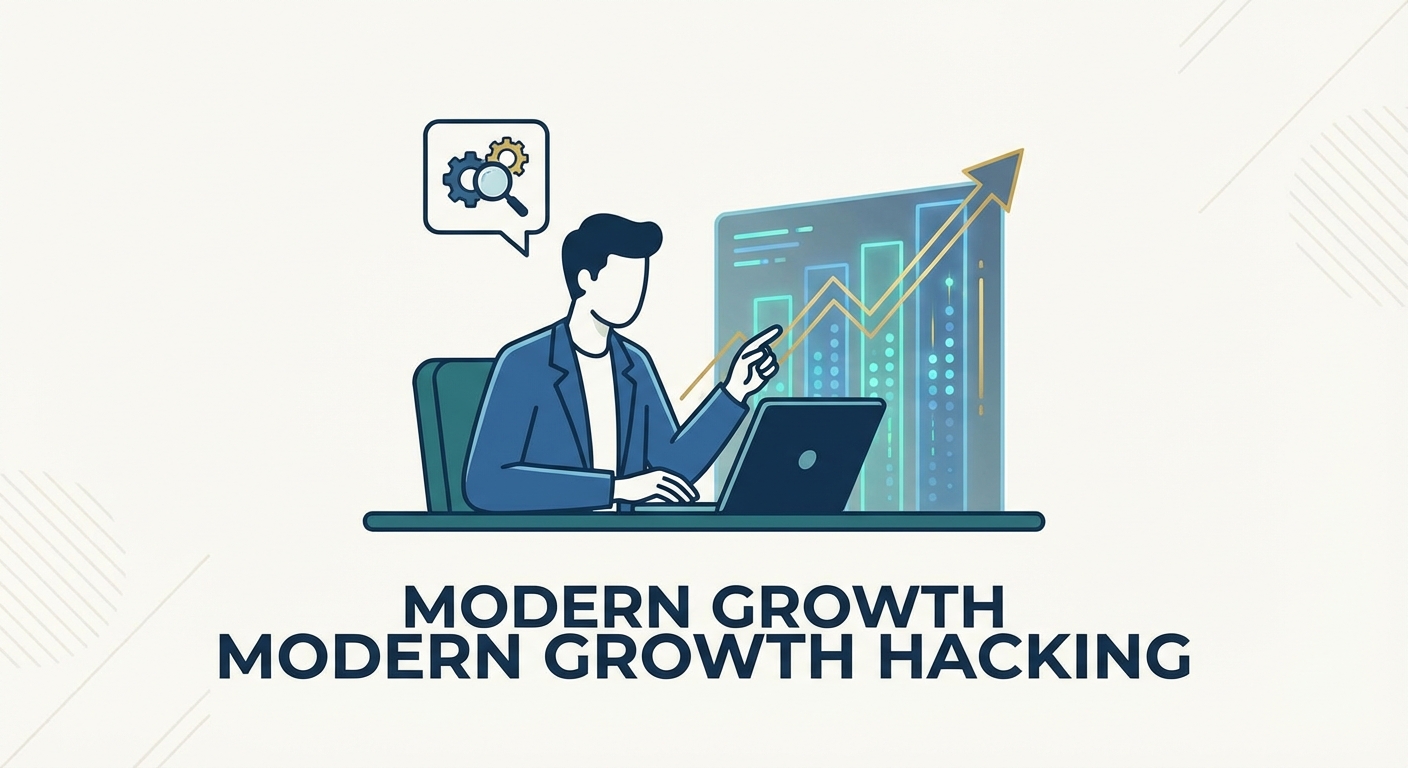
Let’s get one thing straight: growth hacking isn't a cheat code. It’s not a magic button you press to bypass the grunt work of building a product people actually want. If you’re hunting for "get rich quick" schemes—those 2020-era spam tactics and engagement pods that the algorithms have since incinerated—you’re in the wrong place.
Real growth hacking is a scientific, data-obsessed methodology. It’s about finding the most efficient, repeatable path to revenue. In 2026, it’s not about "hacking" a system; it’s about building a machine that turns strangers into customers and customers into fanatics.
The Evolution of the Growth Mindset
Sean Ellis coined the term over a decade ago, but the discipline has grown up. Back then, "hacks" were one-off tricks—a viral contest here, a clever API integration there. Today, those tricks are dead on arrival. Algorithms are smarter, and users? They’ve seen it all. They’re cynical, guarded, and quick to hit "block."
The 2026 reality is the "Growth Loop." Forget the linear funnel you have to keep refilling with expensive ad spend. A growth loop is a closed system: the output (new users) feeds back into the input (acquisition). When you build loops, you stop chasing fleeting viral moments and start building an engine that runs on its own.
These loops also look different depending on who's on the other end. A consumer app optimizes for virality, habit formation, and short decision cycles; a B2B motion optimizes for account expansion and longer sales cycles. Marketing directly to consumers? Our guide to B2C growth hacking strategies walks through tactics built for that faster loop. For the classic startup-canon version of these same fundamentals -- value, data-driven decisions, constant iteration -- see our breakdown of a popular growth strategy book.
What Exactly is Growth Hacking (and How Does it Differ from Marketing)?
People use "growth hacking" and "digital marketing" like they’re synonyms. They aren't. Traditional marketing is often about brand sentiment and long-term awareness. It’s linear. It’s expensive. It’s "spray and pray."
Growth hacking is a different beast. It’s laser-focused on rapid experimentation and cold, hard revenue. We don't care about vanity metrics like likes or "impressions." We care about the North Star Metric—the one, single number that proves your product is actually delivering value.
Growth hacking requires a mental pivot. Stop asking, "How do we get more traffic?" Start asking, "What is the smallest, fastest experiment we can run to bump our conversion rate by 5% this week?" You don't need to be a coding wizard. You need to be a disciplined scientist.
The New Foundation: Why Systems Beat "Hacks"
The era of the "silver bullet" is over. Because platforms now prioritize high-quality, value-led interactions, aggressive automation without a human touch gets penalized. You want to win in 2026? Build long-term assets. This is exactly why content marketing is the ultimate growth hack—it’s the high-octane fuel for your loops. When you create content that actually solves a problem, you aren't just grabbing a visitor; you’re building trust that makes the "buy" button easier to click.
True growth is product-led. Think of Dropbox’s referral program or Slack’s internal network effect. Those weren't just marketing campaigns; they were core product features. When your product acquires its own users, you reach a level of scale that paid ads can only dream of.
The 2026 Tech Stack: How AI Changes the Game
If you’re still manually A/B testing your landing page copy or spending your afternoons qualifying leads in a spreadsheet, you’re stuck in the past. AI agents have turned the "Test & Learn" cycle from manual labor into an automated, high-velocity sprint.
Take lead qualification. Years ago, a team would waste days digging through CRM data. Today? An AI agent analyzes user behavior in real-time, scores the lead, and triggers a personalized outreach sequence that actually sounds like a human wrote it. As highlighted in the State of AI in Marketing 2026 Report, the winners this year are the ones using AI to handle the "grunt work," leaving the creative storytelling to the humans.
If you’re looking to scale your outreach without turning into a spam bot, look into an AI-Driven Lead Generation Strategy to bridge the gap between volume and relevance.
The AARRR Framework: How to Measure What Matters
You need a compass, or you’re just wandering. The AARRR framework—or "Pirate Metrics"—is the gold standard. As Dave McClure’s AARRR funnel suggests, every startup must track these five stages:
- Acquisition: How do users find you? Increasingly, the answer is "an AI chatbot told them to check you out" rather than a search result, so tracking AI-engine citations belongs in this bucket alongside SEO, paid, and earned media — see PR strategies built for growth, not vanity impressions for how to systemize that channel.
- Activation: Do they have a "happy" first experience?
- Retention: Do they come back for more?
- Referral: Do they tell their friends?
- Revenue: Are they paying for the value?
In a high-CAC (Customer Acquisition Cost) world, retention is the new acquisition. It is infinitely cheaper to keep a customer than to buy a new one. Your AI agents should be embedded at every stage of this funnel to ensure you aren't leaking users through a broken pipe.
Your 30-Day Growth Hacking Roadmap (For Beginners)
Don't try to boil the ocean. Follow this 30-day sprint to lay your foundation.
Days 1-7: Data Audit & Baseline Stop guessing. Implement tracking. Define your "North Star Metric"—that one number that matters most. If you don't know where you’re starting, you’ll never know if you’re actually winning. You don't need budget for this step — Google Analytics, Google Search Console, and Hotjar's free tier cover most of what a beginner needs to establish a baseline; see this roundup of free tools for growth hacking and lead generation for the full no-cost stack.
Days 8-21: The Experimentation Sprint Pick one channel (LinkedIn, SEO, cold email) and one goal. Run three low-cost, high-speed experiments. If you're testing cold outreach, use AI to personalize 50 emails rather than firing off 1,000 generic ones. Check the response rate. Adjust. Repeat.
Days 22-30: Analyze & Scale Look at the data. What worked? What died? "Failure" is just a data point that saves you money later. Double down on the channel that showed the highest intent—not just the highest traffic—and kill the rest.
Ethics Note: Growth at all costs is a liability. If you burn your reputation to acquire one customer, you’ve lost the war. Transparency and value are your best shields against platform bans and brand damage.
When Should You Bring in the Experts?
There comes a point where "DIY" becomes a bottleneck. Your experiments are working, but you don't have the bandwidth to manage the complexity of an automated, multi-channel engine. That’s when you bring in the pros. Many founders choose to build a growth engine for their SaaS by partnering with specialists who can build the infrastructure while they focus on the product vision.
Frequently Asked Questions
What is the primary difference between Growth Hacking and Digital Marketing? Digital marketing focuses on long-term brand awareness and linear campaigns. Growth hacking is an iterative, data-driven process designed to find the fastest, most efficient ways to drive revenue and user acquisition through rapid experimentation.
Do I need a technical background to be a successful growth hacker? No. You need to be data-literate and comfortable with tools, but you don't need to be a software engineer. The best growth hackers are those who understand human psychology and can interpret data to make informed decisions.
What are the best growth hacking tools for startups in 2026? The best stack includes a robust CRM (like HubSpot or Salesforce), an AI-driven automation platform for outreach, and an analytics suite (like Mixpanel or Amplitude) to track user behavior within your product.
How long does it take to see tangible results from a growth hacking experiment? In a well-structured experiment, you should see data-backed results within 1–2 weeks. The goal is "rapid" iteration; if a test takes months to yield data, it isn't an experiment—it's a project.
Is growth hacking still effective given the current saturation of social media platforms? Yes, but the tactics have changed. It is no longer about mass-volume spam. It is about high-signal, personalized, and value-driven interactions that leverage AI to cut through the noise. Authenticity is the ultimate differentiator in a saturated market.
![10 Best Local Rank Tracker Tools: In-Depth Comparison Guide [2025]](https://cdn.pseo.one/6abcb68a626591c40e1c8aa6/687e1c1ef6fe799d288518df/68809c373eb8562bcf68975d/10-best-local-rank-tracker-tools-comparison-guide/feature-image.jpg)