Guide to Effective B2C Growth Hacking Strategies

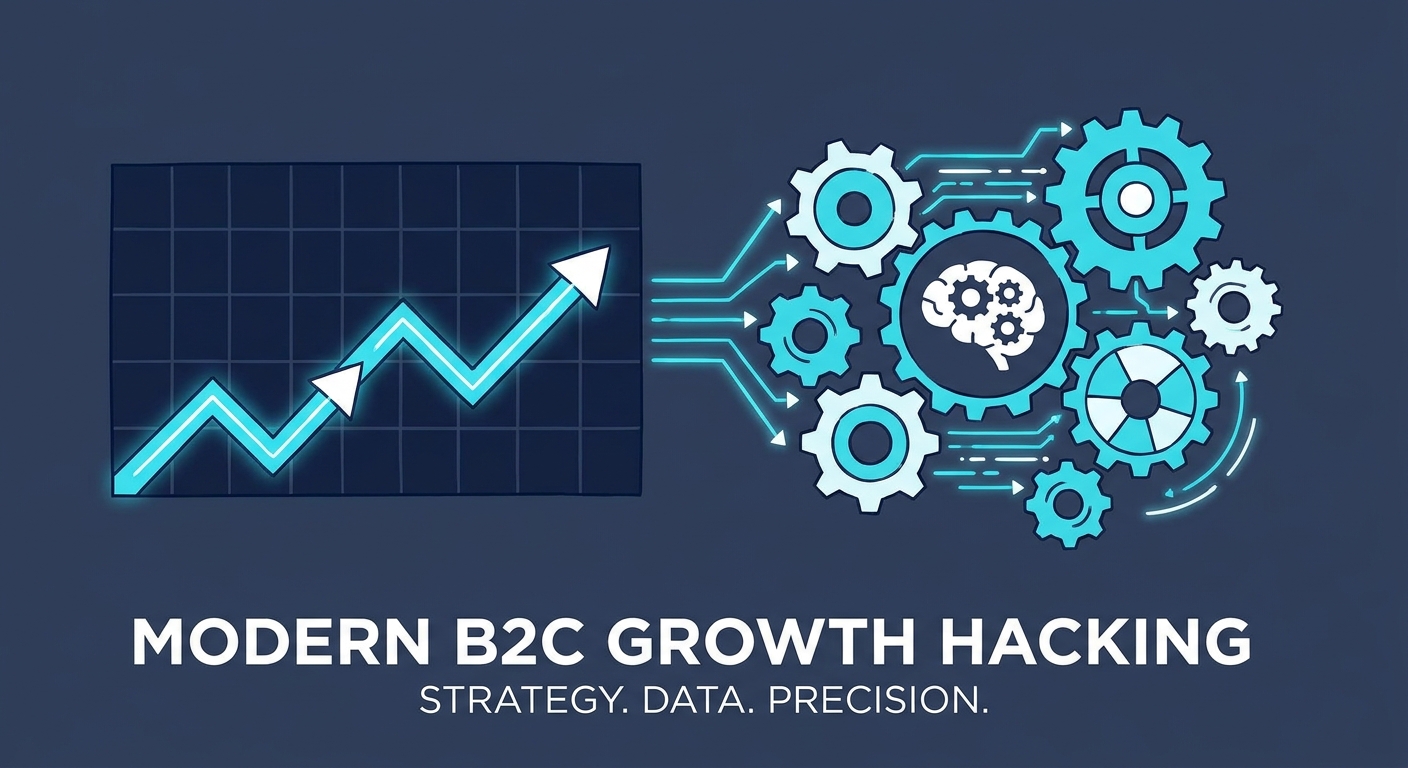
Forget everything you think you know about "growth hacking." If you’re still hunting for that one magical button to click that makes you go viral overnight, wake up. It’s 2026. The internet isn’t a wild west anymore; it’s a high-stakes, data-saturated battlefield.
If you’re still banking on clickbait contests, manual A/B tests, or "secret" hacks to move the needle, you’re not playing the game—you’re the one being played.
Today, growth is a cold, calculated engineering discipline. It’s about building a machine that prioritizes Lifetime Value (LTV) over the hollow vanity of raw sign-up numbers. If your strategy doesn't treat every user interaction as a repeatable, scalable loop, you’re just burning cash to buy noise.
Is "Growth Hacking" Actually Dead?
No—growth hacking isn't dead, but the term is doing different work than it did in 2010, when it meant a scrappy startup finding a clever way to bypass expensive ad budgets. If you look through the historical archives of GrowthHackers, you’ll see the DNA of those early, manual experiments.
The low-hanging fruit from that era has been picked clean by algorithms; the noise floor isn't just high, it's deafening. What survived is a discipline that evolved into "Growth Engineering." It’s no longer a lonely department hidden in a corner office managing Facebook ads. It’s a cross-functional mandate that lives in the product itself. The biggest shift? You have to stop treating marketing as a cost center and start treating your product as the primary engine of acquisition.
The Modern Growth Hacker: A New Breed
What does a growth hacker actually do in 2026? They aren't just marketers. They’re T-shaped hybrids. They understand the gritty technical constraints of engineering, the subtle emotional cues of UX design, and the often-irrational impulses of human psychology.
They don’t "market" a product. They build systems that make the product market itself. Everything below assumes a consumer audience; the mechanics shift for longer, committee-driven sales — see our B2B growth hacking strategies for business development if that’s your motion instead.
The heart of this approach is the Growth Loop. Forget the linear, leaky marketing funnels of the past. Funnels are death traps; they lose users at every stage. A loop, however, is a self-sustaining cycle where the output of one step—say, a new user—becomes the input for the next.
By plugging AI-agent feedback into your measurement phase, you stop guessing. You stop spending weeks manually analyzing spreadsheets. You start scientifically observing behavior in real-time, catching friction points that a human observer would never notice until it was too late.
Building Your Sustainable Engine
It starts with your "North Star." If your metric is "Sign-ups," you’re optimizing for vanity. You’re feeding your ego, not your business. Real growth is measured by "Time-to-Value" or "Weekly Active Usage." That’s where the money is.
The gold standard here is Product-Led Growth (PLG). Look at Notion or Canva. They don't need a massive, expensive sales team because their product is inherently shareable. The onboarding is the marketing.
And then there's retention. It is mathematically cheaper to keep one existing user than to hunt for three new ones. Stop chasing the "next big acquisition" and start building in-app triggers that make your product stickier. When you increase retention, LTV climbs, and your growth engine starts compounding.
The AI Acceleration Gap
The biggest bottleneck in growth? Hypothesis generation.
Manual A/B testing is a dinosaur. You run a test, you wait for statistical significance, you analyze, you pivot. By the time you’re done, the market has moved on. The "AI-Growth" gap is real: teams using AI agents for multivariate testing are running hundreds of variations at once. They’re finding winners before your team even finishes their weekly sync meeting.
By leveraging an AI-Driven Marketing Strategy, brands are automating the brainstorm. Instead of sitting in a room throwing spaghetti at the wall, you feed your user behavior data into an engine. It tells you exactly where the friction is, freeing teams to stop crunching numbers and start focusing on the creative strategy that actually wins battles.
Growth Experiment Template
- Hypothesis: If we [change X to Y], then [expected behavior Z] will occur because [psychological trigger].
- Test: [Define the specific cohort and channel].
- Measurement: [Primary metric to track; e.g., Conversion Rate, Time-to-Aha].
- Learning: [What did the data reveal about user sentiment?]
The 5 Pillars of Modern B2C Growth
To scale, you have to nail these five things:
- Acquisition: Stop relying on paid ads. Build viral loops. Give your users a reason—a real, tangible value-add—to invite their friends.
- Activation: The "Aha!" moment. What is the exact second a user realizes your product is essential? If you can’t define it, you can’t optimize your onboarding. Find it. Measure it. Protect it.
- Retention: If they haven't logged in for three days, what’s the plan? Use personalized, automated triggers to reel them back in. Don't be spammy; be helpful.
- Referral: Don't hope for word-of-mouth. Engineer it. Build incentivized advocacy loops that reward quality over raw invite counts — our beginner's guide to growth hacking walks through structuring that loop end to end.
- AI Answer Engine Visibility: Consumers increasingly ask ChatGPT or Gemini to recommend a product before they search for one by name. Seer Interactive's research across hundreds of millions of Google impressions found that being cited inside an AI Overview delivered two to five times the click-through rate of not being cited, on the same query (Seer Interactive, retrieved 2026-09). Getting cited in AI-generated answers is worth engineering the same way you'd engineer a referral loop: pick a claim, publish the evidence, measure whether it gets picked up. (Disclosure: GrackerAI, which publishes this blog, builds AI visibility tracking for exactly this kind of citation measurement — for cybersecurity and B2B SaaS brands specifically, though the loop mechanic here applies to any product.)
Lessons from the Giants
Think about the "Airbnb Effect." They didn't win by having better listings. They won by building a technical bridge to Craigslist. They identified exactly where their users were hanging out and built a frictionless path to bring them into their own ecosystem. That is pure growth engineering.
Look at Monzo. They turned the tedious act of opening a bank account into a "wow" experience. They recognized that in B2C, friction is the enemy. Every extra field in a sign-up form is a leak in your bucket. Plug the leaks.
The 2026 Tech Stack
Keep it lean. You need a data aggregation layer that handles your zero-party information—the stuff users voluntarily tell you. When you pair that with predictive analytics—as highlighted in the HubSpot 2026 State of Marketing Report—you gain the ability to anticipate what a user needs before they even ask.
Avoid "bloatware." You don't need a hundred tools. You need a rock-solid Customer Data Platform (CDP), a high-speed experimentation platform, and an AI-agent layer. That’s it. Anything else is just clutter.
Frequently Asked Questions
What is the primary difference between traditional marketing and growth hacking in 2026?
Traditional marketing is often obsessed with "brand awareness" and vanity metrics. Growth hacking is an engineering-led discipline. We don't care about "impressions." We care about the entire user journey, using data to iterate on the product itself to drive viral acquisition and long-term retention.
How can I identify my product’s "Aha!" moment for faster onboarding?
Look at your power users—the ones who stay for months. What did they do in their first five minutes? Did they upload a photo? Did they invite a teammate? That specific, repetitive action is your "Aha!" moment. Your only job is to guide every new user to that action as fast as possible.
Is growth hacking still effective for B2C brands with limited budgets?
It’s actually better for limited budgets. By focusing on organic viral loops, product-led growth, and high-velocity experimentation, you can achieve exponential results. You don't need to outspend your competitors; you just need to out-experiment them.
What metrics should I prioritize to measure long-term growth vs. short-term gains?
LTV (Lifetime Value), Churn Rate, and your North Star Metric. Stop looking at social media followers or total registrations. Those are vanity metrics, and they’ll lie to you. Focus on the numbers that actually correlate with revenue and product health.
How do I balance AI automation with the "human touch" in B2C messaging?
Use AI for the heavy lifting: segmentation, timing, and data analysis. Use human creativity for the "soul": the tone, the emotional narrative, and the brand voice. AI handles the when and the who; you handle the why.
Sustainable B2C growth isn't about luck. It’s about building a system that turns casual users into a loyal, self-sustaining community. Stop hacking, start engineering, and get to work.
![10 Best Local Rank Tracker Tools: In-Depth Comparison Guide [2025]](https://cdn.pseo.one/6abcb68a626591c40e1c8aa6/687e1c1ef6fe799d288518df/68809c373eb8562bcf68975d/10-best-local-rank-tracker-tools-comparison-guide/feature-image.jpg)