Step-by-Step Guide to Writing SEO-Friendly Cybersecurity Articles

Ankit Agarwal · Head of Marketing
· Updated September 21, 2026

Writing an SEO-friendly cybersecurity article means answering a reader’s specific question clearly and completely, structuring that answer so both search engines and AI answer engines can extract it, and backing every claim with a real, checkable source — not hitting a target word count or stuffing in keywords. For cybersecurity companies specifically, that balance matters more than in most categories: the audience is technical, skeptical of marketing language, and increasingly researching through an AI chat session before it ever lands on a vendor’s site.
This guide walks through the mechanics — audience and intent, keyword research, headline and structure, formatting, linking, and measurement — for writing individual articles that rank and get cited. For the broader content strategy this sits inside, see our guide to what actually drives pipeline in cybersecurity content marketing; for content mapped to a specific funnel stage, see cybersecurity content ideas for every stage of the funnel; and for a condensed, publish-day checklist version of this same process, see our 2025 SEO writing blueprint.
Key Takeaways
- Google has stated directly that it has no preferred word count and that word count is not a ranking factor — the goal is fully answering the searcher’s question, whether that takes 500 words or 3,000 (Google Search Central, retrieved 2026-09-21).
- Search intent comes before keyword research: “how to secure my business from cyber threats” is informational, “best cybersecurity services for small businesses” is commercial, and they need different content.
- Headlines, subheadings, meta descriptions, and URLs should all carry the target keyword naturally — but the content still has to deliver on what the headline promises.
- External links to primary, checkable sources (NIST, CISA, a vendor’s own documentation) build credibility; external links to unrelated commercial tools do the opposite and can read as manipulative.
- Writing for AI answer engines uses the same discipline as writing for search — answer-first structure, clear headings, verifiable specifics — with the addition of explicit structure (FAQs, comparison tables) that an AI system can extract cleanly.
- For content-format tactics beyond the individual article, see effective strategies for developing cybersecurity content that engages prospects.
Why SEO Matters for Cybersecurity Marketing
Demand for cybersecurity solutions keeps rising, and so does competition among firms offering similar services. Search Engine Optimization (SEO) is the main lever that determines whether a prospect searching “best cybersecurity tools” or “how to protect against phishing” finds your company or a competitor’s. For a broader strategic walkthrough, see SEO for Cybersecurity Firms: A Step-by-Step Guide and 8 proven cybersecurity SEO strategies.
What SEO Actually Does for a Cybersecurity Company
- Increases organic traffic without paid spend. Targeting relevant cybersecurity keywords — “enterprise firewall solutions,” for instance — attracts businesses already searching for what you offer.
- Lowers the cost of lead generation over time. Unlike paid ads, a page that ranks keeps generating traffic without an ongoing spend per click.
- Targets buyers who are ready to act. Long-tail keywords like “best cybersecurity solution for small businesses” reach people further along in their decision than a broad head term like “cybersecurity” does.
- Supports local search for region-specific services. Optimizing for “cybersecurity services in [city]” surfaces your business for nearby buyers specifically.
- Surfaces which content and keywords are actually working, through analytics — informing what gets produced next instead of just measuring what already shipped.
- Compounds into a durable competitive position. A well-optimized site keeps outranking poorly optimized competitor content long after a single campaign would have ended.
Understand Your Audience and Their Search Intent
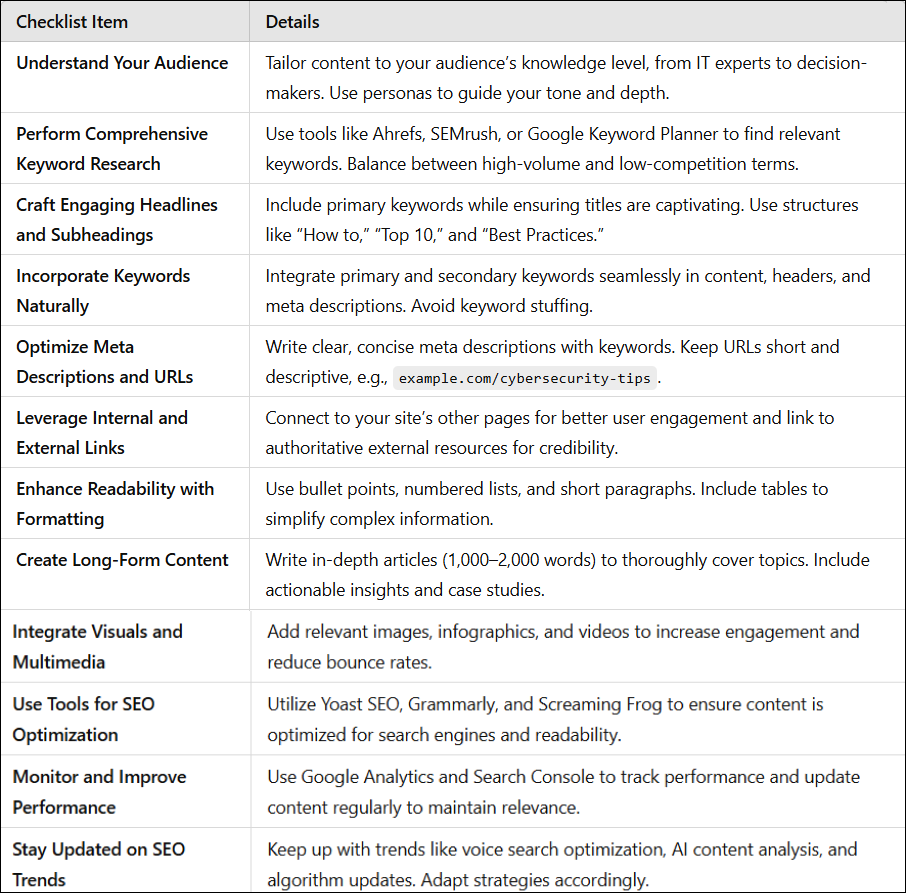
Before keyword research, understand what a searcher actually wants. Someone searching “how to secure my business from cyber threats” has informational intent — they’re learning.

Someone searching “best cybersecurity services for small businesses” has commercial intent — they’re comparing options and close to a decision.
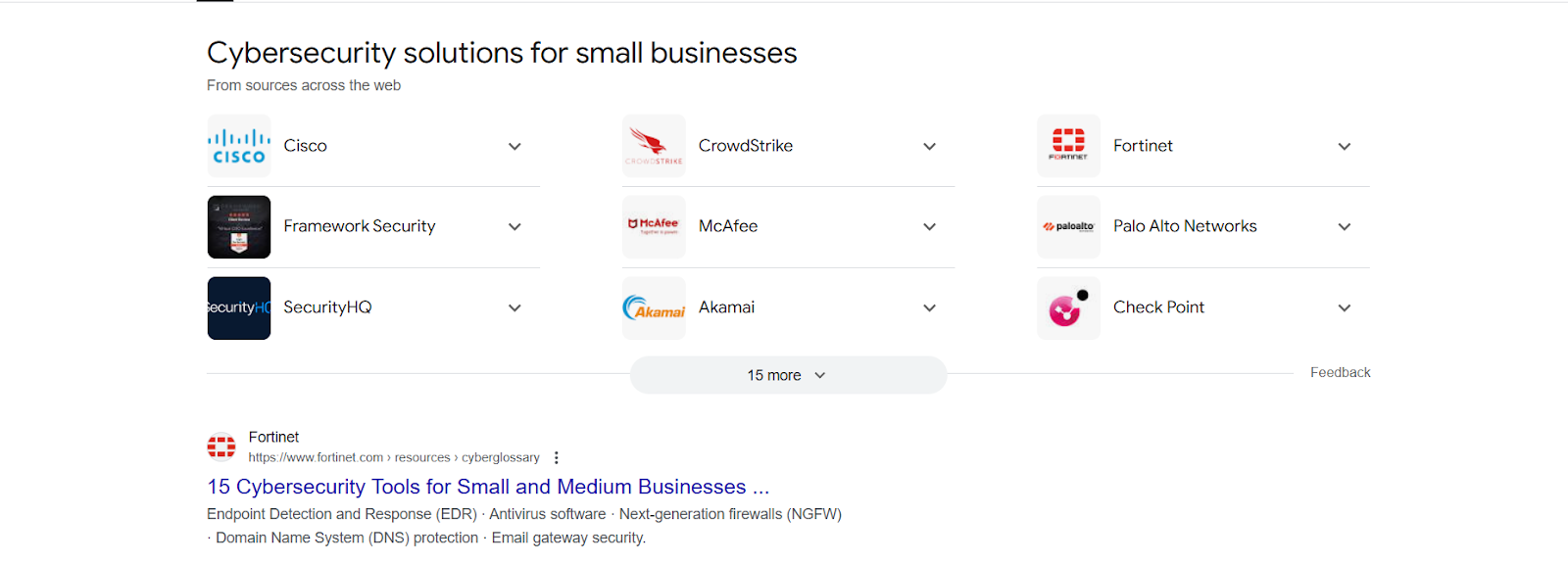
Google shows different kinds of results for each, so aligning content with the stage of the buyer’s journey it’s written for increases the odds it converts a visitor into a lead rather than losing them to a better-matched competitor page.
Perform Comprehensive Keyword Research
Effective keyword research starts with the main topics in your category — “data protection,” “cybersecurity compliance” — then narrows to specific, long-tail phrases. In a competitive field like cybersecurity, ranking for a broad term like “cybersecurity services” is difficult and often low-intent:
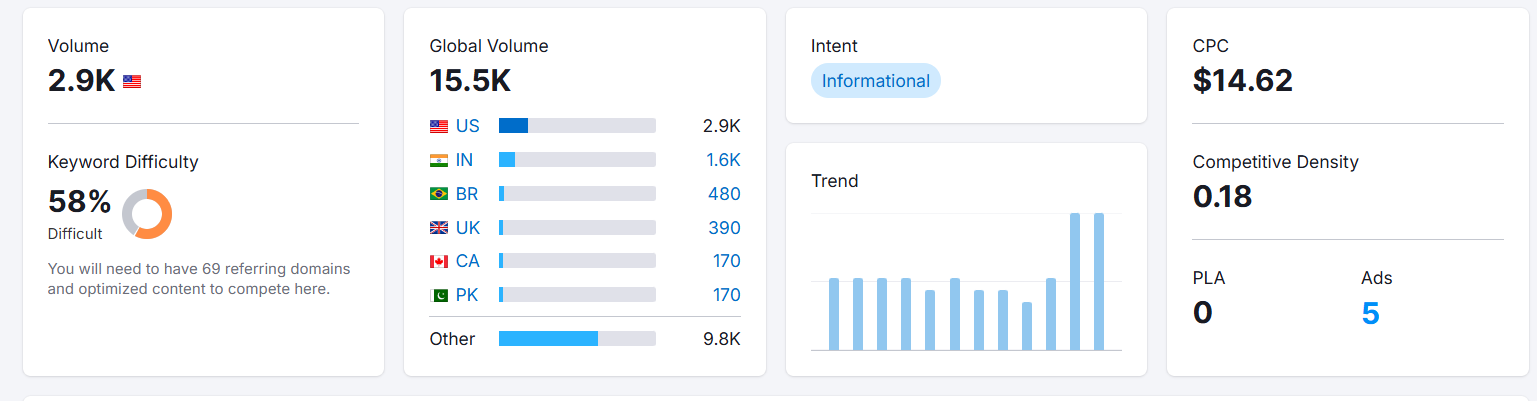
A phrase like “best cybersecurity for remote work teams” or “top solutions for protecting financial data” has less competition and attracts visitors closer to a decision:
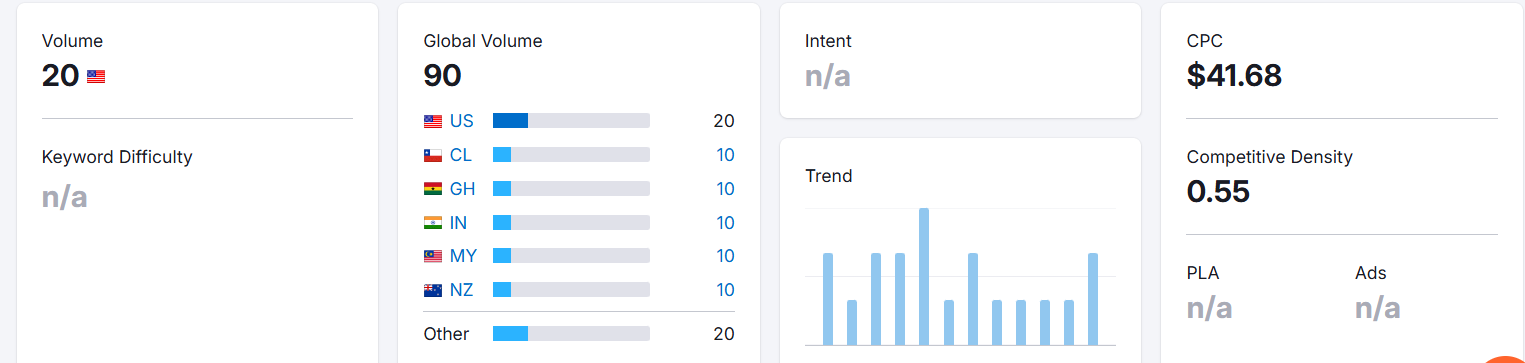
See our guide to conducting keyword research for cybersecurity topics for the full process. Once you’ve identified the right keywords, use them in headers, meta descriptions, and URLs — not just body text — to maximize their impact.
Create Engaging Headlines and Subheadings
Your title is the first thing a reader (and a search or AI engine) evaluates. A specific, keyword-rich headline draws clicks and signals relevance more effectively than a vague one — “Top 10 Cybersecurity Threats in 2026” tells a reader exactly what they’ll get; “Cybersecurity Threats to Watch” doesn’t. Subheadings should mirror how a buyer would actually phrase their question, which helps both human skimmers and AI systems extracting an answer.
Incorporate Keywords Naturally
The goal when placing keywords is readability, not density. Avoid keyword stuffing, which makes text read as unnatural and can work against rankings rather than for them. Use keywords thoughtfully in headings, the opening sentence, and image alt text, and use natural variations — “preventing ransomware attacks” alongside “ransomware protection” — so the content reads like it was written for a person first.
Optimize Meta Descriptions and URLs
Meta descriptions summarize page content in search results; they should be clear, specific, and include relevant keywords to earn the click. URLs should be short and descriptive — site.com/endpoint-security-best-practices tells both users and search engines what the page is about far better than site.com/page12345. See how to create effective meta title tags and writing powerful meta descriptions for the specifics.
Leverage Internal and External Links
Internal links guide readers through your site and help search engines understand its structure. External links matter more for what they signal: linking to a genuinely authoritative primary source — NIST guidelines, CISA advisories, a platform’s own documentation — shows you’re backing claims with checkable evidence and builds the kind of trust both readers and AI answer engines respond to. Linking out to unrelated commercial tools or content mills does the opposite; if a link doesn’t make the article more accurate or more useful to the reader, it doesn’t belong in the article.
Enhance Readability with Formatting
Break down complex ideas using bullet points, short paragraphs, and tables for quick comparisons:

Cybersecurity topics are technical enough without also being formatted as a wall of text — formatting that a human can skim is the same formatting an AI answer engine can extract cleanly.
Write to the Question, Not to a Word Count
Google has said directly that it does not have a preferred word count and that word count is not a ranking factor; the actual goal is a “substantial, complete” answer that leaves the reader feeling they’ve learned enough to act (Google Search Central, retrieved 2026-09-21). In practice, that means a narrow topic — “how to configure MFA for a specific SaaS tool” — can be genuinely complete at a few hundred words, while “how to build a zero-trust architecture” needs real depth to be useful. Padding either one to hit an arbitrary length hurts more than it helps.
Integrate Visuals and Multimedia
Visual elements break up text and make complex ideas easier to understand. An infographic showing “How Firewalls Work” or a diagram of a ransomware attack’s stages communicates in one image what would take several paragraphs to describe — and well-optimized images (compressed, with descriptive alt text) add both accessibility and additional keyword context without padding the body copy.
Tools Worth Using — and the Category to Be Careful With
Grammar and readability tools (Grammarly, Hemingway Editor) and technical SEO crawlers (Screaming Frog) are useful for catching issues a writer misses — broken links, thin pages, readability problems — and Yoast-style on-page checklists help verify basics like title length and keyword placement before publishing.
Keyword-research and rank-tracking platforms are a separate category, and worth a specific caution: many of the best-known ones are themselves competitors to AI-visibility and AEO/GEO platforms, so this guide isn’t the place to recommend one by name. What matters functionally is that whatever tool you use gives you real search-volume data and, increasingly, visibility into whether your content is actually being cited inside AI-generated answers — not just where it ranks in a traditional results page. That second signal is what GrackerAI’s AI-visibility tracking is built to surface specifically for cybersecurity and B2B SaaS brands.
Monitor and Improve Performance
Use Google Analytics 4 and Search Console to track organic traffic, bounce behavior, and which keywords each article ranks for. Regularly checking these metrics surfaces which articles need a refresh — cybersecurity content ages faster than most categories because threats, products, and compliance requirements change quickly, so revisiting rankings and facts periodically matters more here than in a slower-moving niche.
Writing for AI Answer Engines, Not Just Search Rankings
Everything above still applies when the “reader” is ChatGPT, Perplexity, or Google’s AI Overviews deciding what to cite in a direct answer — but AI answer engines add a layer search rankings don’t: they extract and synthesize a specific passage, not just a link, so the passage itself has to stand on its own. That means leading each section with a direct answer before the supporting detail, using headings that mirror how a buyer would phrase the question, structuring facts in lists and tables rather than dense paragraphs, and citing real sources for every claim so the AI system — and the reader — can verify it. GrackerAI, the platform behind this guide, builds AI-optimized cybersecurity content and tracks whether it’s actually earning citations across AI engines; see GrackerAI’s cybersecurity marketing content library and effective GEO strategies for cybersecurity vendors for the specifics.
How This Guide Was Sourced
Written by the GrackerAI research and content team (gracker.ai). The word-count and content-quality guidance is drawn directly from Google Search Central’s “Creating Helpful, Reliable, People-First Content” documentation (retrieved 2026-09-21). The step-by-step writing process is practitioner analysis based on common cybersecurity content practice, not a sourced statistic — treat it as a starting structure to adapt. No unpublished GrackerAI telemetry is used in this guide.
Frequently Asked Questions
What makes a cybersecurity article SEO-friendly?
An SEO-friendly cybersecurity article answers a specific, real search intent completely, uses the target keyword naturally in the title, headers, and URL, is structured with clear headings and short paragraphs, and links to genuinely authoritative sources rather than padding for length. Writing consistently and picking a specific, useful angle matters more than following a formula.
How do I know if my article is SEO-friendly before publishing?
Check that the primary keyword appears naturally in the title, the first paragraph, at least one subheading, and the meta description; that the content fully answers the query rather than skimming it; that sentences and paragraphs are short enough to scan; and that every factual claim has a source a reader could actually check.
What is an SEO-friendly URL?
An SEO-friendly URL is short, readable, and describes the page’s content using the target keyword — example.com/cybersecurity-best-practices rather than a string of random characters. It helps both search engines understand the page and users recognize and remember it.
Does article length affect search rankings?
Not directly. Google has stated it has no preferred word count and that word count itself is not a ranking factor; what it rewards is a complete, genuinely helpful answer to the query, which might be 500 words or 3,000 depending on the topic (Google Search Central, retrieved 2026-09-21).
How is writing for AI answer engines different from writing for traditional search?
The underlying discipline — a direct answer up front, clear structure, verifiable specifics — is the same. AI answer engines add the need for explicit extractable structure: headings phrased as questions, FAQs, and comparison tables, since the engine is pulling a specific passage into a generated answer rather than just linking to the page.
Should I link out to competitor SEO tools or platforms in a cybersecurity article?
Only when the article is genuinely a roundup of named tools and the mention is accurate and necessary — not as a generic “here are some tools” aside. For any tool in the AI-visibility, AEO/GEO, or SEO-platform category specifically, be careful about recommending a name that’s a direct competitor to the platform publishing the article; describe the functional need instead when that’s the concern, as this guide does above.
Conclusion
Writing SEO-friendly cybersecurity articles comes down to understanding your audience’s search intent, doing real keyword research, structuring content so both readers and AI systems can extract the answer, and backing every claim with a source that holds up to scrutiny. Word count, keyword density, and tool checklists are secondary to that — get the intent, the structure, and the sourcing right, and the rankings follow.
Related Articles
-
 cybersecurity content audit
 How to Audit Cybersecurity Content for Accuracy and Originality
Cybersecurity content with incorrect facts destroys confidence fast. Here's a practical audit framework for correctness and originality that preserves the credibility of your security publications.
-

10 Examples of SaaS Companies with Exceptional Marketing
Explore 10 SaaS marketing examples with actionable tactics. Learn innovative strategies from top companies to elevate your own campaigns.
-

How to Find the Right B2B Prospects for Your SaaS Product
Stop wasting sales outreach on leads that're not a good fit. Learn ways to find, check, and work with the right B2B prospects for your SaaS product.
-
 online reputation management
 The Importance of SEO in Online Reputation Management
Discover how SEO influences your digital brand. Learn actionable strategies to suppress negative search results and build a positive online reputation today.