Cybersecurity Content Ideas for Every Stage of the Funnel

TL;DR
- Map cybersecurity content to four stages — awareness, evaluation, decision and post-purchase — and let the stage pick the format, because a technical white paper aimed at the awareness stage loses the reader it was written for.
The right cybersecurity content for each funnel stage matches what a buyer actually needs to know at that moment: broad threat education at awareness, head-to-head technical comparisons at consideration, implementation proof at decision, and onboarding support after the sale. Security purchases involve more reviewers than a typical B2B deal — IT administrators, security engineers, and C-suite executives each weigh in with different priorities — so a single piece of content rarely serves the whole journey. This guide breaks down what to publish at each stage, from first awareness of a vulnerability through post-purchase advocacy.
For the broader strategic framework this funnel sits inside — pillars, formats, and measurement — see our guide to what actually drives pipeline in cybersecurity content marketing. For content-format tactics specifically, see effective strategies for developing cybersecurity content that engages prospects.
Key Takeaways
- Cybersecurity buying decisions typically involve multiple stakeholders — IT administrators, security engineers, and C-suite executives — each of whom needs different content, not just a different version of the same pitch.
- Awareness-stage content should educate without selling; consideration-stage content should help prospects evaluate; decision-stage content should remove the last objections; post-purchase content should drive retention and expansion.
- Enterprise B2B buying groups are large and prone to friction — Gartner's 2025 sales survey found 74% of buying teams show "unhealthy conflict" during the decision process, which is exactly what stage-appropriate, multi-stakeholder content is built to reduce (Gartner, retrieved 2026-09-21).
- The most common funnel mistake is leading with technical depth too early, or leading with a sales pitch before the prospect has finished defining the problem.
- Structuring each format for AI answer engines — not just human search — is now part of doing funnel content well, since more of the early research stage happens inside an AI chat session before a vendor's site is ever visited.
- For the mechanics of writing an individual, SEO- and AEO-ready article, see our step-by-step guide to writing SEO-friendly cybersecurity articles.
Understanding the Cybersecurity Buyer's Journey
The cybersecurity buyer's journey is often more complex than a typical B2B purchase because of the technical nature of security solutions and the stakes involved if the wrong vendor is chosen. Security decisions typically involve multiple stakeholders, from IT administrators to C-suite executives, each with different concerns and priorities.
- Awareness stage: Prospects recognize they have a security vulnerability, a compliance requirement, or a need to upgrade their current security posture.
- Consideration stage: They're actively researching solutions, comparing vendors, and trying to understand which approach best fits their specific environment and requirements.
- Decision stage: They're ready to make a purchase decision and need final validation that they're choosing the right solution and vendor.
- Retention stage: Post-purchase, they need ongoing support, education, and proof of value to remain satisfied customers and potential advocates.
Top-of-Funnel Content Ideas: Building Security Awareness
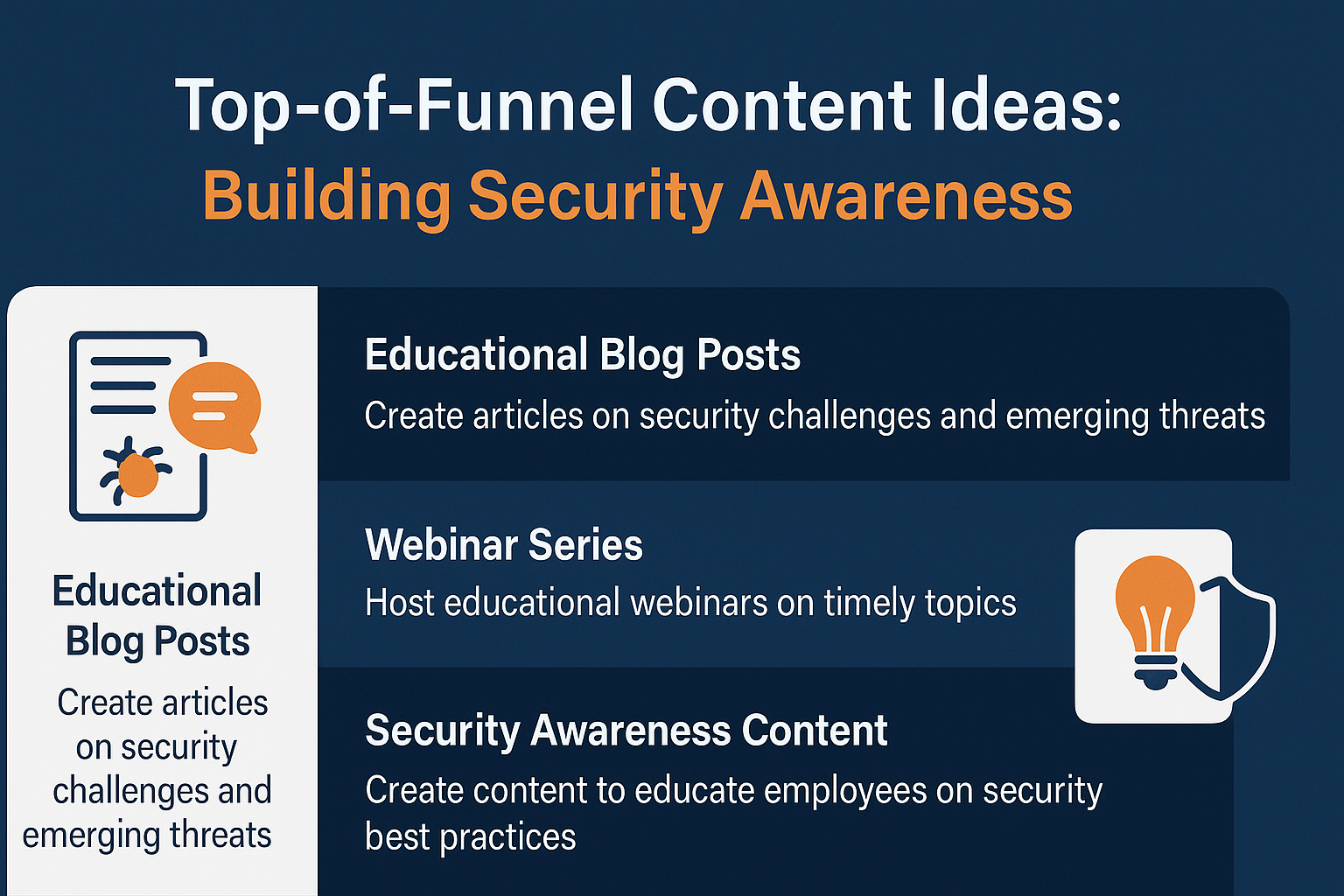
At the awareness stage, your cybersecurity content strategy should focus on education and establishing expertise without being overly promotional. Your audience is looking for insights, not sales pitches.
Educational Blog Posts
Create in-depth articles that address current security challenges and emerging threats — one specific threat and one specific fix per post, rather than a broad survey. A post like "The Future of Passwordless Authentication: Enhancing Security Without User Friction" demonstrates the kind of specific, practitioner-useful angle that works better than a generic overview.
Threat Intelligence Reports
Develop quarterly or annual reports that analyze threat landscapes, attack trends, and industry-specific vulnerabilities. These comprehensive resources demonstrate deep understanding of the security ecosystem and provide insights prospects can't find elsewhere — and, published consistently, they double as the kind of original data that earns citations from both other publishers and AI answer engines.
Interactive Security Assessments
Create self-assessment tools that help organizations evaluate their current security posture. A "Cybersecurity Maturity Assessment" or "Ransomware Readiness Quiz" provides immediate value while capturing leads and surfacing a prospect's specific pain points.
Webinar Series
Host educational webinars on timely topics like "Navigating New Compliance Requirements" or "Securing Remote Work Environments." Live sessions allow for real-time engagement and position your team as practitioners, not just marketers, while building relationships with potential customers.
Security Awareness Content
Develop content that helps organizations educate their own employees about security best practices. Templates for security-awareness training, phishing-simulation guides, and incident-response checklists provide practical value while showcasing your commitment to comprehensive security.
Middle-of-Funnel Content Ideas: Guiding Solution Evaluation
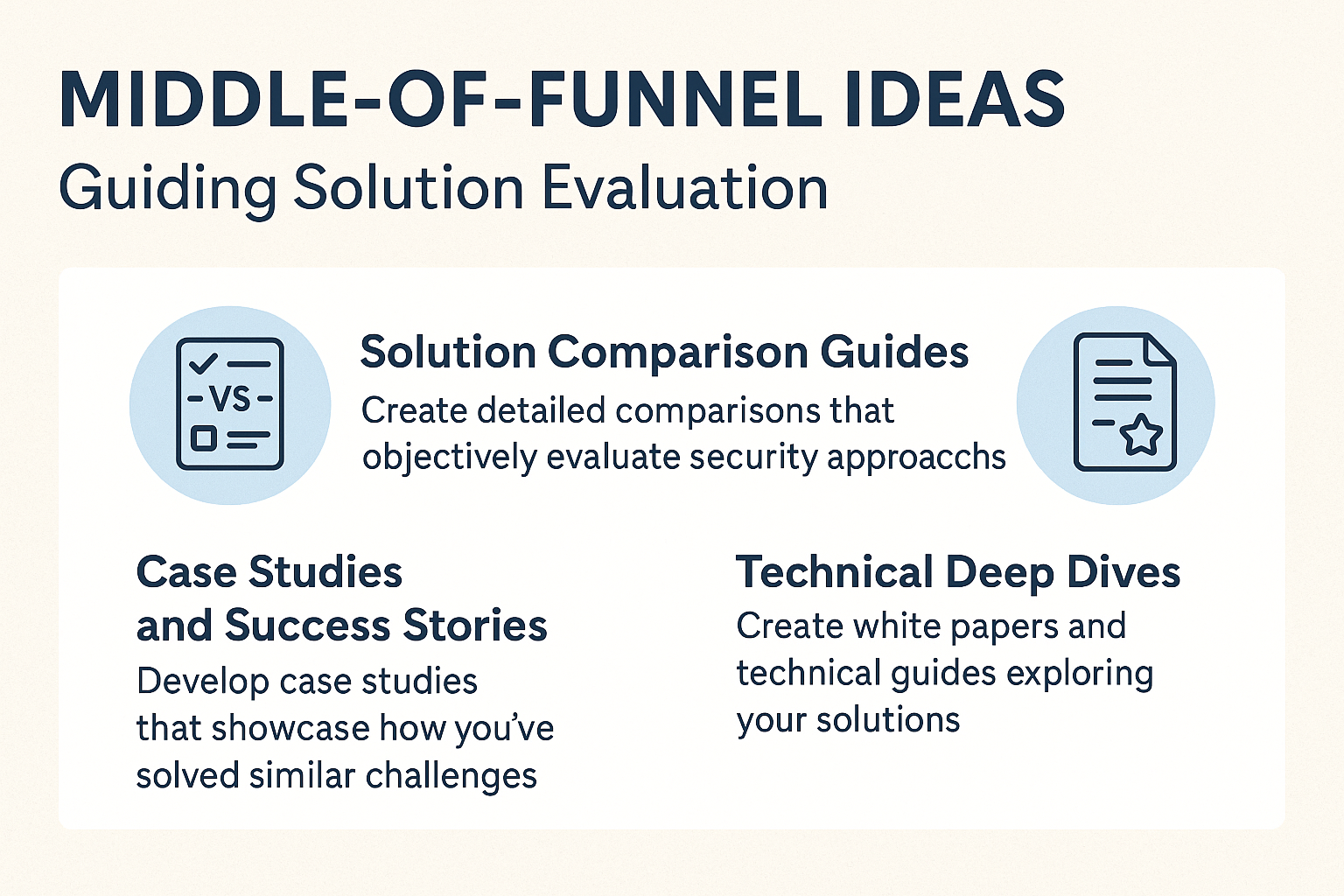
During the consideration stage, prospects are actively comparing solutions and vendors. Content here should demonstrate a clear value proposition and help prospects make informed decisions, without crossing into vendor-vs-vendor comparison that reads as biased.
Solution Comparison Guides
Create detailed comparisons that objectively evaluate different approaches to solving a specific security challenge. For example, "SIEM vs. SOAR vs. XDR: Choosing the Right Security Operations Solution" helps prospects understand the landscape while positioning your solution appropriately within it.
Case Studies and Success Stories
Develop detailed case studies that showcase how you've solved similar challenges for comparable organizations. Include specific metrics, implementation timelines, and lessons learned. Focus on outcomes that matter to your prospects: reduced incident response times, improved compliance scores, or cost savings.
Technical Deep Dives
Create technical guides that explore the architecture, implementation, and benefits of your approach. Content like "Implementing Zero Trust in Hybrid Cloud Environments: A Technical Guide" demonstrates expertise while helping prospects envision how your solution fits their environment.
ROI Calculators and Tools
Develop interactive tools that help prospects quantify the business impact of security investments — a "Cost of Data Breach Assessment" or an ROI calculator for a specific control provides tangible value while supporting the business case for your solution. GrackerAI's own cybersecurity marketing ROI calculator is a free example of this pattern applied to content marketing spend specifically.
Industry-Specific Content
Create content tailored to specific industries' unique security challenges and compliance requirements. Healthcare organizations have different needs than financial services companies, and your content should reflect those nuances rather than treating "cybersecurity buyer" as one persona.
Bottom-of-Funnel Content Ideas: Closing the Deal
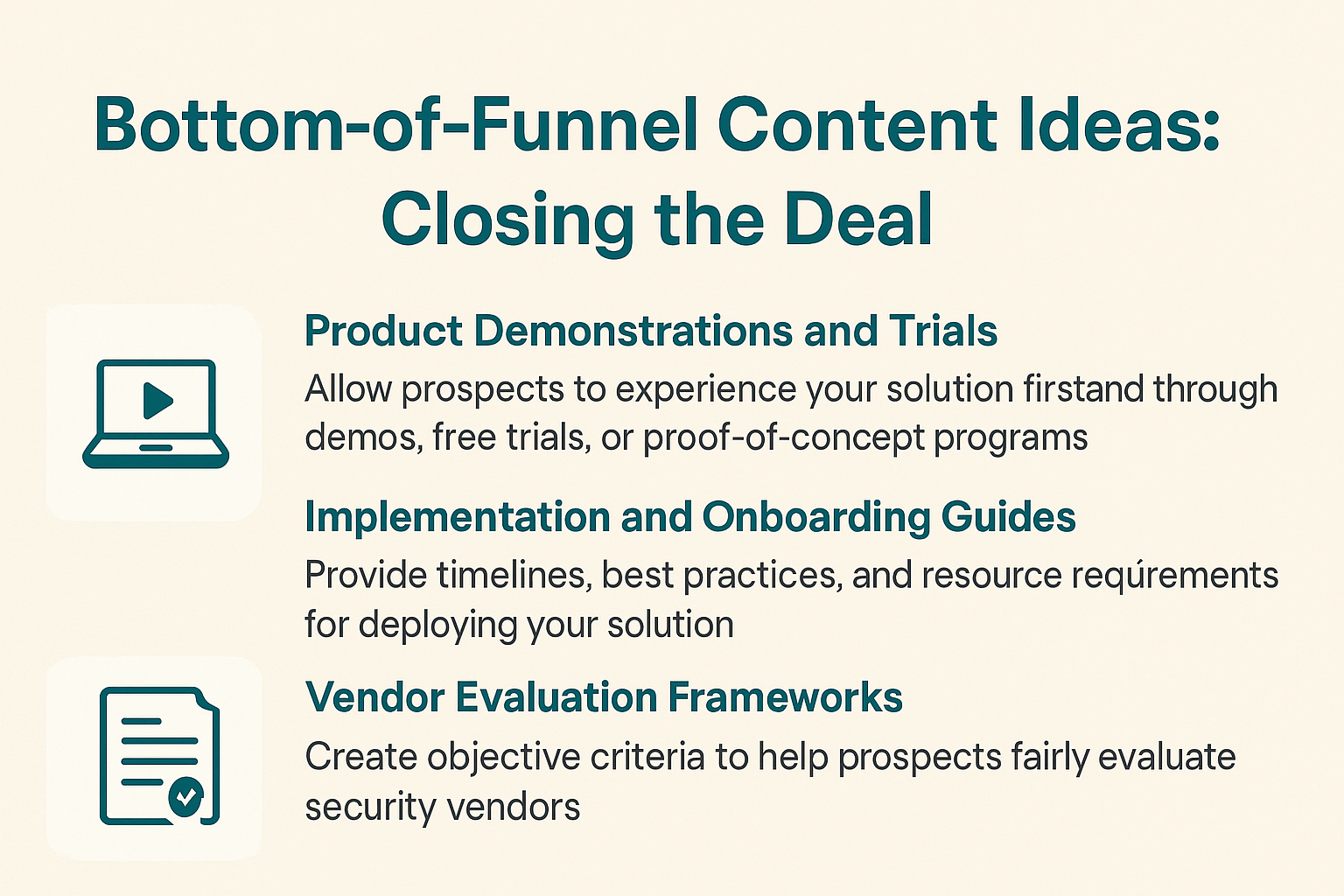
At the decision stage, prospects need confidence that they're making the right choice. Content here should address final concerns and provide the reassurance needed to move forward — and, per the buying-committee research above, often needs to satisfy several reviewers at once, not just the person who's been evaluating the product hands-on.
Product Demonstrations and Trials
Offer interactive demos, free trials, or proof-of-concept programs that let prospects experience your solution firsthand. Supporting materials like "Getting Started with Your Security Trial" guides help prospects get value from the trial instead of abandoning it half-configured.
Implementation and Onboarding Guides
Provide detailed implementation timelines, resource requirements, and best practices for deploying your solution. Content like "Your 90-Day Security Implementation Roadmap" addresses concerns about complexity and demonstrates commitment to customer success before the contract is even signed.
Vendor Evaluation Frameworks
Create objective frameworks that help prospects evaluate security vendors, including your own company. Providing fair evaluation criteria — the kind a prospect could use against a competitor too — builds trust and confidence in your transparency.
Executive Summary Reports
Develop concise summaries that distill key benefits and ROI into executive-friendly formats. C-suite stakeholders often make final approval decisions and need clear, business-focused justification for a security investment, not the full technical case.
Reference and Testimonial Programs
Curate compelling customer testimonials, reference calls, and peer reviews that provide social proof. Video testimonials from similar organizations can be particularly powerful in addressing final concerns.
Post-Purchase Content Ideas: Ensuring Long-Term Success
Your cybersecurity content strategy shouldn't end at purchase. Post-purchase content is crucial for customer satisfaction, retention, and advocacy — and it's the cheapest content to produce relative to the revenue it protects.
Onboarding and Training Materials
Create comprehensive onboarding programs that help customers maximize their investment: training videos, best-practice guides, and advanced configuration tutorials that ensure customers actually achieve the outcomes they bought for.
Regular Security Updates and Insights
Provide ongoing value through regular threat-intelligence briefings, product updates, and security recommendations. Monthly security newsletters or quarterly business reviews keep your solution top-of-mind while demonstrating continuous value.
Customer Success Stories and Expansion Opportunities
Share success metrics and outcomes with existing customers while identifying opportunities for additional services or solutions. Content like "Expanding Your Security Program: Next Steps for Mature Organizations" can drive account growth.
Community Building Content
Foster customer communities through user forums, customer advisory boards, and exclusive events. Content that facilitates peer-to-peer learning positions your company as the hub of a valuable professional network, not just a vendor.
Distribution, Measurement, and Common Mistakes
Creating great content is only half the battle — it needs a distribution plan and a way to tell whether it's working.
Distribution: LinkedIn is particularly effective for reaching cybersecurity professionals, while industry forums, partner co-marketing, and search (both traditional and AI-answer-engine) extend reach further. Segment nurture emails by industry, company size, and funnel stage rather than sending the same sequence to everyone.
Measurement, by stage:
| Stage | What to track |
|---|---|
| Awareness | Traffic, social engagement, webinar attendance, content downloads |
| Consideration | Lead quality, email engagement, funnel progression, sales-qualified leads |
| Decision | Proposal requests, sales-cycle length, win rate, deal size |
| Post-purchase | Satisfaction scores, product adoption, expansion revenue, advocacy |
Common mistakes:
- Being too technical too early. Lead with the business problem before the technical specification, especially at awareness.
- Ignoring different stakeholder perspectives. Content built for the technical evaluator alone stalls when it reaches the rest of the buying committee.
- Focusing only on product features. Prospects care about the outcome your solution delivers, not a feature list.
- Neglecting compliance and regulatory content. Many cybersecurity purchases are driven by a specific compliance requirement — content that doesn't address it directly gets skipped.
- Underestimating trust. Cybersecurity is fundamentally about trust; content that overclaims once loses the reader for every post after it.
How This Guide Was Sourced
Written by the GrackerAI research and content team (gracker.ai). The buying-committee friction figure is drawn from Gartner's 2025 B2B sales survey (retrieved 2026-09-21). The funnel-stage content mapping is practitioner analysis based on common cybersecurity marketing practice, not a sourced statistic — treat it as a starting structure to adapt to your own buyer's journey. No unpublished GrackerAI telemetry is used in this guide.
GrackerAI builds AI-optimized content production and a cybersecurity marketing content library for exactly this kind of stage-mapped content, and tracks whether it's actually getting cited across AI answer engines once it's live — see effective GEO strategies for cybersecurity vendors.
Frequently Asked Questions
What's the difference between top-of-funnel and bottom-of-funnel cybersecurity content?
Top-of-funnel content educates a prospect who has just recognized a problem — threat explainers, awareness content, webinars — without selling. Bottom-of-funnel content removes the last objections for a prospect who is ready to decide — implementation guides, vendor-evaluation frameworks, references. Using bottom-of-funnel content (a hard sales pitch) at the top of the funnel is the most common way to lose a prospect early.
How many pieces of content does a cybersecurity buyer typically consume before talking to sales?
There's no single reliable public figure specific to cybersecurity that we can cite with confidence. What's consistent is that B2B buying groups are large and self-directed — Gartner's 2025 research found most B2B buying teams experience friction working through options together, which argues for having stage-appropriate content ready for each stakeholder rather than assuming one champion will do the internal selling alone (Gartner, retrieved 2026-09-21).
Should the same content serve both a security engineer and a CFO?
Rarely well. A security engineer needs API references and hands-on detail; a CFO needs a cost model. The more effective pattern is separate assets for each stakeholder, bundled together at the decision stage so the committee doesn't have to re-derive each other's argument.
What's the biggest content gap most cybersecurity companies have?
Post-purchase content. Most content budgets concentrate on awareness and consideration, leaving onboarding, retention, and expansion content thin — even though it's cheaper to produce and directly protects revenue that's already been won.
Does funnel-stage content need to be structured differently for AI answer engines?
The stage-appropriate substance doesn't change, but the formatting does: answer-first paragraphs, explicit headings that mirror how a buyer would phrase the question, and structured lists or tables make each stage's content easier for an AI engine to extract and cite — on top of making it easier for a human to skim.
How often should funnel content be refreshed?
Threat-intelligence and trend content ages fastest and needs the most frequent refresh; evergreen guides (implementation roadmaps, vendor-evaluation frameworks) hold up longer but should still be re-verified against current product and compliance facts at least annually.
Building Your Cybersecurity Content Strategy: Next Steps
Developing an effective cybersecurity content strategy requires understanding your target audience's challenges, decision-making process, and content preferences at each stage, then mapping specific content pieces to those stages and to business objectives. Establish clear, stage-specific metrics and review performance regularly to identify optimization opportunities. Cybersecurity content strategy is not a one-time effort — it's an ongoing process that evolves with your market, your customers, and your business goals, and increasingly with how AI answer engines are reading and citing it. Matching each stage to what a buyer is actually typing into a search bar — not just to a funnel label — is its own discipline; see how to build cybersecurity content people actually search for and trust for that intent-mapping approach.
![10 Best Local Rank Tracker Tools: In-Depth Comparison Guide [2025]](https://cdn.pseo.one/6abcb68a626591c40e1c8aa6/687e1c1ef6fe799d288518df/68809c373eb8562bcf68975d/10-best-local-rank-tracker-tools-comparison-guide/feature-image.jpg)