How the August 2024 Core Update Affects Your SEO Strategy

Google's August 2024 Core Update is a broad algorithm change aimed at improving search result relevance. It focuses on better understanding content quality, user intent, and site authority, affecting SEO rankings across various industries. Websites may experience fluctuations in traffic as a result.
Where this stands now: the August 2024 Core Update was followed by further core updates through 2025 and a August 2025 Spam Update, plus the much larger shift of AI Overviews expanding across search results. The mechanics below — content quality, user intent, site authority — still hold, but they now sit alongside a second question: whether an AI Overview is citing you at all, which classic rank tracking does not show. See Google's "stable traffic" narrative versus what independent data shows for the current picture, sourced to five independent datasets with retrieval dates.
What Google Says About the August 2024 Core Update
Before diving into the analysis and impact, let’s first take a look at what Google has to say about its core update directly. 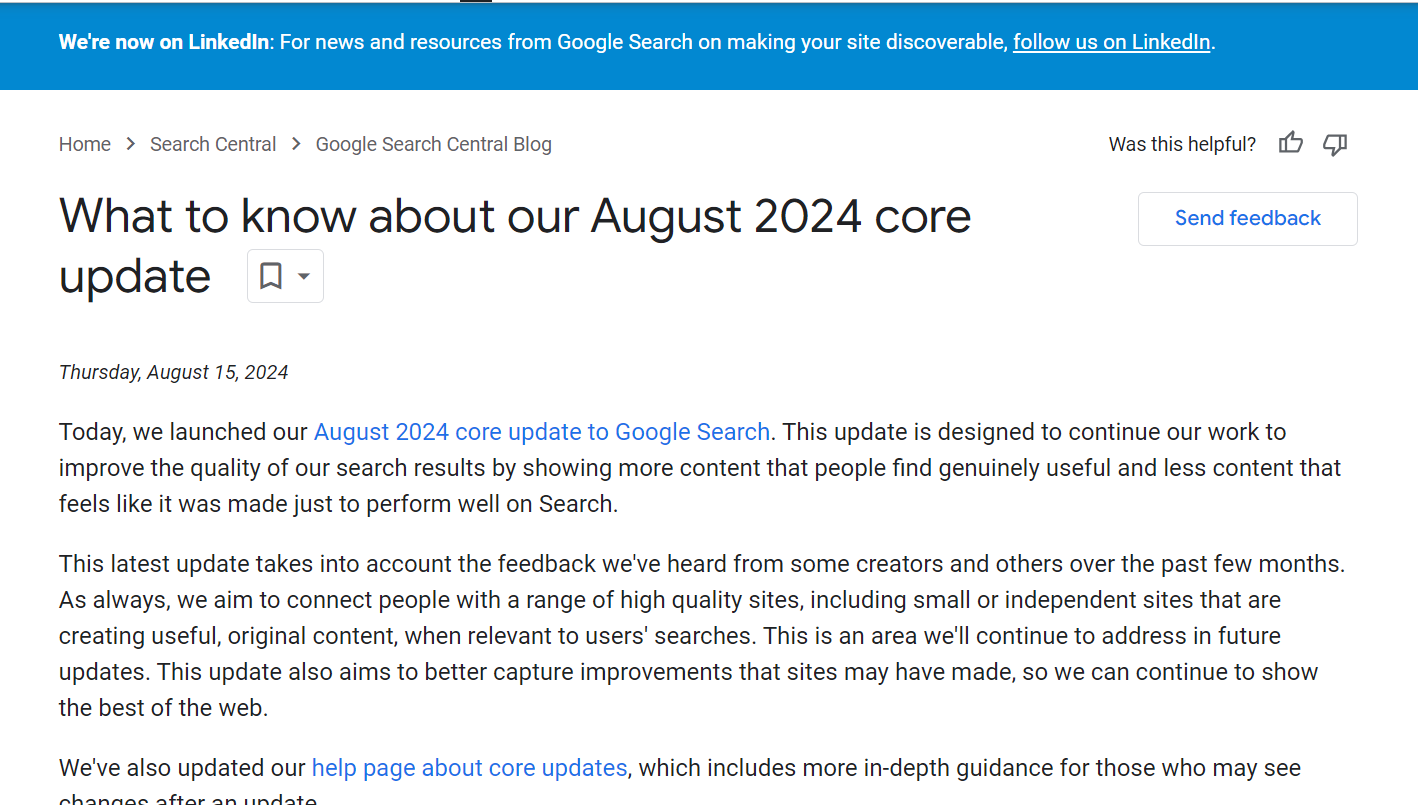
1. Content Quality Takes Center Stage
Google’s core updates are primarily aimed at refining how content is evaluated. This update underscores the importance of content quality in your SEO efforts. Websites that consistently produce authoritative, well-researched, and engaging content are more likely to benefit from the update. If your content is outdated, thin, or unhelpful, you might see a dip in rankings.
2. Shifts in Search Rankings
As with any core update, you can expect to see fluctuations in search rankings. Some sites will see improvements, while others may experience drops. These changes are not necessarily penalties but rather Google re-assessing how well your site meets users’ needs compared to competitors. This is why a well-thought-out SEO strategy is crucial to maintain or recover your rankings.
3. Focus on User Intent
The August 2024 Core Update puts a stronger focus on user intent, ensuring that search results align with what users are really looking for. It’s not just about stuffing keywords anymore—your content needs to be relevant and answer user queries directly. This is especially important for industries where search intent can vary, such as e-commerce or health.
4. Impact on Different Industries
Certain industries, particularly those involving Your Money or Your Life (YMYL) content like health and finance, tend to feel the brunt of core updates. Google continues to scrutinize sites in these industries more closely to ensure they meet high standards of expertise, authority, and trustworthiness (E-A-T). If you’re in one of these sectors, it’s time to review your content strategy and make sure it aligns with Google’s quality expectations.
5. Ongoing Evolution of SEO
Every core update is a reminder that SEO is not static. The August 2024 Core Update matters because it represents another step in the continuous evolution of search algorithms. If you haven’t updated your SEO strategy in a while, now is the time to audit your site, improve content, and enhance user experience.
The same content-quality and user-intent signals a core update rewards are also what an AI engine looks for before citing a source in an AI Overview or a ChatGPT answer — clear structure, direct answers, credible sourcing. A site that recovers well from a core update is usually already doing most of what AEO (Answer Engine Optimization) rewards; the two are converging disciplines, not separate ones. For the fuller picture of what keeps a site resilient across updates like this one, see our long-term SEO growth strategies guide.
How to Adjust Your SEO Strategy?
Now that the August 2024 Core Update has fully rolled out, it’s important to evaluate your website’s performance and refine your SEO strategy. Here are some tips to help you adapt to the changes:
1. Conduct a Content Audit
A thorough content audit is essential after the August 2024 Core Update. Review your existing content to identify areas of improvement. Focus on:
Content Quality: Ensure each piece provides value, is well-researched, and meets user intent.
Relevance: Update outdated information and remove irrelevant content.
Performance: Use analytics to pinpoint underperforming pages and optimize or consolidate them.
2. Improve User Experience
With the August 2024 Core Update emphasizing user intent, enhancing your website's user experience (UX) is crucial. Consider the following:
Mobile Optimization: Ensure your site is responsive and functions smoothly on all devices.
Page Speed: Reduce load times to improve user satisfaction and ranking potential.
Navigation: Make your site easy to explore with clear menus and internal links.
Readability: Use headings, bullet points, and visuals to make content easier to digest.
3. Build High-Quality Backlinks
Building high-quality backlinks is essential for improving your website's authority and search engine rankings. Here are key strategies:
Guest Posting: Contribute valuable content to reputable sites in your niche.
Content Marketing: Create shareable, informative content that naturally attracts links.
Broken Link Building: Find broken links on relevant websites and suggest your content as a replacement.
Influencer Outreach: Collaborate with industry influencers to promote your content.
Directories & Citations: Submit your site to high-authority directories.
4. Monitor AI Content Quality
Monitoring AI content quality is key to ensuring consistency and relevance. Here’s how you can maintain high standards:
Human Review: Always review AI-generated content for accuracy, tone, and alignment with your brand.
Fact-Checking: Verify data and claims made by AI to avoid misinformation.
Clarity and Readability: Ensure content is well-structured, clear, and easy to understand.
Avoid Redundancy: Check for repetitive phrases or irrelevant information in the content.
Consistency: Ensure the AI follows your style guide, voice, and tone.
For the AI-visibility side of this — whether your content is actually being surfaced and cited in AI-generated answers, not just ranking classically — see GrackerAI's AI visibility monitoring.
5. Optimize for Local Search
Optimizing for local search following the August 2024 Core Update requires a focus on user intent and local relevance. Key strategies include:
Google Business Profile: Keep your business listing updated with accurate information (address, hours, services).
Local Keywords: Include location-specific keywords in your content, meta tags, and titles.
Reviews & Ratings: Encourage positive customer reviews to build trust and boost local rankings.
Local Backlinks: Acquire links from local businesses, directories, and community organizations.
Mobile Optimization: Ensure your site is mobile-friendly, as local searches often happen on mobile devices.
What to Do if Your Rankings Dropped?
If your rankings dropped after the August 2024 Core Update, take these steps to recover:
Analyze User Intent: Ensure your content aligns with the search intent of your audience. Google’s update emphasizes meeting user needs.
Review Content Quality: Update and improve outdated content to make it more relevant, valuable, and comprehensive.
Optimize for UX:
Improve page speed.
Enhance mobile usability.
Simplify navigation for a better user experience.
Evaluate Backlinks: Ensure your backlinks are high-quality and relevant. Remove or disavow toxic links.
Monitor Competitors: Analyze competitors' strategies to identify new trends or content gaps you can address.
Review Google Guidelines: Stay updated on Google's best practices and adhere to their latest SEO guidelines.
Frequently asked questions
Is the August 2024 Core Update still relevant in 2026?
The specific update finished rolling out in September 2024, but the underlying signals it reinforced — content quality, user intent match, site authority — carry forward into every core update since, including through 2025. Treat it as the start of a pattern, not a one-time event to recover from and forget.
How is a core update different from a spam update?
A core update reassesses how Google evaluates relevance and quality broadly, affecting many sites without targeting specific violations. A spam update specifically targets policy-violating tactics — thin content, cloaking, spammy backlinks — and legitimate sites with no such tactics typically see little to no impact. See Google's August 2025 Spam Update for how that distinction played out in practice.
How long does it take to recover from a core update?
Google has stated recovery can take until the next core update if the underlying quality issues aren't fixed, though addressing genuine content and UX problems can show improvement sooner. There's no guaranteed timeline, which is why an audit-and-fix approach outperforms waiting.
Does ranking well after a core update mean I'm safe from AI Overviews reducing my clicks?
No — they are different problems. A core update affects whether you rank; AI Overviews affect whether a high ranking still earns a click. Independent data shows click-through rate drops meaningfully when an AI Overview appears even for a well-ranked result. See Google's "stable traffic" narrative vs. reality for the sourced breakdown.
What's the single highest-leverage fix after a core update hits?
A genuine content audit against real user intent, not a technical tweak. Most core-update losses trace back to content that ranked on thin relevance rather than because it was the most complete, trustworthy answer to the query — fixing that is what recovers rankings, not schema or speed changes alone.
Conclusion
Google’s August 2024 Core Update reinforces that SEO is constantly evolving. To achieve long-term success, it's essential to stay updated on these changes and adjust your strategies accordingly. Prioritize high-quality content, enhance user experience, and strengthen your site’s authority to succeed in the post-update environment. As rankings fluctuate, keep a close eye on your site’s performance and make necessary adjustments to stay ahead. With the right tactics, your site can emerge even stronger after this core update. For more on what's changed since, see this roundup of expert SEO insights and trends.
![10 Best Local Rank Tracker Tools: In-Depth Comparison Guide [2025]](https://cdn.pseo.one/6abcb68a626591c40e1c8aa6/687e1c1ef6fe799d288518df/68809c373eb8562bcf68975d/10-best-local-rank-tracker-tools-comparison-guide/feature-image.jpg)