Examples of Successful Growth Hacking Techniques

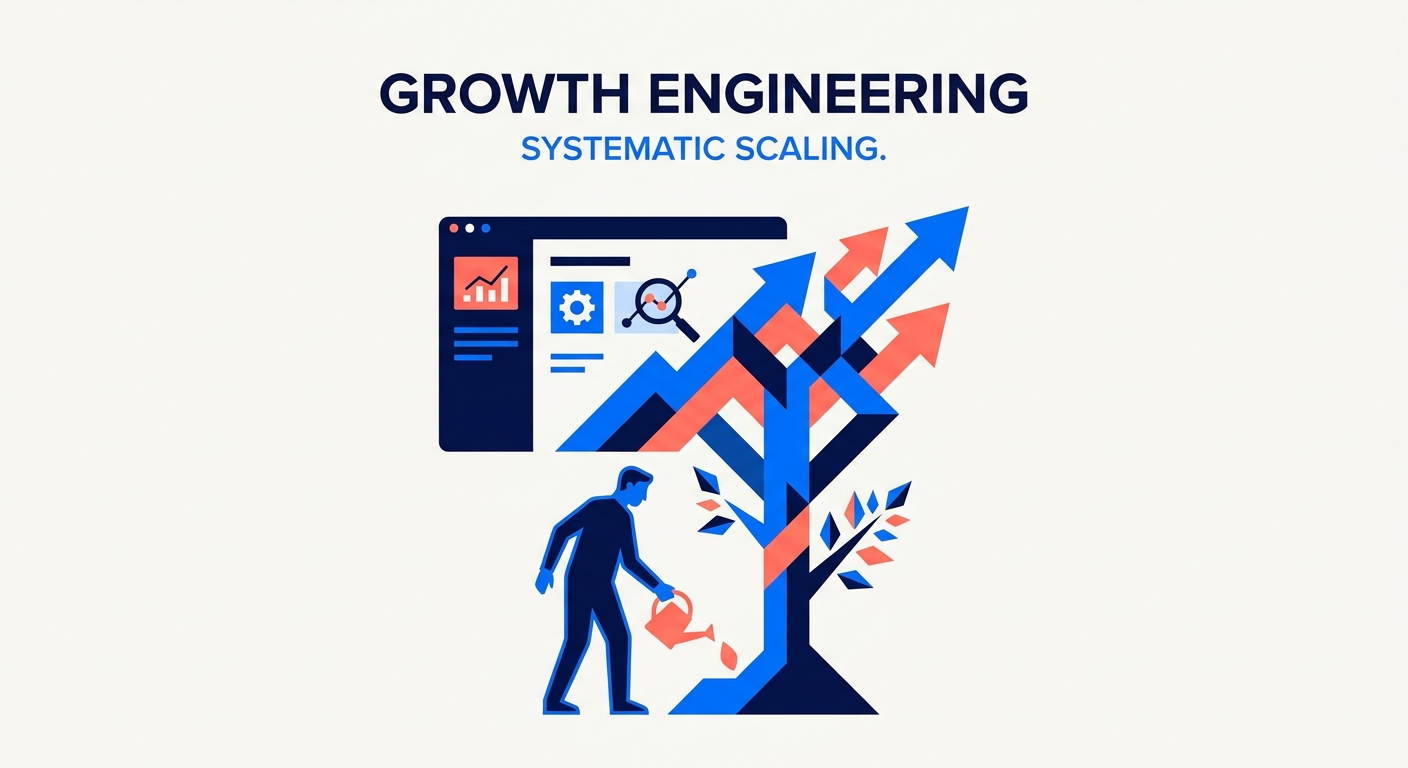
"Growth hacking." The term sounds like a relic from a dusty basement, doesn't it? Back in the day, it was all about finding a loophole in Facebook’s algorithm or scraping a lead list until your fingers bled.
That mindset isn't just dead in 2026. It’s a liability.
Today, we call it "Growth Engineering." It’s not about clever tricks or quick wins. It’s a rigorous, cross-functional discipline that treats user acquisition as a core product feature—not a marketing afterthought. If you’re still hunting for "hacks" to save your startup, you’re building on sand. Sustainable growth is about loops. It’s about building systems that scale while everyone else is busy chasing vanity metrics. For a deeper look at how the industry has matured, you can review the modern SaaS perspective on growth.
Why Most Growth Experiments Die on the Vine
Let’s be honest: most growth experiments fail because they’re disconnected from the product.
Teams get obsessed with the wrong things. They chase likes, impressions, and sign-ups that never actually convert. They ignore the mechanics of the growth loop entirely. The biggest killer of growth? Platform dependency.
If your growth engine relies on a third-party algorithm, you aren't a business owner. You’re a tenant. You’re renting your audience from a landlord who could hike the rent—or evict you—whenever they feel like it.
The companies winning right now are building "ownable" channels. They build email lists. They cultivate private communities. They create assets that exist entirely outside the whims of a platform update. If your product doesn’t naturally lead to more users, you’re fighting a losing battle against the rising cost of acquisition. It’s time to stop renting and start building.
The Three Pillars of 2026 Growth Engineering
Modern growth isn't magic. It’s architecture. Here is how you turn your product into a self-sustaining engine.
1. Product-Led Growth (PLG)
In 2026, the product is your best salesperson. If a user doesn't hit their "Aha!" moment within the first few minutes of onboarding, no amount of marketing budget will save you. PLG is about one thing: frictionless value. If you make them work for it, they’ll leave. Period.
2. Distribution Arbitrage
Stop trying to build an audience from scratch. Go where the people already are. Use API integrations with established platforms. Participate in marketplaces. If you can bake your product into an industry-specific software suite, you’ve won half the battle. You aren't building a audience; you’re tapping into an existing one.
3. AI-Native Virality
We’re way past simple referral codes. Today, virality is baked into the output. When a user creates a report, a design, or a data set using your tool, that output is the advertisement. If your product output isn't inherently sharable, you’re missing the most powerful distribution channel in existence.
Building a High-Leverage Viral Loop
The best viral loops are almost boring in their simplicity. They rely on the "One-Feature Hook." Don't try to optimize an entire campaign. Pick one specific, high-leverage mechanism. Maybe it’s a tiered credit system. Maybe it’s a shared workspace. Whatever it is, it must offer immediate, tangible value to both the sender and the receiver.
Understanding the nuance of these mechanics is vital, and you can see the foundational principles of viral loops here.
Think about the classic Dropbox referral. It’s not about "free storage" anymore; it’s about "value-add" sharing. If a user generates an AI-powered visualization, the loop triggers when they share that asset. The recipient shouldn't just see a pretty picture—they should be invited to "Create your own with [Product Name]." Now, every user’s output is a billboard for you.
Case Studies: What Still Works?
History repeats itself, but the tools look different. Let's look at how the old guard translates to 2026.
The AI-Asset Watermark (The New Hotmail)
Back in the 90s, Hotmail added "PS: I love you. Get your free email at Hotmail" to every outgoing message. It was genius. Today, this is the "Powered by" footer on AI-generated assets. By embedding your brand into the artifact your user creates, you turn every successful use case into a billboard.
Frictionless API Integration
Airbnb famously grew by letting users cross-post to Craigslist. Today, we call that API integration. If you’re a project management tool, you aren't complete until you have one-click integrations with Slack, Notion, and Jira. Become a native part of their workflow, and you become indispensable.
Community-Led Acquisition
Ads are expensive and trust is at an all-time low. The winners are hiding in niche Discord servers, Telegram groups, and specialized forums. They aren't there to spam. They’re there to be the smartest person in the room. If your brand becomes the "expert" in a community, acquisition becomes organic and highly qualified. For those looking to scale this, implementing an AI-driven content strategy can help maintain consistency across these disparate channels.
Automating Your Growth Experiments
Automation isn't for mass-producing junk. Use AI to find lead sources, analyze sentiment, and predict which features actually drive retention.
Keep your team focused with a "Growth Experiment Template." Every single experiment needs four things:
- The Hypothesis: "If we change X, then Y will happen."
- The Metric: What is the one number we’re moving?
- The Duration: Exactly 14 days. No more, no less.
- The Result: Did it move the needle? If yes, productize it. If no, kill it immediately.
If you’re staring at your data and feeling lost, you might benefit from a professional growth audit and strategy review to clear the noise.
What’s Officially Dead in 2026?
The "Spammy" Trap.
Automated cold-outreach emails that offer zero value? Buying followers? These are relics of a desperate, low-trust era. According to the State of AI in Marketing Report 2026, trust is the only currency that matters.
When you spam, you aren't just annoying a prospect. You’re devaluing your brand. Modern users have high-fidelity "BS detectors." If your outreach feels like a bot, it will be treated like a bot. It will be deleted before it’s even read.
Your Growth Stack: Function Over Form
Stop buying tools just because they’re popular. Build your stack based on what you actually need:
- Analytics: You need to track the entire journey, not just page views. See exactly where your loop breaks.
- AI-Led Automation: Use tools that personalize communication based on actual user behavior, not generic templates.
- Community/Retention: If you aren't using a platform that facilitates long-term engagement, you aren't building a business. You’re just building a funnel with a hole in the bottom.
Conclusion: Start the Cadence
Growth engineering is a cadence, not a destination. Don't try to overhaul your entire product in a week. Audit your current loop. Find the friction. Pick one metric—sign-up rate, referral rate, whatever—and run a single 2-week experiment.
The goal isn't to be clever. It’s to be consistent. Focus on sustainable, product-integrated growth, and you’ll ensure your business thrives on its own merit, rather than on the temporary favor of an algorithm.
Frequently Asked Questions
Is growth hacking still relevant in 2026?
Yes, but the definition has evolved. It is no longer about finding "tricky shortcuts" or "gray-hat" loopholes. In 2026, it has matured into a rigorous engineering discipline focused on data-driven, sustainable, and product-led growth cycles.
What is the difference between growth hacking and traditional marketing?
Traditional marketing often focuses on high-level brand awareness and top-of-funnel acquisition via paid media. Growth hacking—or growth engineering—integrates directly into the product, focusing on rapid experimentation, viral loops, and optimizing every stage of the user journey for speed and efficiency.
How do I start growth hacking with a $0 budget?
Start by identifying where your audience already hangs out and create "distribution arbitrage." Focus on building a community, creating high-value content that earns natural backlinks, and integrating your product into existing, high-traffic ecosystems (like marketplaces or community hubs) rather than paying for traffic.
Which growth hacks are considered "spammy" and should be avoided?
Avoid any tactic that violates platform terms of service or sacrifices user trust for short-term gain. This includes mass-automated cold messaging, buying fake followers, deceptive clickbait, or "growth loops" that force users to spam their contacts without their explicit consent. Focus on value-add growth, not extraction.
![10 Best Local Rank Tracker Tools: In-Depth Comparison Guide [2025]](https://cdn.pseo.one/6abcb68a626591c40e1c8aa6/687e1c1ef6fe799d288518df/68809c373eb8562bcf68975d/10-best-local-rank-tracker-tools-comparison-guide/feature-image.jpg)